




SCARS Institute’s Encyclopedia of Scams™ Published Continuously for 25 Years


SCARS™ Special Report: U.S. FBI Reported Cybercrimes Passes 5 Million
Internet Crime Complaint Center Marks 20 Years And More Than 5 Million Reports
From Early Frauds to Sophisticated Schemes, IC3 Has Tracked the Evolution of Online Crime
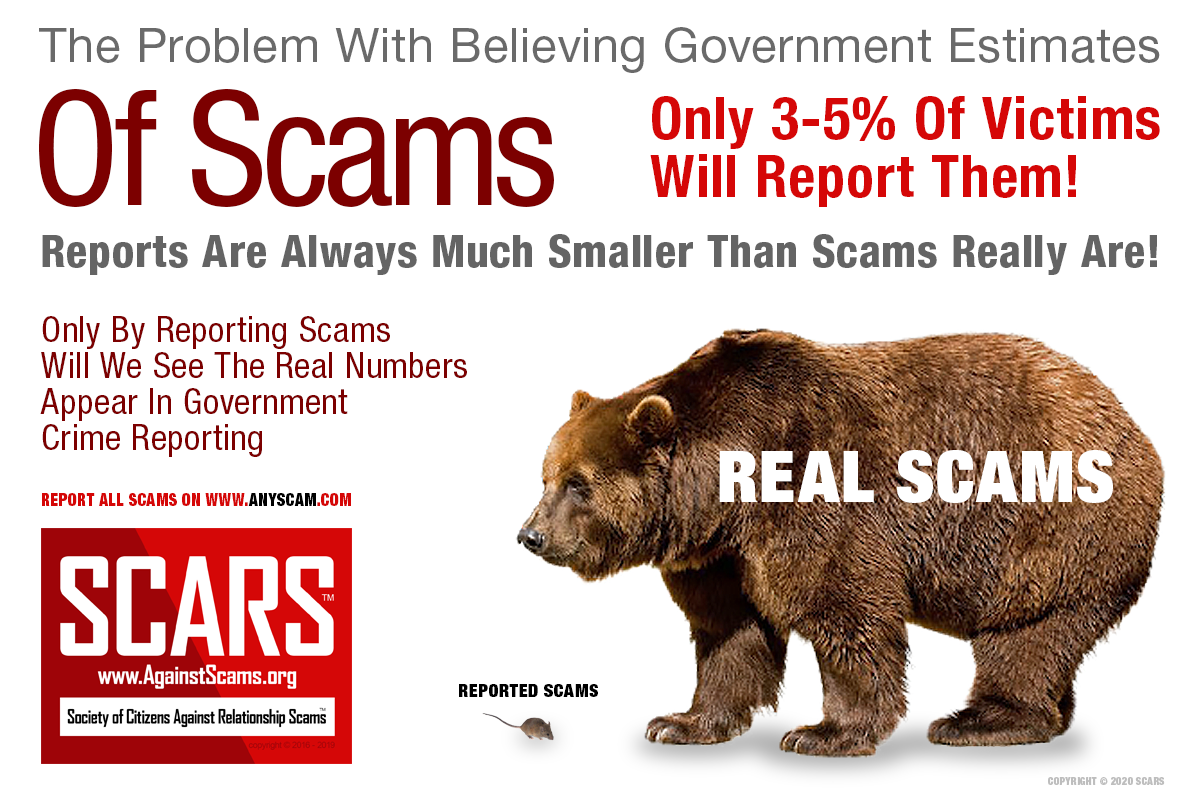
NOTE: IT IS ESTIMATED CYBERCRIME VICTIMS ONLY REPORT BETWEEN 3% TO 5% OF ALL SCAMS AND CYBERCRIMES. THEREFORE THIS NUMBER SHOULD BE MULTIPLIED BY 20X TO GET A REAL SENSE OF THE NUMBER OF CYBERCRIMES OCCURRING.
According to the FBI’s Press Release:
Throughout the 1990s, Americans took to the internet in droves. The decade saw the launch of the first web browsers, the introduction of now ubiquitous search engines, the birth of online commerce, and the ascendance of email as a go-to mode of communication.
As this new landscape bloomed, so did opportunities for criminals. The web offered easy access for cyber actors to target hundreds or even thousands of people at relatively low cost and risk.
When these crimes started occurring more frequently, the public was unsure where to turn for help. “People really didn’t know where to report internet scams or other online fraudulent activity,” said Internet Crime Complaint Center (IC3) Chief Donna Gregory. “And law enforcement agencies were saying: ‘What do we do with these? How do we handle them?’”
Recognizing the need to collect and assess information on cyber crime, the FBI started the Internet Fraud Complaint Center in May 2000 as a pilot project with the National White Collar Crime Center.
That Internet Crime Complaint Center (IC3) turns 20 this month. Renamed the Internet Crime Complaint Center (IC3) in 2002, the IC3 logged its 5 millionth complaint in March 2020. All that data has improved the public’s awareness of online crimes and helped the FBI and other law enforcement agencies better address internet-enabled attacks, fraud, thefts, and scams.
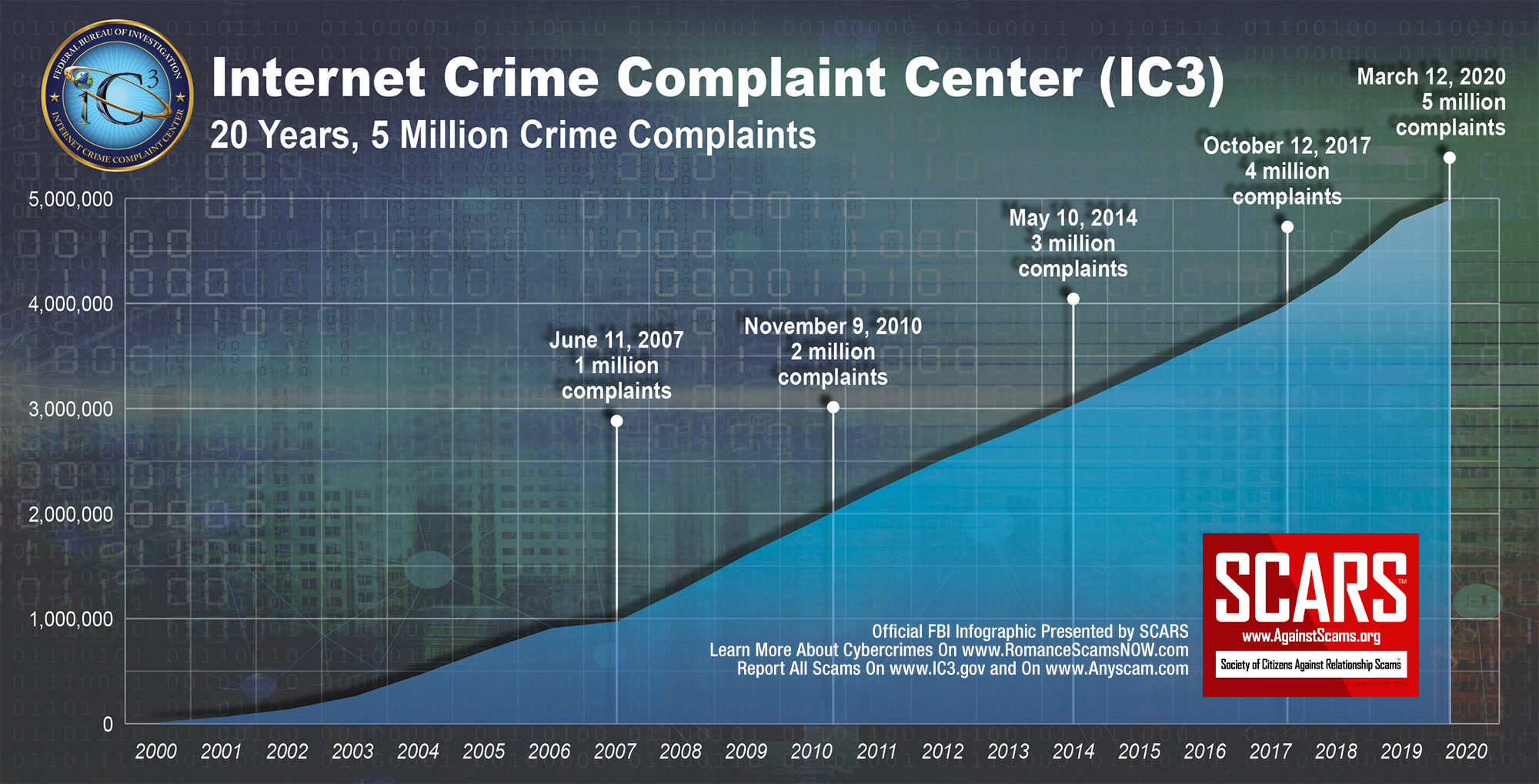
U.S. FBI – Federal Bureau of Investigation – Internet Crime Complaint Center (IC3) Cybercrime Reporting Statistics Through March 12, 2020
Online Crimes Grow More Damaging and Targeted
The crimes cataloged by the IC3 mirror the evolution of the web across two decades—growing in sophistication and number as the internet grows ever more essential to our professional and personal lives.
“The scale, scope, speed, and impact of cyber threats is constantly evolving,” said FBI Cyber Division Assistant Director Matt Gorham. “Criminals are opportunistic, and we’ve seen them rapidly adapt to the cyber environment, creating a variety of schemes to exploit the public and private sector.”
In its first full year of operation, the IC3 logged 49,711 complaints. Most of them revolved around internet auction fraud, non-delivery scams, and the West African letter (yes, that now-infamous message from a prince or princess with an untapped fortune they wanted to share with you).
“People still fall victim to that letter and versions of it,” said Gregory. “We still see scams that involve lotteries or windfalls where the victim just needs to pay what they believe are taxes or some fee to receive the winnings or a share of the fortune.” Of course, there is no windfall to claim after the criminal collects those “fees” or “taxes.”
“The scale, scope, speed, and impact of cyber threats is constantly evolving.” said Matt Gorham, assistant director, FBI Cyber Division
“The more prevailing trend,” said Gregory, who has been with the IC3 since its founding, “is that those early, rudimentary scams have given way to more destructive and costly data breaches and network intrusions, ransomware, romance scams, and sophisticated financial crimes like business email compromise.” Criminals still target individuals, but businesses and organizations are becoming more common targets because of the potential of a larger payout.
Losses recorded by the IC3 in recent years reflect the greater financial damage of this evolution. In 2019, victims reported more than $3.5 billion in losses—an average of $7,500 for each of the 467,361 complaints recorded that year. In 2001, the average victim lost $435.
Gregory said “the IC3 has also seen a shift in the types of criminals perpetrating the illegal activity. Many of the criminals now live overseas, and organized crime groups are on the rise.”
“The sophistication of modern online criminals is the most troubling part,” Gregory said. “We used to be able to give people common sense tips to keep them safe; now it is just much harder to tell the real messages and websites from the fake.”
Instead of an impersonal spam message with poor spelling and grammar, the scam may arrive via a well-written email that appears to come from a trusted colleague, business, or vendor.
Another enduring trend revealed in 20 years of crime data is that scammers will take advantage of a moment in time to prey on people who want to help or may need help in the wake of a natural disaster or tragic event.
The Internet Crime Complaint Center saw an uptick in charity and disaster fraud reports around the time of Hurricanes Rita and Katrina and after the Boston Marathon bombings.
In 2008, scammers tried to gather banking information from Americans waiting to receive stimulus checks as the nation slipped into recession.
Now, during the COVID 19 pandemic, scammers are working overtime hawking fake cures and investment schemes, selling protective equipment without the inventory on hand, and looking to take advantage of a more concentrated online presence during increased telework and distance learning arrangements.
“Criminals and scammers go where there is opportunity,” said Gorham. “Right now, they are exploiting a public health emergency to steal from and deceive people who are vulnerable, worried, or seeking vital supplies and assistance.”
“Those early, rudimentary scams have given way to more destructive and costly data breaches and network intrusions, ransomware, romance scams, and sophisticated financial crimes like business email compromise.” said Donna Gregory, chief, IC3
Supporting Investigations
The IC3 collects and reports out its data in an annual report and educates the public by sending out notices about new scams or upticks in certain types of crimes. Its other key role is to support law enforcement. Federal, state, local, and tribal agencies can access the IC3’s data through a secure database.
“The IC3 was created to provide the public and law enforcement with valuable information collected and analyzed by the FBI.” Gorham stated. “By sharing this information, we hope to protect the American public from becoming victims of cyber crime and enable law enforcement to identify links and trends they may not otherwise be able to see.”
Gregory also points to how IC3 data has helped improve the FBI’s response to frauds carried out online. “We were seeing victims losing a lot of money, mostly through cases of business e-mail compromise,” she said. “Initially we were able to work with financial institutions to examine wires going to international banks. Once we saw success in stopping some of those transactions, the criminals shifted to domestic accounts.”
Gregory said money mules play a huge role in dividing up stolen money into U.S. accounts before moving it overseas. Money mules are people who allow criminals to use their bank accounts to launder illicit funds—either because they are receiving a commission for the service or because they trust the person asking for access to their account.
“Law enforcement could not keep up as the money started moving through U.S. accounts,” Gregory said. “By the time they could take action, it was too late. So we started to look into working directly with the banks to stop the money flow and give law enforcement time to do the investigation.”
In 2018, the FBI created the Recovery Asset Team to streamline communication with financial institutions and FBI field offices to halt fraudulent transactions faster. The team successfully recovered more than $300 million for victims in 2019.
After 20 years with the IC3, Gregory has learned “that the online environment will continue to change and that the criminals will adapt along with it.” She worries about the trends she’s seeing in manipulated photos and videos but can never be certain where the next threat will emerge. “The only things that are certain is that the IC3 will continue to evolve as well, finding new and better ways to warn and protect the public from cyber scams and support law enforcement as they combat the threat.”
Reporting To The FBI
To report a crime or see the IC3’s annual reports and warnings about current crimes, scams, and frauds, visit ic3.gov.
Also, remember to report scams on www.Anyscam.com for worldwide distribution through the SCARS|CDN Cybercrime Data Network.

TAGS: SCARS, Important Article, Information About Scams, Anti-Scam, Scams, Scammers, Fraudsters, Cybercrime, Crybercriminals, Scam Victims, Money Recovery, Asset Recovery, IC3, FBI, Federal Bureau of Investigation, Online Crimes, Reporting Scams, Reporting Online Fraud, Reporting Cybercrime, Reporting Cybercriminals

SCARS™ Editorial Team
Society of Citizens Against Relationship Scams Inc.
A Worldwide Crime Victims Assistance Nonprofit Organization
Visit: www.AgainstScams.org
Contact Us: Contact@AgainstScams.org
PLEASE SHARE OUR ARTICLES WITH YOUR FRIENDS & FAMILY
HELP OTHERS STAY SAFE ONLINE – YOUR KNOWLEDGE CAN MAKE THE DIFFERENCE!
The Latest SCARS Posts:




FIND MORE SCAM NEWS
«SCAMCRIME.COM»
JOIN US ON FACEBOOK
«CLICK HERE»
END
MORE INFORMATION
– – –
Tell us about your experiences with Romance Scammers in our
« Scams Discussion Forum on Facebook »
– – –
FAQ: How Do You Properly Report Scammers?
It is essential that law enforcement knows about scams & scammers, even though there is nothing (in most cases) that they can do.
Always report scams involving money lost or where you received money to:
- Local Police – ask them to take an “informational” police report – say you need it for your insurance
- U.S. State Police (if you live in the U.S.) – they will take the matter more seriously and provide you with more help than local police
- Your National Police or FBI « www.IC3.gov »
- The SCARS|CDN™ Cybercriminal Data Network – Worldwide Reporting Network on « www.Anyscam.com »
This helps your government understand the problem, and allows law enforcement to add scammers on watch lists worldwide.
– – –
To learn more about SCARS visit « www.AgainstScams.org »
Please be sure to report all scammers
on « www.Anyscam.com »
Disclaimer:
SCARS IS A DIGITAL PUBLISHER AND DOES NOT OFFER HEALTH OR MEDICAL ADVICE, LEGAL ADVICE, FINANCIAL ADVICE, OR SERVICES THAT SCARS IS NOT LICENSED OR REGISTERED TO PERFORM.
IF YOU’RE FACING A MEDICAL EMERGENCY, CALL YOUR LOCAL EMERGENCY SERVICES IMMEDIATELY, OR VISIT THE NEAREST EMERGENCY ROOM OR URGENT CARE CENTER. YOU SHOULD CONSULT YOUR HEALTHCARE PROVIDER BEFORE FOLLOWING ANY MEDICALLY RELATED INFORMATION PRESENTED ON OUR PAGES.
ALWAYS CONSULT A LICENSED ATTORNEY FOR ANY ADVICE REGARDING LEGAL MATTERS.
A LICENSED FINANCIAL OR TAX PROFESSIONAL SHOULD BE CONSULTED BEFORE ACTING ON ANY INFORMATION RELATING TO YOUR PERSONAL FINANCES OR TAX RELATED ISSUES AND INFORMATION.
This content and other material contained on the website, apps, newsletter, and products (“Content”), is general in nature and for informational purposes only and does not constitute medical, legal, or financial advice; the Content is not intended to be a substitute for licensed or regulated professional advice. Always consult your doctor or other qualified healthcare provider, lawyer, financial or tax professional with any questions you may have regarding the educational information contained herein. SCARS makes no guarantees about the efficacy of information described on or in SCARS’s Content. The information contained are subject to change and are not intended to cover all possible situations or effects. SCARS does not recommend or endorse any specific professional or care provider, product, service, or other information that may be mentioned in SCARS’s websites, apps, and Content unless explicitly identified as such.
The disclaimers herein are provided on this page for ease of reference. These disclaimers supplement and are a part of SCARS’s websites Terms of Use.
Legal Notices:
All original content is Copyright © 1991 – 2020 Society of Citizens Against Relationship Scams Inc. (D.B.A SCARS) All Rights Reserved Worldwide & Webwide. Third-party copyrights acknowledge.
SCARS, SCARS|INTERNATIONAL, SCARS, SCARS|SUPPORT, SCARS, RSN, Romance Scams Now, SCARS|WORLDWIDE, SCARS|GLOBAL, SCARS, Society of Citizens Against Relationship Scams, Society of Citizens Against Romance Scams, SCARS|ANYSCAM, Project Anyscam, Anyscam, SCARS|GOFCH, GOFCH, SCARS|CHINA, SCARS|CDN, SCARS|UK, SCARS|LATINOAMERICA, SCARS|MEMBER, SCARS|VOLUNTEER, SCARS Cybercriminal Data Network, Cobalt Alert, Scam Victims Support Group, are all trademarks of Society of Citizens Against Relationship Scams Inc.
Contact the law firm for the Society of Citizens Against Relationship Scams Incorporated by email at legal@AgainstScams.org
-/ 30 /-
What do you think about this?
Please share your thoughts in a comment below!
Table of Contents
- Internet Crime Complaint Center Marks 20 Years And More Than 5 Million Reports
- According to the FBI’s Press Release:
- Online Crimes Grow More Damaging and Targeted
- Supporting Investigations
- Reporting To The FBI
- Finally Tax Relief for American Scam Victims is on the Horizon – 2026
- Ethereum ETHM Token Trap and Pig Butchering Scams – 2026
- New U.S. Law – S.3643 – 118th Congress – Will Dramatically Impact Scammers and Terrorists – 2026
- How Scam Survivors Can Survive Valentine’s Day – 2026
- U.S. Veterans Benefits Scams – 2026
- New AI Voice Cloning Phone Scams – 2026





Rapid Report Scammers

In the U.S. & Canada
U.S. & Canada Suicide Lifeline 988
LEAVE A COMMENT?
Recent Comments
On Other Articles
- Wendy Guiher on 15 Things That Nearly Every Online and Phone Scams Have In Common – 2026: “Very concise, direct information. When I look back on the crime against me I now can see ALL of the…” Apr 1, 06:24
- on The Danger of Using AI in Law Enforcement – The Grandmother Wrongly Arrested as a Fraudster – 2026: “Excellent article – I can’t imagine the terror Angela most certainly experienced. Compound this with the lack of accountability by…” Mar 24, 09:20
- on The Crazy Gregor MacGregor and the Country of Poyais Scam – History of Scams – 2026: “interesting” Mar 23, 19:24
- on BEC Fraud Reaches $43 Billion Per Year: “oh my gosh so much of an increase in the fraud I pray the officials can continue tracking and make…” Mar 23, 15:09
- on Establishing The United States Task Force To Eliminate Fraud – 2026: “Make Online Safe Again!” Mar 17, 19:11
- on Establishing The United States Task Force To Eliminate Fraud – 2026: “Finally an administration takes the initiative to help solve the gigantic situation. Make America Safe Again, thank you!” Mar 17, 15:41
- on What Is The Difference Between A Scam Victim And A Scam Survivor? [Updated]: “Due to my scams I don’t fully trust anyone online and I shouldn’t even those people I knew in high…” Mar 7, 12:46
- on SCARS 3 Steps For New Scam Victims 2024: “I was very fearful “he” would come to my home because I was knew my address, I spoke to someone…” Mar 7, 09:50
- on Sadness & Scam Recovery: “Before my scam, my mom passed away and I got a divorce, so I was dealing with the loss of…” Mar 7, 09:37
- on The Story Of Kira Lee Orsag (aka Dani Daniels) [Updated]: “There is NO evidence and she is not, she is a victim too. Sebastian, stop letting your anger think for…” Mar 6, 23:18
ARTICLE META
Important Information for New Scam Victims
- Please visit www.ScamVictimsSupport.org – a SCARS Website for New Scam Victims & Sextortion Victims
- Enroll in FREE SCARS Scam Survivor’s School now at www.SCARSeducation.org
- Please visit www.ScamPsychology.org – to more fully understand the psychological concepts involved in scams and scam victim recovery
If you are looking for local trauma counselors please visit counseling.AgainstScams.org or join SCARS for our counseling/therapy benefit: membership.AgainstScams.org
If you need to speak with someone now, you can dial 988 or find phone numbers for crisis hotlines all around the world here: www.opencounseling.com/suicide-hotlines
A Note About Labeling!
We often use the term ‘scam victim’ in our articles, but this is a convenience to help those searching for information in search engines like Google. It is just a convenience and has no deeper meaning. If you have come through such an experience, YOU are a Survivor! It was not your fault. You are not alone! Axios!
A Question of Trust
At the SCARS Institute, we invite you to do your own research on the topics we speak about and publish, Our team investigates the subject being discussed, especially when it comes to understanding the scam victims-survivors experience. You can do Google searches but in many cases, you will have to wade through scientific papers and studies. However, remember that biases and perspectives matter and influence the outcome. Regardless, we encourage you to explore these topics as thoroughly as you can for your own awareness.
Statement About Victim Blaming
SCARS Institute articles examine different aspects of the scam victim experience, as well as those who may have been secondary victims. This work focuses on understanding victimization through the science of victimology, including common psychological and behavioral responses. The purpose is to help victims and survivors understand why these crimes occurred, reduce shame and self-blame, strengthen recovery programs and victim opportunities, and lower the risk of future victimization.
At times, these discussions may sound uncomfortable, overwhelming, or may be mistaken for blame. They are not. Scam victims are never blamed. Our goal is to explain the mechanisms of deception and the human responses that scammers exploit, and the processes that occur after the scam ends, so victims can better understand what happened to them and why it felt convincing at the time, and what the path looks like going forward.
Articles that address the psychology, neurology, physiology, and other characteristics of scams and the victim experience recognize that all people share cognitive and emotional traits that can be manipulated under the right conditions. These characteristics are not flaws. They are normal human functions that criminals deliberately exploit. Victims typically have little awareness of these mechanisms while a scam is unfolding and a very limited ability to control them. Awareness often comes only after the harm has occurred.
By explaining these processes, these articles help victims make sense of their experiences, understand common post-scam reactions, and identify ways to protect themselves moving forward. This knowledge supports recovery by replacing confusion and self-blame with clarity, context, and self-compassion.
Additional educational material on these topics is available at ScamPsychology.org – ScamsNOW.com and other SCARS Institute websites.
Psychology Disclaimer:
All articles about psychology and the human brain on this website are for information & education only
The information provided in this article is intended for educational and self-help purposes only and should not be construed as a substitute for professional therapy or counseling.
While any self-help techniques outlined herein may be beneficial for scam victims seeking to recover from their experience and move towards recovery, it is important to consult with a qualified mental health professional before initiating any course of action. Each individual’s experience and needs are unique, and what works for one person may not be suitable for another.
Additionally, any approach may not be appropriate for individuals with certain pre-existing mental health conditions or trauma histories. It is advisable to seek guidance from a licensed therapist or counselor who can provide personalized support, guidance, and treatment tailored to your specific needs.
If you are experiencing significant distress or emotional difficulties related to a scam or other traumatic event, please consult your doctor or mental health provider for appropriate care and support.
Also read our SCARS Institute Statement about Professional Care for Scam Victims – click here to go to our ScamsNOW.com website.


Thank you for your comment. You may receive an email to follow up. We never share your data with marketers.