


SCARS Institute’s Encyclopedia of Scams™ Published Continuously for 25 Years
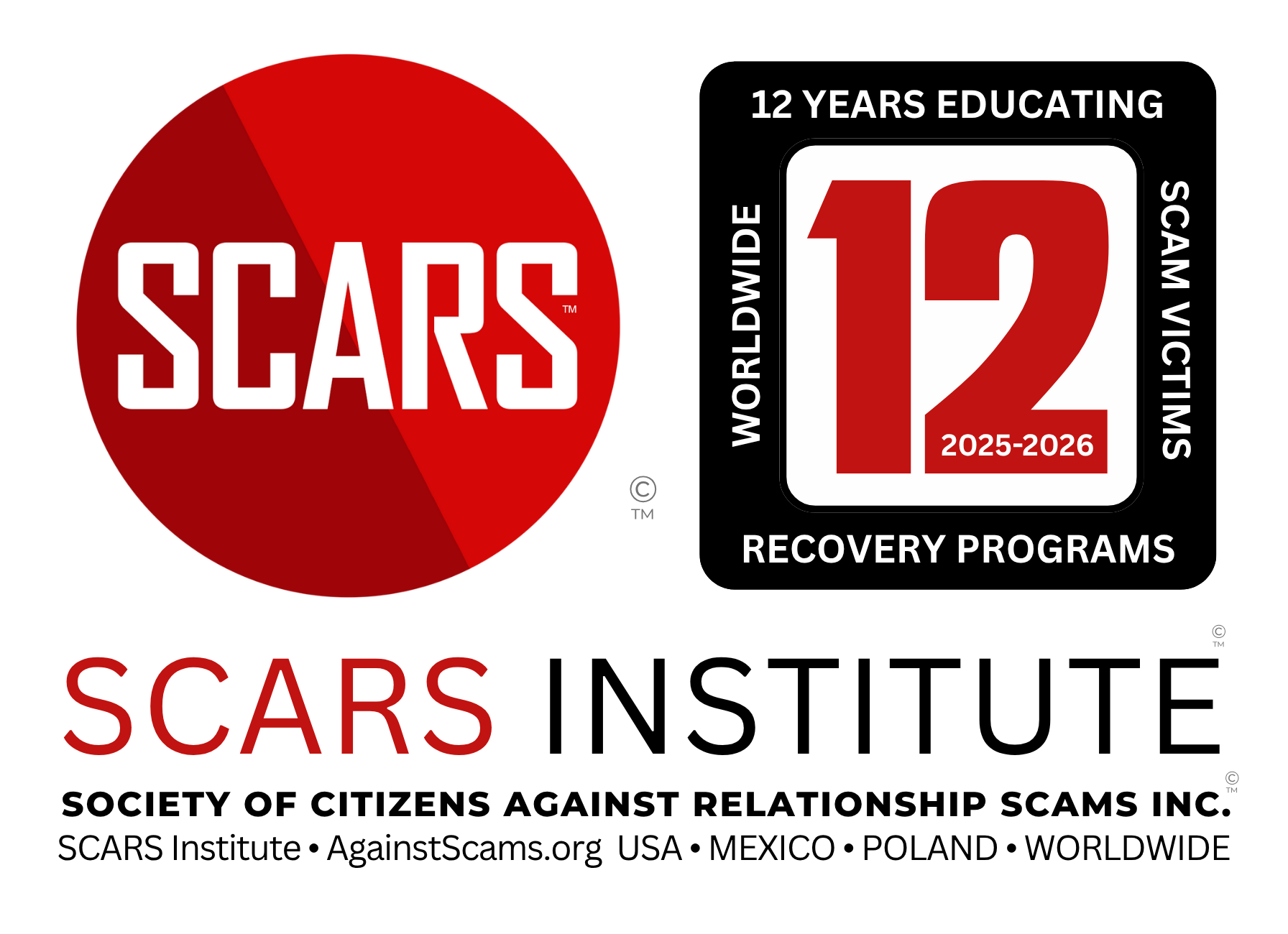


Relationship Scam Impact on Married Scam Victims
Married Scam Victims Divorce and Separation After Scam-Related Financial Loss in the U.S.
Married Victim Scam Impact Analysis – A SCARS Institute Insight
Author:
• Tim McGuinness, Ph.D., DFin, MCPO, MAnth – Anthropologist, Scientist, Director of the Society of Citizens Against Relationship Scams Inc.
Article Abstract
Divorce or separation are very real possibilities when a married individual falls victim to a scam; the emotional and financial damage extends beyond the primary target. The SCARS Institute has found that, with proper recovery guidance and support, over 90 percent of marriages can be preserved after a scam. Their approach focuses on helping the victim understand that their spouse is also affected, often feeling betrayed, confused, or blindsided by the situation. This perspective shift plays a key role in rebuilding trust. Recovery plans include structured communication, education about the psychological impact of scams, and acknowledgment of the partner’s emotional reality. Marriages survive not by ignoring the damage, but by recognizing that both individuals have been hurt in different ways. When both parties commit to understanding, patience, and healing, the relationship can not only survive but grow stronger in the aftermath.

Married Scam Victims Divorce and Separation After Scam-Related Financial Loss in the U.S.
A SCARS Institute Scam Victim Impact Analysis
Financial fraud and scams can put extreme strain on marriages, often precipitating divorce or separation when a couple’s finances and trust are devastated. In the United States, major scams like investment frauds, romance scams, and business-related cons have been linked with marital breakdowns. While precise statistics on “scam-induced” divorces are scarce (divorce filings rarely cite a specific scam), a convergence of research, government data, and expert observations shows a clear pattern:
- Financial Stress as a Leading Cause of Divorce
- Financial Ruin and Eroded Trust
- Emotional Betrayal Meets Financial Loss
Part 1: Divorce or Separation and Scams/Fraud
Financial Scams and the Collapse of Marital Stability
When a married couple suffers a significant financial loss due to a scam or fraud, the impact does not stop with money. It often tears at the foundation of the relationship itself. Trust fractures. Communication breaks down. Emotional and psychological strain replaces security. In some cases, the marriage survives. In many others, it does not.
Financial betrayal, whether it stems from an investment scam, business fraud, or a romance scam involving one spouse, destabilizes more than bank accounts. It undermines shared goals, long-held assumptions, and future plans. One spouse may feel responsible. The other may feel betrayed. Both are likely to experience shame, fear, or helplessness. When those emotions are not processed in healthy ways, they drive distance and resentment. What started as external victimization becomes an internal collapse.
Although financial strain is a known risk factor for divorce, the specific role that scams and fraud play in separation and divorce has been understudied. Unlike natural financial setbacks, scams carry an emotional charge: deception, violation, and humiliation. These elements heighten distress and often lead to secrecy, blame, or emotional withdrawal. If the fraud involves a romance scam, and one spouse was emotionally entangled with the scammer, the resulting betrayal can rival infidelity in its impact on the marriage.
This analysis explores whether and how financial scams contribute to marital breakdown in the United States. It examines the emotional and psychological factors behind these outcomes, and it identifies patterns where divorce or separation follow directly from scam-related financial loss. Whether the victim was acting alone or both partners were involved, the consequences can be long-lasting and life-altering. Understanding this connection is critical not just for recovery but for prevention and informed relationship support.
Financial Stress as a Leading Cause of Divorce
Money troubles are a well-known predictor of divorce. Financial stress ranks among the top causes of marital breakdown in the U.S.; roughly 40% of divorces involve financial issues as a primary factor. In a survey of Certified Divorce Financial Analysts, “money issues” were cited as the third leading cause of divorce (22% of cases), after basic incompatibility and infidelity. Moreover, a 2012 peer-reviewed study of 4,500 couples found that financial disagreements were the strongest predictor of divorce (more so than conflicts over kids, in-laws, etc.). In short, when a couple’s economic security collapses, the marriage often falters.
Scams and frauds create exactly the kind of severe financial stress that can push marriages to a breaking point. Losing one’s life savings or racking up debt due to a fraudulent scheme can spark blame, guilt, and panic between spouses. The sudden loss of money needed for mortgages, retirement, or bills introduces intense pressure. Indeed, wealth and divorce data suggest that negative financial shocks increase divorce risk, and lower-income or financially insecure couples have higher divorce rates than those with more cushion. It stands to reason that a big financial loss from a scam is one such shock that can trigger marital instability. Family lawyers note that many couples simply lack the communication tools to weather a major money crisis, especially one involving deceit or betrayal.
Investment and Business Scams: Financial Ruin and Eroded Trust
Investment frauds (Ponzi schemes, pyramid schemes, bogus business ventures) can be devastating to married couples. These scams often wipe out savings, retirement funds, or home equity, leaving both partners reeling financially. The stress of sudden financial ruin is frequently cited in divorce cases, for example, one Texas law firm reports it’s “no secret” that money problems contribute to up to 40% of divorces, with many couples saying financial disagreements ended their marriage. When a scam drains a couple’s assets, it can lead to relentless arguments over blame and future security.
Beyond the dollars lost, trust between spouses may be badly damaged. If one spouse fell for the scam or unwittingly exposed the family to fraud, the other may feel anger and betrayal. The spouse who was victimized might also blame themselves, feel shame, or hide the problem, which only further undermines marital communication. Fraud victims often experience intense self-blame and embarrassment; nearly 47% of victims in one U.S. survey blamed themselves for being conned, and the majority reported feeling “angry, regretful, betrayed, helpless” after the incident. These emotions, especially feelings of betrayal, can easily transfer into the marital relationship.
- Illustrative case: A recent story recounted a husband whose wife repeatedly invested in her brother’s fraudulent house-flipping scheme. She secretly gave her brother $175,000 of their savings (in what turned out to be a Ponzi scheme) and even took a second lump sum without her husband’s knowledge. When the scam collapsed, the couple’s money was gone. The husband was devastated that his wife “could stab him in the back like that”, his trust in her destroyed, and his own brother urged him to consider divorce. This example underscores how even business-related fraud within the family can lead to talk of divorce; the financial loss and deception were simply too much for the marriage to bear.
- Impact on trust and communication: Legal experts describe that when one spouse persistently falls for scams or risky schemes, it creates a cycle of conflict. The defrauded spouse may become defensive or deny the problem, while the other grows fearful of “losing everything financially.” This dynamic often “leads to a breakdown in communication and a sense of isolation” in the marriage. The betrayed spouse might feel they must go into “protection” mode to safeguard whatever assets remain. In many cases, couples in this situation end up consulting divorce attorneys, especially if the fraudulent behavior recurs. The emotional toll of financial betrayal is comparable to infidelity; trust is hard to rebuild once it’s broken in such a fundamental way.
Financial scams can also have legal consequences that strain marriages. If a spouse’s entanglement in a scam leads to lawsuits, tax problems, or even criminal charges, the stress multiplies. (For instance, spouses of perpetrators of fraud, say a business owner running a scam, often divorce due to the public fallout and jail time, as seen in high-profile Ponzi scheme cases.) Even when both spouses are innocent victims, the road to financial recovery is long and taxing, which can fray even strong partnerships. Bankruptcy due to fraud-related losses is not uncommon, and about 54% of people say a spouse being in heavy debt is a valid reason to consider divorce.
Romance Scams: When Emotional Betrayal Meets Financial Loss
Romance scams , in which a con artist poses as an online lover to swindle money , have a uniquely corrosive effect on marriages. In these scams, one spouse (the victim) is not only sending money to a fake persona, but often developing a secret emotional relationship with the scammer. This scenario introduces elements of infidelity (albeit one-sided and fraudulent) alongside the financial exploitation. Not surprisingly, romance scams have ended long-standing marriages in the U.S. The FBI warns that “families, relationships, [and] marriages can be torn apart” by the devastating toll of romance frauds.
Several high-profile cases and expert observations underline the risk:
- Spousal betrayal and divorce: Local news outlets have reported cases like a 45-year marriage that broke down after the wife fell in love with a scammer on Instagram, prepared to leave her real husband for this fictitious “lover”. In another case, a man dubbed “Joe” discovered his wife had secretly sent $60, 70k to an “internet lover” she met through a word game app. He unearthed 4,400 text messages between his wife and the scammer in just one month, evidence he later prepared for divorce court. The wife in that story had effectively been romantically “catfished” and financially cheated; her husband, feeling utterly betrayed, moved to end the marriage. These examples show that romance scams can act as a one-two punch: they steal money and the emotional fidelity that a marriage is built on.
- Emotional bonds to scammers: Research indicates romance scam victims often become deeply attached to their fake partners. Many victims report that the loss of the relationship hurt more than losing the money. They describe the scammer as an “ideal partner” and may remain psychologically hooked even after learning the truth. In one qualitative study, victims struggled to separate the criminal’s real identity from the persona they fell in love with; some continued to feel affection for the scammer even after knowing it was a fraud. For a married couple, this is akin to a spouse having an emotional affair or delusion. The victimized spouse might be grieving an imagined love, while the other spouse feels jilted and bewildered. It’s easy to see how this situation can erode a marriage’s foundation of trust and intimacy. Therapists note that the “double hit” of romance scams, financial loss plus emotional trauma, often leaves victims depressed, ashamed, and isolated, which in turn undermines their real-life relationships.
- Psychological fallout in the marriage: The stress factors from romance scams are profound. The victim may experience trauma-like symptoms (even PTSD or depression are reported in scam victims). They often feel embarrassed and may hide the scam from their spouse for fear of judgment. This secrecy can delay any joint response to the problem and further erode marital communication. When the truth comes out, often after finances have been drained, the non-victim spouse may react with intense anger or disgust that their partner was “duped” and emotionally unfaithful. Marriage counselors compare this to healing from infidelity combined with recovering from a financial crisis. Many couples cannot withstand that combination, and separation or divorce becomes likely.
Importantly, romance scams have become alarmingly common in recent years, which puts more marriages at risk. According to the Federal Trade Commission, nearly 70,000 (estimated to be less than 3% of actual) Americans reported romance scam incidents in 2022, with losses reaching an astonishing $1.3 billion (median loss around $4,400 per victim)(this is estimated by most to be grossly low). Those figures were double the total just a few years prior, reflecting an epidemic of online con artists. Older adults, who may be lonely or less tech-savvy, are frequently targeted, but victims span all ages. The FBI and USPS have issued public warnings noting that romance scammers prey on vulnerable people and then “ask for tens of thousands of dollars,” often using excuses like medical emergencies or military service. For married victims, sending large sums of money in secret can amount to a form of financial infidelity, even if they were coerced. It’s not unusual for the other spouse to view it as a grave breach of trust. In sum, romance scams present a uniquely poisonous mix of financial and emotional betrayal that correlates strongly with marital breakdown.
Marital Outcomes: Legal Divorce vs. Informal Separation
When a couple is hit by a scam-related loss, the outcome isn’t always an immediate legal divorce, but many do end up either formally or informally separated. Some couples attempt to weather the storm together, especially if they acknowledge the external blame (the scammer) and seek financial or counseling help. For instance, a few anecdotal reports note couples who survived a major scam by uniting in their recovery efforts (one story described a marriage that “survived and even thrived after losing all their savings in a Ponzi scheme,” though this is likely an exception). However, in a significant number of cases, the fallout is irreparable:
- Divorce filings: Family law attorneys do see cases explicitly involving scam losses. While divorce petitions may use generic terms (like “irreconcilable differences”), the backstory often includes a catastrophic financial event. An FBI supervisory agent affirmed that these frauds are devastating, saying the scams “can take a massive toll on someone’s life and well-being” and have torn apart marriages. In other words, agencies recognize that divorce is a frequent consequence. One U.S. survey of older fraud victims even hinted that those who were divorced or separated had slightly higher fraud prevalence than married individuals, suggesting a possible link between prior marital instability and victimization, or vice versa.
- Informal separations: In scenarios where couples don’t divorce immediately, you often see informal separations or marital strain that effectively ends the partnership. For example, a spouse might move out or emotionally disengage after discovering the other’s entanglement in a scam, even if no legal action is taken. Especially among older couples, there may be hesitancy to divorce (due to stigma or intertwined finances), yet the relationship may never recover. Unfortunately, there is no hard data on how many couples separate without divorcing after a fraud, since these are private decisions. But mental health professionals observe that many marriages become sexless, trustless cohabitations in the aftermath, essentially broken marriages in all but name. The psychological scars (loss of trust, resentment, humiliation) can persist for years if not addressed, making genuine reconciliation difficult.
- Rebuilding vs. breaking point: Key factors that determine whether a marriage survives a scam seem to include: the scale of the financial loss, the degree of deception between spouses, and the support systems available. A small fraud that both spouses tackle openly (for instance, jointly being victims of an investment fraud and working together to recover) might be survivable. In contrast, a massive loss that one spouse concealed or a romance scam involving emotional betrayal is far more likely to end in divorce. Peer-reviewed research on marriage and stress suggests that severe stressors tend to exacerbate pre-existing cracks in the relationship. If a couple had poor financial communication or other unresolved conflicts, a scam can be the breaking point. This aligns with the earlier finding that how couples handle money disagreements is predictive of divorce. A scam essentially forces a high-stakes money disagreement (often with blame attached), and if the couple cannot resolve it constructively, the marriage collapses.
Psychological and Financial Factors Behind These Breakdowns
Across scam types, several common factors contribute to marital breakdown:
- Severe Financial Strain: Quite apart from the relational issues, the practical fallout of losing tens or hundreds of thousands of dollars is enormous. Couples may face foreclosure, bankruptcy, or a ruined retirement. The ensuing lifestyle downgrades and anxiety can spark constant conflict. Money stress tends to increase resentment and blame; indeed, surveys show finances are a trigger for frequent arguments in many marriages even without a triggering scam. When bills can’t be paid or future plans crumble due to fraud, some spouses direct their anger at each other. It becomes hard to view one’s partner the same way if “they got us into this mess.” Financial instability also reduces the positive interactions (vacations, hobbies, etc.) that help buffer a marriage against stress.
- Breach of Trust and Betrayal: Whether it’s an investment scam (where perhaps one spouse trusted a fraudulent advisor or scheme) or a romance scam (where one spouse betrayed the marriage emotionally), trust is shattered. Marriage is built on feeling that your spouse will protect your mutual interests. A scam undermines that: either the spouse was “too gullible” (in the other’s eyes) or was actively hiding things. In either case, each partner’s sense of security in the other is diminished. One clinical report pointed out that loss of trust and security strikes at the heart of a marriage’s foundation after fraud, sometimes as much as infidelity would. Rebuilding trust requires time and often professional help; many couples never get that far and opt to separate.
- Emotional Trauma and Mental Health Issues: Victims of scams frequently suffer emotional trauma, embarrassment, shame, depression, and even PTSD symptoms. This can lead to withdrawal, irritability, or hopelessness. The non-victim spouse might also experience trauma in the form of betrayal or sudden life change. The FINRA Investor Education Foundation noted that fraud victims endure “intense emotional distress and strain on personal relationships” beyond the monetary aspect. In their analysis, nearly 40% of fraud victims sought mental health support (like counseling or peer forums) to cope, and those are just the ones who admit distress. If one or both spouses are plunged into depression or chronic anxiety after a scam, the marriage may struggle to survive that psychological toll. Additionally, scams can isolate victims from their support networks (some feel they “can’t tell anyone,” or scammers alienate them). Isolation and poor social support are predictors of marital failure, as the couple essentially tries to handle a crisis alone.
- Correlation with Pre-Existing Marital Issues: Sometimes the scam itself isn’t the sole cause of divorce, but a catalyst. For instance, if a spouse has a pattern of risky financial behavior or deceit (maybe a gambling addiction or prior financial infidelity like hidden debts), falling victim to a fraud might be the last straw for the other partner. Certified divorce analysts have observed that “deeper issues” often underlie what couples label as incompatibility. A fraud can bring those issues to a head. For example, if one partner never trusted the other’s judgment, an investment scam loss will amplify that distrust and could confirm their worst fears about the spouse’s irresponsibility. Thus, specific types of scams might correlate with breakdown only because they map onto existing vulnerabilities: a spouse prone to secret online relationships is vulnerable to romance scams, or a spouse with a “get rich quick” mentality is drawn into investment fraud. In such cases, the type of scam aligns with a trait that was already problematic in the marriage (e.g., lack of openness, greed, etc.), accelerating the path to separation.
Which Scams Pose the Greatest Risk to Marriages?
All major scam types can lead to marital strife, but romance scams and large investment frauds stand out as particularly destructive for different reasons:
- Romance Scams: These arguably carry the highest risk of outright marital collapse. The combination of emotional infidelity and financial loss is often lethal to a relationship. Even if the victim spouse wasn’t actively seeking an affair (they were duped), the emotional energy invested in the scammer is energy taken away from the marriage. Romance frauds also tend to involve lies told directly to the spouse (e.g. the victim making up stories to cover why money is disappearing). It creates a tangle of deceit that partners have trouble forgiving. Law enforcement emphasizes how devastating these scams are: “the toll…is devastating”, as the FBI said, and they explicitly warn that marriages can be “torn apart”. There’s also some evidence that women victims of romance scams, in particular, experience profound grief and shame, which may cause them to pull away from their real-life partners. Thus, romance scams correlate strongly with marital breakdown due to the intimate betrayal involved.
- Investment and Business Scams: While perhaps less viscerally personal than romance scams, big financial scams (Ponzi schemes, investment frauds, embezzlement by a business partner, etc.) correlate with high divorce and separation rates mostly because of the financial devastation they cause. A sudden loss of wealth can upend a marriage’s power balance and future plans. Research on financial catastrophes (like unemployment or bankruptcy) shows an uptick in divorces following such events, particularly when the husband’s financial role is compromised. In scams, often one spouse may be blamed for being “naive” or for not vetting an opportunity, which can create lasting resentment. For example, during the fallout of notorious scams like Bernie Madoff’s Ponzi scheme, there were reports of marriages under immense strain or ending; some Madoff victims even attempted to legally undo divorce settlements that had unknowingly divided “fake” assets. Ponzi victims sometimes sue ex-spouses or end up in court over who bears the loss, highlighting how these frauds can entangle and break families. In everyday terms, when a couple’s financial foundation is shattered, the marriage often doesn’t survive unless they find a way to truly unite against the problem. Many do not, and thus we see investment fraud as a major correlate of divorce (albeit usually reported under the umbrella of “money problems”).
- Other fraud types: Business-related fraud (for instance, a small business-owning couple deceived by a partner or vendor) can also lead to divorce, though these scenarios often overlap with investment fraud dynamics. Identity theft or credit fraud might cause marital conflict, too, if a spouse’s identity is stolen or if one secretly opens credit lines and gets scammed, it can resemble financial infidelity. However, the scale is typically smaller, and couples might overcome it with less damage than a six-figure scam. Affinity scams (frauds exploiting community or family ties) are a subset worth noting: these often involve trusting someone in your circle. When that trust is broken (say, a church friend cons you, or a relative’s “opportunity” was a scam), the betrayed spouse might not only be angry at the scammer but also at their partner for involving them. Affinity scams can strain extended family relationships in addition to the marriage.
In summary, the more a scam hits both the wallet and the heart, the more lethal it is to a marriage. Romance scams check both boxes strongly. High-dollar investment scams hit the wallet extremely hard and often introduce interpersonal blame. Both categories have been linked to separations and divorces in numerous reports.
Coping and Prevention Insights
While the analysis focuses on data and correlation, it’s worth briefly noting why some couples survive scams and others don’t, as this highlights the factors at play.
Experts suggest that couples who communicate openly and seek support early have a better chance of weathering financial fraud. SCARS Institute’s own experience confirms this. The FINRA Foundation and victim support groups emphasize the importance of mental health support for scam victims, given that only ~38% of victims currently seek professional help. Those who do may learn to cope with emotions like shame and anger in a healthier way, potentially reducing marital conflict. Additionally, financial counseling or legal remedies (where possible) can give couples a sense of control and re-connection, which may ease tensions. On the flip side, secrecy, denial, and delay in addressing the scam are red flags. Unfortunately, many fraud victims are too embarrassed to tell even their spouse right away, which often makes the eventual revelation more explosive (see the case of Renee Holland below).
From a preventative standpoint, financial educators advise couples to be transparent about money and to make big financial decisions jointly, reducing the chance that one spouse can secretly send money to a scam. The FBI and FTC regularly urge people to talk with someone they trust before sending funds in unusual situations; implicitly, a married person’s trusted sounding board should be their spouse. If that communication channel is open, a scam may be caught before it does irreversible harm. Conversely, if the scam succeeds, maintaining that communication and empathy between spouses is critical to avoid turning on each other.
The Role of Law Enforcement: Addressing Marital Fallout When a Victim Reports a Scam
When a scam victim reports the crime, law enforcement often focuses on gathering evidence and documenting financial losses. While that is necessary, officers and investigators should also recognize the emotional and relational impact that this disclosure can have, especially within a marriage. The moment a victim admits to having been scammed, particularly when money from shared accounts is involved, the marriage may enter a period of severe stress. For some couples, this moment becomes a flashpoint for blame, emotional withdrawal, or even abuse.
Police and fraud investigators should take the time to inform scam victims that reporting the crime could have consequences beyond the legal process. Disclosure of the scam may trigger conflict, resentment, or control dynamics in the home. Some spouses will respond with support, but others may lash out, belittle the victim, or even become physically aggressive – it has even resulted in murder (see Renee Holland below). Officers should be trained to ask whether the victim feels emotionally safe sharing the truth at home. If not, the victim may need referrals to counseling, safety planning, or domestic violence resources.
In cases where law enforcement sees early signs of marital strain, such as the spouse refusing to cooperate, becoming visibly angry during interviews, or attempting to control the victim’s responses, they should take these behaviors seriously. Victims may downplay the situation out of guilt, embarrassment, or fear of retaliation. A gentle but direct conversation can help: “Many scam victims face backlash from partners. If that happens, we can help you with resources. You are not alone.”
The goal is not to interfere with personal relationships, but to ensure that the victim is protected emotionally and physically after disclosure. Scam reporting is not just a legal action. It is a turning point that can affect every part of a victim’s life, including their closest relationships.
Preserving the Marriage: The SCARS Institute’s Experience
When a married individual discovers they have been the victim of a scam, the initial response is often isolation. They carry the emotional burden, the guilt, the financial damage, and the fear of telling their spouse. What is frequently overlooked in those early days is that the spouse is also impacted, the whole family is also a victim. While one partner is the primary target, the other becomes a secondary victim. That partner may experience shock, betrayal, and anxiety, all of which can lead to a breakdown in communication and trust if not addressed properly.
The SCARS Institute has supported thousands of scam victims through these circumstances. In cases where both spouses agreed to participate in structured recovery, over 90% of marriages were preserved. This success was not solely due to therapy or general education. It resulted from clear, pragmatic guidance designed to help both individuals understand the full scope of the damage, not just to finances or trust, but to the emotional fabric of the relationship.
Victims require space and support to recover. At the same time, they need to understand that their spouse may be struggling with unspoken trauma, including resentment or fear. These reactions do not indicate a lack of care. They reflect the spouse’s own experience of betrayal and confusion. The SCARS Institute provides specific tools to navigate these issues, including communication strategies, disclosure timing, and ways to avoid unnecessary conflict – these are included in our FREE Scam Survivor’s School.
The emotional posture of the victim plays a critical role. If the spouse is treated as an adversary, the relationship will deteriorate. If, instead, the conversation is approached with transparency, empathy, and respect, there is a greater chance of preserving the bond. Marriages can survive scam-related betrayal, but only when both individuals are seen, heard, and supported throughout the recovery process.
Conclusion
U.S. data and cases make one thing clear: when married couples suffer significant financial losses to scams or fraud, their risk of divorce or separation spikes dramatically. Money woes already account for a large share of American divorces, and scam-induced losses are among the most extreme financial crises a couple can face. Government agencies like the FTC and FBI have highlighted the huge scope of these frauds (Americans lost over $10 billion to fraud in 2023 alone), and experts note the “intense emotional distress” and relational strain that accompany these crimes. Investment scams, which often decimate a family’s finances, and romance scams, which entangle one spouse in a fake infidelity, stand out as major contributors to marital breakdown. Victims frequently feel betrayed, angry, and ashamed, while their partners might feel equally betrayed or financially endangered. The result is often irreconcilable conflict, whether formally through divorce or informally via separation and ongoing discord.
It’s important to recognize that not every marriage fails after a fraud; some couples do pull together. But statistically and anecdotally, specific types of scams correlate strongly with marital dissolution. A romance scam that plays out like an emotional affair can easily end a marriage, and a large-scale fraud that wipes out security can transform spouses into adversaries. The psychological stress (akin to trauma) and the practical financial strain form a potent combination that many relationships cannot survive. As one fraud investigator succinctly put it, the damage from these scams “can be torn apart” marriages and families, leaving lasting scars.
Sources:
- U.S. FTC and FBI fraud statistics and warnings ftc.gov finra.org kbtx.com
- Academic and professional studies on causes of divorce and financial stress institutedfa.com thejimenezlawfirm.com
- News and case reports of marriages impacted by investment scams and romance scams wowt.com chipchick.com pmc.ncbi.nlm.nih.gov
- Expert commentary from fraud victim support research theshermanlawyers.com finra.org, highlighting psychological and relational effects.
Part 2: Domestic Violence and Scams/Fraud
Financial Fraud, Economic Strain, and Domestic Violence in the U.S.
Financial fraud and scams can have devastating ripple effects on families. One often overlooked consequence is how these financial losses can fuel domestic violence, both emotional and physical. While direct statistics on the overlap between scam victimization and domestic abuse are scarce, existing research on financial stress and domestic violence provides valuable insights. The evidence suggests that economic strain and fraud-induced trauma can heighten tensions in intimate relationships, sometimes with tragic results.
Domestic Violence Prevalence and Financial Links
Domestic violence (DV) is widespread in the United States, and financial factors frequently play a role in abusive dynamics:
- Scope of DV: Over 10 million people in the U.S. experience intimate partner violence each year – roughly 20 people every minute. About 1 in 4 women and 1 in 9 men will endure severe physical violence, sexual violence, or stalking by an intimate partner in their lifetime. Intimate partner violence accounts for roughly 15% of all violent crime. These figures underline how common domestic abuse is, even though they don’t specifically tell us how often scams are involved.
- Financial Stress as a Risk Factor: Economic problems are strongly correlated with domestic abuse. Financial hardship and unemployment are known contributors to higher rates of DV, and calls to domestic violence hotlines tend to increase during economic downturns. In fact, one NIJ study found that couples experiencing high financial strain had an IPV rate of 9.5%, compared to just 2.7% for those with low financial strain. Some experts even argue that financial stress may be the single most important risk factor for domestic abuse. In other words, money troubles (like debt, job loss, or sudden financial loss) can greatly escalate conflict in a household.
- Poverty and Abuse: Living in poverty or economic insecurity puts additional stress on relationships. Individuals in lower socioeconomic groups face heightened levels of stress and conflict over basic needs (housing, bills, etc.), which can exacerbate tensions and increase the likelihood of domestic violence. Financial insecurity also makes it harder for victims to leave abusive partners, since they may lack resources for housing, legal fees, or child care. As one domestic violence organization notes, financial strain often leads to conflict, and limited economic options can trap victims in dangerous situations.
Financial Abuse as a Form of Domestic Violence
It’s important to recognize that financial/economic abuse is itself a common component of domestic violence. Abusers often use money as a tool of power and control:
- According to the National Network to End Domestic Violence, financial abuse occurs in 99% of domestic violence cases. Nearly all survivors report that their partner restricted or sabotaged their finances in some way – for instance, by controlling bank accounts, ruining credit, or preventing them from working. This tactic keeps victims dependent and makes it extremely hard to escape. In fact, survivors frequently cite economic dependence as a top reason for staying or returning to an abusive partner.
- Economic Control: Abusive partners may conceal information, limit access to funds, or rack up debt in the victim’s name. This behavior can be subtle or overt, ranging from giving an “allowance” to outright taking paychecks. Over time, financial control erodes the victim’s autonomy. An abuser might say, “I’ll handle the money since you’re no good with finances,” only to tighten the purse strings further. In more blatant cases, abusers use threats or violence to keep the victim from working or accessing money. All of these forms of financial abuse reinforce the abuser’s dominance.
- Impacts of Financial Abuse: The consequences are both practical and psychological. With destroyed credit or no savings, victims often feel trapped because they fear they cannot support themselves or their children without the abuser. Financial abuse thus intensifies emotional abuse – victims lose confidence and may feel they “deserve” the mistreatment because they’re financially dependent. This economic trapping is why addressing finances (job training, financial literacy, etc.) is a key part of domestic violence intervention programs.
How Scams and Fraud Heighten Abuse Risk (Emotional and Physical)
Financial frauds and scams – such as romance scams, investment frauds, or identity theft – can introduce a severe financial and emotional shock into a household. When a family loses a large sum of money or falls victim to a scam, it can act as a catalyst for domestic abuse in several ways:
- Emotional Fallout and Vulnerability: Victims of scams often suffer intense shame, guilt, and isolation. For example, people duped by romance scams report feeling humiliated and emotionally devastated when they realize the truth. This emotional fallout can mirror the trauma seen in domestic abuse survivors. Crucially, that trauma may make a person more vulnerable to an abuser. Scammers exploit trust and create isolation, much like domestic abusers do. Researchers have noted that the manipulative “grooming” techniques used in online romance fraud (e.g., isolating the victim from friends or monopolizing their time) closely resemble the psychological abuse tactics of domestic violence perpetrators. In other words, a scam victim might already be experiencing DV-like emotional abuse from the scammer, leaving them with diminished self-esteem and a sense of powerlessness. An unscrupulous partner at home can sense this weakened state and may seize on it.
- Escalation of Emotional Abuse at Home: If the scam victim is in a relationship, the revelation of the fraud can drastically alter the family dynamic. The non-victim spouse or partner may react with anger, betrayal, or ridicule. Blame and belittling are common emotional abuse responses. For instance, an abuser might lash out with insults like, “You’re so gullible/stupid with money – you brought this on us,” or “You can’t be trusted with our finances anymore.” Such remarks heap shame on the victim. The SCARS advocacy group notes real cases where abusive partners used the victim’s scam losses as leverage for coercive control – isolating them further or monitoring their every move under the pretext of “protecting the family’s finances”. This kind of emotional abuse (shaming, controlling, threatening) often intensifies after a financial betrayal comes to light. The abusive partner may feel justified in their rage and domination because “you lost our money.” Meanwhile, the scam victim, crushed by guilt, might internalize the blame and submit to harsher treatment.
- Financial Instability Fuels Conflict: The economic instability caused by fraud can, by itself, increase domestic conflict. Losing savings or falling into debt because of a scam puts tremendous stress on couples. They may argue more about bills, budgets, or future plans. If one partner was already inclined to be aggressive or controlling, this stress can push them over the edge. Studies confirm that couples under severe financial strain have a higher frequency of domestic violence incidents. Abusers commonly exploit any financial vulnerability – for example, taking full control of all money, “since you clearly can’t handle it” or using the loss as an excuse to yell and intimidate. In essence, a scam’s financial impact can act as a trigger, turning a tense or unhealthy relationship into an outright abusive one. The lack of financial security can also trap the scam victim further, especially if the abuser restricts access to whatever funds remain.
- Increased Risk of Physical Violence: In the worst cases, the combination of financial loss and emotional volatility can escalate to physical violence. If a partner has violent tendencies, the turmoil following a scam disclosure can be a flashpoint. Domestic violence experts warn that when a relationship is already strained, a crisis like this can ignite underlying anger into violence. The betrayed partner might feel “pushed over the edge” and resort to physical harm. It’s important to note that financial strain itself is linked not just to more frequent abuse but sometimes to more severe abuse. Economic stress has been associated with increased severity of assaults and a higher likelihood of repeated violence. Thus, a major scam can act as the spark in a powder keg, turning emotional abuse into physical aggression.
Case Study: The Renee Holland Tragedy (Florida, 2018)
One of the most poignant examples of a scam intertwining with domestic violence is the case of Renee Holland in Florida:
- Romance Scam and Financial Ruin: Renee Holland, a 56-year-old wife and mother, became entangled in a Facebook romance scam. Over the course of 2017, she sent money, gift cards, and even paid for supposed plane tickets to help a man she believed was a U.S. soldier overseas. In reality, it was a fraud. All told, Renee and her family lost an estimated $26,000–$30,000 to the scam, much of their life savings. The toll was not only financial; Renee was devastated emotionally. When a promised reunion at the airport proved fake, the truth came crashing down. Renee recalled sobbing, “There’s no way I can go home and tell my husband.” In despair, she attempted suicide by overdosing on sleeping pills and vodka in June 2017. (She survived after receiving hospital care.)
- Domestic Strain and Abuse: Renee’s husband, Mark Holland, initially showed some sympathy, even helping her send a care package to the scammer before they knew it was a con. But after the fraud was revealed, their marriage came under immense strain. They reportedly relocated to start fresh, but the trust and finances were badly damaged. Tensions simmered: by mid-2018, Mark’s behavior grew violent. In August 2018, he was arrested for domestic violence against Renee, though she later dropped the charges. This indicates the classic cycle of abuse – an incident of violence followed by reconciliation or pressure on the victim to not pursue legal action.
- Deadly Conclusion: On December 23, 2018, this situation reached a horrific end. During an altercation at their Port St. Lucie home, Mark Holland fatally shot 58-year-old Renee and her 84-year-old father, who lived with them, before turning the gun on himself. Mark died of his self-inflicted wound later that night. The St. Lucie County Sheriff’s Office investigated the case as a double murder–suicide rooted in domestic violence. Neighbors and authorities were shocked, noting there had been no prior 911 calls to warn of the impending violence. Only later did it emerge that behind this tragedy was the story of an online scam. Renee’s involvement in a romance scam and the huge financial loss it caused was the hidden trigger that contributed to the domestic conflict. In essence, the scam betrayal became the flashpoint for lethal domestic violence.
The Renee Holland case starkly illustrates how financial fraud can intertwine with domestic abuse. A fraudulent scheme preyed on Renee’s emotions and finances, and when the secret surfaced, it magnified existing strains in her marriage. Mark Holland’s violent tendencies (evidenced by the earlier DV arrest) were inflamed by the monetary loss and feelings of betrayal. As one report put it, the community was left grappling with “the consequences of domestic violence mixed with the victimization of online scams.” This tragic outcome is extreme, but it highlights a continuum: even when scams don’t lead to murder, they can still provoke escalated emotional abuse and physical threats in the home.
The Overlap of Financial Fraud and Domestic Abuse
Though comprehensive data is lacking, the patterns are clear: financial turmoil from fraud or scams can significantly heighten the risk of domestic violence. The emotional devastation of being scammed – shame, humiliation, loss of trust – may make a victim more susceptible to an abusive partner’s control. At the same time, the concrete financial strain caused by fraud (empty bank accounts, debt, job loss due to stress) removes buffers against conflict and can trigger violence in an already tense relationship.
It’s important to recognize that domestic abuse isn’t only about direct physical harm; it often involves emotional and economic abuse, which can be worsened by a scam’s fallout. An abuser might use the scam as a convenient excuse to ramp up coercive tactics, for example, taking complete control of all finances “for the family’s own good,” isolating the victim from friends, or incessantly monitoring their behavior. All of these are classic abusive behaviors, now fueled by the financial crisis. Meanwhile, the victim may feel guilt and lowered self-worth from having fallen victim to fraud, making it harder to stand up to such treatment.
Key Takeaways:
- Financial problems and abuse are deeply linked. Money issues (whether from scams, job loss, or poverty) correlate with higher domestic violence rates. Financial stress can turn up the heat in a relationship, sometimes boiling over into abuse.
- Scams amplify risk factors. Falling for a fraud often induces isolation, secrecy, and stress – conditions that mimic domestic abuse dynamics and can set the stage for an abusive partner to act. The scam victim’s vulnerability (emotional turmoil, financial dependence) may invite further exploitation at home.
- Emotional abuse often accompanies financial abuse. After a scam, an angry partner might belittle or blame the victim relentlessly. Phrases like “You ruined us financially” or “I’ll never trust you again” signal emotional abuse that can be just as harmful as physical violence. This abuse can erode the victim’s confidence and agency even more.
- Physical violence can result, especially if prior tendencies exist. If the partner has violent or controlling tendencies, the added provocation of a financial disaster can lead to physical attacks. The extreme case of Renee Holland shows how a scam’s revelation became the lethal flashpoint in a domestically violent relationship. Even less extreme cases may involve pushing, threats, or other physical intimidation related to fights about money.
Financial fraud can be both a cause and a consequence of domestic abuse. On one hand, abusers frequently perpetrate financial fraud within relationships (stealing money or identity from their partner) as a method of control. On the other hand, when someone outside the relationship scams a victim, it can inject chaos that an abusive partner may exploit. The emotional trauma and economic loss create a volatile situation in the household, potentially unleashing or worsening patterns of emotional and physical abuse.
Domestic violence advocates stress the need to address these intertwined issues holistically. Victims of scams who are in unhealthy relationships should be cautious and seek support if they fear their partner’s reaction. Likewise, domestic violence prevention efforts increasingly recognize economic empowerment and financial education as critical tools to both reduce vulnerability to scammers and to help survivors safely exit abusive situations. The intersection of financial fraud and domestic violence is a developing area of research, but the available evidence and real-world cases underscore a clear message: financial strain and abuse are a dangerous mix, and protecting victims requires understanding how deeply those problems feed into one another.
Sources:
- National Network to End Domestic Violence – About Financial Abuse nnedv.org
- Connections for Abused Women and Their Children (CAWC) – Socioeconomic Risk Factors for DV cawc.org
- StatPearls/NCBI – Domestic Violence (2023) ncbi.nlm.nih.gov
- National Institute of Justice – Financial Strain and IPV nij.ojp.gov
- SCARS (Society of Citizens Against Relationship Scams) – Scam Victimization & Domestic Abuse scamsnow.com
- The New York Times – “Facebook connected her to a tattooed soldier… or so she thought” (Jack Nicas, 2019) bdnews24.com
- CBS12 News (Florida) – Report on Mark and Renee Holland case cbs12.com cbs12.com
- TCPalm News – Coverage of Port St. Lucie murder-suicide (2018) scamsnow.com (via SCARS citing)
- ABC News/The Conversation – Romance scams and domestic violence psychology abc.net.auabc.net.au
References
More information for Married Scam Victims/Survivors and their Families.
- Acknowledging The Harm Done
- The Unique Injury Of Betrayal Trauma On Scam Victims
- Rebuilding Trust: The Scam Victim’s Journey from Victimhood to Empowerment
- Dear Scam Victim Family & Friends – You Are Also Scam Victims
- Married Scam Victims: Rebuilding Trust in a Marriage Following a Romance Scam
- The Family of Scam Victims are Also Victims! Understanding How This Works in Families of Relationship Scam Victims
- Romance Scam As Internet Infidelity
- Romance Scam Infidelity – A SCARS Guide
- Understanding Romance Scams For Family & Friends
- Romance Scams And Risk Of Divorce
- Romance Scammers Know What Their Victims Are Longing To Hear
- Scam Victimization and Risks for Domestic Abuse
- How To Explain It To Others
-/ 30 /-
What do you think about this?
Please share your thoughts in a comment below!
Table of Contents


Rapid Report Scammers

In the U.S. & Canada
U.S. & Canada Suicide Lifeline 988
LEAVE A COMMENT?
Thank you for your comment. You may receive an email to follow up. We never share your data with marketers.
Recent Comments
On Other Articles
- on The Danger of Using AI in Law Enforcement – The Grandmother Wrongly Arrested as a Fraudster – 2026: “Excellent article – I can’t imagine the terror Angela most certainly experienced. Compound this with the lack of accountability by…” Mar 24, 09:20
- on The Crazy Gregor MacGregor and the Country of Poyais Scam – History of Scams – 2026: “interesting” Mar 23, 19:24
- on BEC Fraud Reaches $43 Billion Per Year: “oh my gosh so much of an increase in the fraud I pray the officials can continue tracking and make…” Mar 23, 15:09
- on Establishing The United States Task Force To Eliminate Fraud – 2026: “Make Online Safe Again!” Mar 17, 19:11
- on Establishing The United States Task Force To Eliminate Fraud – 2026: “Finally an administration takes the initiative to help solve the gigantic situation. Make America Safe Again, thank you!” Mar 17, 15:41
- on What Is The Difference Between A Scam Victim And A Scam Survivor? [Updated]: “Due to my scams I don’t fully trust anyone online and I shouldn’t even those people I knew in high…” Mar 7, 12:46
- on SCARS 3 Steps For New Scam Victims 2024: “I was very fearful “he” would come to my home because I was knew my address, I spoke to someone…” Mar 7, 09:50
- on Sadness & Scam Recovery: “Before my scam, my mom passed away and I got a divorce, so I was dealing with the loss of…” Mar 7, 09:37
- on The Story Of Kira Lee Orsag (aka Dani Daniels) [Updated]: “There is NO evidence and she is not, she is a victim too. Sebastian, stop letting your anger think for…” Mar 6, 23:18
- on The Story Of Kira Lee Orsag (aka Dani Daniels) [Updated]: “There is real evidence that behind these two people there is something that not many people know. This woman is…” Mar 4, 03:58
ARTICLE META
Important Information for New Scam Victims
- Please visit www.ScamVictimsSupport.org – a SCARS Website for New Scam Victims & Sextortion Victims
- Enroll in FREE SCARS Scam Survivor’s School now at www.SCARSeducation.org
- Please visit www.ScamPsychology.org – to more fully understand the psychological concepts involved in scams and scam victim recovery
If you are looking for local trauma counselors please visit counseling.AgainstScams.org or join SCARS for our counseling/therapy benefit: membership.AgainstScams.org
If you need to speak with someone now, you can dial 988 or find phone numbers for crisis hotlines all around the world here: www.opencounseling.com/suicide-hotlines
A Note About Labeling!
We often use the term ‘scam victim’ in our articles, but this is a convenience to help those searching for information in search engines like Google. It is just a convenience and has no deeper meaning. If you have come through such an experience, YOU are a Survivor! It was not your fault. You are not alone! Axios!
A Question of Trust
At the SCARS Institute, we invite you to do your own research on the topics we speak about and publish, Our team investigates the subject being discussed, especially when it comes to understanding the scam victims-survivors experience. You can do Google searches but in many cases, you will have to wade through scientific papers and studies. However, remember that biases and perspectives matter and influence the outcome. Regardless, we encourage you to explore these topics as thoroughly as you can for your own awareness.
Statement About Victim Blaming
SCARS Institute articles examine different aspects of the scam victim experience, as well as those who may have been secondary victims. This work focuses on understanding victimization through the science of victimology, including common psychological and behavioral responses. The purpose is to help victims and survivors understand why these crimes occurred, reduce shame and self-blame, strengthen recovery programs and victim opportunities, and lower the risk of future victimization.
At times, these discussions may sound uncomfortable, overwhelming, or may be mistaken for blame. They are not. Scam victims are never blamed. Our goal is to explain the mechanisms of deception and the human responses that scammers exploit, and the processes that occur after the scam ends, so victims can better understand what happened to them and why it felt convincing at the time, and what the path looks like going forward.
Articles that address the psychology, neurology, physiology, and other characteristics of scams and the victim experience recognize that all people share cognitive and emotional traits that can be manipulated under the right conditions. These characteristics are not flaws. They are normal human functions that criminals deliberately exploit. Victims typically have little awareness of these mechanisms while a scam is unfolding and a very limited ability to control them. Awareness often comes only after the harm has occurred.
By explaining these processes, these articles help victims make sense of their experiences, understand common post-scam reactions, and identify ways to protect themselves moving forward. This knowledge supports recovery by replacing confusion and self-blame with clarity, context, and self-compassion.
Additional educational material on these topics is available at ScamPsychology.org – ScamsNOW.com and other SCARS Institute websites.
Psychology Disclaimer:
All articles about psychology and the human brain on this website are for information & education only
The information provided in this article is intended for educational and self-help purposes only and should not be construed as a substitute for professional therapy or counseling.
While any self-help techniques outlined herein may be beneficial for scam victims seeking to recover from their experience and move towards recovery, it is important to consult with a qualified mental health professional before initiating any course of action. Each individual’s experience and needs are unique, and what works for one person may not be suitable for another.
Additionally, any approach may not be appropriate for individuals with certain pre-existing mental health conditions or trauma histories. It is advisable to seek guidance from a licensed therapist or counselor who can provide personalized support, guidance, and treatment tailored to your specific needs.
If you are experiencing significant distress or emotional difficulties related to a scam or other traumatic event, please consult your doctor or mental health provider for appropriate care and support.
Also read our SCARS Institute Statement about Professional Care for Scam Victims – click here to go to our ScamsNOW.com website.


Very good article. My wife has been involved in a romance crime for a couple years, or more. I found out about it a year and a half ago, and I was devastated. I didn’t understand what was actually going on. I thought it was an online affair with a real person. There were bank withdrawals but she always explained it away as helping her sons with something or another. (They had drugs addition problems). I didn’t realize the money was going to these criminals. Helping her kids with excessive cash assistance was one thing, but sending it to these criminals was even worse. The lies are incredibility convincing at first as we had a trusting relationship.The loss of emotional and financial trust is very hard on me and our marriage. I’ve been so angry with her for this lying. Over time I have learned about these Romance criminals and how powerful their tactics are, and I do have compassion for her. What they are doing to my wife is terrible and it is hurting more than just her. It hurting the whole family. This is still going on. She won’t listen to me when I tell her that this is an emotional crime. I agree with what is mentioned in the article, that, even if our marriage survives, it will probably be riddled with problems far worse than it was previous to all this crap. Never-the-less, she isn’t even willing to acknowledge that this is happening and that it is a crime and therefor my hope is slim that we will survive this.
Ron, here is a potential aid in helping you both get through this. We have had many married couples go through our FREE Scam Survivor’s School at the same time. You learn separately, but it helps both of you to really understand what happened, why no one is to blame, and how to recover from it. It gives you something you can talk about and explore together. It gives you both the knowledge you need, and it demonstrates a commitment that is not only about understanding the crime but also preserving your marriage. First, both of you should read the new scam victim articles on http://www.ScamVictimsSupport.org – there is only a dozen. The sign up separately for the free Scam Survivor’s School course at http://www.SCARSeducation.org We wish you both all the best.