


SCARS Institute’s Encyclopedia of Scams™ Published Continuously for 25 Years

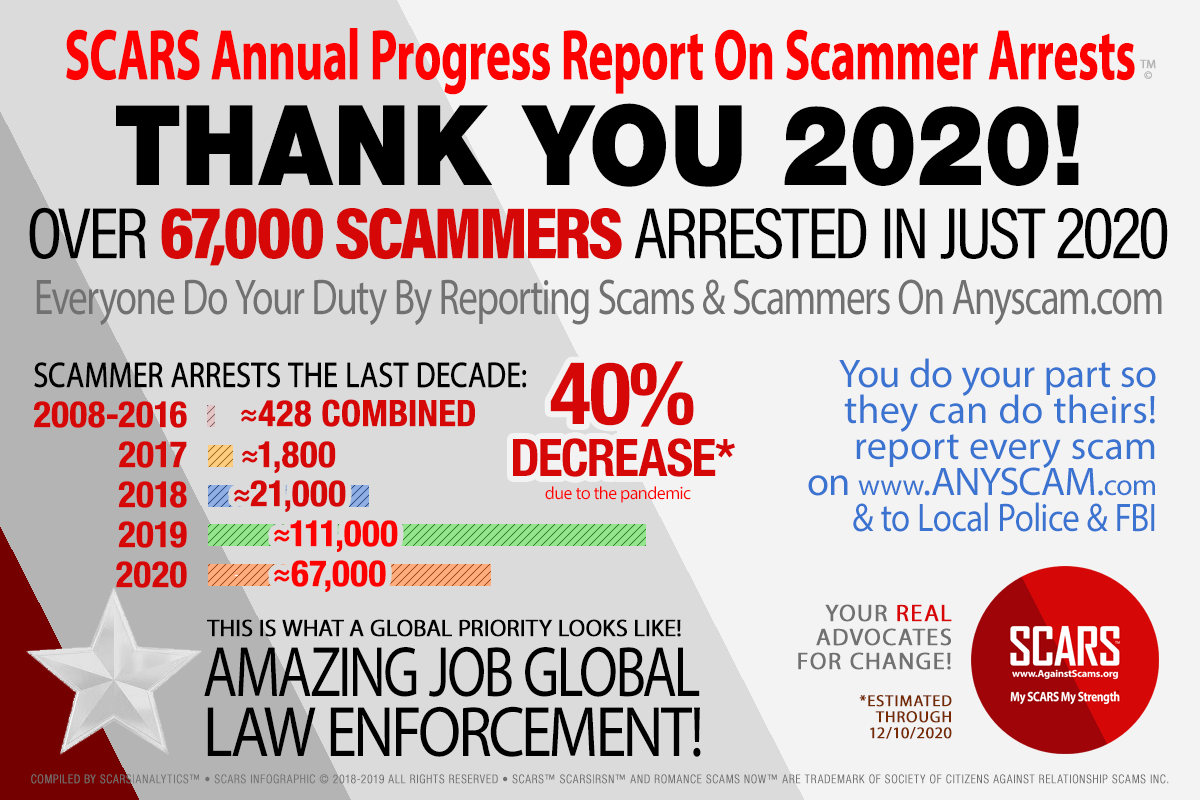
SCARS™ Report: Over 67,000 Scammers Arrested In 2020
SCARS has completed its preliminary year-end report on the number of scammers arrested during 2020
It is much better than we thought it was going to be!
We expected a very poor showing during this pandemic year where law enforcement was both restricted and totally focused on helping to protect their countries from the COVID-19 virus. Instead what we found was significant efforts worldwide. And even though the totals were less than 2019, we found a much more balanced and cooperative effort globally.
2020 was the year that global law enforcement got serious about scams!
There were TWO MAJOR BRIGHT SPOTS:
- China reported over 30,000 scammers arrested inside of the PRC.
- Interpol reported more than 20,000 scammers arrested worldwide (outside of the PRC).
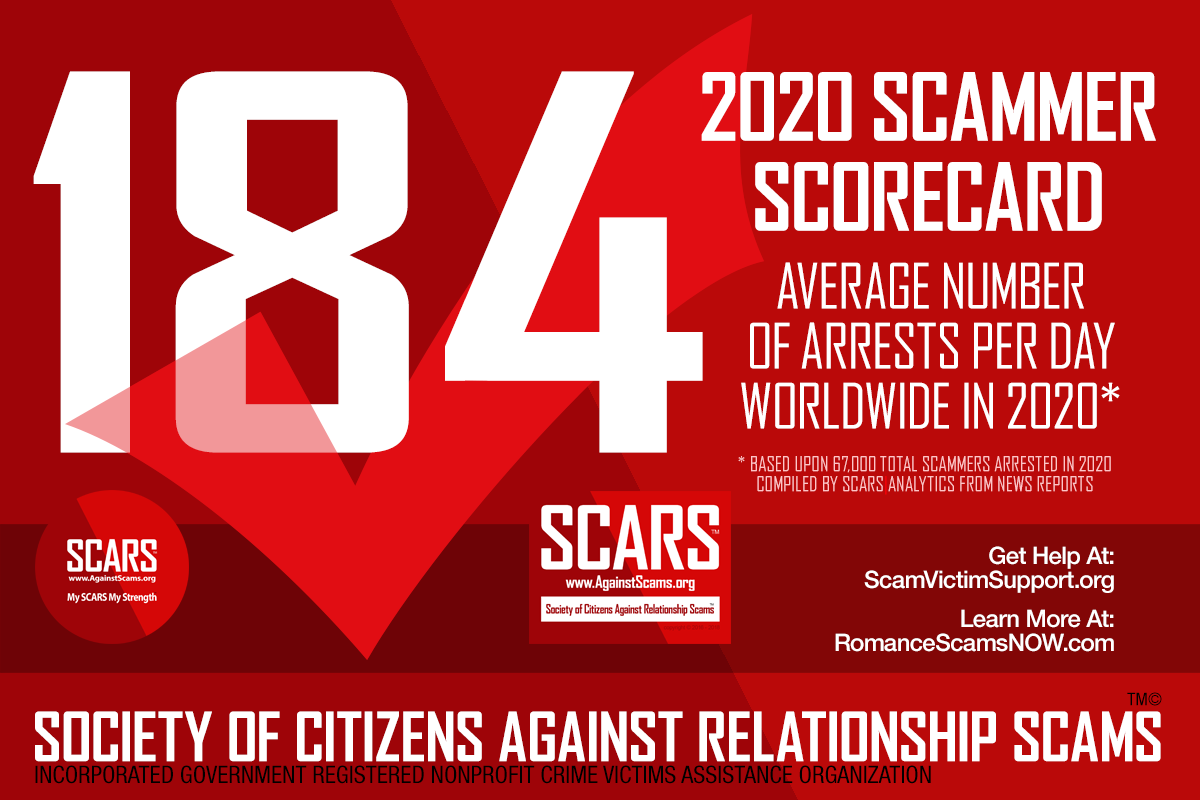
Overall, SCARS estimates that the current number of scammers, fraudsters, and cyber fraud criminals that have been arrested during 2020 is: 67,000
Here is Interpol’s summary report:
More than 20,000 arrests in year-long global crackdown on phone and Internet scams
Targeting rising trends in telephone and online scams, Operation First Light intercepted over 150 million dollars in illicit funds.
LYON, France: A year-long investigative clampdown on criminal networks coordinated by INTERPOL has demonstrated the scale of phone and online frauds worldwide.
Codenamed First Light, the Interpol operation officially concluded in November with the following results:
- 10,380 locations raided
- 21,549 operators, fraudsters and money launderers arrested
- 310 bank accounts frozen
- USD$ 153,973,709 worth of illicit funds intercepted.
This latest edition of Operation First Light marked the first time law enforcement has coordinated with INTERPOL on a global scale to combat telecoms fraud, with operations taking place on every continent.
Purple Notices
A three-month enforcement phase (1 September – 30 November 2019) saw 35 countries participate in a coordinated crackdown on organized crime groups engaged in various types of telecommunications and social engineering scams.
This was followed by a year (2020) of intensive information sharing among participating countries, analyzing the intelligence acquired in the operation in order to identify suspects and pursue investigative leads.
Based on the criminal techniques uncovered, INTERPOL also issued three Purple Notices on telephone scams, investment fraud and fraud schemes taking advantage of the COVID-19 pandemic.
Purple Notices provide information on objects, devices and concealment methods used by criminals – information that law enforcement organizations can access through INTERPOL’s secure I-24/7.
INTERPOL impersonation
Other types of fraud exposed in the operation include business e-mail compromise, romance scams and ‘smishing’, where standard messaging service (SMS) messages are sent to coerce a victim to divulge personal information that can subsequently be fraudulently used.
In Singapore, police arrested a man who presented false INTERPOL credentials when accompanying an elderly woman into a bank for a withdrawal. A further investigation found that the man appeared to be himself the victim of fraudsters who had called him pretending to be Chinese law enforcement agents, provided him with the fraudulent identification and directed him to seize the elderly woman’s funds.
A transnational threat
The results underscored the transnational nature of many telephone and online scams, where perpetrators often operate from a different country or even continent than their victims.
Leveraging the borderless nature of the Internet, fraudsters rarely respect national jurisdictions in their scams. The money extracted from victims is also likely to involve multiple countries as criminals use overseas bank accounts or money mules to launder their funds.
“It is important for member countries to remember that they are not alone in combatting these frauds,” said INTERPOL Secretary General Jürgen Stock.
“INTERPOL’s global network exists to support one another in precisely this situation, with the timely sharing of police information and intelligence, particularly when it crosses one or more jurisdictions,” added Secretary General Stock.
“The COVID-19 pandemic has seen telecommunications and social engineering frauds multiply. Operation First Light has achieved remarkable success in the past year yet, going forward, a much broader global coalition of law enforcement – facilitated by INTERPOL – will be needed to combat these threats,” said Duan Daqi, Head of the INTERPOL National Central Bureau in Beijing.
This represents an overall escalation in enforcement, even though results were lower.
Our expectations are that in 2021, because of the greater unification of data sharing, that the results will exceed 2019.
This is important because it is also expected by the cybersecurity industry that 2021 funds lost to cybercriminals will reach USD$6 Trillion.
TAGS: SCARS, SCARS Analytics, Information About Scams, Anti-Scam, Scams, Scammers, Fraudsters, Cybercrime, Crybercriminals, Romance Scams, Scam Victims, Scammers Arrested, Interpol, Law Enforcement, Cyber Fraud

SCARS™ Team
Society of Citizens Against Relationship Scams Inc.
A Worldwide Crime Victims Assistance Nonprofit Organization
Visit: www.AgainstScams.org
Contact Us: Contact@AgainstScams.org
PLEASE SHARE OUR ARTICLES WITH YOUR FRIENDS & FAMILY
HELP OTHERS STAY SAFE ONLINE – YOUR KNOWLEDGE CAN MAKE THE DIFFERENCE!
REPORT-BLOCK-RECOVER
The Latest SCARS Posts:


FIND MORE SCAM NEWS
«SCAMCRIME.COM»
JOIN US ON FACEBOOK
«CLICK HERE»
END
MORE INFORMATION
– – –
Tell us about your experiences with Romance Scammers in our
« Scams Discussion Forum on Facebook »
– – –
FAQ: How Do You Properly Report Scammers?
It is essential that law enforcement knows about scams & scammers, even though there is nothing (in most cases) that they can do.
Always report scams involving money lost or where you received money to:
- Local Police – ask them to take an “informational” police report – say you need it for your insurance
- U.S. State Police (if you live in the U.S.) – they will take the matter more seriously and provide you with more help than local police
- Your National Police or FBI « www.IC3.gov »
- The SCARS|CDN™ Cybercriminal Data Network – Worldwide Reporting Network on « www.Anyscam.com »
This helps your government understand the problem, and allows law enforcement to add scammers on watch lists worldwide.
– – –
To learn more about SCARS visit « www.AgainstScams.org »
Please be sure to report all scammers
on « www.Anyscam.com »
Disclaimer:
SCARS IS A DIGITAL PUBLISHER AND DOES NOT OFFER HEALTH OR MEDICAL ADVICE, LEGAL ADVICE, FINANCIAL ADVICE, OR SERVICES THAT SCARS IS NOT LICENSED OR REGISTERED TO PERFORM.
IF YOU’RE FACING A MEDICAL EMERGENCY, CALL YOUR LOCAL EMERGENCY SERVICES IMMEDIATELY, OR VISIT THE NEAREST EMERGENCY ROOM OR URGENT CARE CENTER. YOU SHOULD CONSULT YOUR HEALTHCARE PROVIDER BEFORE FOLLOWING ANY MEDICALLY RELATED INFORMATION PRESENTED ON OUR PAGES.
ALWAYS CONSULT A LICENSED ATTORNEY FOR ANY ADVICE REGARDING LEGAL MATTERS.
A LICENSED FINANCIAL OR TAX PROFESSIONAL SHOULD BE CONSULTED BEFORE ACTING ON ANY INFORMATION RELATING TO YOUR PERSONAL FINANCES OR TAX RELATED ISSUES AND INFORMATION.
This content and other material contained on the website, apps, newsletter, and products (“Content”), is general in nature and for informational purposes only and does not constitute medical, legal, or financial advice; the Content is not intended to be a substitute for licensed or regulated professional advice. Always consult your doctor or other qualified healthcare provider, lawyer, financial, or tax professional with any questions you may have regarding the educational information contained herein. SCARS makes no guarantees about the efficacy of information described on or in SCARS’ Content. The information contained is subject to change and is not intended to cover all possible situations or effects. SCARS does not recommend or endorse any specific professional or care provider, product, service, or other information that may be mentioned in SCARS’ websites, apps, and Content unless explicitly identified as such.
The disclaimers herein are provided on this page for ease of reference. These disclaimers supplement and are a part of SCARS’ website’s Terms of Use.
Legal Notices:
All original content is Copyright © 1991 – 2020 Society of Citizens Against Relationship Scams Inc. (D.B.A SCARS) All Rights Reserved Worldwide & Webwide. Third-party copyrights acknowledge.
SCARS, SCARS|INTERNATIONAL, SCARS, SCARS|SUPPORT, SCARS, RSN, Romance Scams Now, SCARS|INTERNATION, SCARS|WORLDWIDE, SCARS|GLOBAL, SCARS, Society of Citizens Against Relationship Scams, Society of Citizens Against Romance Scams, SCARS|ANYSCAM, Project Anyscam, Anyscam, SCARS|GOFCH, GOFCH, SCARS|CHINA, SCARS|CDN, SCARS|UK, SCARS|LATINOAMERICA, SCARS|MEMBER, SCARS|VOLUNTEER, SCARS Cybercriminal Data Network, Cobalt Alert, Scam Victims Support Group, are all trademarks of Society of Citizens Against Relationship Scams Inc., All Rights Reserved Worldwide
Contact the law firm for the Society of Citizens Against Relationship Scams Incorporated by email at legal@AgainstScams.org
-/ 30 /-
What do you think about this?
Please share your thoughts in a comment below!
Table of Contents
- SCARS has completed its preliminary year-end report on the number of scammers arrested during 2020
- Here is Interpol’s summary report:
- LYON, France: A year-long investigative clampdown on criminal networks coordinated by INTERPOL has demonstrated the scale of phone and online frauds worldwide.
- This represents an overall escalation in enforcement, even though results were lower.
- Ethereum ETHM Token Trap and Pig Butchering Scams – 2026
- New U.S. Law – S.3643 – 118th Congress – Will Dramatically Impact Scammers and Terrorists – 2026
- How Scam Survivors Can Survive Valentine’s Day – 2026
- U.S. Veterans Benefits Scams – 2026
- New AI Voice Cloning Phone Scams – 2026
- An Essay on Justice and Money Recovery – 2026
- Tell us about your experiences with Romance Scammers in our
« Scams Discussion Forum on Facebook » - FAQ: How Do You Properly Report Scammers?
- Please be sure to report all scammers
on « www.Anyscam.com »

Rapid Report Scammers

In the U.S. & Canada
U.S. & Canada Suicide Lifeline 988
LEAVE A COMMENT?
Recent Comments
On Other Articles
- Wendy Guiher on 15 Things That Nearly Every Online and Phone Scams Have In Common – 2026: “Very concise, direct information. When I look back on the crime against me I now can see ALL of the…” Apr 1, 06:24
- on The Danger of Using AI in Law Enforcement – The Grandmother Wrongly Arrested as a Fraudster – 2026: “Excellent article – I can’t imagine the terror Angela most certainly experienced. Compound this with the lack of accountability by…” Mar 24, 09:20
- on The Crazy Gregor MacGregor and the Country of Poyais Scam – History of Scams – 2026: “interesting” Mar 23, 19:24
- on BEC Fraud Reaches $43 Billion Per Year: “oh my gosh so much of an increase in the fraud I pray the officials can continue tracking and make…” Mar 23, 15:09
- on Establishing The United States Task Force To Eliminate Fraud – 2026: “Make Online Safe Again!” Mar 17, 19:11
- on Establishing The United States Task Force To Eliminate Fraud – 2026: “Finally an administration takes the initiative to help solve the gigantic situation. Make America Safe Again, thank you!” Mar 17, 15:41
- on What Is The Difference Between A Scam Victim And A Scam Survivor? [Updated]: “Due to my scams I don’t fully trust anyone online and I shouldn’t even those people I knew in high…” Mar 7, 12:46
- on SCARS 3 Steps For New Scam Victims 2024: “I was very fearful “he” would come to my home because I was knew my address, I spoke to someone…” Mar 7, 09:50
- on Sadness & Scam Recovery: “Before my scam, my mom passed away and I got a divorce, so I was dealing with the loss of…” Mar 7, 09:37
- on The Story Of Kira Lee Orsag (aka Dani Daniels) [Updated]: “There is NO evidence and she is not, she is a victim too. Sebastian, stop letting your anger think for…” Mar 6, 23:18
ARTICLE META
Important Information for New Scam Victims
- Please visit www.ScamVictimsSupport.org – a SCARS Website for New Scam Victims & Sextortion Victims
- Enroll in FREE SCARS Scam Survivor’s School now at www.SCARSeducation.org
- Please visit www.ScamPsychology.org – to more fully understand the psychological concepts involved in scams and scam victim recovery
If you are looking for local trauma counselors please visit counseling.AgainstScams.org or join SCARS for our counseling/therapy benefit: membership.AgainstScams.org
If you need to speak with someone now, you can dial 988 or find phone numbers for crisis hotlines all around the world here: www.opencounseling.com/suicide-hotlines
A Note About Labeling!
We often use the term ‘scam victim’ in our articles, but this is a convenience to help those searching for information in search engines like Google. It is just a convenience and has no deeper meaning. If you have come through such an experience, YOU are a Survivor! It was not your fault. You are not alone! Axios!
A Question of Trust
At the SCARS Institute, we invite you to do your own research on the topics we speak about and publish, Our team investigates the subject being discussed, especially when it comes to understanding the scam victims-survivors experience. You can do Google searches but in many cases, you will have to wade through scientific papers and studies. However, remember that biases and perspectives matter and influence the outcome. Regardless, we encourage you to explore these topics as thoroughly as you can for your own awareness.
Statement About Victim Blaming
SCARS Institute articles examine different aspects of the scam victim experience, as well as those who may have been secondary victims. This work focuses on understanding victimization through the science of victimology, including common psychological and behavioral responses. The purpose is to help victims and survivors understand why these crimes occurred, reduce shame and self-blame, strengthen recovery programs and victim opportunities, and lower the risk of future victimization.
At times, these discussions may sound uncomfortable, overwhelming, or may be mistaken for blame. They are not. Scam victims are never blamed. Our goal is to explain the mechanisms of deception and the human responses that scammers exploit, and the processes that occur after the scam ends, so victims can better understand what happened to them and why it felt convincing at the time, and what the path looks like going forward.
Articles that address the psychology, neurology, physiology, and other characteristics of scams and the victim experience recognize that all people share cognitive and emotional traits that can be manipulated under the right conditions. These characteristics are not flaws. They are normal human functions that criminals deliberately exploit. Victims typically have little awareness of these mechanisms while a scam is unfolding and a very limited ability to control them. Awareness often comes only after the harm has occurred.
By explaining these processes, these articles help victims make sense of their experiences, understand common post-scam reactions, and identify ways to protect themselves moving forward. This knowledge supports recovery by replacing confusion and self-blame with clarity, context, and self-compassion.
Additional educational material on these topics is available at ScamPsychology.org – ScamsNOW.com and other SCARS Institute websites.
Psychology Disclaimer:
All articles about psychology and the human brain on this website are for information & education only
The information provided in this article is intended for educational and self-help purposes only and should not be construed as a substitute for professional therapy or counseling.
While any self-help techniques outlined herein may be beneficial for scam victims seeking to recover from their experience and move towards recovery, it is important to consult with a qualified mental health professional before initiating any course of action. Each individual’s experience and needs are unique, and what works for one person may not be suitable for another.
Additionally, any approach may not be appropriate for individuals with certain pre-existing mental health conditions or trauma histories. It is advisable to seek guidance from a licensed therapist or counselor who can provide personalized support, guidance, and treatment tailored to your specific needs.
If you are experiencing significant distress or emotional difficulties related to a scam or other traumatic event, please consult your doctor or mental health provider for appropriate care and support.
Also read our SCARS Institute Statement about Professional Care for Scam Victims – click here to go to our ScamsNOW.com website.

Thank you for your comment. You may receive an email to follow up. We never share your data with marketers.