



SCARS Institute’s Encyclopedia of Scams™ Published Continuously for 25 Years


IC3.gov: How To File A Criminal Complaint And What To Expect
The Internet Crime Complaint Center, or IC3, is the United States FBI’s central hub for reporting cybercrime. It is run by the FBI, the lead federal agency for investigating cybercrime. On the IC3 website, you can take two vital steps to protecting cyberspace and your own online security.
What Is IC3.gov
The FBI’s Internet Crime Complaint Center (IC3.gov) is a central reporting system for cybercrime complaints. It is a partnership between the FBI and the National White Collar Crime Center (NW3C).
The IC3.gov complaint reporting system works by allowing victims of cybercrime to file a report online. The report can include information about the crime, such as the date and time it occurred, the type of crime, and the amount of money lost. Victims can also upload any relevant documents, such as emails, screenshots, or chat logs.
Once a report is filed, the IC3 Team will review it and assign it to an investigator if appropriate for investigation. The investigator will then contact the victim to gather more information and investigate the crime. The IC3 may also share the report with other law enforcement agencies.
NOTE: not all complaints will be assigned for investigation. Unfortunately, the FBI is not great at communicating this fact or letting victims know if their complaint is not going to be investigated.
The IC3 does not have the authority to investigate or prosecute cybercrime cases – this is done by the FTC and other government law enforcement agencies and the United States Attorney (prosecutor.) However, it can provide victims with information about their rights and options, and it can help victims to recover their losses in some cases. The IC3 can also provide law enforcement agencies with information about cybercrime trends and patterns – this is vitally important.
Here are the steps on how to file a complaint with the IC3:
- Go to the IC3 website at www.IC3.gov [BEFORE GOING THERE READ THE REST OF THIS GUIDE]
- Click on the “File a Complaint” button.
- Select the type of crime you are reporting.
- Provide information about the crime, such as the date and time it occurred, the type of crime, and the amount of money lost (See below)
- Upload any relevant documents, such as emails, screenshots, or chat logs.
- Click on the “Submit” button.
- An onscreen confirmation will confirm that the report has been sent to IC3 – be sure to look for any error message
The IC3 will send you a confirmation email with the case number for your complaint. You can use this case number to track the status of your complaint online.
The IC3 also offers a number of resources to help victims of cybercrime, including:
- A victim assistance guide
- A list of victim compensation programs
- A list of resources for businesses
Unfortunately, they do not direct you to victims’ assistance or support resources. SCARS was founded to provide just that type of support. See the resource below or if you want to sign up for a victims support group visit support.AgainstScams.org or for trauma counseling or therapy go to counseling.AgainsTScams.org
Be Aware
NOTE: The FBI is not always the best choice for victims of cybercrime. It depends on the type of crime and the losses.
- Anything can and should be reported to the FBI, but other reporting is always needed
- Anyone, anywhere in the world can report to the FBI on IC3.gov – they do not have to be a U.S. resident
- If a business or institution that has been cyberattacked call the FBI
- If an individual that has been scammed contact local police first – regardless of the type of scam
- If the scam involved cryptocurrency report it to the United States Secret Service (U.S. residents only)
- It is also advisable to report to the Federal Trade Commission
- Learn more about reporting these crimes on reporting.AgainstScams.org
If you believe you have fallen victim to cybercrime, file a complaint or report on IC3.gov. Your information is invaluable to helping the FBI and its partners bring cybercriminals to justice.
Anyone can become a victim of internet crime – it is not your fault. Take action for yourself and others by reporting it. Reporting internet crimes can help bring criminals to justice and make the internet a safer place for us all.
Protecting Our Digitally-connected World Is A Top Priority And Focus Of The FBI
But they can’t do it alone.
In today’s interconnected digital world, security plays a critical role in various aspects of our lives, from maintaining connections with family and friends to conducting online transactions and remote work. Unfortunately, the digital landscape is under constant attack by criminals worldwide, targeting both large corporate networks and personal devices like smartphones. No device or individual is exempt from these threats, making it imperative for all of us to work together to safeguard our digital environment. In the realm of cybersecurity, a single vulnerability can have far-reaching consequences, making it crucial to eliminate any weak links in our defenses. Every organization and individual must take proactive and informed measures to protect their devices and systems and be vigilant in recognizing and avoiding scams.
The data you provide to IC3.gov makes a significant difference. It enables the FBI to investigate reported crimes, identify trends and emerging threats, and, in some instances, freeze stolen assets. Equally important, IC3.gov shares crime reports across its extensive network of FBI field offices and law enforcement partners, bolstering our nation’s collective response at both local and national levels.
Given the sheer volume of complaints received each year, IC3.gov may not be able to respond directly to every submission. Nevertheless, rest assured that each report is treated seriously. With your assistance, we can respond more swiftly, fortify cyber networks more effectively, and better protect our nation’s digital landscape.
SCARS NOTE: Most people that report a crime on IC3.gov will see a confirmation that their complaint was accepted but will not receive any further contact from the FBI until their open an investigation. Sadly, the FBI simply does not have the number of people needed to respond to each complaint.
Filing A Complaint On IC3.gov – Data Requirements
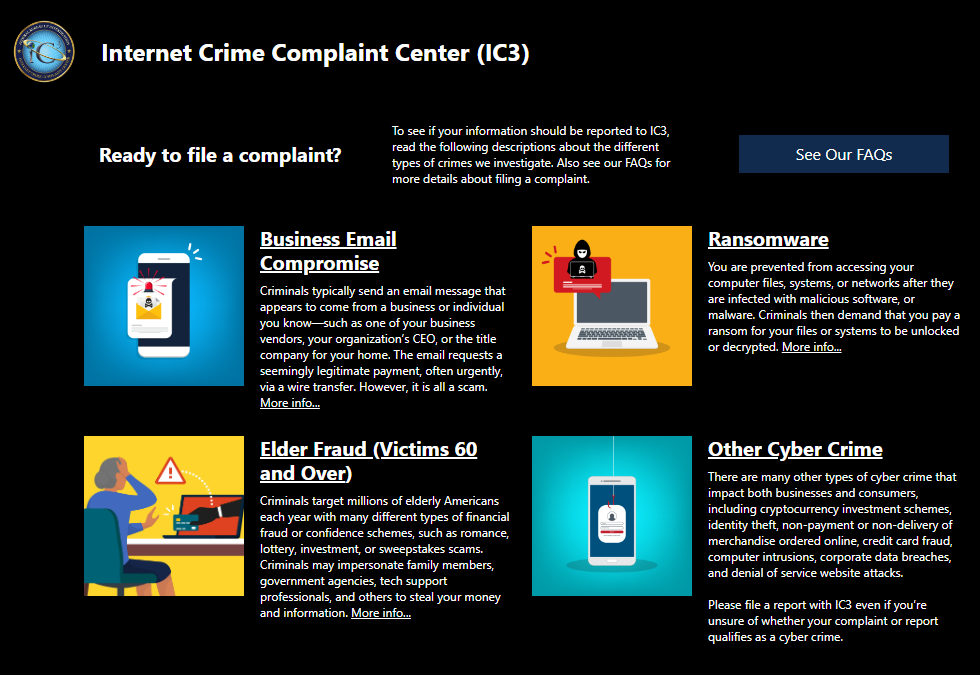
Reporting For Individual Victims of Scams (Other Cyber Crimes) on IC3.gov:
The details listed below are very important to Other Cyber Crimes. Please have this information ready before filing your complaint. During the filing process, you will have the opportunity to provide any other information you feel is relevant to your complaint.
-
- Victim Mailing Address
- Victim Email Address
- Victim Phone Number
- Description of Incident
- Any additional information requested in the form deemed relevant to your report
Before you file a complaint, please read this to help you prepare and organize the information they will need: A Scam Victim’s Checklist (romancescamsnow.com)
Reporting Elder Fraud (Victims 60 and Over) on IC3.gov:
The details listed below are very important to Elder Fraud. Please have this information ready before filing your complaint. During the filing process, you will have the opportunity to provide any other information you feel is relevant to your complaint.
-
- Victim Mailing Address
- Victim Email Address
- Victim Phone Number
- Description of Incident
- Victim bank and account details
- Subject/recipient bank and account details
- Cryptocurrency wallet details (if applicable)
- Transaction dates and amounts
- The full financial wiring/routing instructions provided by the subject
Before you file a complaint, please read this to help you prepare and organize the information they will need: A Scam Victim’s Checklist (romancescamsnow.com)
Reporting Ransomware on IC3.gov:
The details listed below are very important to Ransomware. Please have this information ready before filing your complaint. During the filing process, you will have the opportunity to provide any other information you feel is relevant to your complaint.
-
- Victim Mailing Address
- Victim Email Address
- Victim Phone Number
- Description of Incident
- Business name and address
- Business IT or remediation firm contact information
- Transaction details for any ransom paid
- Ransomware variant name (if known); file extension of the encrypted file(s); cryptocurrency type and address; email address utilized by attackers; website(s) / URL(s) provided by attackers; ransom demand amount; whether the ransom was paid and if so, the amount paid
Reporting For Businesses Filing A Business Email Compromise (BEC Scam) Complaint on IC3.gov:
The details listed below are very important to Business Email Compromise. Please have this information ready before filing your complaint. During the filing process, you will have the opportunity to provide any other information you feel is relevant to your complaint.
-
- Victim Mailing Address
- Victim Email Address
- Victim Phone Number
- Description of Incident
- Victim bank and account details
- Subject/recipient bank and account details
- Cryptocurrency wallet details (if applicable)
- Transaction dates and amounts
- The full financial wiring/routing instructions provided by the subject
Terms & Conditions Per The FBI
File a Complaint
Prior to filing a complaint with the IC3, please read the following information regarding terms and conditions. Should you have additional questions prior to filing your complaint, view FAQs for more information on inquiries such as:
- What details will I be asked to include in my complaint?
- What happens after I file a complaint?
- How are complaints resolved?
- Should I retain evidence related to my complaint?
The information I’m providing on this form is correct to the best of my knowledge. I understand that providing false information could make me subject to fine, imprisonment, or both. (Title 18, U.S. Code, Section 1001)
Complaints filed via this website are processed and may be referred to federal, state, local or international law enforcement or regulatory agencies for possible investigation. I understand any investigation opened on any complaint I file on this website is initiated at the discretion of the law enforcement and/or regulatory agency receiving the complaint information.
Filing a complaint with the IC3 in no way serves as notification to my credit card company that I am disputing unauthorized charges placed on my card or that my credit card number may have been compromised. I should contact my credit card company directly to notify them of my specific concerns.
The complaint information you submit to this site is encrypted via secure socket layer (SSL) encryption. Please see the Privacy Policy for further information.
We thank you for your cooperation.
Special Notes About Filing an IC3.gov Complaint
- You can file a complaint for yourself or for others, such as a family member, friend, or a business.
- You are filing a criminal complaint – filing false complaints can be considered a crime
- You cannot withdraw a complaint once it has been filed
- Do not file a complaint for something that is not a cybercrime
- Your information does not have to be perfect or complete, you can add information later by creating a new complaint and including a reference to the original complaint – in this way, you can chain the information together
After The Complaint What Happens Next?
The FBI uses the information from IC3.gov complaints to:
- Analyze trends and patterns in cybercrime. The FBI uses the information from IC3.gov complaints to track the types of cybercrimes that are being committed, the methods that criminals are using, and the victims that are most commonly targeted. This information helps the FBI to develop strategies to prevent and investigate cybercrimes.
- Share information with other law enforcement agencies. The FBI shares information from IC3.gov complaints with other law enforcement agencies around the world. This helps to ensure that criminals are not able to operate across borders.
- Provide victim assistance. The FBI offers a variety of victim assistance programs to help victims of cybercrime, such as:
- Restitution: The FBI can help victims of cybercrime to recover their losses.
- Victim Compensation Funds: The FBI can help victims of cybercrime to apply for victim compensation funds. These funds are available to victims who have suffered financial losses as a result of cybercrime.
The FBI also works with other government agencies and private organizations to combat cybercrime. For example, the FBI works with the National Cyber Security Alliance and other nonprofits registered with the U.S. Department of Justice to provide resources and education to help people protect themselves from cybercrime.
After the complaint on IC3.gov is filed
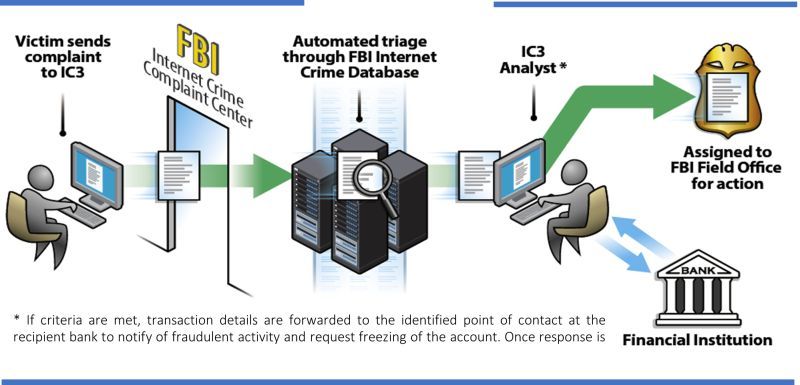
After the complaint on IC3.gov is filed the FBI’s algorithms analyze the complaint to determine if further review and investigation is warranted.
In the case where the FBI investigates the crimes, the FBI will assign resources as appropriate. This can also include financial recovery specialists.
The FBI Recovery Asset Team (RAT) can activate a Financial Fraud Kill Chain (FFKC)? This process occurs between law enforcement and financial entities to recover fraudulent funds wired by victims’ fraudulent money transfers. When an FFKC is initiated, the FBI works with financial institutions and our workforce worldwide to assist victims by freezing their funds. In 2022, the RAT was able to assist in the freezing of over $433 million of $590 million fraudulent money transfers – a 73% recovery rate! The faster you report fraudulent money transfers, the more likely the FBI will be able to make an impact.
What Happens If You Never Hear From The FBI Again?
After filing the complaint, individual victims should turn away from the crime and criminals and focus on their own personal recovery.
In many cases, the complaints do not have enough information or accurate information that would allow an immediate investigation. So this information accumulates until (hopefully) there is a clear picture of the criminals and their organization which can enable further investigation and an arrest and prosecution. It is not uncommon for it to take dozens of reports to piece together the information needed to target specific criminals.
All victims should know that they did the right thing by reporting and then letting the FBI do its job and now turn to their own personal recovery needs. This can be frustrating that nothing happens quickly, but this is just the nature of combatting organized crime worldwide.
Victims are not law enforcement or criminology professionals, so after filing the complaint should not try to involve themselves in separate investigations. This can significantly deepen victim trauma, and waste vast amounts of time and money.
Resources:
- Signing up for free SCARS Support & Recovery groups: support.AgainstScams.org
- Finding professional trauma counseling or therapy: counseling.AgainstScams.org
- Learn more about reporting these crimes worldwide: reporting.AgainstScams.org
More:
- More about reporting cybercrime worldwide: Reporting Scams Worldwide (romancescamsnow.com)
- FBI 2022 IC3 Internet Crime Report (romancescamsnow.com)
- FBI Goes After Scammers & Cybercriminals With RAT (romancescamsnow.com)
- Government Impersonation Scams Are On The Rise! (scamsnow.com)
- What Does The FBI’s IC3.gov Actually Do? (romancescamsnow.com)
- Did The FBI on IC3.gov Ignore Your Crime Victims’ Rights? (romancescamsnow.com)
- Local Law Enforcement/Police Scam Victims’ Experience Study (romancescamsnow.com)
-/ 30 /-
What do you think about this?
Please share your thoughts in a comment below!
Table of Contents




Rapid Report Scammers

In the U.S. & Canada
U.S. & Canada Suicide Lifeline 988
LEAVE A COMMENT?
Thank you for your comment. You may receive an email to follow up. We never share your data with marketers.
Recent Comments
On Other Articles
- on 15 Things That Nearly Every Online and Phone Scams Have In Common – 2026: “Very concise, direct information. When I look back on the crime against me I now can see ALL of the…” Apr 1, 06:24
- on The Danger of Using AI in Law Enforcement – The Grandmother Wrongly Arrested as a Fraudster – 2026: “Excellent article – I can’t imagine the terror Angela most certainly experienced. Compound this with the lack of accountability by…” Mar 24, 09:20
- on The Crazy Gregor MacGregor and the Country of Poyais Scam – History of Scams – 2026: “interesting” Mar 23, 19:24
- on BEC Fraud Reaches $43 Billion Per Year: “oh my gosh so much of an increase in the fraud I pray the officials can continue tracking and make…” Mar 23, 15:09
- on Establishing The United States Task Force To Eliminate Fraud – 2026: “Make Online Safe Again!” Mar 17, 19:11
- on Establishing The United States Task Force To Eliminate Fraud – 2026: “Finally an administration takes the initiative to help solve the gigantic situation. Make America Safe Again, thank you!” Mar 17, 15:41
- on What Is The Difference Between A Scam Victim And A Scam Survivor? [Updated]: “Due to my scams I don’t fully trust anyone online and I shouldn’t even those people I knew in high…” Mar 7, 12:46
- on SCARS 3 Steps For New Scam Victims 2024: “I was very fearful “he” would come to my home because I was knew my address, I spoke to someone…” Mar 7, 09:50
- on Sadness & Scam Recovery: “Before my scam, my mom passed away and I got a divorce, so I was dealing with the loss of…” Mar 7, 09:37
- on The Story Of Kira Lee Orsag (aka Dani Daniels) [Updated]: “There is NO evidence and she is not, she is a victim too. Sebastian, stop letting your anger think for…” Mar 6, 23:18
ARTICLE META
Important Information for New Scam Victims
- Please visit www.ScamVictimsSupport.org – a SCARS Website for New Scam Victims & Sextortion Victims
- Enroll in FREE SCARS Scam Survivor’s School now at www.SCARSeducation.org
- Please visit www.ScamPsychology.org – to more fully understand the psychological concepts involved in scams and scam victim recovery
If you are looking for local trauma counselors please visit counseling.AgainstScams.org or join SCARS for our counseling/therapy benefit: membership.AgainstScams.org
If you need to speak with someone now, you can dial 988 or find phone numbers for crisis hotlines all around the world here: www.opencounseling.com/suicide-hotlines
A Note About Labeling!
We often use the term ‘scam victim’ in our articles, but this is a convenience to help those searching for information in search engines like Google. It is just a convenience and has no deeper meaning. If you have come through such an experience, YOU are a Survivor! It was not your fault. You are not alone! Axios!
A Question of Trust
At the SCARS Institute, we invite you to do your own research on the topics we speak about and publish, Our team investigates the subject being discussed, especially when it comes to understanding the scam victims-survivors experience. You can do Google searches but in many cases, you will have to wade through scientific papers and studies. However, remember that biases and perspectives matter and influence the outcome. Regardless, we encourage you to explore these topics as thoroughly as you can for your own awareness.
Statement About Victim Blaming
SCARS Institute articles examine different aspects of the scam victim experience, as well as those who may have been secondary victims. This work focuses on understanding victimization through the science of victimology, including common psychological and behavioral responses. The purpose is to help victims and survivors understand why these crimes occurred, reduce shame and self-blame, strengthen recovery programs and victim opportunities, and lower the risk of future victimization.
At times, these discussions may sound uncomfortable, overwhelming, or may be mistaken for blame. They are not. Scam victims are never blamed. Our goal is to explain the mechanisms of deception and the human responses that scammers exploit, and the processes that occur after the scam ends, so victims can better understand what happened to them and why it felt convincing at the time, and what the path looks like going forward.
Articles that address the psychology, neurology, physiology, and other characteristics of scams and the victim experience recognize that all people share cognitive and emotional traits that can be manipulated under the right conditions. These characteristics are not flaws. They are normal human functions that criminals deliberately exploit. Victims typically have little awareness of these mechanisms while a scam is unfolding and a very limited ability to control them. Awareness often comes only after the harm has occurred.
By explaining these processes, these articles help victims make sense of their experiences, understand common post-scam reactions, and identify ways to protect themselves moving forward. This knowledge supports recovery by replacing confusion and self-blame with clarity, context, and self-compassion.
Additional educational material on these topics is available at ScamPsychology.org – ScamsNOW.com and other SCARS Institute websites.
Psychology Disclaimer:
All articles about psychology and the human brain on this website are for information & education only
The information provided in this article is intended for educational and self-help purposes only and should not be construed as a substitute for professional therapy or counseling.
While any self-help techniques outlined herein may be beneficial for scam victims seeking to recover from their experience and move towards recovery, it is important to consult with a qualified mental health professional before initiating any course of action. Each individual’s experience and needs are unique, and what works for one person may not be suitable for another.
Additionally, any approach may not be appropriate for individuals with certain pre-existing mental health conditions or trauma histories. It is advisable to seek guidance from a licensed therapist or counselor who can provide personalized support, guidance, and treatment tailored to your specific needs.
If you are experiencing significant distress or emotional difficulties related to a scam or other traumatic event, please consult your doctor or mental health provider for appropriate care and support.
Also read our SCARS Institute Statement about Professional Care for Scam Victims – click here to go to our ScamsNOW.com website.


I have used IC3 for my original fraud case as well as a follow up scam attempt where the scammer claimed to be the FBI director Christopher Wray.