



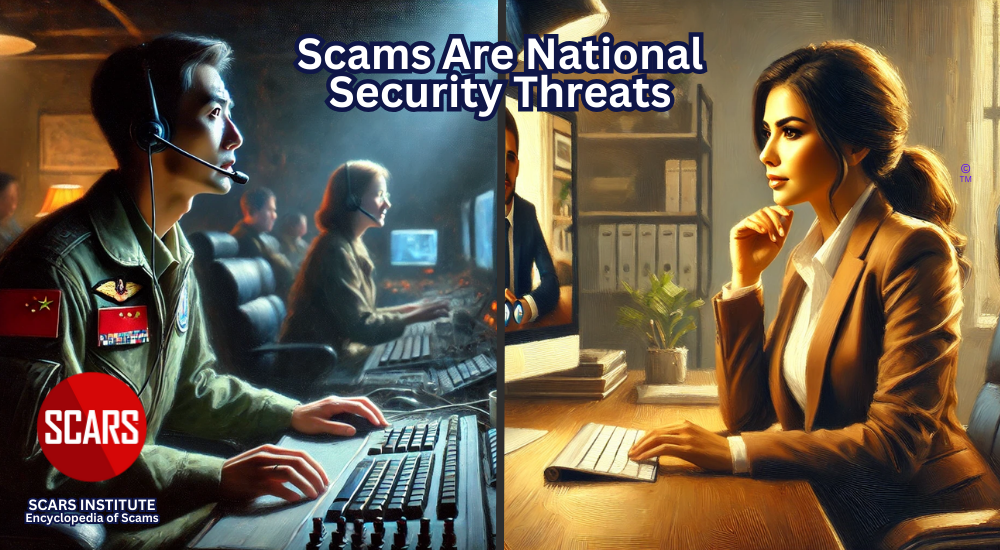

SCARS Institute’s Encyclopedia of Scams™ Published Continuously for 25 Years

Relationship Scams Represent a Corporate Cybersecurity and National Security Threat Because of Compromised Scam Victims
How Relationship Scam Victims Pose a National Security Threat: Manipulation, Blackmail, and Cybersecurity Risks
How Scammers Operate – A SCARS Institute Insight
Author:
• Tim McGuinness, Ph.D., DFin, MCPO, MAnth – Anthropologist, Scientist, Director of the Society of Citizens Against Relationship Scams Inc.
Article Abstract
Scammers who engage in relationship fraud, including romance scams and cryptocurrency investment schemes, pose a significant national security risk by manipulating victims into revealing sensitive information. This risk is particularly severe for government employees, military personnel, law enforcement officers, and corporate executives who have access to classified or proprietary data. Through psychological tactics such as emotional bonding, feigning shared interests, and exploiting empathy, scammers gain victims’ trust and extract confidential details over time. In many cases, these scams are linked to state-sponsored actors from countries like China, North Korea, Iran, and Russia, who use manipulated individuals as unwitting informants.
Even after a scam is exposed, victims remain vulnerable to blackmail, where scammers threaten to reveal compromising personal or financial details unless further information is provided. This can lead to operational compromise, cybersecurity breaches, and financial exploitation, making these scams more than just personal losses—they become matters of national security. Cases have shown that individuals working in intelligence, defense, and finance have been tricked into leaking classified data, bypassing security protocols, or granting unauthorized access to networks, with devastating consequences. Preventing these risks requires stringent cybersecurity measures, awareness training, and policies that encourage victims to report without fear of professional repercussions. Recognizing the broader implications of relationship scams is essential to safeguarding both individuals and national interests.

How Relationship Scam Victims Pose a National Security Threat: Manipulation, Blackmail, and Cybersecurity Risks
Relationship scams, encompassing tactics like romance frauds and cryptocurrency investment schemes, can profoundly affect victims, leading them to divulge sensitive information.
This vulnerability poses significant national security risks, particularly when targeting government employees in sectors such as the military, law enforcement, security, and finance.
Manipulation Techniques Employed by Scammers
Scammers adeptly exploit psychological tactics to extract desired information from victims. By fostering trust and emotional connections, they create environments where victims feel safe sharing confidential details. This manipulation often involves:
Emotional Bonding: Manipulating Trust to Extract Sensitive Information
Scammers understand that deep emotional connections lower a person’s natural defenses, making them more willing to share personal and professional details they would otherwise keep private. The emotional manipulation employed in relationship scams is deliberate, systematic, and highly effective. Scammers invest time in crafting a narrative that makes the victim feel valued, loved, and uniquely understood. This process can take weeks or even months, with the scammer gradually becoming an indispensable part of the victim’s life.
One of the most common tactics scammers use is the illusion of long-term commitment. They make promises about a future together, discussing marriage, family, and a life built on shared dreams. By fostering this sense of intimacy, the victim begins to trust the scammer completely, often ignoring inconsistencies or warning signs. This emotional dependency creates a strong psychological bond, making the victim more susceptible to requests for personal and professional favors.
In cases where the victim works in a sensitive profession, such as cybersecurity, military intelligence, or corporate finance, the scammer subtly steers conversations toward work-related topics. At first, this may seem like innocent curiosity—asking about work routines, general responsibilities, or frustrations with colleagues. Over time, the questions become more targeted, with scammers coaxing out specific details under the guise of casual conversation. The victim, eager to maintain their emotional connection, often does not recognize the incremental loss of sensitive information.
There have been numerous cases where intelligence agencies have linked online relationship scams to state-sponsored espionage efforts. For example, in 2018, a series of romance scams targeting Australian defense officials was traced back to foreign intelligence operatives. Victims, believing they were in long-distance relationships, unknowingly disclosed sensitive military details that compromised national security. By the time authorities intervened, the damage had already been done.
Scammers exploit the fact that humans are wired to trust those they feel emotionally connected to. Once trust is established, the victim is far more likely to comply with requests that, under normal circumstances, would seem suspicious or inappropriate.
Feigning Shared Interests: Creating a False Sense of Camaraderie
One of the most effective ways scammers manipulate victims is by pretending to have similar backgrounds, careers, or passions. This tactic, known as mirroring, creates an artificial sense of shared identity, making the victim believe they have found someone who truly understands them. The more a victim identifies with the scammer, the more likely they are to let their guard down and share personal or professional information.
Scammers conduct extensive research before engaging with a potential victim. They may analyze social media profiles, professional networking sites, or past interactions to gather data on the victim’s interests, work history, and personal beliefs. Armed with this information, they fabricate a persona that aligns closely with the victim’s world.
For example, if the victim is an engineer working on cybersecurity, the scammer might claim to be a tech entrepreneur or an ethical hacker. They discuss industry trends, share articles, and engage in technical conversations to gain credibility. Over time, the victim begins to see the scammer as a knowledgeable and trustworthy figure within their field. Once this trust is established, the scammer can start extracting valuable information under the pretense of professional curiosity or collaboration.
One high-profile case involved a British intelligence analyst who was deceived by an online scammer posing as a fellow security expert. Over several months, the scammer—allegedly linked to a foreign state actor—engaged in discussions about encryption methods, emerging cyber threats, and internal government cybersecurity strategies. The victim, believing they were exchanging harmless professional insights, inadvertently exposed vulnerabilities in national defense systems.
This technique is not limited to intelligence circles. In the corporate world, scammers pose as investors, potential business partners, or consultants to infiltrate companies and gain insider knowledge. By presenting themselves as industry experts, they gain access to trade secrets, proprietary algorithms, and corporate strategies, which can then be exploited for financial gain or competitive advantage.
Mirroring is particularly effective because it plays into the victim’s desire for validation and connection. When someone appears to share your professional struggles, ambitions, and interests, it creates a sense of camaraderie that overrides natural skepticism. The victim becomes emotionally invested in the relationship, making them more likely to disclose confidential details without recognizing the risks.
Exploiting Empathy: Using Fabricated Hardships to Manipulate Victims
Empathy is one of the most powerful human emotions, and scammers exploit it ruthlessly. By presenting themselves as victims of hardship, they trigger a deep emotional response in their targets, prompting them to take actions they might otherwise resist. Whether it is a fabricated medical emergency, a legal problem, or a tragic family loss, these false narratives serve a dual purpose—eliciting financial support and extracting sensitive information.
Scammers often introduce hardship stories early in the relationship to test the victim’s willingness to help. At first, the requests are minor, such as emotional support or assistance with an insignificant task. As the relationship progresses, the scammer escalates their claims, creating a sense of urgency and desperation. By this stage, the victim is emotionally invested and feels compelled to act.
For victims in government, law enforcement, or corporate positions, this emotional manipulation can have serious security implications. Consider the case of a U.S. Department of Defense contractor who was targeted by a scammer posing as a war refugee. The scammer claimed to be trapped in a conflict zone, needing assistance to escape. As trust deepened, the scammer convinced the victim to provide classified flight schedules and troop movement details under the pretense of helping coordinate an escape plan. The victim believed they were acting out of compassion, unaware that they were endangering national security.
Similarly, in the financial sector, scammers manipulate employees into bypassing security protocols under the guise of assisting someone in distress. A common tactic is to fabricate an emergency where the scammer needs urgent access to funds. By leveraging the victim’s empathy, they convince them to override standard verification procedures, leading to unauthorized transfers or security breaches.
One notable case involved a European banking executive who was manipulated into approving fraudulent wire transfers. The scammer, posing as a distant relative, claimed to be facing imminent deportation and needed financial assistance to secure legal representation. The victim, moved by the story, bypassed standard approval channels and authorized the transfer, only to later realize they had fallen for a well-orchestrated scam.
This form of manipulation is especially dangerous because it bypasses logical reasoning. Scammers do not directly demand sensitive information or financial favors—they create scenarios that make the victim feel morally obligated to help. The emotional pressure can be so intense that even experienced professionals fail to recognize the deception until it is too late.
Recognizing and Preventing Manipulation
Understanding how scammers exploit emotional bonding, shared interests, and empathy is the first step in preventing manipulation. Individuals working in sensitive fields must be especially cautious in online relationships, particularly when interacting with strangers who quickly form deep emotional connections.
Security protocols should emphasize the importance of verifying identities before sharing any information, regardless of how genuine a person seems. Organizations should conduct regular training on social engineering tactics, helping employees recognize the psychological techniques scammers use to gain trust.
Individuals must also be aware of their own vulnerabilities. Emotional manipulation thrives on a victim’s need for connection, validation, and purpose. By maintaining a healthy level of skepticism and setting firm boundaries in personal and professional interactions, people can protect themselves from becoming targets.
While scammers rely on deception, their success ultimately depends on the willingness of victims to trust them. By understanding the warning signs, questioning unusual requests, and prioritizing security over emotional impulses, individuals can safeguard both their personal lives and the institutions they serve.
For instance, in a notable case, an Australian couple lost their $48,000 house deposit to scammers who impersonated their solicitor’s office. The fraudsters manipulated the couple into transferring funds to a fraudulent account, showcasing the sophisticated methods employed to exploit victims’ trust.
Scammers as State Actors
In certain instances, scammers operate on behalf of state actors, including nations like North Korea, China, Iran, or Russia. These state-sponsored operations aim to gather intelligence, disrupt adversaries, or fund governmental initiatives. For example, reports have indicated that cybercriminals associated with these countries have targeted individuals to extract information or financial resources, which are then utilized to support state agendas.
Post-Scam Blackmail Tactics
After successfully executing a scam, perpetrators may resort to blackmail to extract further information or resources. Armed with compromising data or sensitive communications, scammers threaten to expose victims unless additional demands are met. This coercion can lead to:
Disclosure of Classified Information
Victims of relationship scams often find themselves in emotionally vulnerable positions, manipulated into revealing information they would typically guard closely. When the victim is a government employee, a military officer, or someone working in a sensitive industry such as cybersecurity or finance, the consequences of such disclosure can be severe. Scammers, particularly those working on behalf of state actors, use emotional manipulation, social engineering, and coercion to extract classified or restricted data.
A common tactic is to establish an intense emotional connection with the victim, making them believe they are in a genuine romantic relationship. Scammers create scenarios that require secrecy—such as an overseas lover in distress, an emergency that necessitates immediate action, or a fabricated legal problem that demands inside knowledge to resolve. In these situations, the victim, feeling responsible for their supposed partner’s well-being, may disclose restricted information in an attempt to help.
For example, in 2018, a British Ministry of Defence employee was tricked into revealing classified details about troop movements to an online persona claiming to be a U.S. military officer stationed abroad. The scammer, later linked to a foreign intelligence agency, built trust over several months before asking for seemingly innocuous but sensitive data. The victim, believing they were assisting a military ally, unknowingly compromised national security.
Scammers can also manipulate victims into sending documents, passwords, or access credentials under the pretense of verifying identity or assisting in a fabricated emergency. If the scam is linked to a state-sponsored actor, this information can be passed directly to intelligence agencies of hostile nations, further exacerbating security risks.
Financial Exploitation
Beyond the emotional and psychological toll, financial exploitation is a significant concern for victims ensnared in these scams. Scammers working for personal gain or as part of an organized group frequently exploit victims by demanding continuous financial support. In cases involving blackmail or threats of exposure, victims may feel they have no choice but to comply with these financial demands to avoid professional and personal ruin.
Financial exploitation often starts subtly, with small requests for money that escalate over time. In many cases, scammers introduce fabricated emergencies that require immediate financial assistance. Victims working in government or high-level corporate positions may divert funds from their own finances to meet these demands, leading to personal financial collapse. In extreme situations, they may misappropriate company or government funds to satisfy the scammer’s relentless financial demands, creating legal and ethical violations.
One notable example is the case of a high-ranking financial executive in Singapore who fell for an online romance scam in 2021. The scammer, posing as an affluent investor, manipulated the victim into sending large sums of money under the guise of business investments. Over time, the victim was coerced into siphoning company funds to sustain the relationship, ultimately resulting in their termination and criminal charges.
In situations involving government employees, financial coercion can also serve as a pathway to espionage. Scammers who realize their victim is in a sensitive role may demand insider information in exchange for financial relief. This is particularly dangerous when the scammer is affiliated with foreign intelligence agencies seeking economic or military intelligence.
Operational Compromise
When victims hold positions of influence in government, law enforcement, military, or corporate settings, they may be coerced into actions that undermine security. Scammers can exploit their influence to facilitate unauthorized access, sabotage operations, or enable cybersecurity breaches.
Operational compromise often occurs when a victim, desperate to prevent exposure, agrees to actions they would typically resist. This may include granting system access, bypassing security protocols, or intentionally overlooking suspicious activity. When state-sponsored actors are involved, these compromises can serve broader intelligence-gathering missions, allowing hostile nations to gain access to confidential data, disrupt operations, or weaken national security defenses.
One case illustrating operational compromise is that of a U.S. defense contractor who, in 2020, was manipulated into providing access credentials to a supposed online lover. The scammer, later linked to an Eastern European cybercrime syndicate, convinced the victim that they needed remote access to classified project data. Under emotional pressure and blackmail, the victim provided login credentials, leading to a data breach affecting sensitive military technology.
Another example involves law enforcement personnel who, under the influence of a scammer, may unknowingly obstruct investigations or provide information on ongoing cases. Scammers targeting police officers or security officials often pose as distressed individuals needing protection. Through emotional manipulation, they persuade their victims to reveal internal protocols or details about investigations, which can be used to evade capture or obstruct justice.
The risk of operational compromise extends beyond government roles. Corporate executives, particularly those in finance and technology sectors, are frequently targeted for insider access. A 2022 study on cybersecurity breaches revealed that 15% of corporate data leaks originated from employees manipulated through social engineering tactics, including relationship scams. Once compromised, these individuals may feel trapped, unable to report the breach for fear of professional repercussions.
Addressing the Threat
To mitigate the risks associated with scams that lead to classified disclosure, financial exploitation, and operational compromise, institutions must implement stringent awareness programs and cybersecurity protocols. Regular training on social engineering tactics, mandatory reporting mechanisms for suspected scams, and psychological support for victims can help prevent these breaches from occurring.
Government agencies and corporations must also adopt a proactive approach to digital security by monitoring employees for unusual financial transactions, sudden behavioral shifts, and potential online vulnerabilities. Early intervention can prevent minor incidents from escalating into full-scale breaches.
Ultimately, relationship scams are not just financial crimes—they represent a profound national security risk when victims in strategic positions are manipulated into acts that threaten security, economic stability, and confidential operations. By recognizing the tactics scammers use and strengthening protective measures, both individuals and institutions can reduce vulnerabilities and protect critical information from falling into the wrong hands.
In a recent incident, an elderly couple from Ohio lost $45,000 of their retirement savings to scammers posing as bank officials. The fraudsters manipulated the couple into withdrawing their funds and delivering them to a supposed bank executive, highlighting the lengths to which scammers will go to exploit victims.
Facilitating Cybersecurity Breaches
Scammers often manipulate victims into actions that compromise cybersecurity, such as:
-
Installing Malware: Convincing victims to download attachments or click links that introduce malicious software into secure systems.
-
Sharing Credentials: Deceiving victims into providing login information, granting unauthorized access to sensitive networks.
-
Bypassing Security Protocols: Persuading victims to disable security measures, leaving systems vulnerable to attacks.
For example, a sophisticated scam operation based in Tbilisi, Georgia, known as the “skameri,” used deepfakes and high-pressure sales tactics to defraud over 6,000 individuals, resulting in losses totaling £27 million. The scammers lured victims into investing in fraudulent schemes, demonstrating the advanced methods employed to breach cybersecurity defenses.
Conclusion
The intersection of relationship scams and national security is a growing concern. Scammers’ ability to manipulate victims into divulging sensitive information poses significant risks, especially when state actors are involved. Awareness and proactive measures are essential to mitigate these threats and protect both individuals and national interests.
Corporate and Institutional Support
The SCARS Institute team of world-case experts in the Psychology of Scams and in understanding scam victims, having helped more than 11 million scam victims, can help corporations, organizations, and institutions to harden their teams against scams and scam victimization. If you would like to explore this in more detail contact Dr. McGuinness at drtim@AgainstScams.org to explore your needs and potential SCARS Institute solutions.
-/ 30 /-
What do you think about this?
Please share your thoughts in a comment below!
Table of Contents




Rapid Report Scammers

In the U.S. & Canada
U.S. & Canada Suicide Lifeline 988
LEAVE A COMMENT?
Thank you for your comment. You may receive an email to follow up. We never share your data with marketers.
Recent Comments
On Other Articles
- on 15 Things That Nearly Every Online and Phone Scams Have In Common – 2026: “Very concise, direct information. When I look back on the crime against me I now can see ALL of the…” Apr 1, 06:24
- on The Danger of Using AI in Law Enforcement – The Grandmother Wrongly Arrested as a Fraudster – 2026: “Excellent article – I can’t imagine the terror Angela most certainly experienced. Compound this with the lack of accountability by…” Mar 24, 09:20
- on The Crazy Gregor MacGregor and the Country of Poyais Scam – History of Scams – 2026: “interesting” Mar 23, 19:24
- on BEC Fraud Reaches $43 Billion Per Year: “oh my gosh so much of an increase in the fraud I pray the officials can continue tracking and make…” Mar 23, 15:09
- on Establishing The United States Task Force To Eliminate Fraud – 2026: “Make Online Safe Again!” Mar 17, 19:11
- on Establishing The United States Task Force To Eliminate Fraud – 2026: “Finally an administration takes the initiative to help solve the gigantic situation. Make America Safe Again, thank you!” Mar 17, 15:41
- on What Is The Difference Between A Scam Victim And A Scam Survivor? [Updated]: “Due to my scams I don’t fully trust anyone online and I shouldn’t even those people I knew in high…” Mar 7, 12:46
- on SCARS 3 Steps For New Scam Victims 2024: “I was very fearful “he” would come to my home because I was knew my address, I spoke to someone…” Mar 7, 09:50
- on Sadness & Scam Recovery: “Before my scam, my mom passed away and I got a divorce, so I was dealing with the loss of…” Mar 7, 09:37
- on The Story Of Kira Lee Orsag (aka Dani Daniels) [Updated]: “There is NO evidence and she is not, she is a victim too. Sebastian, stop letting your anger think for…” Mar 6, 23:18
ARTICLE META
Important Information for New Scam Victims
- Please visit www.ScamVictimsSupport.org – a SCARS Website for New Scam Victims & Sextortion Victims
- Enroll in FREE SCARS Scam Survivor’s School now at www.SCARSeducation.org
- Please visit www.ScamPsychology.org – to more fully understand the psychological concepts involved in scams and scam victim recovery
If you are looking for local trauma counselors please visit counseling.AgainstScams.org or join SCARS for our counseling/therapy benefit: membership.AgainstScams.org
If you need to speak with someone now, you can dial 988 or find phone numbers for crisis hotlines all around the world here: www.opencounseling.com/suicide-hotlines
A Note About Labeling!
We often use the term ‘scam victim’ in our articles, but this is a convenience to help those searching for information in search engines like Google. It is just a convenience and has no deeper meaning. If you have come through such an experience, YOU are a Survivor! It was not your fault. You are not alone! Axios!
A Question of Trust
At the SCARS Institute, we invite you to do your own research on the topics we speak about and publish, Our team investigates the subject being discussed, especially when it comes to understanding the scam victims-survivors experience. You can do Google searches but in many cases, you will have to wade through scientific papers and studies. However, remember that biases and perspectives matter and influence the outcome. Regardless, we encourage you to explore these topics as thoroughly as you can for your own awareness.
Statement About Victim Blaming
SCARS Institute articles examine different aspects of the scam victim experience, as well as those who may have been secondary victims. This work focuses on understanding victimization through the science of victimology, including common psychological and behavioral responses. The purpose is to help victims and survivors understand why these crimes occurred, reduce shame and self-blame, strengthen recovery programs and victim opportunities, and lower the risk of future victimization.
At times, these discussions may sound uncomfortable, overwhelming, or may be mistaken for blame. They are not. Scam victims are never blamed. Our goal is to explain the mechanisms of deception and the human responses that scammers exploit, and the processes that occur after the scam ends, so victims can better understand what happened to them and why it felt convincing at the time, and what the path looks like going forward.
Articles that address the psychology, neurology, physiology, and other characteristics of scams and the victim experience recognize that all people share cognitive and emotional traits that can be manipulated under the right conditions. These characteristics are not flaws. They are normal human functions that criminals deliberately exploit. Victims typically have little awareness of these mechanisms while a scam is unfolding and a very limited ability to control them. Awareness often comes only after the harm has occurred.
By explaining these processes, these articles help victims make sense of their experiences, understand common post-scam reactions, and identify ways to protect themselves moving forward. This knowledge supports recovery by replacing confusion and self-blame with clarity, context, and self-compassion.
Additional educational material on these topics is available at ScamPsychology.org – ScamsNOW.com and other SCARS Institute websites.
Psychology Disclaimer:
All articles about psychology and the human brain on this website are for information & education only
The information provided in this article is intended for educational and self-help purposes only and should not be construed as a substitute for professional therapy or counseling.
While any self-help techniques outlined herein may be beneficial for scam victims seeking to recover from their experience and move towards recovery, it is important to consult with a qualified mental health professional before initiating any course of action. Each individual’s experience and needs are unique, and what works for one person may not be suitable for another.
Additionally, any approach may not be appropriate for individuals with certain pre-existing mental health conditions or trauma histories. It is advisable to seek guidance from a licensed therapist or counselor who can provide personalized support, guidance, and treatment tailored to your specific needs.
If you are experiencing significant distress or emotional difficulties related to a scam or other traumatic event, please consult your doctor or mental health provider for appropriate care and support.
Also read our SCARS Institute Statement about Professional Care for Scam Victims – click here to go to our ScamsNOW.com website.

It is shocking, sad but true how victims are being exploited on a daily basis.
The worst is those that think it cannot happen to them or advocate they have never been scammed.