



CDA Section 230 – Why Facebook & Social Media Largely Ignore Scammers

SCARS Institute’s Encyclopedia of Scams™ Published Continuously for 25 Years
- Published: March 23, 2022
- Modified: February 23, 2023
- Comments: 3
- Read Status:
CDA Section 230
Facebook & Social Media Largely Ignore Scammers, Why?
Reprinted from the Society of Citizens Against Relationship Scams Inc. (SCARS) main website www.AgainstScams.org
SCARS Advocacy – A Section 230 Special Report
Why Does Facebook & Social Media Largely Ignore Scammers? Section 230 Is The Answer!
Originally published in 2015
This Simple Answer Is Because They Can – A Get Away With It!
In the early days of the web, there was a problem, and in typical fashion, a new law – the Communications Decency Act including Section 230 was created to solve it. However, 25 years later, the solution was worse than the problem. The law’s section 230 almost forces all web platforms and publishers to ignore the abuses from criminals and they get away with it because it also gives them immunity from liability!
Under the Trump Administration, real progress was being made on revising the problem section 230, but that was forgotten under the Biden Admin., and in fact, Presidential Orders changing the focus were all rescinded when Biden took office. We do not expect any change to section 230 until after the new 2022 Congress takes office.
You will note that we are quite critical of the Obama/Biden administrations simply because the opportunities to resolve the terrible wrongs that take place on the internet were lost and section 230 remains unchanged.
United States Law Ruled The Internet
(or did until Obama gave the internet away in 2017)
One of these laws is 47 U.S.C. Section 230, a Provision of the Communication Decency Act
All of us in the Internet industry in those days (which included our Managing Director who was a co-founder of TigerDirect.com – the largest internet retailer at that time) were looking for ways to allow our site visitors to comment and participate on our websites. We were all scared of what people were posting on our websites, chat services, and incipient social network services (such as ICQ and America Online). A solution was needed, but like with all solutions there are unforeseen consequences. Section 230 of the CDA became that solution and the curse.
The provisions of the Communications Decency Act (CDA) of 1996 were designed to allow the Internet to grow and prosper.
Tucked inside the Communications Decency Act (CDA) is one of the most valuable tools for protecting freedom of expression and innovation on the Internet: Section 230.
This comes somewhat as a surprise since the original purpose of the legislation was to restrict free speech on the Internet. The Internet community as a whole objected strongly to the Communications Decency Act, and with EFF’s (Electronic Freedom Foundation) help, the anti-free speech provisions were struck down by the Supreme Court. But thankfully, CDA Section 230 remains and in the years since has far outshone the rest of the law. But sometimes there are unforeseen consequences.
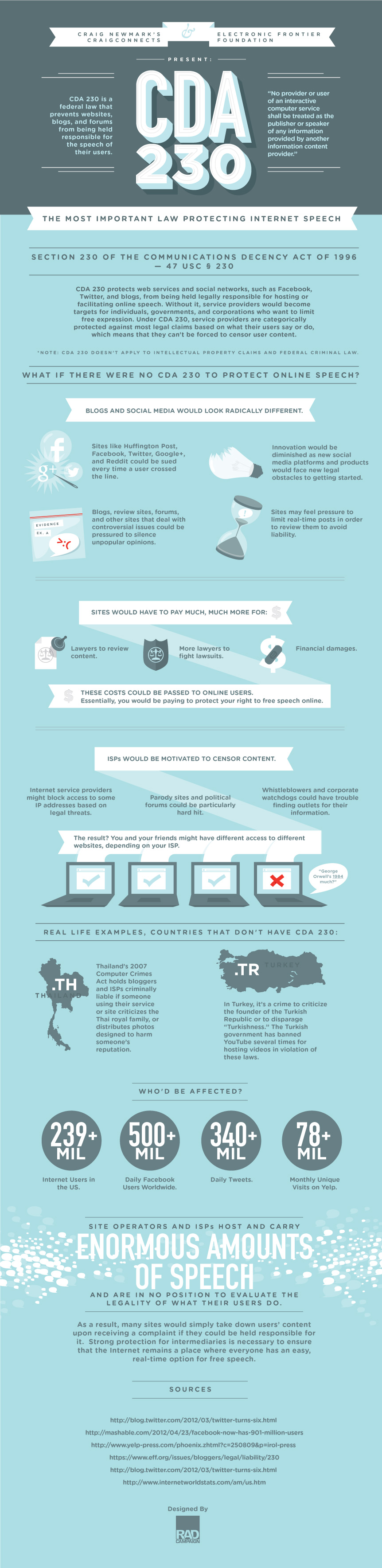
Section 230 says that “No provider or user of an interactive computer service shall be treated as the publisher or speaker of any information provided by another information content provider” (47 U.S.C. § 230). In other words, online intermediaries that host or republish speech are protected against a range of laws that might otherwise be used to hold them legally responsible for what others say and do. The protected intermediaries include not only regular Internet Service Providers (ISPs), but also a range of “interactive computer service providers,” including basically any online service that publishes third-party content. Though there are important exceptions for certain criminal, intellectual property-based claims, identity theft & impersonation, and defamation, the CDA section 230 creates a broad protection that has allowed innovation and free speech online to flourish.
This legal and policy framework has allowed for YouTube and Vimeo users to upload their own videos, Amazon and Yelp to offer countless user reviews, craigslist to host classified ads, and Facebook and Twitter to offer social networking to more than a billion Internet users.
Given the sheer size of user-generated websites (for example, Facebook alone has more than 1 billion users, and YouTube users upload more than 100 hours of video every minute), it would be infeasible for online intermediaries to prevent objectionable content from cropping up on their site.
Rather than face potential liability for their users’ actions, most would likely not host any user content at all or would need to protect themselves by being actively engaged in censoring what we say, what we see, and what we do online. In short, CDA 230 is perhaps the most influential law to protect the kind of innovation that has allowed the Internet to thrive since 1996.
However, it has a dark side too! (Enter the scammers, the haters, the defamers, fake news, and the terrorists!) Because these people use this loophole to exploit what and who they want.
The good news is that there are laws against that behavior too.
- Haters and defamers can be sued and stripped of their money and assets.
- Terrorists and criminals can be discovered and in many cases arrested in the more developed countries.
But scammers have flourished even though arrested continue to rise year after year.
Why? Because the flip side of the law (specifically section 230) is that websites and social media companies act like the three monkeys: See No Evil, Hear No Evil, Speak No Evil. So if they don’t look, they are not liable.
They have had their lawyers establish Community Standards, Terms, Conditions, and Policies that protect them at all costs, and sometimes even the consumer. However, it means that anything wrong has to be reported. Just one problem in this “live happily ever after” world of legal fiction – the ability of consumers to report and be heard by these websites and social media networks is that the platforms can selectively decide what they hear thanks to section 230.
Facebook especially is massively deficient in the training of their Standards Checking Personnel to the point that they don’t recognize scammers when they see them, and Facebook doesn’t even use basic technology to check the IP addresses of profile creators and editors to match where they say they live. It is for these reasons that the Society has created the SCARS Plan to help Facebook and others understand their weakness and what could even be called culpable negligence, and simple remedies to resolve a significant number of these problems rapidly.
Now that you know why Social Media and websites behave this way, what will you do to help change their minds? We would love to hear your opinions!
Where Do We Go Front Here?
Basically, the CDA needs an overhaul. SCARS has developed a change that addresses the real needs while retaining the value of the CDA. You can see it here!
However, until there is a willing Congress and a concerned public we will see no change!
Remember, that you have a dog in this fight! So act like it matters, because it does!
Section 230 Infographic
- External link 1: TigerDirect Sunset, tigerdirect.com
- External link 2: Section 230 - Wikipedia, en.wikipedia.org
- External link 3: Electronic Frontier Foundation, eff.org
- External link 4: 47 U.S. Code § 230 - Protection for private blocking and screening of offensive material, law.cornell.edu
- External link 5: YouTube, youtube.com
- External link 6: Vimeo - All-in-One Video Platform, vimeo.com
- External link 7: amazon.com
- External link 8: yelp.com
Glossary Search
Table of Contents
To Understand All Scams
Read This
The SCARS Institute Relationship Scams Formula Checklist
This is the Formula that all Relationship Scams Follow
ARTICLE CATEGORIES



In the U.S. & Canada
U.S. & Canada Suicide Lifeline 988

Get Organized Now – FREE
Organize the Records from Your Crime here: The SCARS Institute’s RED BOOK free Online Edition
A Tool to help you collect your information and make it more presentable to the Police, Banks, and for Your Records.
100% safe, private, and confidential. Only you see it.
 SCARS Institute Insight
Free, Safe, and Confidential After-Scam Healing & Support is Available from the SCARS Institute
Join Us www.SCARScommunity.org
Please Leave A Comment!
Please tell us what you took from this?
Commenting is an essential part of healing
Read • Think • Write
Thank you for your comment. You may receive an email to follow up. We never share your data with marketers.
Recent Comments
On Other Articles
- Janina on Adult Sextortion Scam Simulator – v2: “As a victim of a romance scam, I wasn’t asked to send any intimate photos during my fake relationship, but…” Oct 24, 08:19
- Barbara on The New AI/SI Chat Bot Romance Scams – Companies Are Draining Victims This Time – 2026: “I’m shaking my head in disbelief (almost), but after my own exploitation I can at least understand the business model…” Oct 23, 22:10
- Cynthia Frank on A New Analysis of Romance Scam Scripts and Flows – 2026: “After reading this I’m wondering if my second scam could have been a Recovery Scam? But they didn’t seem to…” Oct 22, 12:07
- SCARS Institute Editorial Team on Is It A Scam? Teen Sextortion Scam Diagnostic – For Parents – v2: “Thank you Moira” Oct 20, 00:13
- Moira on Is It A Scam? Teen Sextortion Scam Diagnostic – For Parents – v2: “This is an exceptional good service and i hope that we can use it along side some of things that…” Oct 19, 12:27
- Barbara on SCARS Institute – Romance Scam Simulator: “Fantastic! I have to go to bed, but I’ll do some more tomorrow. I picked an easy scenario tonight, but…” Oct 9, 18:01
- SCARS Institute Editorial Team on United States – Federal Bureau of Investigations [FBI]: “It is only that way because of the shame you feel. The reality is that it was not your fault.…” Sep 30, 15:36
- thalia calleon on United States – Federal Bureau of Investigations [FBI]: “yhisis humiliating experience e and isembarassassing to to own up to peolealreadyassume u are not to bright because Arnold and…” Sep 30, 12:28
- thalia calleon on United States – Federal Bureau of Investigations [FBI]: “should be better known by public live in assisiwdlivi g apartment many manyinstancresof Romance scams here ano.us ederly l” Sep 30, 12:24
- Maria on Is It A Scam? Phone Scam Diagnostic – v1: “I tried the this test Is it a phone scam? Mine was. I think this is a helpful tool to…” Sep 30, 10:34
Important Information for New Scam Victims
- Please visit www.ScamVictimsSupport.org – a SCARS Website for New Scam Victims & Sextortion Victims
- Enroll in FREE SCARS Scam Survivor’s School now at www.SCARSeducation.org
- Please visit www.ScamPsychology.org – to more fully understand the psychological concepts involved in scams and scam victim recovery
If you are looking for local trauma counselors please visit counseling.AgainstScams.org or join SCARS for our counseling/therapy benefit: membership.AgainstScams.org
If you need to speak with someone now, you can dial 988 or find phone numbers for crisis hotlines all around the world here: www.opencounseling.com/suicide-hotlines
A Note About Labeling!
We often use the term ‘scam victim’ in our articles, but this is a convenience to help those searching for information in search engines like Google. It is just a convenience and has no deeper meaning. If you have come through such an experience, YOU are a Survivor! It was not your fault. You are not alone! Axios!
A Question of Trust
At the SCARS Institute, we invite you to do your own research on the topics we speak about and publish, Our team investigates the subject being discussed, especially when it comes to understanding the scam victims-survivors experience. You can do Google searches but in many cases, you will have to wade through scientific papers and studies. However, remember that biases and perspectives matter and influence the outcome. Regardless, we encourage you to explore these topics as thoroughly as you can for your own awareness.
Statement About Victim Blaming
SCARS Institute articles examine different aspects of the scam victim experience, as well as those who may have been secondary victims. This work focuses on understanding victimization through the science of victimology, including common psychological and behavioral responses. The purpose is to help victims and survivors understand why these crimes occurred, reduce shame and self-blame, strengthen recovery programs and victim opportunities, and lower the risk of future victimization.
At times, these discussions may sound uncomfortable, overwhelming, or may be mistaken for blame. They are not. Scam victims are never blamed. Our goal is to explain the mechanisms of deception and the human responses that scammers exploit, and the processes that occur after the scam ends, so victims can better understand what happened to them and why it felt convincing at the time, and what the path looks like going forward.
Articles that address the psychology, neurology, physiology, and other characteristics of scams and the victim experience recognize that all people share cognitive and emotional traits that can be manipulated under the right conditions. These characteristics are not flaws. They are normal human functions that criminals deliberately exploit. Victims typically have little awareness of these mechanisms while a scam is unfolding and a very limited ability to control them. Awareness often comes only after the harm has occurred.
By explaining these processes, these articles help victims make sense of their experiences, understand common post-scam reactions, and identify ways to protect themselves moving forward. This knowledge supports recovery by replacing confusion and self-blame with clarity, context, and self-compassion.
Additional educational material on these topics is available at ScamPsychology.org – ScamsNOW.com and other SCARS Institute websites.
Psychology Disclaimer:
All articles about psychology and the human brain on this website are for information & education only
The information provided in this article is intended for educational and self-help purposes only and should not be construed as a substitute for professional therapy or counseling.
While any self-help techniques outlined herein may be beneficial for scam victims seeking to recover from their experience and move towards recovery, it is important to consult with a qualified mental health professional before initiating any course of action. Each individual’s experience and needs are unique, and what works for one person may not be suitable for another.
Additionally, any approach may not be appropriate for individuals with certain pre-existing mental health conditions or trauma histories. It is advisable to seek guidance from a licensed therapist or counselor who can provide personalized support, guidance, and treatment tailored to your specific needs.
If you are experiencing significant distress or emotional difficulties related to a scam or other traumatic event, please consult your doctor or mental health provider for appropriate care and support.
Also read our SCARS Institute Statement about Professional Care for Scam Victims – click here to go to our ScamsNOW.com website.
If you are in crisis, feeling desperate, or in despair please call 988 or your local crisis hotline.
- External link 1: TigerDirect Sunset, tigerdirect.com
- External link 2: Section 230 - Wikipedia, en.wikipedia.org
- External link 3: Electronic Frontier Foundation, eff.org
- External link 4: 47 U.S. Code § 230 - Protection for private blocking and screening of offensive material, law.cornell.edu
- External link 5: YouTube, youtube.com
- External link 6: Vimeo - All-in-One Video Platform, vimeo.com
- External link 7: amazon.com
- External link 8: yelp.com

Yes all guys with the last name Becerra are scammers
People should be aware of the names of scammers,should be posted all over Facebook,television,radio so they will be discourage to scam women in all over Canada,the U S.Most of this Scammers are from Nigeria,India,Malaysia,UK and every part of the World its a virus that is affecting the World.Why??????
THEY ARE IF PEOPLE REPORT THEM – SCAMMERS REPORTED ON OUR WEBSITE ARE DISTRIBUTED THROUGH THE SCARS ANTI-SCAM DATA REPORTING NETWORK