


SCARS Institute’s Encyclopedia of Scams™ Published Continuously for 25 Years

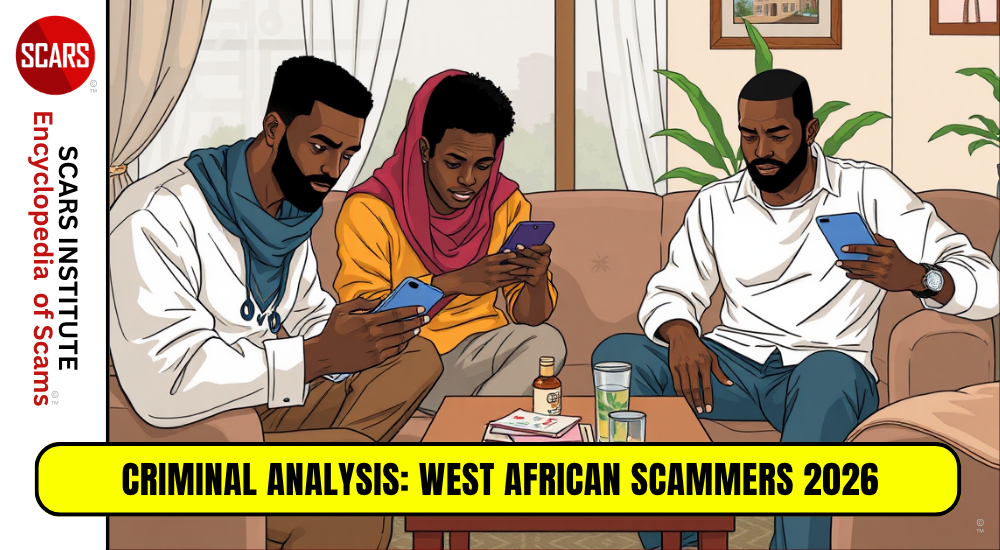
Updated Analysis of West African Scammers
Beyond Poverty and Boredom: Understanding the Motivations of West African Romance Scammers
Criminology – A SCARS Institute Insight
Authors:
• Tim McGuinness, Ph.D., DFin, MCPO, MAnth – Anthropologist, Scientist, Director of the Society of Citizens Against Relationship Scams Inc.
See Author Biographies Below
Article Abstract
Research, field observations, and criminological analysis increasingly indicate that many West African romance scammers cannot be understood solely through poverty, unemployment, or boredom. Significant numbers appear to possess education, technological competence, communication skills, and the ability to conduct sophisticated long-term deception campaigns. Opportunity, social status competition, criminal peer networks, and moral rationalization often play important roles in sustaining participation. Many offenders operate within organized structures that resemble criminal enterprises, using specialization, training, shared resources, and coordinated operational methods to maximize efficiency and profits. The evidence suggests that romance fraud is frequently supported by social, cultural, and organizational factors that extend far beyond individual economic hardship. Effective responses require coordinated efforts involving governments, universities, law enforcement agencies, communities, and financial institutions to address both the causes and the infrastructure that support large-scale online fraud.
Keywords
Romance Scams, Ghana, Nigeria, West Africa, Cybercrime, Organized Crime, West Africa, Yahoo Boys, Sakawa, Criminal Motivation, Fraud Psychology, Cyber Ethics, Victim Recovery

Beyond Poverty and Boredom: Understanding the Motivations of West African Romance Scammers
Author’s Note
The following is an analysis and update based on the SCARS Institute’s work on the ground in West Africa over the last few years. We have been involved in working with institutions in both Ghana and Nigeria. In Ghana, we have influenced the directions of new scammer recruitment and have seen a significant reduction in new scammers entering criminality. Unfortunately, Nigeria is the opposite; the political climate is not responsive to change.
Driven By Poverty: Not!
One of the most persistent myths about online romance scammers is that they are primarily driven by poverty, desperation, or simple boredom. This belief is comforting because it offers a straightforward explanation for a complex criminal phenomenon. If scammers are merely poor, desperate individuals seeking survival, then their behavior can be understood through economic hardship alone. If they are simply bored young people looking for excitement, then the crime appears less organized and less intentional.
Unfortunately, the latest evidence increasingly suggests a far more complicated reality.
Research conducted by the SCARS Institute in Ghana, along with emerging academic studies and law enforcement assessments, paints a different picture. Many individuals involved in online fraud are neither uneducated nor technologically unsophisticated. A significant percentage appear to be university students or graduates. Many possess strong communication skills, technological competence, psychological awareness, and the patience necessary to conduct long-term deception campaigns against victims around the world.
This distinction matters because understanding criminal motivation is essential to understanding the crime itself. Understanding the crime not only helps law enforcement be more effective, but it can also help to bring a degree of acceptance to these criminals’ victims.
The Myth of the Desperate Scammer
For many years, public discussions of online fraud focused heavily on economic explanations. The assumption was simple: poverty creates desperation, desperation creates crime. This narrative became particularly common when discussing cybercriminals operating from parts of West Africa, where economic hardship, unemployment, and income inequality are visible and well documented.
There is certainly some truth within this framework. Economic hardship can increase vulnerability to criminal recruitment. Limited employment opportunities can make illegal income appear attractive. Financial insecurity can influence decision-making and increase willingness to take risks.
However, the poverty explanation becomes increasingly inadequate when examined against the reality of modern romance fraud.
The stereotype of the desperate scammer suggests an individual acting out of immediate necessity. It implies impulsive behavior driven by survival. Yet many romance scams involve extraordinary levels of patience, planning, and discipline. Criminals may spend months cultivating trust, maintaining detailed narratives, tracking victim information, adapting to changing circumstances, and coordinating complex financial transactions. These are not typically characteristics associated with impulsive survival behavior.
The scale of many fraud operations raises additional questions. Romance scams generate billions of dollars in global losses each year. Entire criminal ecosystems have emerged around victim acquisition, identity theft, financial movement, money laundering, technical support, and operational security. Such structures are difficult to explain solely through individual desperation.
Field observations conducted by the SCARS Institute in Ghana further challenge the stereotype. Many offenders encountered through research and outreach efforts do not fit the popular image of uneducated individuals with no alternatives. Many demonstrate substantial communication skills, technological competence, and social sophistication. Some possess university-level education and professional capabilities that could be applied in legitimate occupations.
This does not mean poverty is irrelevant. Economic conditions can create environments where criminal opportunities become more attractive. However, poverty alone cannot adequately explain the persistence, sophistication, organization, and growth of modern romance fraud.
The evidence increasingly suggests that economic hardship may be one contributing factor among many, but it is rarely a complete explanation. To understand why individuals enter and remain in online fraud, it is necessary to look beyond simple economic survival and examine the broader social, psychological, and cultural forces that shape criminal decision-making.
Education and Criminal Capability
The SCARS Institute’s observations that many scammers are university students or graduates challenge another common stereotype. So education does not automatically create ethical behavior. It creates capability. The same skills that support academic success can also support criminal success when applied toward unethical goals.
Effective romance scammers often demonstrate:
- Strong written communication skills
- Emotional intelligence
- Research abilities
- Technical competence
- Social adaptability
- Long-term planning
- Cultural awareness
- Strategic thinking
These are not characteristics typically associated with criminal incompetence. In many cases, the offender’s education becomes an asset that increases criminal effectiveness.
This realization can be unsettling for victims. Many survivors struggle to understand how someone who appeared intelligent, articulate, and sophisticated could engage in such harmful behavior. The answer may be that intelligence and morality are not the same thing. Education can enhance ethical decision-making, but it can also enhance deception when ethical constraints are absent.
The Role of Opportunity
Criminologists have long distinguished between motivation and opportunity. Many people experience financial pressure. Many people experience frustration, disappointment, social inequality, or limited economic prospects. Many people experience boredom, ambition, envy, or resentment. Yet the overwhelming majority do not become criminals.
What often separates offenders from non-offenders is not motivation alone, but the presence of opportunity.
This principle forms the foundation of several modern criminological theories. Opportunity-based theories suggest that crime becomes more likely when a motivated offender encounters an attractive target in an environment where the perceived risk of detection or punishment is low. Motivation may create the desire to commit a crime, but opportunity creates the practical pathway through which that desire can be acted upon.
The Rise of the Internet Fundamentally Transformed the Opportunity Landscape for Fraud
Before the digital age, fraudsters were constrained by geography, communication costs, and limited access to potential victims. Criminals generally operated within local or regional environments where reputation, social connections, and law enforcement oversight created meaningful barriers to large-scale deception.
The Internet Removed Many of Those Barriers
Today, a single scammer can contact hundreds or thousands of potential victims across multiple countries without leaving their home. Social media platforms, dating websites, messaging applications, and professional networking services provide direct access to individuals who would have been completely unreachable only a generation ago. Geographic distance no longer protects potential victims from contact.
The digital environment also provides an unusual combination of anonymity and accessibility. Criminals can hide behind false identities, stolen photographs, fabricated biographies, virtual phone numbers, encrypted communications, and anonymous financial channels. Victims often know almost nothing about the true identity of the person they are communicating with, while scammers can gather extensive information about their targets through social media, public records, and online research.
This Imbalance Creates a Powerful Advantage for the Offender
Technology has also made fraud highly scalable. A traditional con artist could only manage a limited number of victims at one time. Modern scammers use templates, scripts, translation tools, artificial intelligence, customer relationship management techniques, and organized team structures to interact with dozens or even hundreds of victims simultaneously. The same emotional manipulation strategies can be repeated over and over with different targets, increasing efficiency and reducing effort.
Equally Important is the Issue of Perceived Risk
Many online offenders operate under the belief that the chances of arrest, prosecution, or meaningful punishment are relatively low. International jurisdictional boundaries complicate investigations. Victims often reside in different countries from the offenders. Financial transactions may pass through multiple intermediaries. Stolen identities obscure the true perpetrators. Law enforcement agencies frequently face limited resources when investigating crimes that cross national borders.
From the Offender’S Perspective, the Equation Can Appear Highly Favorable
Potential rewards may include substantial financial gains, social recognition within criminal networks, access to luxury lifestyles, and opportunities for advancement within organized fraud structures. At the same time, the perceived likelihood of serious consequences may appear distant or unlikely.
Under these conditions, the question is often not whether an individual is desperate enough to commit fraud. The question becomes whether the opportunity is simply too attractive to ignore.
This perspective also helps explain why many scammers continue offending long after their immediate financial needs have been satisfied. If crime were driven solely by survival, participation would be expected to decline once basic economic goals were achieved. Instead, many offenders expand their operations, recruit others, diversify into additional forms of fraud, and pursue increasingly ambitious criminal activities.
The Opportunity Itself Becomes Valuable
Access to victims, access to criminal networks, access to proven techniques, and access to reliable financial channels can all become assets worth protecting and expanding. What may begin as an opportunistic activity can evolve into a career, a business model, or participation in a larger criminal enterprise.
Understanding the role of opportunity is important because it shifts attention away from simplistic explanations based solely on poverty or personal hardship. Opportunity does not eliminate personal responsibility, but it helps explain why some individuals choose criminal pathways while others facing similar circumstances do not. The modern internet has created an environment in which opportunities for fraud are abundant, scalable, profitable, and often perceived as low risk. For many offenders, those opportunities become far more influential than desperation itself.
Status, Prestige, and Social Competition
Money Alone Does Not Explain the Appeal of Online Fraud
Research involving Nigerian Yahoo Boys, Ghanaian Sakawa operators, and other cybercrime subcultures consistently reveals the importance of status, prestige, recognition, and social visibility. While financial gain remains an important objective, money often functions less as an end goal and more as a means of achieving social standing. Wealth becomes valuable not simply because it provides security or comfort, but because it communicates success to others.
In many cases, the visible display of wealth is more important than the wealth itself.
Expensive clothing, luxury vehicles, designer accessories, exclusive nightlife, romantic attention, social influence, and public visibility become symbols of achievement. These symbols communicate success to peers, family members, romantic partners, and local communities. The ability to display wealth publicly often carries greater social value than quietly accumulating financial resources.
The scammer is not simply seeking income.
The Scammer is Seeking Status
This distinction is important because status competition exerts a powerful psychological influence over human behavior. Across cultures, individuals naturally compare themselves to others. Success is rarely evaluated in absolute terms. Instead, people measure their position relative to peers, social groups, community expectations, and cultural definitions of achievement.
A young university student may not compare their circumstances to someone living in extreme poverty. Instead, they may compare themselves to successful entrepreneurs, musicians, athletes, celebrities, politicians, social media influencers, or affluent peers who appear to enjoy lifestyles that seem desirable and attainable. Modern technology has intensified these comparisons. Social media platforms expose individuals to carefully curated images of wealth, luxury, success, and influence on a daily basis.
The resulting gap between aspiration and reality can become a powerful source of dissatisfaction.
Sociologists often describe this phenomenon as relative deprivation. Relative deprivation occurs when individuals perceive themselves as disadvantaged compared to the lifestyles, opportunities, or social positions they believe they should possess. The issue is not necessarily actual poverty. The issue is the perception that others are achieving levels of success that remain out of reach.
This distinction helps explain why cybercrime participation frequently emerges among individuals who are not among the poorest members of society. A person may possess housing, education, access to technology, and basic economic stability while still feeling unsuccessful when compared to wealthier peers or public figures. The motivation is not survival. The motivation is advancement.
Within many cybercrime subcultures, status is often measured through visible evidence of success. Luxury purchases, expensive electronics, nightlife spending, travel, fashionable clothing, and public displays of wealth can become indicators of personal achievement. Success is not merely experienced privately. It is performed publicly.
This public performance creates a powerful feedback system. Individuals who display signs of financial success may receive admiration, attention, romantic interest, social influence, and elevated standing within their peer groups. Younger participants observe these rewards and may begin to associate fraud not only with money, but also with prestige and social mobility.
Over time, the pursuit of status can become self-reinforcing. The offender is no longer motivated solely by financial gain. The rewards become psychological and social as well. Recognition from peers, admiration from others, and inclusion within perceived successful groups can become powerful incentives for continued participation.
This dynamic also helps explain why some offenders continue engaging in fraud even after achieving substantial financial success. The goal continually shifts. Once one level of status is achieved, a higher level becomes desirable. New comparisons emerge. New aspirations develop. New standards of success appear. The pursuit becomes less about obtaining enough and more about obtaining more than others.
Understanding the role of status and social competition helps illuminate an important aspect of offender motivation that is often overlooked. Many participants in online fraud are not simply responding to economic need. They are responding to social pressures, cultural expectations, and personal aspirations that define success in visible and comparative terms. Money remains important, but its deeper value often lies in what it symbolizes. Within many cybercrime environments, wealth represents recognition, influence, prestige, and the ability to occupy a higher position within the social hierarchy.
The Attraction of the Game
This is where boredom enters the discussion.
Research suggests that boredom may contribute to criminal behavior, but rarely as a primary cause. For many offenders, online fraud provides stimulation, challenge, excitement, and social engagement. Some scammers describe their activities in ways that resemble competitive gaming.
- Targets become challenges.
- Manipulations become strategies.
- Success becomes a score.
- The victim becomes part of a game.
This does not mean the offender scams because of boredom. Rather, the scam itself becomes a source of entertainment.
The criminal receives psychological rewards beyond financial gain.
- There is excitement in maintaining deception.
- There is satisfaction in overcoming resistance.
- There is stimulation in manipulating emotions.
- There is a status associated with successful outcomes.
The crime becomes rewarding on multiple levels. This distinction is critical. Boredom may help attract some individuals toward fraudulent activity, but it does not adequately explain why they remain involved for years or why they become increasingly sophisticated.
The Power of Criminal Communities
Online Fraud Rarely Develops in Isolation
Popular portrayals often depict the scammer as a lone individual sitting behind a computer, independently creating fake identities and targeting victims. While solitary offenders certainly exist, evidence from West Africa and other cybercrime centers increasingly suggests that many fraud participants operate within broader social networks that actively encourage, support, and reinforce criminal behavior.
In many cases, online fraud functions as a learned social activity rather than an individual invention.
New participants are often introduced to fraud through friends, relatives, classmates, neighbors, or existing criminal associates. They observe successful offenders displaying wealth, status, and social influence. They hear stories of financial success. They witness apparent rewards while seeing relatively few visible consequences. What initially appears unusual or unethical gradually begins to appear normal.
This process reflects a well-established criminological principle known as differential association. Individuals learn attitudes, values, techniques, and justifications for criminal behavior through interaction with others who already engage in those activities. Crime, in this sense, becomes a social learning process.
Within many cybercrime communities, experienced offenders serve as informal mentors. New recruits learn how to create believable identities, establish emotional relationships, identify vulnerable targets, maintain long-term deception, avoid detection, and move money through financial networks. Techniques are shared. Scripts are exchanged. Mistakes are discussed. Successful approaches are refined and repeated.
The learning process resembles an apprenticeship more than spontaneous criminal experimentation.
The social environment provides more than technical knowledge. It also provides belonging.
Human beings are deeply influenced by the groups to which they belong. Acceptance by peers, recognition from respected individuals, and participation in a shared community can become powerful motivators. Within criminal networks, success is often rewarded with admiration, influence, and elevated social status. Individuals who generate significant profits may become role models for newer participants. Their achievements become examples to emulate.
Over time, the offender’s primary reference group may shift. Instead of evaluating behavior according to broader social standards, individuals increasingly evaluate themselves according to the norms of the criminal community. Activities that outsiders view as exploitation may be viewed internally as skill, entrepreneurship, resourcefulness, or success.
This Process Creates Powerful Social Reinforcement
Behaviors that might otherwise trigger guilt, hesitation, or self-doubt become normalized through repeated exposure. The offender no longer perceives themselves as acting alone against accepted moral standards. They see themselves as participating in an activity supported by peers, validated by mentors, and rewarded by the surrounding community.
For victims attempting to understand offender behavior, this is an important insight.
Many scammers are not isolated predators operating independently. They often function within criminal cultures that actively support deception, celebrate successful manipulation, and encourage continued participation. The fraud becomes larger than any individual offender. It becomes part of a social system that teaches, rewards, and perpetuates exploitation.
Moral Neutralization and Psychological Justification
Even within Supportive Criminal Communities, Another Problem Remains
Most human beings possess moral standards that discourage harming others. Empathy, guilt, conscience, and social responsibility create internal barriers against exploitation. For long-term fraud participation to occur, offenders must find ways to bypass those barriers.
This Process Is Commonly Described By Criminologists as Moral Neutralization
Moral neutralization does not eliminate an offender’s awareness that harm is occurring. Instead, it allows the offender to reinterpret that harm in ways that reduce guilt and preserve a positive self-image. The individual continues to see themselves as a reasonable or even ethical person while engaging in behavior that causes significant suffering to others.
Research involving fraud offenders consistently reveals recurring patterns of justification.
- Some offenders argue that victims are wealthy and can easily absorb the loss.
- Others claim that victims are greedy, lonely, foolish, or responsible for their own victimization.
- Some portray fraud as compensation for historical injustice, economic inequality, colonial exploitation, or global power imbalances.
- Others adopt the view that everyone is trying to exploit everyone else, making fraud simply another form of competition.
- Still others convince themselves that no real harm occurs because victims eventually recover financially or emotionally.
The specific explanation is often less important than the psychological function it serves.
- These narratives reduce empathy.
- They reduce guilt.
- They reduce personal responsibility.
Most importantly, they allow the offender to continue offending without experiencing constant internal conflict.
This process resembles what psychologists sometimes describe as cognitive restructuring. Facts are reinterpreted in ways that support desired behavior. Evidence of suffering is minimized. Victims are dehumanized or transformed into abstract categories. Responsibility is shifted away from the offender and onto circumstances, society, or the victims themselves.
Without these rationalizations, sustained participation in fraud would become significantly more difficult. Every successful scam would require confronting the reality that another human being was manipulated, betrayed, emotionally harmed, and often financially devastated.
The existence of these justifications reveals something important about offender psychology. Most scammers are not unaware that they are causing harm. In many cases, they understand exactly what they are doing.
The challenge is not ignorance
The challenge is that many offenders develop psychological mechanisms that allow them to acknowledge the harm intellectually while disconnecting from it emotionally.
This distinction is critically important because it challenges one of the most common misconceptions held by scam victims. Many victims spend months or even years trying to answer a painful question: “Did they know what they were doing to me?” The question often arises because the relationship felt personal. The conversations felt intimate. The emotional connection felt genuine. Victims naturally struggle to reconcile those experiences with the realization that they were being manipulated for financial gain.
The evidence increasingly suggests that many offenders do understand the consequences of their actions.
- They understand that victims become emotionally attached.
- They understand that victims invest trust.
- They understand that victims may lose savings, retirement funds, homes, relationships, and emotional stability.
- They understand that some victims experience depression, trauma, anxiety, shame, and profound grief after the fraud is exposed.
Many offenders have witnessed these reactions directly. Some have heard victims cry. Some have received desperate messages from victims after the scam collapses. Some have watched victims plead for honesty, compassion, or mercy. The emotional consequences are often visible and unmistakable.
Yet awareness alone does not necessarily produce empathy. Human beings possess a remarkable ability to compartmentalize information when that information conflicts with their goals, interests, or self-image. An offender can simultaneously understand that a victim is suffering while convincing themselves that the suffering is not their responsibility, is somehow deserved, or is less significant than the benefits they receive from continuing the deception.
Psychologists sometimes describe this process as moral disengagement. The individual does not deny that harm exists. Instead, the individual mentally restructures the situation in ways that make the harm easier to tolerate. The victim becomes an abstraction rather than a person. The loss becomes a number rather than a life-changing event. The relationship becomes a transaction rather than an emotional bond.
Over time, repeated exposure can further reduce emotional responsiveness. The first deception may create discomfort. The tenth may create less. The hundredth may create almost none. What once felt morally troubling gradually becomes routine. The victim’s pain becomes background noise within a system focused on financial gain, social status, peer approval, or organizational success.
This process is strengthened when offenders operate within groups that reinforce these beliefs. When peers repeat the same justifications, celebrate successful scams, and minimize victim suffering, the individual’s moral concerns become easier to suppress. The offender receives continual social confirmation that the behavior is acceptable, normal, or even admirable.
For victims, this reality can be difficult to accept because it undermines the hope that somewhere beneath the deception there was genuine concern, hidden remorse, or emotional conflict. While some offenders undoubtedly experience guilt or ambivalence, the evidence suggests that many learn to separate their awareness of victim suffering from their emotional response to it.
- The result is not ignorance.
- The result is selective disengagement.
- The offender sees the harm but chooses not to experience it fully.
- The offender recognizes the consequences but constructs explanations that make those consequences seem acceptable, necessary, justified, or unimportant.
These rationalizations do not excuse the behavior. They simply help explain how otherwise ordinary individuals can continue participating in deception over long periods while preserving a sense of personal legitimacy. Understanding this distinction can help victims better understand the nature of the crime. The deception persisted not because the offender failed to recognize the damage being done, but because the offender developed psychological tools that allowed that damage to be acknowledged without becoming morally prohibitive.
What This Means for Scam Victims
Understanding offender motivation does not excuse offender behavior. However, it can help victims understand the nature of the crime more accurately, and that understanding can become an important part of recovery.
Many victims spend months, years, or even decades trying to understand the person behind the deception. They search for explanations that might make the experience feel more understandable and less painful. Common questions often include:
- “Did they really need the money?”
- “Were they desperate?”
- “Were they forced into it?”
- “Did they ever care about me?”
- “Was there any genuine emotion involved?”
- “Did they feel guilty about what they were doing?”
These questions are understandable because victims experienced what appeared to be a genuine relationship. The conversations felt authentic. The emotional connection felt personal. The attachment felt real. After the fraud is exposed, many victims struggle to reconcile those experiences with the reality that the relationship was built upon deception. The mind naturally seeks explanations that might preserve some element of the connection that seemed so meaningful.
The evidence examined throughout this discussion suggests that many victims and offenders entered the interaction with fundamentally different objectives. Victims were often seeking companionship, affection, understanding, intimacy, validation, or love. Offenders, by contrast, were frequently pursuing financial gain, social status, personal advancement, excitement, recognition within criminal networks, or access to profitable opportunities. While both parties participated in the same conversations, they were often participating in entirely different experiences. One person was building a relationship. The other was conducting an operation.
This distinction is important because it helps explain why many victims struggle to understand offender behavior. Victims frequently evaluate the scammer’s actions through the lens of their own values, emotions, and expectations. They assume that the offender experienced similar feelings or faced similar moral conflicts. However, the research increasingly suggests that many offenders operate within environments that normalize deception, reward manipulation, provide social reinforcement, and encourage the continued exploitation of victims. The emotional framework that guided the victim’s decisions often differs dramatically from the framework guiding the offender.
This does not mean that all scammers share identical motivations. Criminal populations are diverse. Some offenders may be influenced primarily by financial hardship. Others may be motivated by status, opportunity, peer influence, social competition, excitement, personal ambition, or a combination of factors. However, the emerging evidence consistently challenges the belief that most offenders are simply desperate individuals acting out of necessity. In many cases, the offender appears to be an active participant in a criminal culture that views fraud as a legitimate pathway toward financial and social success.
For many victims, accepting this reality can be emotionally difficult. The belief that the offender was trapped by circumstances, driven by desperation, or forced into criminal behavior can sometimes preserve the hope that a fundamentally good person existed beneath the deception. It can also support the belief that some portion of the relationship was genuine. Unfortunately, the evidence often points toward a more deliberate and calculated reality. The deception was frequently supported by planning, training, social reinforcement, and psychological strategies specifically designed to exploit trust and emotional attachment.
This understanding can play an important role in recovery because it helps shift attention away from the imagined personality of the scammer and toward the reality of the crime. Many victims become trapped in endless attempts to understand what the offender felt, whether the offender experienced guilt, or whether any genuine emotions existed behind the deception. While these questions are understandable, they are often impossible to answer with certainty.
The more productive focus is not on who the offender claimed to be, but on what the offender actually did. The offender created a false identity, established trust through deception, cultivated emotional dependence, manipulated the victim’s perceptions, and ultimately sought financial or personal gain through fraudulent means. Those actions remain unchanged regardless of the offender’s personal history, education, background, motivations, or circumstances.
Understanding this reality does not eliminate grief, restore financial losses, or erase the experience of betrayal. What it can do is help victims view the crime more clearly. The relationship was not destroyed by unfortunate circumstances. It was built upon deception from the beginning. The victim was not participating in a troubled romance that failed. The victim was interacting with a criminal operation designed to exploit trust for profit. For many survivors, accepting that distinction becomes an important step in separating the fantasy created by the scam from the reality that recovery requires.
The Emerging Reality
The emerging picture from Ghana, Nigeria, and other cybercrime centers is becoming increasingly difficult to ignore. For many years, public discussions about romance scammers have relied upon simple explanations that focused almost exclusively on poverty, unemployment, or boredom. While these factors can contribute to criminal participation, the evidence increasingly suggests that they do not adequately explain the scale, sophistication, persistence, and growth of modern romance fraud.
Throughout this discussion, several important patterns have emerged. Research findings, field observations, criminological theory, and law enforcement investigations consistently point toward a more complex reality. Modern romance scammers often possess characteristics that differ substantially from the popular stereotype of the desperate criminal acting out of necessity.
Offenders appear to demonstrate:
- Educational attainment beyond basic schooling.
- Strong communication and interpersonal skills.
- Technological competence and digital literacy.
- Access to criminal peer networks and support systems.
- Exposure to social environments that reward visible success.
- The ability to rationalize harmful behavior while maintaining a positive self-image.
- Long-term planning, patience, and strategic thinking.
These characteristics do not describe every offender. Criminal populations remain diverse, and individual motivations vary considerably. However, they do suggest that many romance scammers are not simply reacting to immediate economic hardship. Instead, they often appear to be making calculated decisions within environments that provide opportunity, social reinforcement, financial rewards, and psychological justification for continued participation.
The evidence also suggests that romance fraud is rarely sustained by a single factor. Poverty alone does not explain it. Boredom alone does not explain it. Unemployment alone does not explain it. Rather, these crimes frequently emerge from the interaction of multiple influences operating simultaneously. Opportunity creates access to victims. Status competition creates motivation. Criminal communities provide training and reinforcement. Moral rationalizations reduce guilt. Organized networks increase efficiency and profitability. Together, these factors create an environment in which fraud can become normalized, rewarded, and sustained over long periods.
For victims, this understanding can provide an important form of clarity. Many survivors struggle to reconcile the sophistication of the deception with the common image of the scammer as a desperate individual trapped by circumstances. The reality revealed by increasing evidence is often more troubling. In many cases, the offender appears to be an active participant in a criminal culture that encourages exploitation, rewards manipulation, and treats human trust as a resource to be converted into profit.
This distinction does not reduce the pain of betrayal, nor does it lessen the emotional damage caused by the crime. However, it can help explain why the deception was often so persistent, so organized, and so resistant to appeals for honesty, empathy, or compassion. The offender was frequently operating within a framework that viewed manipulation not as a moral failure, but as a practical strategy for achieving desired outcomes.
Perhaps most importantly, this understanding helps shift attention away from simplistic explanations that can prevent victims from fully understanding what happened. The crime was not necessarily the product of desperation. In many cases, it was the product of choice. The offender may have faced economic challenges, social pressures, or personal frustrations, but those circumstances alone do not explain the deliberate decisions required to maintain months or years of deception.
The more accurately victims understand the motivations, influences, and environments that support romance fraud, the better equipped they become to understand the true nature of the individuals and organizations responsible for these crimes. A clear understanding cannot undo the harm that was done, but it can help replace confusion with insight, fantasy with reality, and unanswered questions with a more accurate understanding of how modern romance fraud actually operates.
The Organized Crime Structure Behind Modern Romance Scams
One of the most persistent misconceptions held by romance scam victims is the belief that they were communicating with a single individual acting alone. This belief is understandable because the entire purpose of the scam is to create the illusion of a personal relationship. The victim encounters a single profile, a single identity, a single photograph, and a single life story. Conversations often become deeply personal and emotionally intimate. Over time, the interaction appears to involve one person developing one relationship with one victim.
Increasingly, evidence from law enforcement investigations, cybercrime researchers, victim reports, and field observations suggests that this perception is often inaccurate. While some romance scams are conducted by individual offenders, many modern operations are organized and collaborative. The person communicating with the victim may represent not one individual, but a team of people performing different functions within a larger criminal enterprise.
The structure of these operations varies considerably, but many exhibit a degree of specialization that resembles legitimate business organizations. Different individuals may be responsible for different stages of the fraud process. Some focus on identifying and contacting potential victims. Others specialize in maintaining conversations and building emotional relationships. More experienced operators may handle financial requests, crisis scenarios, and victim management once emotional attachment has been established. Technical specialists may provide support related to fake identities, stolen photographs, account creation, communication platforms, and financial transactions.
As a result, the victim experiences what appears to be a continuous relationship with one person, while the organization may involve multiple participants working behind the scenes. Responsibility for the victim can be transferred between operators without the victim’s knowledge. One team member may conduct conversations during one shift while another continues the same relationship later. Information about the victim, including personal details, emotional vulnerabilities, financial circumstances, and relationship history, may be recorded and shared among multiple participants.
This organizational approach provides significant advantages for criminal groups. It allows fraud operations to scale far beyond what a single individual could manage independently. A coordinated team can maintain dozens or even hundreds of active victims simultaneously. Training materials, scripts, emotional manipulation techniques, fabricated biographies, stolen identity packages, and financial procedures can be standardized and distributed throughout the organization. The operation becomes less dependent upon individual talent and more dependent upon repeatable systems and processes.
Many fraud networks operating in West Africa appear to function within informal but recognizable hierarchies. Experienced offenders often mentor newer recruits, teaching communication techniques, emotional manipulation strategies, victim selection methods, and operational security practices. Individuals who consistently generate significant profits may acquire influence, status, and authority within the group. Knowledge, techniques, and resources flow throughout the organization, allowing successful methods to be replicated and refined.
In some cases, these structures begin to resemble small criminal enterprises or pyramid-style organizations. At lower levels are newer participants learning basic fraud techniques. Above them are experienced operators managing multiple victims and overseeing active scams. Higher levels may coordinate recruitment, training, identity theft resources, financial movement, technical infrastructure, and relationships with other criminal networks. Individuals at the top may profit not only from their own activities but also from the activities of those operating beneath them.
This organizational structure helps explain why victims around the world frequently report remarkably similar experiences. Similar opening messages, similar emotional narratives, similar crisis scenarios, similar requests for financial assistance, and similar relationship patterns often appear across thousands of cases. These similarities are rarely coincidental. They frequently reflect shared training, shared scripts, shared operational practices, and the transfer of successful techniques throughout criminal networks.
The organized nature of these operations also helps explain the extraordinary persistence often reported by victims. When one operator becomes unavailable, another may simply assume responsibility for the relationship. The victim continues communicating with what appears to be the same person, while the organization continues pursuing the same objective. The continuity of the identity masks the reality that multiple individuals may be participating in the deception.
For many victims, accepting this reality can be emotionally challenging because it fundamentally changes how the relationship is understood. The mind naturally attempts to organize the experience around a single individual. The emotional attachment was directed toward one personality, one identity, and one imagined relationship. Learning that multiple people may have participated in creating and maintaining that illusion often introduces an additional layer of grief, shock, and betrayal.
However, understanding the organizational structure behind many romance scams can also provide important clarity. The victim was not necessarily interacting with a troubled individual making a series of poor decisions. In many cases, the victim was interacting with a coordinated criminal operation specifically designed to identify vulnerabilities, establish emotional dependence, maintain psychological control, and extract financial resources. The deception was supported by systems, training, shared knowledge, and organizational objectives that extended far beyond any single participant.
This distinction is important because it shifts attention away from the imagined personality of the scammer and toward the reality of the criminal enterprise. The central question becomes less about why one individual chose to behave in a particular way and more about how an organized system used multiple people, multiple techniques, and multiple layers of deception to exploit trust for profit. Understanding that reality often helps victims see the crime more clearly and reduces the tendency to interpret the offender’s actions as personal expressions of affection, conflict, or emotional attachment.
The evidence increasingly suggests that many modern romance scams are not failed relationships that evolved into financial exploitation. They are organized criminal operations that use the appearance of a relationship as a tool of deception. The emotional connection serves the objectives of the enterprise, and the enterprise exists to generate profit.
Recommendations for Governments, Universities, and Regional Institutions
If online fraud is driven by a combination of opportunity, social reinforcement, status competition, criminal subcultures, organizational support, and moral rationalization, then effective interventions must address each of these factors simultaneously. Efforts that focus exclusively on poverty reduction or law enforcement are unlikely to produce lasting results because they address only part of a much larger problem.
Governments, universities, educational institutions, community organizations, and private-sector partners all have important roles to play in reducing the social and economic conditions that allow cybercrime to flourish.
Strengthen Enforcement and Increase Consequences
One of the most important findings in criminology is that perceived risk influences criminal decision-making. When offenders believe the likelihood of arrest, prosecution, or meaningful punishment is low, criminal activity becomes more attractive. Increasing the certainty of enforcement can therefore have a greater deterrent effect than simply increasing penalties.
Governments should invest in specialized cybercrime units, digital forensic capabilities, financial intelligence resources, and international investigative partnerships. Because romance scams frequently cross national borders, cooperation between countries is essential. Information sharing, joint investigations, asset tracing, and coordinated enforcement efforts can significantly increase the perceived risks associated with online fraud.
Publicizing successful investigations and prosecutions can also serve an important deterrent function. Many offenders operate under the belief that cybercrime is a low-risk activity. Visible enforcement helps challenge that perception.
Address the Social Status of Cybercriminals
In some communities, successful scammers have acquired a degree of social prestige. Wealth generated through fraud may be publicly displayed through luxury vehicles, expensive clothing, nightlife spending, real estate purchases, and social media content. Younger individuals observing these displays may conclude that cybercrime represents a legitimate pathway to social mobility.
Governments and community leaders should actively challenge the normalization and glorification of cybercriminal success. Public education campaigns can highlight the human consequences of fraud, expose the realities of criminal organizations, and reduce the perception that scammers are successful entrepreneurs or role models.
Communities must work to ensure that legitimate achievement receives greater recognition than criminal success. When honest accomplishment becomes more socially valued than fraudulent wealth, recruitment into cybercrime becomes less attractive.
Create University-Based Cyber Ethics Programs
Research and field observations increasingly suggest that a significant number of participants in online fraud possess higher levels of education than commonly assumed. This reality creates an opportunity for universities to become part of the solution.
Universities should incorporate cyber ethics, digital responsibility, online fraud awareness, and cybercrime prevention into relevant academic programs. Students studying technology, business, communications, marketing, finance, and computer science should understand both the technical and human consequences of online fraud.
Educational institutions should also create clear disciplinary frameworks addressing participation in cybercrime activities. Students must understand that involvement in fraud networks threatens not only potential victims but also their own professional futures, reputations, and employment opportunities.
Expand Legitimate Technology and Entrepreneurship Opportunities
Many individuals involved in cybercrime possess skills that could be applied successfully within legitimate industries. Communication skills, digital marketing capabilities, social engineering knowledge, technology literacy, and entrepreneurial initiative can all have lawful applications.
Governments, universities, and private-sector organizations should expand programs that connect talented young adults with legitimate opportunities in technology, software development, cybersecurity, digital marketing, financial services, and entrepreneurship. The goal is not simply to provide employment but to create attractive alternatives that offer both economic opportunity and social recognition.
Reducing the appeal of cybercrime often requires increasing the attractiveness of legitimate success.
Disrupt Criminal Recruitment Networks
Many cybercriminals are introduced to fraud through existing social connections. Friends, classmates, relatives, neighbors, and criminal mentors frequently play significant roles in recruitment and training. This means that intervention efforts should focus not only on individuals but also on the networks that facilitate entry into criminal activity.
Community organizations, schools, universities, and law enforcement agencies should develop programs designed to identify recruitment pathways and interrupt the transmission of criminal techniques. Former offenders who have successfully exited cybercrime may also provide valuable perspectives regarding recruitment tactics and the realities of long-term participation.
Reduce Moral Neutralization Through Public Awareness
Many offenders justify their activities through narratives that minimize victim harm or transfer responsibility away from themselves. These rationalizations become easier to maintain when victims remain invisible.
Public education initiatives should emphasize the real-world consequences of online fraud. Victims are not abstract financial targets. They are individuals who frequently experience emotional trauma, financial devastation, damaged relationships, psychological distress, and long-term recovery challenges.
Increasing awareness of victim experiences may help weaken some of the moral justifications that allow offenders to continue participating in fraud while maintaining a positive self-image.
Strengthen Financial Monitoring and Disruption
Romance scams depend upon the ability to move money efficiently through financial systems. Financial institutions, payment processors, cryptocurrency platforms, and regulatory agencies can play important roles in disrupting criminal operations.
Enhanced transaction monitoring, suspicious activity reporting, anti-money laundering controls, mule-account detection, and cross-border financial cooperation can make it more difficult for fraud organizations to access and retain criminal proceeds. Increasing operational friction raises costs and reduces profitability for organized fraud networks.
Promote a Long-Term Cultural Response
Perhaps the most important lesson from the available evidence is that online fraud is not solely a law enforcement problem. It is also a social, educational, economic, and cultural challenge.
Long-term reductions in cybercrime are unlikely to result from arrests alone. Sustainable progress will require changes in social norms, educational priorities, community expectations, and public attitudes toward criminal success. When communities reject the normalization of fraud, when educational institutions reinforce ethical responsibility, when governments increase accountability, and when legitimate pathways to achievement become more attractive than criminal alternatives, the foundations that support large-scale cybercrime begin to weaken.
The challenge is substantial, but the same social forces that contribute to the growth of cybercrime can also be mobilized to reduce it. Effective intervention requires a coordinated effort that addresses not only the individual offender but also the environments, institutions, and cultural influences that allow organized fraud to thrive.
Conclusion
The evidence emerging from Ghana, Nigeria, and other cybercrime centers increasingly challenges many of the assumptions that have traditionally shaped public understanding of romance scammers. While poverty, unemployment, and economic hardship remain important social factors, they do not adequately explain the sophistication, persistence, and organizational complexity of modern romance fraud. The reality appears far more complicated and far more troubling.
Many offenders possess education, technological competence, strong communication skills, and the ability to sustain highly sophisticated deception campaigns over extended periods. Their participation is often reinforced by criminal peer networks, social status competition, perceived opportunities for advancement, and psychological mechanisms that minimize feelings of guilt or responsibility. In many environments, cybercrime has evolved beyond isolated criminal behavior and become embedded within subcultures that reward deception, celebrate financial success, and normalize the exploitation of victims.
The growth of organized fraud networks further illustrates the scale of the challenge. What many victims perceive as a relationship with a single individual may actually involve multiple participants operating within coordinated criminal enterprises. Training, recruitment, operational specialization, shared scripts, and financial infrastructures allow these organizations to function with a degree of efficiency that resembles legitimate businesses. The emotional manipulation experienced by victims is frequently the product of systems and processes designed specifically to generate trust and convert that trust into profit.
Understanding these realities is important for governments, educational institutions, law enforcement agencies, and communities seeking effective solutions. Efforts focused solely on economic conditions or criminal penalties are unlikely to produce lasting results. Sustainable progress requires addressing the social, cultural, educational, and organizational factors that support cybercrime participation. It requires reducing the social prestige associated with criminal wealth, expanding legitimate opportunities for talented young people, disrupting recruitment networks, increasing accountability, and strengthening public understanding of the human consequences of fraud.
For victims, greater understanding provides an opportunity to view the crime more clearly. The deception was often not the result of a desperate individual making a single poor decision. In many cases, it was the product of deliberate choices made within environments that encouraged, rewarded, and sustained exploitation. Recognizing that reality does not lessen the pain of betrayal, but it can replace misconceptions with insight and help reveal the true nature of the individuals, groups, and organizations responsible for these crimes.

Glossary
- Access to Victims — Access to victims refers to the ability of offenders to contact large numbers of potential targets through digital platforms. Online romance fraud expanded because social media, dating sites, messaging apps, and professional networks allow criminals to reach people across borders with little physical risk. This access changes fraud from a local crime into a scalable international operation. — Criminal Exploitation
- Anonymity Advantage — Anonymity advantage refers to the protection criminals gain when they hide behind false identities, stolen photographs, fabricated biographies, and digital communication tools. Romance scammers often know detailed information about victims, while victims know very little about the offenders. This imbalance allows deception to continue while reducing the offender’s perceived risk. — Scam Manipulation
- Attractive Target — An attractive target refers to a person or group that offenders perceive as accessible, emotionally reachable, financially useful, or vulnerable to manipulation. In romance fraud, a target may be selected because of loneliness, trust, grief, social isolation, or visible financial stability. Opportunity-based crime becomes more likely when an offender can reach a target with limited barriers. — Vulnerability Awareness
- Criminal Capability — Criminal capability refers to the skills, knowledge, discipline, and tools that allow offenders to conduct complex fraud successfully. Modern romance scammers often use communication skills, technological competence, emotional awareness, and strategic planning to sustain deception. Capability explains why many offenders are more organized and sophisticated than public stereotypes suggest. — Criminal Exploitation
- Criminal Communities — Criminal communities refer to peer groups, social circles, or informal networks that encourage, teach, normalize, and reward fraud. These communities can provide belonging, status, mentorship, technical knowledge, and emotional validation for offenders. Their influence helps explain why online fraud often becomes a learned social activity rather than an isolated individual choice. — Criminal Exploitation
- Criminal Ecosystem — Criminal ecosystem refers to the broader network of roles, resources, platforms, financial channels, scripts, identities, and social supports that allow romance fraud to continue. It includes victim acquisition, identity theft, money movement, technical support, operational security, and peer reinforcement. This ecosystem makes fraud more durable than a simple one-person deception. — Criminal Exploitation
- Criminal Enterprise — Criminal enterprise refers to an organized fraud operation that uses roles, processes, training, and shared resources to generate profit. Many modern romance scams function less like personal deception and more like coordinated business systems. This structure helps offenders manage multiple victims, standardize techniques, and increase financial returns. — Organized Crime
- Criminal Recruitment — Criminal recruitment refers to the process through which new participants are introduced into online fraud by peers, relatives, classmates, mentors, or criminal associates. Recruitment can occur through social admiration, visible wealth, promises of quick money, and exposure to successful offenders. Interrupting recruitment pathways is essential for reducing future participation in romance fraud. — Criminal Exploitation
- Cyber Ethics Programs — Cyber ethics programs refer to educational initiatives that teach digital responsibility, online harm, fraud prevention, and the human consequences of cybercrime. Universities and institutions can use these programs to address students who possess technical and communication skills that could be misused. Ethical education helps connect digital capability with responsibility, accountability, and lawful opportunity. — Prevention and Education
- Cybercrime Subculture — Cybercrime subculture refers to a social environment where online fraud becomes normalized, admired, or treated as a legitimate pathway to success. Groups such as Yahoo Boys or Sakawa operators can develop their own language, values, prestige systems, and peer expectations. Subculture helps sustain criminal participation by turning exploitation into a socially reinforced identity. — Criminal Exploitation
- Deception Campaign — Deception campaign refers to a sustained effort to manipulate victims through false identities, emotional narratives, crisis stories, and staged relationship development. Romance fraud often requires weeks, months, or years of careful communication and adaptation. This duration shows that the crime is often deliberate, planned, and persistent rather than impulsive. — Scam Manipulation
- Differential Association — Differential association is a criminological concept describing how people learn criminal behavior through interaction with others who already practice it. Offenders can learn techniques, attitudes, justifications, and norms from peers and mentors. This concept helps explain why online fraud can spread through social networks and become normalized among groups. — Criminal Psychology
- Digital Fraud Scalability — Digital fraud scalability refers to the ability to expand fraud operations across many victims, platforms, and countries using technology. Scripts, templates, translation tools, artificial intelligence, fake profiles, and organized teams allow offenders to manage more victims than traditional con artists could. Scalability increases profits and makes romance fraud more efficient. — Criminal Exploitation
- Digital Literacy — Digital literacy refers to the ability to understand, evaluate, and safely navigate online identities, platforms, communication, and verification tools. Offenders often use digital literacy to create convincing deception, while victims may lack the same verification skills. The gap between offender capability and victim awareness increases vulnerability. — Vulnerability Awareness
- Economic Hardship Explanation — Economic hardship explanation refers to the belief that poverty, unemployment, or financial insecurity are the main causes of romance scam participation. Economic hardship can contribute to recruitment, but it does not fully explain long-term deception, organized operations, or sophisticated manipulation. A complete explanation must also include opportunity, status, peer influence, and moral rationalization. — Cognitive Processing
- Educational Attainment — Educational attainment refers to the level of schooling, university exposure, or professional training that some offenders possess. Higher education can create communication skills, technological competence, research ability, and strategic thinking. Education does not automatically produce ethical behavior, and those same capabilities can be used for criminal purposes when moral restraints are absent. — Criminal Psychology
- Emotional Manipulation — Emotional manipulation refers to the deliberate use of affection, sympathy, intimacy, urgency, guilt, hope, or fear to influence a victim’s decisions. Romance scammers often use emotional manipulation to create dependence and weaken critical judgment. The technique is central to relationship-based fraud because the victim’s trust becomes the pathway to exploitation. — Scam Manipulation
- Financial Movement — Financial movement refers to the transfer, laundering, conversion, or routing of stolen money through banks, payment services, cryptocurrency platforms, money mules, or intermediaries. Romance scams depend on moving funds quickly and disguising the true recipients. Disrupting financial movement can weaken fraud networks and reduce profitability. — Financial Exploitation
- Fraud Normalization — Fraud normalization refers to the process by which repeated exposure to criminal behavior makes deception appear ordinary, acceptable, or admired within a group. New offenders may become less troubled by scams when peers celebrate successful manipulation. Normalization reduces hesitation and weakens the social barriers that normally discourage exploitation. — Criminal Psychology
- Ghanaian Sakawa Boys — Ghanaian Sakawa Boys refers to a cybercrime subculture associated with online fraud, status display, and social recognition in Ghana. The term is often linked to fraud participation that combines digital skill, peer influence, and cultural narratives of success. Understanding the subculture helps explain why participation can involve more than poverty or boredom. — Criminal Exploitation
- Human Trust as Resource — Human trust as a resource refers to the criminal use of trust as something to be cultivated, managed, and converted into money or information. Romance scammers do not merely deceive victims through facts, but through attachment, emotional dependence, and perceived intimacy. This framing helps victims understand that their capacity for trust was targeted as part of the crime. — Scam Manipulation
- Identity Theft Resources — Identity theft resources refer to stolen photographs, fake biographies, profile materials, documents, and account assets used to create believable false personas. These resources allow offenders to hide their real identities while presenting a convincing appearance to victims. Shared identity resources support organized fraud and make operations easier to scale. — Criminal Exploitation
- International Jurisdictional Barriers — International jurisdictional barriers refer to the legal and practical difficulties created when victims, offenders, money channels, and platforms exist in different countries. These barriers can slow investigations and reduce the perceived risk of prosecution. Romance scammers often benefit from distance because enforcement becomes more complicated across borders. — Criminal Exploitation
- Long-Term Deception — Long-term deception refers to sustained manipulation that continues over an extended period to build trust, emotional dependence, and financial compliance. Romance scams often require patience, detailed narratives, and repeated adaptation to the victim’s reactions. This pattern contradicts the stereotype of desperate, impulsive criminal behavior. — Scam Manipulation
- Moral Disengagement — Moral disengagement refers to the psychological process that allows offenders to separate awareness of harm from emotional responsibility for that harm. An offender can know that victims suffer while convincing themselves that the suffering is deserved, exaggerated, or irrelevant. This process helps explain how repeated deception can continue without constant guilt. — Criminal Psychology
- Moral Neutralization — Moral neutralization refers to the rationalizations offenders use to reduce guilt and preserve a positive self-image while harming others. Fraud offenders may claim that victims are wealthy, greedy, careless, or able to recover from the loss. These explanations do not remove responsibility, but they make continued offending psychologically easier. — Criminal Psychology
- Nigerian Yahoo Boys — Nigerian Yahoo Boys refers to a cybercrime subculture associated with online fraud, visible wealth, status competition, and peer recognition. The term often describes offenders who use digital platforms to conduct scams and display criminal success. This subculture illustrates how fraud can become linked to identity, prestige, and social aspiration. — Criminal Exploitation
- Opportunity Landscape — Opportunity landscape refers to the conditions that make crime easier, more profitable, and less risky. The internet expanded this landscape by removing geographic barriers, increasing victim access, and supporting anonymity. For many offenders, opportunity becomes more influential than desperation because fraud appears available, scalable, and rewarding. — Criminal Exploitation
- Opportunity-Based Crime — Opportunity-based crime refers to offending that occurs when a motivated person encounters accessible targets and low perceived risk. Many individuals experience hardship or frustration, but most do not offend without a workable pathway. Romance fraud becomes attractive when digital tools make victims reachable, and consequences appear unlikely. — Criminal Psychology
- Peer Reinforcement — Peer reinforcement refers to encouragement, admiration, validation, and status provided by groups that approve of criminal success. In fraud networks, peers may praise effective manipulation, celebrate financial gains, and treat successful offenders as role models. Reinforcement helps keep offenders involved even when moral discomfort might otherwise emerge. — Social Support
- Perceived Risk — Perceived risk refers to how likely offenders believe arrest, exposure, prosecution, or punishment will be. When perceived risk is low and rewards are high, fraud becomes more attractive. Increasing visible enforcement and consequences can reduce the appeal of cybercrime by changing the offender’s calculation. — Criminal Psychology
- Poverty Myth — Poverty myth refers to the oversimplified belief that romance scammers are primarily desperate people committing crimes for survival. Poverty can influence criminal recruitment, but it does not explain education, planning, status-seeking, organized networks, and long-term manipulation. Challenging this myth helps victims view the crime more accurately. — Cognitive Processing
- Professionalized Fraud — Professionalized fraud refers to online deception that operates through specialization, training, repeatable systems, and businesslike methods. Romance scams can involve openers, relationship managers, financial extractors, technical specialists, and money movers. This professionalization allows fraud networks to scale and sustain operations over time. — Organized Crime
- Psychological Sophistication — Psychological sophistication refers to the offender’s ability to understand emotions, build attachment, exploit vulnerabilities, and adapt manipulation to a victim’s responses. Romance scammers often use this ability to maintain trust and delay suspicion. Such sophistication shows that the deception is frequently intentional and strategically managed. — Scam Manipulation
- Rationalization Narratives — Rationalization narratives refer to the stories offenders tell themselves and others to justify fraud. These narratives may blame victims, minimize harm, invoke inequality, or frame deception as normal competition. Their purpose is to reduce guilt and make exploitation feel acceptable within the offender’s moral framework. — Criminal Psychology
- Relative Deprivation — Relative deprivation refers to dissatisfaction that arises when people compare their lives to the status, wealth, or success they believe they should have. Offenders may not be among the poorest people, but they can feel disadvantaged compared with celebrities, influencers, affluent peers, or public displays of luxury. This perceived gap can motivate status-seeking behavior. — Cognitive Processing
- Romance Fraud Motivation — Romance fraud motivation refers to the combination of reasons that lead individuals to enter and remain in relationship-based scams. These motivations can include opportunity, status, peer influence, excitement, ambition, financial reward, and moral justification. Understanding motivation helps victims see that the crime often reflects deliberate choice rather than simple desperation. — Victim Psychology
- Scam Mentorship — Scam mentorship refers to experienced offenders teaching newer participants how to conduct fraud. Mentors may share scripts, identity materials, communication methods, victim selection techniques, and strategies for avoiding detection. This learning process allows criminal skills to spread through communities and become more efficient over time. — Criminal Exploitation
- Scam Scripts — Scam scripts refer to prepared messages, stories, crisis scenarios, romantic narratives, and financial requests used repeatedly against victims. Scripts allow offenders to standardize manipulation and replicate successful techniques. Similar scam experiences across victims often reflect shared scripts rather than coincidence. — Scam Manipulation
- Selective Disengagement — Selective disengagement refers to the offender’s ability to recognize victim suffering while choosing not to feel the full moral weight of that suffering. The offender sees the harm but mentally distances from it. This process allows repeated exploitation to continue while preserving the offender’s sense of personal legitimacy. — Criminal Psychology
- Social Reinforcement — Social reinforcement refers to the rewards a person receives from peers, mentors, or communities for certain behavior. In criminal fraud networks, successful scams may bring admiration, inclusion, status, and encouragement. These rewards can make continued offending more psychologically and socially appealing. — Social Support
- Social Status Competition — Social status competition refers to the pursuit of recognition, prestige, admiration, and visible success compared with others. In some cybercrime subcultures, fraud-generated wealth becomes a public symbol of achievement. Status competition can motivate offenders beyond basic financial need. — Criminal Psychology
- Strategic Thinking — Strategic thinking refers to planning, adapting, coordinating, and making decisions that support long-term fraud objectives. Romance scammers often use strategic thinking to manage multiple identities, maintain emotional narratives, and respond to victim doubts. This capability shows that many scams are conducted as calculated operations rather than impulsive acts. — Cognitive Processing
- Technological Competence — Technological competence refers to the ability to use digital tools, platforms, accounts, communication systems, artificial intelligence, payment channels, and privacy methods effectively. Offenders use technological competence to locate victims, hide identity, automate parts of deception, and move money. This skill increases the sophistication and reach of romance fraud. — Criminal Exploitation
- University-Based Prevention — University-based prevention refers to programs within higher education that address cyber ethics, fraud awareness, digital responsibility, and lawful career alternatives. This approach is important when many offenders are students or graduates with marketable skills. Universities can help reduce recruitment by pairing capability with accountability and legitimate opportunity. — Prevention and Education
- Victim Acquisition — Victim acquisition refers to the process of identifying, contacting, and engaging potential targets for romance fraud. Digital platforms make this process easier because offenders can reach many people across countries quickly. Organized fraud networks may treat victim acquisition as a specialized stage within the larger operation. — Scam Manipulation
- Victim Emotional Dependence — Victim emotional dependence refers to the attachment and reliance created through repeated communication, affection, crisis narratives, and manufactured intimacy. Romance scammers cultivate dependence because it increases compliance and reduces skepticism. This dependence can make it harder for victims to accept evidence of deception. — Victim Psychology
- Victim Recovery Clarity — Victim recovery clarity refers to the understanding that helps victims separate the fantasy relationship from the criminal reality. Learning about offender motivation, organized networks, and moral rationalization can reduce confusion and misplaced sympathy. Clarity does not remove grief, but it can support acceptance and recovery. — Recovery Process
- Visible Wealth Display — Visible wealth display refers to public demonstrations of money through clothing, vehicles, electronics, nightlife, travel, property, or social media imagery. In cybercrime subcultures, these displays can create admiration and encourage recruitment. Wealth becomes a symbol of status rather than merely a means of survival. — Criminal Psychology
- West African Romance Scams — West African romance scams refers to relationship-based fraud operations associated with cybercrime activity in countries such as Ghana and Nigeria. These scams often involve emotional manipulation, false identities, international victim targeting, and organized support structures. Understanding the regional context helps explain how opportunity, status, peer networks, and weak enforcement interact. — Criminal Exploitation
Author Biographies
To Understand All Scams, Read This:
The SCARS Institute Relationship Scams Formula Checklist
This is the Formula that all Relationship Scams Follow
-/ 30 /-
What do you think about this?
Please share your thoughts in a comment below!
Table of Contents





In the U.S. & Canada

U.S. & Canada Suicide Lifeline 988
Please Leave A Comment!
Please tell us what you took from this?
Commenting is an essential part of healing
Read • Think • Write
Recent Comments
On Other Articles
- Cynthia Frank on The SCARS Institute Relationship Scams Formula Checklist – 2026: “As I read this I could see myself in every step with my scam. I gained a lot more knowledge…” Aug 28, 19:51
- on The Persistence of Danielle Delaunay as a Fake Identity – 2026: “Unfortunately, you are being scammed. She is using a fake name regardless. At this point, your best option is to…” Aug 26, 20:16
- on The Persistence of Danielle Delaunay as a Fake Identity – 2026: “Dear Sirs, I have met this woman with the name Abigail Boateng in Ghana. I have an intensive mail contact…” Aug 26, 12:28
- on Trauma-Induced Fear May Cause Paranoia: “Very interesting article. I’m wondering if someone would likely recognize that they’re becoming increasingly paranoid, or hypervigilant, or does it…” Aug 24, 12:07
- on Spotting AI Scams – Using AI to Catch Artificial Intelligence Scams – 2026: “Wow, very useful and thorough advice! I don’t plan on talking to any strangers online ever again, at least not…” Aug 22, 22:11
- on The Persistence of Danielle Delaunay as a Fake Identity – 2026: “Knowing they are criminals, why would you want to talk to them? Avoid all strangers online.” Aug 19, 12:54
- on The Persistence of Danielle Delaunay as a Fake Identity – 2026: “THERE ARE THREE DANIELLE DELAUNAYS ON FACEBOOK RIGHT NOW USEING HER NAME AND PHOTOS. I’M BEING TOLD THEY ARE ALL…” Aug 19, 11:15
- on Natalie Sparks: Have You Seen Her? Another Stolen Face / Stolen Identity: “John, we are sorry, but you are still being scammed.” Aug 19, 09:52
- on #1 Worldwide – SCARS Anyscam.com: “You have been scammed. The unfortunate part about the images is difficult to address. You can learn more about Sextortion…” Aug 19, 09:48
- on SCARS™ Scam News Now: Six Ghanaian Scammers Arrested in the U.K. For Online Fraud: “Ann, recognizing that it was a scam is the first step in healing. We can help in your after-scam healing…” Aug 19, 09:47
ARTICLE META
Important Information for New Scam Victims
- Please visit www.ScamVictimsSupport.org – a SCARS Website for New Scam Victims & Sextortion Victims
- Enroll in FREE SCARS Scam Survivor’s School now at www.SCARSeducation.org
- Please visit www.ScamPsychology.org – to more fully understand the psychological concepts involved in scams and scam victim recovery
If you are looking for local trauma counselors please visit counseling.AgainstScams.org or join SCARS for our counseling/therapy benefit: membership.AgainstScams.org
If you need to speak with someone now, you can dial 988 or find phone numbers for crisis hotlines all around the world here: www.opencounseling.com/suicide-hotlines
A Note About Labeling!
We often use the term ‘scam victim’ in our articles, but this is a convenience to help those searching for information in search engines like Google. It is just a convenience and has no deeper meaning. If you have come through such an experience, YOU are a Survivor! It was not your fault. You are not alone! Axios!
A Question of Trust
At the SCARS Institute, we invite you to do your own research on the topics we speak about and publish, Our team investigates the subject being discussed, especially when it comes to understanding the scam victims-survivors experience. You can do Google searches but in many cases, you will have to wade through scientific papers and studies. However, remember that biases and perspectives matter and influence the outcome. Regardless, we encourage you to explore these topics as thoroughly as you can for your own awareness.
Statement About Victim Blaming
SCARS Institute articles examine different aspects of the scam victim experience, as well as those who may have been secondary victims. This work focuses on understanding victimization through the science of victimology, including common psychological and behavioral responses. The purpose is to help victims and survivors understand why these crimes occurred, reduce shame and self-blame, strengthen recovery programs and victim opportunities, and lower the risk of future victimization.
At times, these discussions may sound uncomfortable, overwhelming, or may be mistaken for blame. They are not. Scam victims are never blamed. Our goal is to explain the mechanisms of deception and the human responses that scammers exploit, and the processes that occur after the scam ends, so victims can better understand what happened to them and why it felt convincing at the time, and what the path looks like going forward.
Articles that address the psychology, neurology, physiology, and other characteristics of scams and the victim experience recognize that all people share cognitive and emotional traits that can be manipulated under the right conditions. These characteristics are not flaws. They are normal human functions that criminals deliberately exploit. Victims typically have little awareness of these mechanisms while a scam is unfolding and a very limited ability to control them. Awareness often comes only after the harm has occurred.
By explaining these processes, these articles help victims make sense of their experiences, understand common post-scam reactions, and identify ways to protect themselves moving forward. This knowledge supports recovery by replacing confusion and self-blame with clarity, context, and self-compassion.
Additional educational material on these topics is available at ScamPsychology.org – ScamsNOW.com and other SCARS Institute websites.
Psychology Disclaimer:
All articles about psychology and the human brain on this website are for information & education only
The information provided in this article is intended for educational and self-help purposes only and should not be construed as a substitute for professional therapy or counseling.
While any self-help techniques outlined herein may be beneficial for scam victims seeking to recover from their experience and move towards recovery, it is important to consult with a qualified mental health professional before initiating any course of action. Each individual’s experience and needs are unique, and what works for one person may not be suitable for another.
Additionally, any approach may not be appropriate for individuals with certain pre-existing mental health conditions or trauma histories. It is advisable to seek guidance from a licensed therapist or counselor who can provide personalized support, guidance, and treatment tailored to your specific needs.
If you are experiencing significant distress or emotional difficulties related to a scam or other traumatic event, please consult your doctor or mental health provider for appropriate care and support.
Also read our SCARS Institute Statement about Professional Care for Scam Victims – click here to go to our ScamsNOW.com website.


Thank you for your comment. You may receive an email to follow up. We never share your data with marketers.