


SCARS Institute’s Encyclopedia of Scams™ Published Continuously for 25 Years


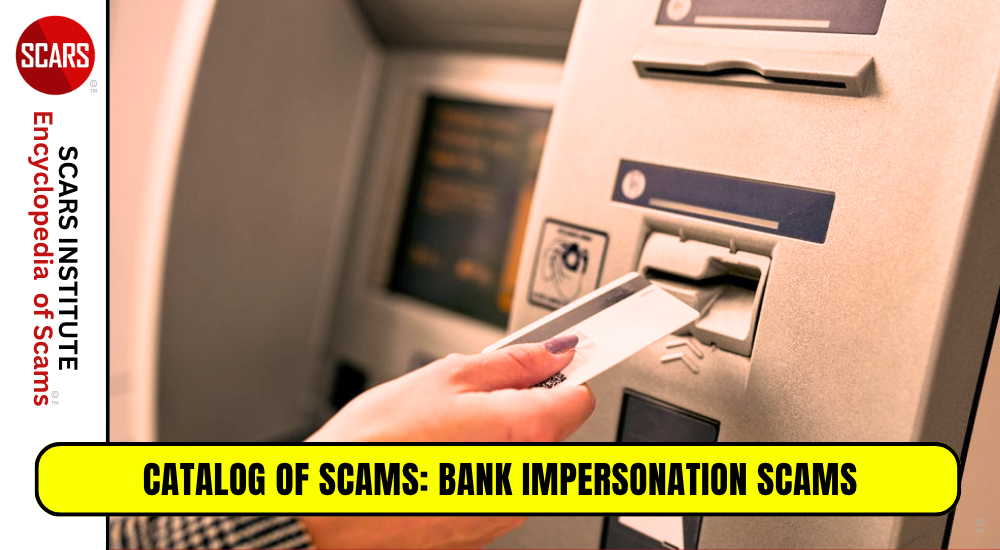
Bank Impersonation Scams
Bank Impersonation Scams and Account Takeovers: How Criminal Networks Use Texts, Emails, Calls, Identity Data, and Voice Cloning to Steal Money
How Scams Work – A SCARS Institute Insight
Article Abstract
Bank impersonation scams use text messages, emails, and phone calls that appear to come from legitimate financial institutions in order to steal money, credentials, and personal information. Criminals often rely on urgency, fear, and spoofed identities to pressure consumers into responding. These schemes may lead to account takeovers through password theft, one-time passcode fraud, SIM swaps, remote access scams, or identity verification abuse. Short conversations can also provide voice recordings, emotional cues, and confirmation that a target is reachable. Captured audio may support deepfake impersonation or future social engineering attempts. The safest response is to avoid engagement, never trust unsolicited contact, verify concerns directly with the bank, protect identity records, and report suspicious activity promptly.

Bank Impersonation Scams and Account Takeovers: How Criminal Networks Use Texts, Emails, Calls, Identity Data, and Voice Cloning to Steal Money
Bank Impersonation Scams
Bank impersonation scams have become one of the fastest-growing forms of financial fraud in the United States, the United Kingdom, and many other countries. These crimes often begin with a text message, email, or phone call that appears to come from a trusted bank. The message may warn of suspicious activity, a frozen card, a failed payment, or an urgent need to verify account details. It may display the real bank’s name, use familiar branding, or even appear in the same message thread as legitimate alerts.
Consumers in the United States may see names such as Chase, Bank of America, Wells Fargo, or Citibank. In the United Kingdom, criminals frequently imitate Barclays, HSBC, Lloyds Bank, NatWest, Santander UK, or Halifax. Same for Canadian banks, Australian banks, New Zealand banks, and those around the world.
The purpose is not always immediate theft. In many cases, criminals want confirmation that the target is real, reachable, trusting, and willing to engage. Once contact begins, they may steal passwords, one-time passcodes, identity details, or persuade the victim to authorize transfers. In other cases, they gather information for future account takeovers or identity theft.
Authorities, including the Federal Trade Commission, the Federal Bureau of Investigation, and UK anti-fraud agencies, have repeatedly warned that impersonation scams are widespread and increasingly sophisticated.
How the Scam Begins
Most bank impersonation scams begin through three communication channels: SMS text messages, email, and voice calls.
Text Message Scams
A consumer may receive a message stating:
- “Did you authorize a $1,295 transfer? Reply NO now.”
- “Your card has been suspended. Verify immediately.”
- “Unusual login detected. Click here to secure your account.”
This form of fraud is commonly called smishing, meaning phishing by SMS. Criminals use urgency and fear to trigger fast reactions before the recipient thinks critically.
Email Scams
Fraud emails may copy a bank’s colors, logos, fonts, and formatting. They often include fake login pages that capture usernames, passwords, and security answers.
Phone Call Scams
This method is often called vishing, or voice phishing. Criminals call while pretending to be fraud investigators, security teams, or account managers. Caller ID may be spoofed so the number appears to belong to the real bank. Because caller ID can be manipulated, it should never be treated as proof of legitimacy.
How Account Takeovers Happen
An account takeover occurs when criminals gain enough access to control a consumer’s financial account. Once inside, they may transfer funds, add new payees, request cards, or change security settings.
Password Capture
Victims may unknowingly type credentials into fake banking websites linked through texts or emails.
One-Time Passcode Theft
Many banks send temporary codes by text or app. Criminals pretending to be fraud staff may ask the victim to read the code aloud. That code can unlock the real account.
Remote Access Fraud
Some victims are instructed to install remote support software so the “bank” can secure the device. In reality, criminals gain control of the screen and banking session.
SIM Swap Fraud
Criminals sometimes hijack a victim’s mobile number through carrier fraud. Once they control the number, they can intercept authentication texts.
Identity-Based Verification Abuse
If criminals already know personal information such as date of birth, address, and partial Social Security number, they may pass security checks that rely on knowledge-based questions.
How Criminals Capture Your Voice
A growing number of scams are not only about passwords and codes. They are also about collecting the victim’s voice.
When a scammer calls, they may ask simple questions designed to keep the person speaking:
- “Can you confirm your name?”
- “Did you make this transaction?”
- “Can you hear me clearly?”
- “Please say yes to verify.”
- “Tell me what happened.”
These prompts may sound harmless, but they can serve multiple criminal purposes. First, they confirm the target is real and responsive. Second, they provide clean audio samples of the victim’s speech. Third, they reveal tone, accent, cadence, vocabulary, and emotional state.
Modern AI tools can sometimes build convincing synthetic voice models from relatively short recordings. The better the audio quality and the more speech collected, the stronger the imitation may become.
How Stolen Voice Samples Can Be Used
Once criminals capture voice samples, they may attempt several forms of fraud.
Banking and Customer Service Fraud
Some institutions use voice authentication or voiceprint systems. Criminals may attempt to imitate the customer during calls to banks, brokerages, insurers, or utilities.
Family Emergency Scams
A cloned voice may be used to call relatives claiming there has been an accident, an arrest, a kidnapping, or an urgent financial emergency.
Workplace Fraud
A fake executive or manager voice may be used to pressure employees into sending payments or disclosing information.
Follow-Up Social Engineering
Hearing a familiar voice lowers suspicion. Criminals may use cloned audio to make future scams appear credible.
Why Short Conversations Matter
Many people believe that if they did not provide passwords, account numbers, or one-time security codes, then no real damage was done. That assumption can be dangerous. In modern fraud operations, even a brief conversation can have value to criminals.
A short unsolicited call may allow scammers to collect several forms of useful information within seconds.
- Voice recordings that can be stored, analyzed, or reused
- Confirmation that the phone number belongs to a real, reachable person
- Confirmation that the number is actively answered
- Clues about age, location, stress level, or confidence
- Emotional vulnerability signals such as fear, confusion, politeness, loneliness, or urgency
- Personal details mentioned casually, including names, family references, schedules, travel plans, or banking habits
- Better targeting data for future scams
- Evidence that the person responds to authority language or pressure tactics
To a criminal organization, this can be intelligence gathering. The first call may not be the theft attempt. It may simply be research for later fraud.
Why Voice Samples Matter
Even a few spoken words can provide material for future misuse. Audio can be used to study accent, pronunciation, cadence, speech rhythm, and tone. Combined with newer AI tools, criminals may attempt synthetic voice impersonation, family emergency scams, or social engineering attacks.
Some systems still use voice recognition or verbal verification during customer-service calls. While security controls vary, consumers should assume that unnecessary voice exposure creates avoidable risk.
Why Saying “Yes” Is Best Avoided
For many years, consumer warnings have circulated about criminals recording people saying “yes.” While not every story is proven in the dramatic form often repeated online, there is a practical reason to avoid saying it during unexpected calls.
“Yes” is a clean affirmation word. It can:
- Confirm engagement
- Confirm hearing and comprehension
- Be edited into misleading recordings
- Encourage the caller to continue scripted manipulation
- Create a habit of cooperative responding under pressure
There is little benefit to giving an unknown caller a clear affirmative response.
How to Limit What You Say on Stranger Calls
When an unknown or suspicious caller is on the line, the safest approach is minimal speech and fast disengagement.
Best practices include:
- Do not answer unknown numbers when possible. Let them go to voicemail.
- If answered accidentally, keep responses brief and neutral.
- Use single-syllable noncommittal sounds such as “Mm,” “Huh,” or “No.”
- Avoid saying “Yes,” “Correct,” “That’s me,” or your full name.
- Do not confirm date of birth, address, family names, or account relationships.
- Do not answer open-ended questions.
- Do not explain why you are busy, where you are, or what you are doing.
- Do not remain on the line out of politeness.
- End the call quickly and independently verify any claim through official channels.
Safer Response Examples
Instead of saying:
- “Yes, this is John.”
- “Yes, I can hear you.”
- “Yes, that charge was not mine.”
- “Yes, I bank there.”
Use:
- “Who is calling?”
- “Mm-hm?”
- “No.”
- “I will call the bank directly.”
- “Send it by mail.”
- “Not discussing this by phone.”
- Then hang up.
The Power of Silence
Scammers rely on momentum. They want conversations to flow before skepticism activates. Silence, delay, and refusal to engage disrupt their script. A pause is protective. Hanging up is protective. Letting voicemail screen the call is often the best choice.
A New Rule for Modern Fraud Prevention
In the past, people were taught that being polite on the phone was respectful. Today, with organized fraud networks and AI-enabled scams, cautious disengagement is often wiser than politeness.
Consumers should treat unexpected financial calls as unverified until proven otherwise. A thirty-second conversation can provide more value to criminals than many people realize.
The safest standard is simple:
Say less. Never say “yes.” Reveal nothing. Hang up. Verify independently.
Why Criminals Already Know So Much
Many victims are alarmed when scammers know their name, address, date of birth, or partial account details. This information may come from:
- Large corporate data breaches
- Dark web data markets
- Public records
- Social media exposure
- Purchased consumer databases
- Prior scam victim lists
- Stolen mail or documents
In many cases, criminals do not need to steal everything from scratch. They only need to confirm the person behind the data is active and reachable.
That is why even a simple reply such as “No, I did not authorize that payment” can be valuable.
They do not always need your money directly. They may only need to confirm you.
Why Responding Is Dangerous
Some people believe they can answer once, ask questions, insult the scammer, or waste their time. That assumption can create real risk.
By responding, a person may confirm:
- The phone number is active
- The email address is monitored
- The person reacts to financial fear
- The person may be reachable during certain hours
- The person may trust authority language
- The person is willing to continue a conversation
- The person’s voice can be recorded for later abuse
That information can be sold, shared, or reused by criminal networks.
Do Not Confront Scammers
Many people imagine scammers as isolated amateurs working alone. That image is outdated. Modern scammers are much smarter, organized, and connected. They are dangerous!
Modern fraud operations often function like businesses. Different teams may handle:
- Text message campaigns
- Phishing websites
- Call centers
- Payment laundering through mule accounts
- Identity theft resale
- SIM swaps
- AI voice fraud
- Technical support and remote access fraud
These networks are tied to organized transnational crime.
Confronting scammers does not protect the consumer. It may expose more data, encourage repeat targeting, or escalate harassment.
The safest rule is clear:
- Never respond.
- Never confront.
- Never threaten.
- Never educate them.
- Just block and report.
UK Banking Scam Protections
The United Kingdom has promoted the 159 short code for consumers who receive suspicious banking calls. People are encouraged to hang up and call 159 to reach participating bank fraud lines through an independent route.
UK consumers may also report fraud through Action Fraud and seek guidance from the Financial Conduct Authority.
What Major Banks Commonly State
Large banks in both the U.S. and the UK regularly warn customers that they will not unexpectedly ask for:
- Full passwords
- PIN numbers
- One-time passcodes
- Card readers to be used during unsolicited calls
- Remote access to devices
- Transfers to “safe accounts”
A request for any of these items during an unexpected contact should be treated as a major warning sign.
What To Do Instead
If a suspicious message claims to be from a bank:
- Do not reply.
- Do not click links.
- Do not call the number in the message.
- Do not stay on unsolicited calls to “hear them out.”
- Do not provide codes, passwords, PINs, or personal data.
- Instead, independently contact the bank using the number on the back of the debit card, the official mobile app, or the verified website typed manually into the browser.
- Then block the sender and report the attempt.
What To Do If Contact Already Happened
If a person has already replied, clicked, or spoken with the caller:
- Contact the bank immediately through official channels
- Explain that suspicious callers may have recorded your voice
- Freeze cards if necessary
- Change passwords
- Enable multifactor authentication
- Review transactions
- Check devices for remote access software
- Contact the mobile carrier if SIM fraud is suspected
- Place fraud alerts with credit bureaus
- Consider a credit freeze
- Monitor accounts daily
- Warn family members about possible impersonation calls
- Watch for follow-up scams
Remember
Bank impersonation scams and account takeovers are no longer simple crimes committed by lone opportunists. They are often structured operations using stolen data, spoofed calls, fraudulent texts, realistic emails, psychological pressure, and increasingly advanced AI tools. Their goal may be immediate theft, but it may also be identity confirmation, reconnaissance, voice harvesting, future fraud preparation, or long-term exploitation.
Consumers are safest when they refuse unsolicited engagement. Every reply can reveal something valuable. Every conversation can create new risk. Even a short phone call can provide voice samples that criminals may try to weaponize later.
The most effective defense is disciplined skepticism. Slow down. Assume urgency may be manufactured. Verify independently through trusted banking channels. Protect identity records. Monitor accounts. Use strong authentication.
When a suspicious contact arrives, the smartest response is the simplest one:
- Never respond.
- Never confront.
- Block it. Report it. Move on.
Conclusion
Bank impersonation scams and account takeovers have evolved into highly organized forms of modern financial crime. These operations often combine stolen personal data, spoofed phone numbers, convincing text alerts, fraudulent emails, psychological pressure, and emerging artificial intelligence tools. What appears to be a simple call or message may actually be the opening move in a broader criminal process designed to gather information, test vulnerability, capture voice samples, or prepare for future fraud. Immediate theft is only one possible objective.
Consumers face the greatest risk when they respond impulsively. Fear, confusion, curiosity, and the natural desire to protect an account can cause people to engage before verifying the source. Even short conversations may confirm identity, reveal emotional state, validate an active phone number, or provide speech recordings that can be misused later. Criminals understand human behavior and design their contact methods around predictable reactions.
The strongest defense is disciplined non-engagement. Unexpected banking messages and calls should always be treated as unverified until independently confirmed. Consumers are safest when they avoid clicking links, refuse to discuss account matters with unknown callers, and contact their bank only through trusted numbers, official apps, or verified websites. Strong passwords, multifactor authentication, credit monitoring, and identity theft alerts add additional layers of protection.
Modern fraud prevention is no longer only about guarding money. It is about guarding identity, voice, access, and trust. When suspicious contact arrives, the wisest response is calm skepticism and immediate disengagement. Say less. Reveal nothing. Verify independently. Block, report, and move forward.


Glossary
- Account Takeover—An account takeover occurs when criminals gain unauthorized control of a financial account and begin changing settings, moving funds, or adding new payees. It often follows stolen passwords, intercepted codes, or identity verification abuse. Recovery usually requires immediate contact with the institution, password changes, and close transaction review.
- Action Fraud—Action Fraud serves as the United Kingdom’s national reporting channel for fraud and cybercrime complaints. Victims may use it to document incidents and receive guidance about next steps. Reporting can also help authorities identify patterns and organized criminal activity.
- Active Number Confirmation—Active number confirmation happens when a scammer learns that a telephone number is real, answered, and connected to a reachable person. Even a brief reply can provide this information. That confirmation may increase future scam contacts and targeting attempts.
- Artificial Intelligence Voice Fraud—Artificial intelligence voice fraud uses software to imitate a person’s speech patterns, tone, or cadence after collecting audio samples. Criminals may use it for impersonation, pressure calls, or customer service deception. Limiting unnecessary speech with unknown callers can reduce exposure.
- Authentication Text Code—An authentication text code is a temporary security number sent by a bank or service to confirm identity during login or transactions. Scammers often attempt to trick victims into revealing it. Sharing that code can allow direct account access.
- Banking Impersonation—Banking impersonation occurs when criminals pretend to represent a legitimate financial institution through calls, texts, emails, or websites. They rely on trust in recognized brands to lower suspicion. Independent verification through official channels remains essential.
- Caller ID Spoofing—Caller ID spoofing is the manipulation of phone display information so a call appears to come from a trusted source. A victim may see a bank name or familiar number. Displayed caller information should never be treated as proof of legitimacy.
- Casual Disclosure—Casual disclosure refers to personal details shared during conversation without recognizing their value to criminals. Names, schedules, travel plans, and family references may all assist in later scams. Careful restraint during unexpected calls can reduce this risk.
- Cloned Voice Scam—A cloned voice scam uses synthetic audio that imitates a known person to create credibility and urgency. Criminals may pretend to be relatives, managers, or the victim. Emotional shock often increases compliance if targets are unprepared.
- Credential Capture—Credential capture is the theft of usernames, passwords, or security answers through fake websites, emails, or deceptive calls. Once obtained, criminals may enter real accounts quickly. Strong password changes and rapid reporting are common first responses.
- Credit Freeze—A credit freeze restricts access to a consumer’s credit file so new lenders cannot easily open accounts in that person’s name. It can reduce identity theft damage after data exposure. Victims often use it after a suspected compromise.
- Dark Web Data Market—A dark web data market is an illicit online space where stolen personal records may be bought or sold. Criminals can purchase names, dates of birth, and other details there. Victims may be targeted even without direct prior contact.
- Deepfake Impersonation—Deepfake impersonation uses advanced software to create convincing audio or visual representations of another person. Fraudsters may exploit it to bypass trust and trigger urgent payments. Verification through separate contact methods is important.
- Emotional Vulnerability Signal—An emotional vulnerability signal is a clue showing fear, confusion, loneliness, urgency, or stress during contact with criminals. Scammers may adjust tactics when these reactions appear. Calm disengagement can deny them useful feedback.
- Emergency Family Scam—An emergency family scam uses panic by claiming a loved one has been arrested, injured, kidnapped, or stranded. A cloned voice may be used to increase believability. Independent confirmation before sending money is critical.
- Fraud Alert—A fraud alert is a notice placed on credit files asking lenders to take extra steps before issuing new credit. It can help after identity data has been exposed. Many victims use it alongside account monitoring.
- Fraud Prevention Line—A fraud prevention line is an official telephone channel provided by a bank for suspicious activity reports and security concerns. Consumers should locate this number independently. Calling numbers from suspicious messages increases danger.
- Identity Confirmation Probe—An identity confirmation probe is a question designed to verify that the contacted person matches stolen data already held by criminals. A simple answer may complete their profile. Silence or independent verification is safer.
- Identity Theft Monitoring—Identity theft monitoring is the regular review of accounts, credit files, and suspicious activity after possible data exposure. Early detection can limit damage and speed recovery. Consistency matters more than occasional checking.
- Independent Verification—Independent verification means contacting a bank or institution through a trusted number, official app, or manually typed website rather than using information provided by the suspicious contact. This breaks the scammer’s control of communication. It is one of the strongest protective habits.
- Intelligence Gathering Call—An intelligence gathering call is a contact made primarily to collect useful information rather than steal money immediately. Criminals may seek habits, reactions, voice samples, or identity confirmation. Later scams may become more convincing because of it.
- Knowledge-Based Verification Abuse—Knowledge-based verification abuse happens when criminals use stolen personal facts to answer security questions. Birth dates, addresses, and partial identification numbers are common examples. Institutions relying heavily on such questions may create risk.
- Message Thread Mimicry—Message thread mimicry occurs when fraudulent texts appear inside an existing chain of legitimate alerts. This presentation can lower suspicion because the message seems familiar. Consumers should still verify requests independently.
- Minimal Speech Strategy—A minimal speech strategy is the practice of saying as little as possible during calls from unknown or suspicious sources. Short neutral responses reduce disclosed information and usable recordings. Ending the call quickly remains preferable.
- Multifactor Authentication—Multifactor authentication requires more than one proof of identity, such as a password plus a code or app approval. It can slow unauthorized access after stolen credentials. No system is perfect, but layered security helps.
- Mule Account—A mule account is a bank account used to receive, move, or disguise stolen funds on behalf of criminals. The holder may be complicit or manipulated. These accounts complicate tracing and recovery efforts.
- Noncommittal Response—A noncommittal response is a neutral sound or short reply that avoids confirming identity or agreement. Examples include brief acknowledgments rather than clear affirmations. This can limit exploitable information during unknown calls.
- One-Time Passcode Theft—One-time passcode theft occurs when criminals persuade a victim to reveal a temporary security code sent by text or app. That code may unlock accounts immediately. Legitimate institutions rarely request that customers read such codes aloud unexpectedly.
- Organized Fraud Network—An organized fraud network is a coordinated criminal structure where separate teams handle texting, calling, laundering money, or technical deception. These groups can operate across borders. Their scale often exceeds common stereotypes about scammers.
- Open-Ended Question Trap—An open-ended question trap invites a victim to speak freely and reveal more than intended. Questions like asking what happened can produce names, events, and emotional cues. Controlled brief responses reduce exposure.
- Payment Laundering—Payment laundering is the movement of stolen money through accounts or transactions to hide criminal origins. It helps fraud proceeds appear legitimate. This process can involve mule accounts and cross-border transfers.
- Phishing Link—A phishing link directs victims to a fake website designed to steal credentials or install malicious software. It often appears urgent and official. Manually typing known addresses can help avoid this trap.
- Politeness Exploitation—Politeness exploitation occurs when criminals rely on social pressure that makes people stay on calls or answer questions. Many victims fear seeming rude. Modern fraud prevention often requires ending suspicious contact quickly.
- Remote Access Fraud—Remote access fraud happens when criminals persuade a victim to install software that lets them control the device. They may claim to fix security problems. Once connected, they can observe banking activity or manipulate transactions.
- Safe Account Lie—A safe account lie is the false claim that money must be transferred to protect it from fraud. In reality, the destination is controlled by criminals. Legitimate banks generally do not require emergency self-transfers this way.
- SIM Swap Fraud—SIM swap fraud occurs when criminals transfer a victim’s phone number to a different SIM card they control. This may allow interception of calls and security codes. Rapid carrier contact is often necessary when suspected.
- Smishing—Smishing is phishing conducted through SMS text messages that imitate trusted organizations or urgent alerts. It often seeks clicks, replies, or phone calls. Speed and fear are common manipulation tools.
- Social Engineering Pressure—Social engineering pressure is the use of authority, urgency, fear, or trust to push victims into unsafe actions. The technique targets human reactions more than technology. Awareness can weaken its power.
- Suspicious Contact Protocol—A suspicious contact protocol is a planned personal routine for handling unknown banking messages or calls. It may include no reply, no clicking, independent verification, blocking, and reporting. Prepared habits improve responses under stress.
- Synthetic Voice Model—A synthetic voice model is a computer-generated representation of a person’s speech created from recorded samples. It may imitate tone and cadence convincingly. Criminal misuse can support impersonation scams.
- Target Validation—Target validation is the process of confirming that stolen data belongs to a living, reachable, responsive person. Criminals often value this step highly. Even short replies can complete validation.
- Transaction Panic Trigger—A transaction panic trigger is a false alert about suspicious payments meant to provoke immediate reaction. Fear can reduce careful thinking and increase compliance. Slowing down helps restore judgment.
- Trusted Brand Mimicry—Trusted brand mimicry is the copying of names, logos, colors, or messaging styles from respected institutions. Criminals use familiarity to lower suspicion. Appearance alone should never determine trust.
- Verbal Verification Risk—Verbal verification risk refers to the danger of using spoken information or voice traits as security proof during calls. Criminals may collect or imitate those signals. Stronger layered verification methods are safer.
- Vishing—Vishing is voice phishing conducted through telephone calls where criminals pose as trusted officials or institutions. It often uses spoofed caller information and urgency. Hanging up and calling back independently is protective.
- Voice Harvesting—Voice harvesting is the deliberate collection of speech samples from unsuspecting victims during calls. Those recordings may support impersonation, analysis, or later fraud. Limiting speech reduces available material.
- Voiceprint System—A voiceprint system is a security tool that compares a caller’s speech characteristics with stored patterns. It may improve convenience but is not immune to misuse attempts. Consumers should ask about added safeguards.
- Voicemail Screening—Voicemail screening is the practice of letting unknown callers leave messages instead of answering live. Legitimate organizations can usually state their purpose there. This reduces pressure and real-time manipulation.
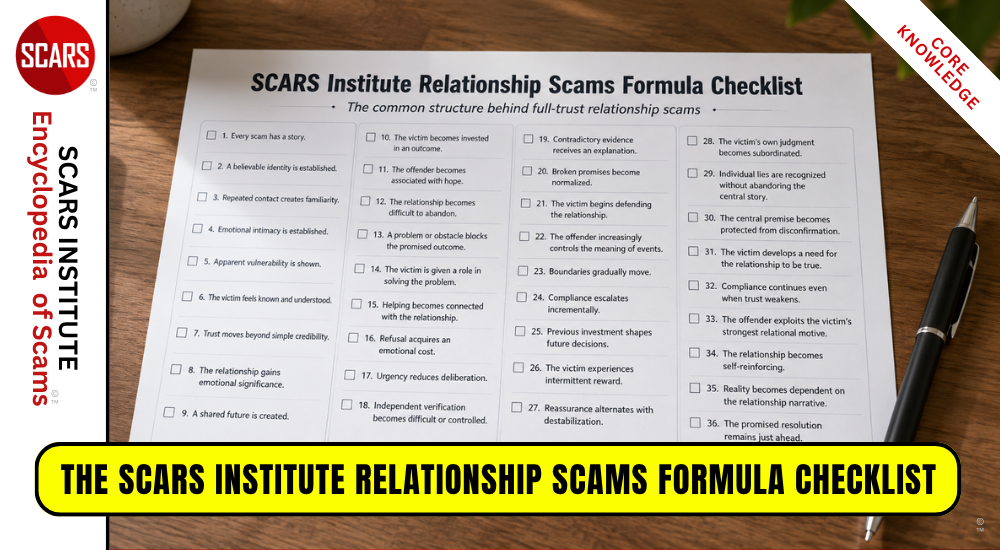
To Understand All Scams, Read This:
The SCARS Institute Relationship Scams Formula Checklist
This is the Formula that all Relationship Scams Follow
-/ 30 /-
What do you think about this?
Please share your thoughts in a comment below!
Table of Contents
- Bank Impersonation Scams and Account Takeovers: How Criminal Networks Use Texts, Emails, Calls, Identity Data, and Voice Cloning to Steal Money
- Bank Impersonation Scams and Account Takeovers: How Criminal Networks Use Texts, Emails, Calls, Identity Data, and Voice Cloning to Steal Money
- Bank Impersonation Scams
- How the Scam Begins
- How Account Takeovers Happen
- How Criminals Capture Your Voice
- How Stolen Voice Samples Can Be Used
- Why Criminals Already Know So Much
- Why Responding Is Dangerous
- Do Not Confront Scammers
- UK Banking Scam Protections
- What Major Banks Commonly State
- What To Do Instead
- What To Do If Contact Already Happened
- Remember
- Conclusion
- Glossary


Rapid Report Scammers

In the U.S. & Canada
U.S. & Canada Suicide Lifeline 988
Please Tell Us What You Took From This?
Please Leave A Comment!
Commenting Is An Essential Part Of Healing
Read • Think • Write
Thank you for your comment. You may receive an email to follow up. We never share your data with marketers.
Recent Comments
On Other Articles
- on The SCARS Institute Relationship Scams Formula Checklist – 2026: “As I read this I could see myself in every step with my scam. I gained a lot more knowledge…” Aug 28, 19:51
- on The Persistence of Danielle Delaunay as a Fake Identity – 2026: “Unfortunately, you are being scammed. She is using a fake name regardless. At this point, your best option is to…” Aug 26, 20:16
- on The Persistence of Danielle Delaunay as a Fake Identity – 2026: “Dear Sirs, I have met this woman with the name Abigail Boateng in Ghana. I have an intensive mail contact…” Aug 26, 12:28
- on Trauma-Induced Fear May Cause Paranoia: “Very interesting article. I’m wondering if someone would likely recognize that they’re becoming increasingly paranoid, or hypervigilant, or does it…” Aug 24, 12:07
- on Spotting AI Scams – Using AI to Catch Artificial Intelligence Scams – 2026: “Wow, very useful and thorough advice! I don’t plan on talking to any strangers online ever again, at least not…” Aug 22, 22:11
- on The Persistence of Danielle Delaunay as a Fake Identity – 2026: “Knowing they are criminals, why would you want to talk to them? Avoid all strangers online.” Aug 19, 12:54
- on The Persistence of Danielle Delaunay as a Fake Identity – 2026: “THERE ARE THREE DANIELLE DELAUNAYS ON FACEBOOK RIGHT NOW USEING HER NAME AND PHOTOS. I’M BEING TOLD THEY ARE ALL…” Aug 19, 11:15
- on Natalie Sparks: Have You Seen Her? Another Stolen Face / Stolen Identity: “John, we are sorry, but you are still being scammed.” Aug 19, 09:52
- on #1 Worldwide – SCARS Anyscam.com: “You have been scammed. The unfortunate part about the images is difficult to address. You can learn more about Sextortion…” Aug 19, 09:48
- on SCARS™ Scam News Now: Six Ghanaian Scammers Arrested in the U.K. For Online Fraud: “Ann, recognizing that it was a scam is the first step in healing. We can help in your after-scam healing…” Aug 19, 09:47
ARTICLE META
Important Information for New Scam Victims
- Please visit www.ScamVictimsSupport.org – a SCARS Website for New Scam Victims & Sextortion Victims
- Enroll in FREE SCARS Scam Survivor’s School now at www.SCARSeducation.org
- Please visit www.ScamPsychology.org – to more fully understand the psychological concepts involved in scams and scam victim recovery
If you are looking for local trauma counselors please visit counseling.AgainstScams.org or join SCARS for our counseling/therapy benefit: membership.AgainstScams.org
If you need to speak with someone now, you can dial 988 or find phone numbers for crisis hotlines all around the world here: www.opencounseling.com/suicide-hotlines
A Note About Labeling!
We often use the term ‘scam victim’ in our articles, but this is a convenience to help those searching for information in search engines like Google. It is just a convenience and has no deeper meaning. If you have come through such an experience, YOU are a Survivor! It was not your fault. You are not alone! Axios!
A Question of Trust
At the SCARS Institute, we invite you to do your own research on the topics we speak about and publish, Our team investigates the subject being discussed, especially when it comes to understanding the scam victims-survivors experience. You can do Google searches but in many cases, you will have to wade through scientific papers and studies. However, remember that biases and perspectives matter and influence the outcome. Regardless, we encourage you to explore these topics as thoroughly as you can for your own awareness.
Statement About Victim Blaming
SCARS Institute articles examine different aspects of the scam victim experience, as well as those who may have been secondary victims. This work focuses on understanding victimization through the science of victimology, including common psychological and behavioral responses. The purpose is to help victims and survivors understand why these crimes occurred, reduce shame and self-blame, strengthen recovery programs and victim opportunities, and lower the risk of future victimization.
At times, these discussions may sound uncomfortable, overwhelming, or may be mistaken for blame. They are not. Scam victims are never blamed. Our goal is to explain the mechanisms of deception and the human responses that scammers exploit, and the processes that occur after the scam ends, so victims can better understand what happened to them and why it felt convincing at the time, and what the path looks like going forward.
Articles that address the psychology, neurology, physiology, and other characteristics of scams and the victim experience recognize that all people share cognitive and emotional traits that can be manipulated under the right conditions. These characteristics are not flaws. They are normal human functions that criminals deliberately exploit. Victims typically have little awareness of these mechanisms while a scam is unfolding and a very limited ability to control them. Awareness often comes only after the harm has occurred.
By explaining these processes, these articles help victims make sense of their experiences, understand common post-scam reactions, and identify ways to protect themselves moving forward. This knowledge supports recovery by replacing confusion and self-blame with clarity, context, and self-compassion.
Additional educational material on these topics is available at ScamPsychology.org – ScamsNOW.com and other SCARS Institute websites.
Psychology Disclaimer:
All articles about psychology and the human brain on this website are for information & education only
The information provided in this article is intended for educational and self-help purposes only and should not be construed as a substitute for professional therapy or counseling.
While any self-help techniques outlined herein may be beneficial for scam victims seeking to recover from their experience and move towards recovery, it is important to consult with a qualified mental health professional before initiating any course of action. Each individual’s experience and needs are unique, and what works for one person may not be suitable for another.
Additionally, any approach may not be appropriate for individuals with certain pre-existing mental health conditions or trauma histories. It is advisable to seek guidance from a licensed therapist or counselor who can provide personalized support, guidance, and treatment tailored to your specific needs.
If you are experiencing significant distress or emotional difficulties related to a scam or other traumatic event, please consult your doctor or mental health provider for appropriate care and support.
Also read our SCARS Institute Statement about Professional Care for Scam Victims – click here to go to our ScamsNOW.com website.


It is truly sad that technology and all of these soohisticated tactics are employed for commiting crimes. It is always good to update oneself on the ways scams are performed and identify as well as work on our vulnerabilities and safety.
Great article, great detail, great reminders, Thank You SCARS. Scammers’ tactics unfortunately are advancing at the speed of light. I recently fell prey to scammers utilizing one of my credit cards at a rate the bank was working great efforts to get ahead of cyber criminals.
I have received several of these warning signs- phishing emails, two data breaches on my social security number, and identity theft using my local address to obtain free gift cards. The internet is the “Wild West”.