



SCARS Institute’s Encyclopedia of Scams™ Published Continuously for 25 Years

The Psychology of Self-Justified Harm to Others
Moral Disengagement, Criminal Rationalization, and the Psychology of Self-Justified Harm by Online Criminals
Criminology / Criminal Psychology / How Scams Work – A SCARS Institute Insight
Authors:
• Tim McGuinness, Ph.D., DFin, MCPO, MAnth – Anthropologist, Scientist, Director of the Society of Citizens Against Relationship Scams Inc.
See Author Biographies Below
Article Abstract
Moral disengagement explains how online criminals and other harmful people justify acts that violate their own moral standards. Offenders can reframe harm as necessary, soften criminal behavior with cleaner language, compare themselves with worse people, shift responsibility to others, minimize consequences, blame victims, or dehumanize those they exploit. These mechanisms protect the offender’s self-image but do not reduce responsibility or harm. For scam victims, understanding moral disengagement can help separate criminal accountability from personal shame. The offender’s excuses are not proof that the victim caused the crime. Scam baiting and revenge can also pull victims into distorted moral reasoning. Recovery requires moral reconnection through truth, dignity, evidence, reporting, support, and self-protection.
Keywords
Moral Disengagement, Criminal Rationalization, Scam Victim Recovery, Online Criminals, Victim Blaming, Dehumanization, Moral Reconnection, Scam Baiting, Fraud Awareness, Accountability

Moral Disengagement, Criminal Rationalization, and the Psychology of Self-Justified Harm by Online Criminals
Author’s Note
This discussion about Moral Disengagement examines how people who commit harmful, criminal, or antisocial acts can preserve a favorable self-image while doing real damage to others. The focus is not on excusing offenders, softening accountability, or suggesting that scammers are misunderstood. The purpose is to explain how moral disengagement, rationalization, victim-blaming, softened language, dehumanization, and denial of responsibility allow harmful conduct to continue.
For scam victims and survivors, this understanding can help restore moral clarity. A criminal’s private justification does not become the victim’s burden. The offender’s excuses are not evidence that the victim caused the crime or deserved the harm. At the same time, recovery also requires survivors to remain connected to their own values. Anger, humiliation, and grief can tempt victims toward retaliation, scam baiting, or self-destructive neglect, but healing requires truth, dignity, safety, reporting, education, and support.
The central message is simple: harm must be named accurately, responsibility must be returned to the person who caused it, and recovery must not allow the crime to steal the survivor’s moral center.
Prof. Emeritus Tim McGuinness, Ph.D.
July 2026
Introduction to Self-Justified Harm by Online Criminals
Most people do not wake up in the morning and think of themselves as villains. This is the basis for Self-Justified Harm by Online Criminals.
Even people who commit harmful, criminal, abusive, or antisocial acts often protect a private story in which they remain reasonable, pressured, misunderstood, loyal to a cause, or less guilty than others. This does not make their conduct less harmful. It does not excuse crime. It does not reduce the damage done to victims. However, it helps explain how the human mind can carry out harm while still preserving a tolerable self-image.
This matters deeply in scam victim recovery. Many victims struggle to understand how a person could say loving words while stealing money, promising devotion while manipulating grief, or offering comfort while planning exploitation. The victim often asks, “How could they live with themselves?” The answer is not always that the offender has no moral system at all. It does not automatically mean they are psychopaths, sociopaths, or malignant narcissists. In many cases, the offender has simply found a psychological mechanism to disconnect the harmful act from their personal moral judgment.
Psychologist Albert Bandura studied this process for decades. In his work on moral disengagement, Bandura described how people can deactivate the self-regulating parts of conscience that normally create guilt, shame, restraint, and moral self-correction. His model explains that people do not always abandon moral standards before harming others. They often create psychological distance between what they believe and what they do. Moral agency remains present, but self-sanctions are weakened or bypassed.
That is the center of moral disengagement. A person does something harmful, but the mind reshapes the meaning of the act so it feels acceptable enough to continue.
Moral Disengagement Is Not Innocence
Moral disengagement should never be confused with innocence. A person who justifies harm is still responsible for the harm. The presence of a psychological mechanism does not erase moral responsibility, criminal responsibility, or accountability to victims. Bandura’s work explains how people can weaken or bypass the self-sanctions of conscience, but it does not suggest that the harmful act becomes harmless or that the victim’s injury becomes less real.
This distinction is essential when examining scammers, fraud offenders, abusers, corrupt professionals, and others who engage in harmful behavior. Moral disengagement explains how the person tolerates the act internally. It does not clear the person of responsibility. A scammer can tell themselves that the victim was foolish, greedy, wealthy, lonely, foreign, replaceable, or only a name on a screen. That self-talk does not reduce the crime. It reveals the mental process that allows the crime to continue.
A person can create a story that makes wrongdoing feel less wrong. Almost all criminal behavior involves this. The offender may say the victim should have known better, that everyone does this, that the money was needed, that the harm was not serious, or that someone else ordered the act. The mind reshapes the crime until it feels smaller, cleaner, necessary, deserved, or distant. Once that story becomes familiar, conscience becomes easier to avoid.
This is why moral disengagement is so dangerous. It does not usually feel like evil from the inside. It feels like explanation. It feels like pressure. It feels like survival. It feels like loyalty. It feels like business. It feels like revenge. It feels like justice. The person does not always experience themselves as choosing harm. They experience themselves as doing something that has been mentally renamed, morally softened, or socially excused.
For scam victims, this can be very difficult to understand and accept. A victim often tries to understand how someone could build intimacy, speak with affection, ask about daily life, offer comfort, create a future, and then steal without remorse. Moral disengagement helps explain that contradiction. The scammer does not necessarily need to experience the victim as fully human in the moment of exploitation; to them the victim is an object, a caricature of a real person. The offender can reduce the victim to a role. The victim becomes a target, account, lead, payer, opportunity, or problem. Once the person is reduced to a function, the offender can continue the script with less inner conflict.
This process does not require the offender to be innocent, confused, or unaware that harm is occurring. A person can know enough to hide the act, conceal their identity, use false documents, avoid law enforcement, move money through layers, and silence the victim. Those actions show awareness. Moral disengagement operates alongside that awareness by making the person feel less personally condemned by what they are doing. The offender can know the conduct is wrong in a legal or practical sense and still build an internal story that makes it tolerable.
Moral disengagement can be described as coping-like, but it should not be treated as healthy coping. A coping mechanism is generally understood as a way of managing stress or threat, while coping strategies often involve more conscious and direct efforts to handle problems. Defense mechanisms, including rationalization, can also function as ways people protect themselves from emotional discomfort, but they often distort reality rather than resolve the underlying conflict.
In that sense, moral disengagement can function as a self-protective defense against guilt, shame, fear of accountability, or damage to self-image. It helps the offender cope with the discomfort of being someone who harms others. But this is not the kind of coping that restores health, repairs relationships, or creates moral growth. It is a maladaptive and self-excusing form of coping. It protects the offender’s self-image at the expense of truth and at the expense of the victim.
Rationalization is closely related. The APA describes rationalization as a defense mechanism in which unacceptable behavior, motives, or feelings are explained in ways that appear logical or acceptable. That description fits many forms of moral disengagement because the offender is not simply explaining what happened. The offender is explaining it in a way that makes the self feel less guilty, less responsible, or less cruel.
This is why moral disengagement must be named without softening it. It is not innocence. It is not healing. It is not accountability. It is not remorse. It is the mind’s way of stepping around conscience while leaving the victim to carry the harm, the trauma, and the grief. The offender’s private explanation belongs to the offender. The victim does not have to accept it, carry it, or mistake it for truth. Though victims need to understand it for them to be able to recover.
The scammer’s self-justification does not become the victim’s burden. The criminal may need a story to keep committing the crime, but the survivor does not need to live inside that story. Recovery requires returning the moral weight to its proper place. The crime belongs to the person who chose deception, exploitation, and theft. The victim’s vulnerability was used as an entry point, but it was not the cause of the offender’s conduct. Moral disengagement explains how harm was tolerated. It does not excuse why harm was done.
The Need to Protect the Self-Image
Human beings generally want to see themselves as decent, justified, or at least understandable. When behavior conflicts with self-image, the result can create psychological discomfort. Cognitive dissonance theory describes the unpleasant state that can occur when beliefs, values, or actions conflict with each other. People often try to reduce that discomfort by changing the meaning of the behavior, avoiding facts, or building justifications that make the contradiction easier to bear.
For a person committing harm, the conflict can be simple:
- “I am not a bad person.”
- “I am harming someone.”
Those two ideas cannot sit easily together. The person can stop the harmful behavior, admit guilt, repair damage, and face consequences. Or the person can change the story. Moral disengagement chooses the second path.
The offender does not need to say, “I am evil.” The offender says:
- “It is not that bad.”
- “They deserved it.”
- “Everyone does it.”
- “I had no choice.”
- “I was only doing my job.”
- “They should have known better.”
- “This is for a larger purpose.”
That is how harm becomes livable inside the offender’s mind.
Moral Justification
Moral justification is the process of reframing harmful behavior as serving a greater good. Bandura identified moral justification as one of the major mechanisms of moral disengagement, along with euphemistic language, advantageous comparison, displacement and diffusion of responsibility, minimization of harm, attribution of blame, and dehumanization.
This is one of the most dangerous forms of self-justification because it can make harm feel righteous. A person no longer experiences the act as exploitation. They experience it as justice, necessity, loyalty, survival, revenge, or service to a cause.
In criminal environments, moral justification can take many forms. A scammer may claim they are taking money from rich people, punishing careless people, supporting family, surviving poverty, fighting unfair systems, or doing what others have already done to them. A corrupt employee may claim they are protecting the company. A violent group member may claim they are defending honor. An online abuser may claim they are exposing truth.
The pattern is the same. The harmful act is not denied. It is rebranded as necessary.
For scam victims, this can be painful to understand because the offender’s private justification may have nothing to do with the victim’s reality. The victim was not a symbol. The victim was a person. The victim had a life, trust, grief, savings, dignity, and emotional vulnerability. Moral justification allows the offender to ignore that human reality by placing the crime inside a larger story that flatters the offender’s self-image.
Euphemistic Labeling
Euphemistic labeling means renaming something harmful so it sounds cleaner, softer, technical, ordinary, or less morally serious. Bandura’s model includes euphemistic language as a way to reduce the emotional impact of harmful conduct and make it easier to tolerate.
Language changes conscience. If a person calls theft “hustling,” fraud “business,” manipulation “sales,” emotional grooming “client engagement,” or victim targeting “lead generation,” the act can begin to feel less brutal. Words place moral distance between the offender and the damage.
In workplaces, this can appear when people describe firing workers as “rightsizing” or harmful decisions as “efficiency.” In war or state violence, language such as “collateral damage” can hide the suffering of real people. In scams, the same pattern appears when offenders call victims “clients,” “targets,” “mugs,” “leads,” “payers,” or “accounts.” The words strip away the personal reality of the person being harmed.
This matters because moral recognition often begins with accurate language. When the language is cleaned up, the crime feels cleaner too. The victim becomes a category. The theft becomes a transaction. The lie becomes a strategy. The cruelty becomes a script.
Recovery education must restore accurate language. Fraud is fraud. Manipulation is manipulation. Grooming is grooming. Theft is theft. A scammer did not “make a mistake.” A scammer chose deception for gain.
Advantageous Comparison
Advantageous comparison allows a person to make harmful behavior look acceptable by comparing it with something worse.
The offender says:
- “At least I did not hurt them physically.”
- “At least I did not take as much as others.”
- “At least I am not violent.”
- “At least I am not like that other criminal.”
This is a powerful mental trick. The question shifts from “Did harm occur?” to “Was the harm as bad as something else?” Once the comparison is made, the offender feels less guilty. The damage is minimized because a worse example exists.
This mechanism is especially common in crimes that involve emotional or financial harm. The offender can pretend that because no weapon was visible, the harm was not serious. In scams, this is false. Relationship scams and financial exploitation can create betrayal trauma, attachment injury, financial devastation, shame, depression, isolation, loss of trust, and long-term psychological harm. The absence of physical violence does not make the crime harmless. Scams are violence!
Advantageous comparison also helps offenders stay inside groups where crime is normalized. If someone else is crueler, greedier, more violent, or more extreme, the offender can feel moderate by comparison. The person does not need to become good. The person only needs to find someone worse.
This is why moral comparison is not the same as moral accountability. The right question is not whether someone else did greater harm. The right question is whether harm was done and whether the person responsible is willing to face it.
Displacement of Responsibility
Displacement of responsibility occurs when a person claims that someone else caused, ordered, required, or forced the harmful act. Bandura identified this as a mechanism that reduces accountability by shifting responsibility away from the person who acted. This is the rationale in scam centers around the world.
The classic language is familiar:
- “I was just following orders.”
- “I was only doing my job.”
- “The boss told me to do it.”
- “The system made me do it.”
- “The group required it.”
- “I had no choice.”
There are situations where pressure is real. Criminal networks, gangs, corrupt workplaces, abusive leaders, and organized fraud operations can create strong pressure to comply. But pressure does not automatically erase agency. A person can be pressured and still participate in harm. A person can be influenced and still responsible for choices.
In scam center operations, displacement of responsibility can appear when lower-level participants blame handlers, recruiters, managers, platform systems, corrupt bosses, or economic conditions. These factors can help explain the environment. They do not erase the act of deception, grooming, theft, or exploitation.
It now appears that as many as 60-70% of the workers in Asian Scam Compounds actually knowingly accept the jobs based on personal interviews by the SCARS Institute. Similarly, in other countries too.
For victims, this distinction is important. The scam may have involved many offenders. Some may have written scripts, some may have managed accounts, some may have moved money, some may have impersonated the fake identity, and some may have pressured the victim. Each participant may tell themselves they were only a small part of a larger machine. Yet the victim experienced the full harm.
Diffusion of Responsibility
Diffusion of responsibility is closely related to displacement, but the responsibility is spread across the group rather than shifted to an authority. In this pattern, a person feels less accountable because many others were involved. Bandura’s framework includes diffusion of responsibility among the mechanisms that weaken personal accountability for harmful conduct.
This is common in organized harm. When many people contribute to a crime, each person can pretend their part was too small to matter. One person sends messages. Another creates fake profiles. Another trains recruits. Another handles money transfers. Another launders funds. Another provides stolen images. Another threatens the victim. Each person says, “I did not do the whole thing.”
But victims are not harmed by isolated fragments. They are harmed by the system those fragments create.
Diffusion of responsibility is also common online. Digital distance can make people feel like one comment, one share, one message, one threat, or one lie is not significant. Research on moral disengagement and cyberbullying has found a positive association between moral disengagement and harmful online behavior, including cyberbullying perpetration and reinforcing behavior.
In fraud, the same principle applies. Harm grows when many people tell themselves their part does not count.
Minimizing or Distorting the Consequences
Another mechanism is minimizing, denying, or distorting the consequences of harmful behavior. The offender tells themselves that the victim will recover, insurance will cover it, the bank will fix it, the money was not needed, the emotional harm is exaggerated, or the victim will forget.
This mechanism protects the offender from the full moral weight of the crime. If the harm can be made invisible, conscience has less to react to.
In scams, consequence distortion is especially cruel because victims often suffer in private. The offender may never see the victim crying at night, arguing with family, speaking to police, losing a home, facing debt, experiencing panic, or struggling with shame. The offender may never see the therapy sessions, the loss of sleep, the fear of phones, the collapse of trust, or the grief for a person who never existed as presented.
Distance helps consequence distortion. A victim seen only as a profile, message thread, bank account, or payment source is easier to harm than a person sitting across the room. Technology can widen that distance. It can make harm feel less embodied, less immediate, and less personal.
This is one reason fraud can become routine for offenders. Repeated crime requires repeated emotional numbing. The offender must keep the victim’s suffering out of view.
Attribution of Blame
Attribution of blame means the offender places responsibility on the victim. Bandura’s model includes attribution of blame as a mechanism that justifies harmful conduct by treating the victim’s behavior as the reason harm occurred.
In scams, this can be especially damaging because society already tends to blame victims. Offenders can use the same language. They may say the victim was greedy, lonely, foolish, careless, desperate, weak, or willing. They may claim the victim wanted the fantasy, ignored warnings, gave money voluntarily, or should have known better.
This reverses the moral order.
- The victim’s vulnerability did not create the crime. The criminal’s exploitation of vulnerability created the crime.
- Trust did not create the crime. Deception created the crime.
- Hope did not create the crime. Manipulation created the crime.
- The victim’s emotional attachment did not create the crime. Grooming and coercive persuasion created the crime.
Attribution of blame is one of the offender’s most useful tools because it protects both the offender and the system around the offender. It allows the criminal to feel less guilty. It also encourages bystanders to distance themselves from the victim. If the victim can be blamed, others can feel safer. They can think, “That would not happen to me.”
This is why victim-blaming must be challenged directly. It repeats the offender’s logic.
Dehumanization
Dehumanization is one of the darkest mechanisms of moral disengagement. It becomes easier to harm someone when that person is no longer fully seen as human. Bandura’s framework identifies dehumanization as a mechanism that lowers the victim’s humanity and makes harmful conduct easier to justify.
Dehumanization does not always appear as open hatred. Sometimes it appears as a nickname, a category, a joke, a label, or a role. The person becomes a “mark,” “lead,” “payer,” “case,” “account,” “wallet,” “old fool,” or “target.” Once the person is reduced to a function, the offender can ignore their grief.
This is common in organized fraud because the crime depends on repetition. To repeatedly deceive victims, offenders often need emotional distance. A victim’s humanity would interrupt the script. A victim’s tears would slow the process. A victim’s life story would complicate the theft. Dehumanization removes that obstacle.
For scam victims, understanding this can help reduce self-blame. The offender’s behavior was not based on the victim’s true worth. It was based on the offender’s need to stop seeing that worth.
That is a profound moral failure in the offender, not a defect in the victim.
Techniques of Neutralization
Bandura’s moral disengagement overlaps with another important criminological theory: techniques of neutralization.
Gresham Sykes and David Matza argued that offenders use language and explanations to neutralize guilt before or around criminal behavior.
The classic neutralization techniques include:
- denial of responsibility,
- denial of injury,
- denial of the victim,
- condemnation of condemners, and
- appeal to higher loyalties.
These techniques are easy to recognize in many harmful settings.
- Denial of responsibility says, “I had no choice.”
- Denial of injury says, “No one was really hurt.”
- Denial of the victim says, “They deserved it.”
- Condemnation of condemners says, “The people judging me are worse.”
- Appeal to higher loyalties says, “I did it for family, group, nation, business, survival, or cause.”
This framework is useful because it shows how offenders borrow moral language to escape moral accountability. They do not always reject morality. They redirect it. They use loyalty, survival, justice, or necessity to cover exploitation.
For scams, fraud, and other financial crimes, these neutralizations can appear in both individual offenders and criminal organizations. A scammer may say they are helping family. A recruiter may say everyone is doing it. A money mule may say they did not know the full story. A handler may say the victims were greedy. A platform or related business may deny responsibility by claiming it only provided infrastructure.
The result is the same. Harm is explained away until no one feels fully responsible.
Technology, Distance, and Online Harm
Modern technology makes moral disengagement easier in some contexts because it creates distance between the offender and the victim. A person harmed through a screen may not be seen crying, shaking, losing sleep, or falling apart. The offender sees text, profiles, transaction records, images, and data. The living person becomes less visible.
Research on moral disengagement and online aggression shows that moral disengagement is relevant in technology-mediated harm. Studies of cyberbullying have connected moral disengagement with online aggression, passive bystanding, and reinforcing harmful behavior. Online settings can also add anonymity, social distance, group reinforcement, and rapid repetition.
Scam crimes are especially suited to this distance. The offender can impersonate someone else, use stolen photos, work through scripts, hide behind platforms, rotate accounts, and disappear when challenged. This distance supports emotional numbness. It allows the offender to treat human suffering as an operational issue.
Technology does not cause moral disengagement by itself. People make choices. But technology can make harmful choices easier to repeat, easier to hide, and easier to rationalize.
Why Offenders Rarely Notice the Mechanism
One of the most troubling features of moral disengagement is that it often works best when it feels invisible. The person does not usually think, “I am now using moral justification to avoid guilt.” The person simply feels justified.
That is what makes the mechanism powerful.
- The story feels like truth.
- The label feels normal.
- The comparison feels fair.
- The order feels binding.
- The victim-blame feels reasonable.
- The distance feels natural.
- The group feels responsible.
- The harm feels smaller.
By the time the person is confronted, the justification may already feel like memory. The offender may sincerely repeat it. Sincerity does not make it true. A person can deeply believe a self-serving story.
This is where cognitive dissonance and rationalization connect to moral disengagement. Rationalization is a defense mechanism in which a person makes unacceptable behavior or motives feel tolerable through plausible explanations.
The National Library of Medicine’s MeSH definition describes rationalization as an unconscious defense mechanism in which behavior or motives that would otherwise be intolerable are justified by plausible means.
In plain terms, the mind writes a story that allows the person to keep going.
What This Means for Scam Victims
For scam victims, the psychology of self-justified harm helps answer an agonizing question: “How could they do this to me?”
They could do it because they had a method for not fully seeing the victim. They could do it because they had a story that made the crime feel acceptable. They could do it because they used language that softened cruelty. They could do it because they compared themselves with worse offenders. They could do it because they blamed leaders, poverty, groups, platforms, or the victim. They could do it because they refused to let the victim’s humanity interrupt the crime.
This understanding can be painful, but it can also be clarifying.
- The victim should not accept the offender’s moral story.
- The victim should not wonder whether the scammer was secretly justified.
- The victim should not carry the blame that the offender rejected.
- The offender’s self-justification belongs to the offender.
The crime happened because a person or group chose deception, exploitation, and theft. The justifications explain how they tolerated the choice. They do not excuse it.
Why This Matters for Prevention and Recovery
Understanding moral disengagement can help victims, families, support providers, investigators, and communities recognize how harm hides inside ordinary language. It can also help survivors separate criminal responsibility from personal shame.
- A survivor may think, “They said I wanted it.” That is attribution of blame.
- A survivor may think, “They said it was business.” That is euphemistic labeling.
- A survivor may think, “They said others do worse.” That is advantageous comparison.
- A survivor may think, “They said someone else made them do it.” That is displacement of responsibility.
- A survivor may think, “They treated me like I was nothing.” That is dehumanization.
Naming these mechanisms gives the survivor back reality. It shows that the offender’s explanations are often part of the crime’s moral cover, not evidence of the victim’s fault.
This also matters for prevention. People who can recognize self-justification in themselves and others are better able to stop harm earlier. The most dangerous justifications are not always loud. They often begin quietly:
- “It is only this once.”
- “No one will know.”
- “They can afford it.”
- “I deserve this.”
- “The system is unfair.”
- “They should have protected themselves.”
- “I am not as bad off as the others.”
Those sentences are warning signs. They are the mind trying to let itself off the hook.
Accountability Requires Moral Reconnection
The opposite of moral disengagement is moral reconnection. That means the person returns to the reality of the act, the humanity of the victim, the consequences of the harm, and personal responsibility for choices.
Moral reconnection requires accurate language. It says fraud instead of hustle. It says victim instead of target. It says theft instead of opportunity. It says coercion instead of persuasion. It says harm instead of outcome. It says responsibility instead of excuse.
It also requires the offender to stop hiding behind comparison, authority, group membership, victim-blame, distance, and sanitized words.
We have spoken with many of these criminals over the years. Many said they could not justify the harm it was doing to them and their family. They often say they regret it. However, in all the years, not one ever said they truly understood what they did to the victims.
If there is any justice in the world, it is that the criminals suffer from vicarious trauma. They do not know that term or understand that it is the accumulation of harm they do to others, but at least it heavily impacts many of them in time.
For survivor support, moral reconnection does not require the victim to understand the offender with sympathy, compassion, or empathy. It requires the victim to understand the offender’s mechanisms without absorbing the offender’s excuses. A survivor can say, “That is how they justified it to themselves, but it was still wrong.”
That is a powerful recovery statement.
Victims, Scam Baiting, and Moral Disengagement
Moral disengagement is not limited to offenders. Victims can also enter moral disengagement when pain, anger, humiliation, and helplessness turn into a desire to “turn the tables” on the scammer.
This can happen when a victim moves from recovery into retaliation, especially through scam baiting that uses deception, fake identities, false promises, humiliation, threats, unauthorized access, or attempts to trap the offender. However, in our experience, most of the victims engaged in it never made the first step toward recovery. This is not blame, just recognition.
A victim may believe they are reclaiming power, but the same moral mechanisms used by offenders can begin to appear in a different form.
This does not mean the victim and the scammer are morally equal. They are not. The scammer initiated the crime, exploited trust, caused harm, and bears responsibility for the victimization. However, victimization does not give a survivor unlimited moral permission to commit fraud, harassment, intimidation, hacking, impersonation, public shaming, or reckless entrapment. Harm does not become harmless because it is aimed at someone who has done wrong.
This is where moral disengagement becomes important. Bandura’s work identified several ways people disconnect harmful conduct from personal moral standards, including moral justification, euphemistic labeling, advantageous comparison, displacement of responsibility, diffusion of responsibility, minimizing consequences, attribution of blame, and dehumanization. These mechanisms can operate in ordinary situations, not only in extreme wrongdoing. They allow people to make injurious behavior feel acceptable, deserved, necessary, or smaller than it really is. We see this every day in politically oriented misconduct.
In scam baiting, moral justification can appear as the belief that any tactic is acceptable because the target is a scammer. The victim or baiter may think, “They hurt me, so anything I do to them is justice.” That belief can feel powerful because it changes retaliation into righteousness. The person no longer experiences the behavior as deception or harm. They experience it as punishment, public service, or moral correction.
Euphemistic labeling can also appear. Lying becomes “baiting.” Harassment becomes “pressure.” Humiliation becomes “exposure.” Provocation becomes “investigation.” Retaliation becomes “awareness.” These softer or more heroic labels can hide the actual behavior from the person doing it. The language makes the action feel cleaner than it is.
Advantageous comparison is common as well. The victim may say, “I am not as bad as the scammer,” or “They stole money, so my deception is nothing compared with theirs.” That comparison can be true in degree while still being morally dangerous. A smaller harm does not become ethical simply because a larger harm exists. Recovery requires the survivor to stay connected to their own standards, not to lower those standards to the offender’s level.
Attribution of blame is another trap. The scammer is responsible for the scam, but the victim can begin to use that truth to justify later misconduct. The inner story becomes, “They made me do this,” “They deserve whatever happens,” or “If they did not want this, they should not have scammed people.” That is the same moral reversal that offenders often use against victims. It treats harm as deserved and removes the need for restraint.
Dehumanization may be the most dangerous part. A scammer may be a criminal, but still remains a human being under the law and under basic moral standards. When victims begin to see scammers only as animals, monsters, insects, demons, or objects, cruelty becomes easier. Dehumanization can feel satisfying in anger, but it damages the survivor’s recovery because it keeps the survivor emotionally tied to the same contempt-based world that the offender created.
There is also a legal and safety concern. The word “entrapment” is often used loosely in ordinary conversation, but in United States law it is generally an affirmative defense involving government or state-agent inducement of a criminal act that the defendant otherwise would not have committed. Private citizens usually do not have the same legal role or protection when they try to provoke, manipulate, or trap someone. Scam victims should not confuse personal revenge activity with authorized investigation.
Official victim guidance points in a different direction. The FTC advises scam victims to contact financial institutions, protect accounts and personal information, and report scams so agencies can build cases, identify trends, and educate the public. The FBI likewise directs victims of online or internet-enabled crime to file reports with the Internet Crime Complaint Center as soon as possible. These are recovery and accountability pathways. They preserve evidence, reduce risk, and keep the survivor from becoming entangled in further danger.
This raises the question of whether moral disengagement is a coping mechanism. It can function like a coping mechanism in the sense that it helps a person manage painful emotions, especially shame, helplessness, rage, humiliation, and fear. However, it is not healthy coping. It is a maladaptive defense mechanism. It reduces emotional discomfort by distorting moral reality. Instead of helping the survivor process grief and regain agency, it can keep the survivor fused to the criminal, the crime, and the fantasy of reversal.
Scam baiting can become especially seductive because it gives the victim a temporary feeling of power. After being manipulated, the survivor wants to manipulate back. After being deceived, the survivor wants to deceive the deceiver. After being humiliated, the survivor wants the scammer humiliated. These urges are understandable, but they are not automatically wise. Retaliation can keep the survivor inside the crime long after contact should have ended.
The healthier alternative is moral reconnection. The survivor returns to truth, dignity, evidence, reporting, safety, and recovery. The survivor can want justice without committing harm. The survivor can expose criminal methods without creating new victims, breaking laws, or damaging their own recovery. The survivor can say, “What happened to me was wrong, and I will not let that wrong turn me into someone who abandons my own values.”
That is the central recovery principle. The criminal does not get to steal the victim’s money, trust, peace, and moral center. Reporting, education, testimony, documentation, and support are forms of power. Revenge disguised as justice often keeps the wound open. Moral recovery means refusing to become what the crime tried to make of the survivor.
Review
People who commit harmful, criminal, or antisocial acts often preserve their self-image through moral disengagement and related forms of rationalization. They may reframe harm as righteous, rename cruelty with softer language, compare themselves with worse offenders, shift responsibility to authority, spread responsibility across a group, minimize consequences, blame the victim, or dehumanize the person they harmed. These mechanisms can make wrongdoing feel tolerable inside the offender’s mind, but they do not erase accountability.
For scam victims, this knowledge can help restore moral clarity. The offender’s explanation is not the truth of the victim’s worth. The offender’s justification is not evidence that the victim caused the crime. The criminal may have needed a story to keep harming others, but the survivor does not need to live inside that story.
The truth is simpler and harder. Harm was done. A person or group chose to do it. The victim was exploited, not responsible for the offender’s choices. Recovery begins when the survivor stops carrying the moral burden that belongs to the criminal and returns the crime to the person who committed it.
Conclusion
Moral disengagement explains how harmful people protect their self-image while continuing to injure others. A scammer can rename fraud as business, describe manipulation as skill, call victims targets, blame the victim, minimize the harm, compare themselves with worse offenders, or hide behind group pressure and authority. These mental habits do not make the crime less real. They reveal how the offender steps around conscience while leaving the victim to carry the grief, confusion, financial harm, and trauma.
For scam victims, understanding this process can restore moral clarity. The offender’s justification is not evidence that the victim caused the crime. The offender’s language is not the truth of the victim’s worth. The criminal may need a story to continue deceiving others, but the survivor does not need to live inside that story. The crime belongs to the person or group that chose deception, exploitation, and theft.
This understanding also matters for recovery conduct. Victims who move into revenge, scam baiting, deception, humiliation, harassment, or reckless entrapment can begin using similar moral disengagement patterns, even though they are not morally equal to the criminals who harmed them. Pain explains the urge to turn the tables, but pain does not make every action wise or safe. Moral recovery requires a return to truth, dignity, evidence, reporting, support, and self-protection. The criminal does not get to steal the survivor’s money, trust, peace, and moral center. Recovery begins when the survivor returns responsibility to the offender and refuses to let the crime define their own values.

Glossary
- Accountability Pathway — Accountability pathway is the recovery route that returns responsibility to the person or group that caused harm. In scam recovery, it helps survivors separate criminal responsibility from personal shame. It supports reporting, documentation, truthful language, and safe recovery action instead of revenge or self-blame. — Accountability Practice
- Advantageous Comparison — Advantageous comparison is the process of making harmful behavior seem less serious by comparing it with something worse. An offender can say they did not use physical violence or did not steal as much as another criminal. This shifts attention away from the real harm and weakens moral accountability. — Moral Disengagement
- Antisocial Acts — Antisocial acts are behaviors that violate the rights, safety, dignity, or well-being of others. In scam crimes, these acts can include deception, impersonation, grooming, theft, intimidation, and exploitation. Moral disengagement helps offenders tolerate these acts while preserving a favorable view of themselves. — Criminal Behavior
- Appeal to Higher Loyalties — Appeal to higher loyalties is a neutralization technique in which a person claims harmful behavior served family, group, nation, survival, business, or cause. The offender borrows moral language to cover exploitation. This can make harmful conduct feel loyal or necessary instead of dishonest or abusive. — Criminal Rationalization
- Attribution of Blame — Attribution of blame occurs when an offender places responsibility for harm onto the victim. In scams, this can appear as claims that the victim was greedy, foolish, lonely, careless, or should have known better. This reverses moral reality because deception, grooming, and exploitation caused the crime. — Victim-Blaming
- Conscience Bypass — Conscience bypass is the mental process by which a person avoids the guilt, restraint, or self-correction that would normally follow harmful behavior. The offender does not always lose moral awareness. Instead, the offender weakens the connection between the act and personal responsibility. — Moral Disengagement
- Consequence Distortion — Consequence distortion is the minimization, denial, or reshaping of the harm caused by criminal behavior. A scammer can tell themselves the victim will recover, the bank will fix it, or the emotional harm is exaggerated. This allows the offender to avoid facing the victim’s real suffering. — Harm Minimization
- Criminal Rationalization — Criminal rationalization is the use of explanations that make harmful, illegal, or exploitative conduct seem reasonable or acceptable. The offender can describe the crime as business, survival, loyalty, justice, or necessity. These explanations protect the offender’s self-image while leaving the victim to carry the harm. — Criminal Rationalization
- Criminal Self-Image — Criminal self-image is the offender’s need to remain reasonable, pressured, misunderstood, justified, or less guilty than others. This protected self-image can exist alongside deliberate deception and concealment. It helps explain how someone can know they are committing fraud and still feel personally excused. — Psychological Vulnerability
- Deception for Gain — Deception for gain is the intentional use of falsehood to obtain money, trust, access, obedience, or emotional control. In scams, the offender’s lies are not accidental errors. They are tools used to exploit the victim while moral disengagement helps the offender tolerate the damage. — Scam Tactics
- Denial of Injury — Denial of injury is a neutralization technique in which the offender claims that no one was really harmed. In scam crimes, this can hide emotional trauma, financial devastation, damaged trust, family conflict, and long-term recovery struggles. The victim’s unseen suffering does not make the injury less real. — Criminal Rationalization
- Denial of Responsibility — Denial of responsibility occurs when an offender claims there was no real choice or personal agency. The person can blame poverty, orders, group pressure, a boss, a criminal network, or the system. These pressures can explain circumstances, but they do not erase participation in deception and harm. — Accountability Practice
- Denial of the Victim — Denial of the victim is a neutralization technique that treats the harmed person as deserving, unworthy, or not truly victimized. In scams, this can appear when offenders claim the victim was greedy, careless, or willing. This protects the offender by attacking the victim’s legitimacy. — Victim-Blaming
- Diffusion of Responsibility — Diffusion of responsibility occurs when responsibility is spread across a group so each person feels less accountable. In organized fraud, one person may write scripts, another may move money, and another may manage fake profiles. The victim experiences the whole harm, even if each offender claims only a small part. — Criminal Organization
- Digital Distance — Digital distance is the emotional and moral separation created when harm occurs through screens, profiles, messages, data, and transactions. The offender does not see the victim crying, panicking, grieving, or losing sleep. This distance can make deception easier to repeat and easier to rationalize. — Technology Risk
- Displacement of Responsibility — Displacement of responsibility occurs when a person shifts blame to an authority, leader, employer, handler, or system. In scam operations, lower-level offenders can claim they were only following instructions. That claim can explain pressure but does not remove responsibility for grooming, theft, and exploitation. — Criminal Rationalization
- Euphemistic Labeling — Euphemistic labeling is the use of softer, cleaner, or more technical words to make harm sound less serious. Theft can be called business, manipulation can be called sales, and victims can be called leads or accounts. This language creates moral distance from the crime. — Deception Awareness
- False Moral Story — A false moral story is the private explanation that allows an offender to keep harming others while feeling justified. The story can claim necessity, revenge, loyalty, survival, or fairness. It feels convincing to the offender, but it does not change the victim’s harm or the offender’s responsibility. — Moral Disengagement
- Fraud as Business — Fraud as business is a form of euphemistic labeling that recasts theft and manipulation as work, sales, operations, or enterprise. This language can help offenders feel professional rather than predatory. Accurate recovery language must name fraud, grooming, coercion, and theft plainly. — Scam Tactics
- Group Pressure Defense — Group pressure defense is the claim that harmful conduct occurred because a criminal group, employer, gang, organization, or peer structure demanded compliance. Pressure can be real and powerful. However, it does not automatically erase personal agency or accountability for participation in harm. — Criminal Rationalization
- Harm Minimization — Harm minimization is the reduction of a victim’s suffering in the offender’s mind. A scammer may assume the money was not needed, the victim will forget, or the emotional injury is exaggerated. This protects the offender from the full moral weight of the crime. — Harm Minimization
- Higher Cause Framing — Higher cause framing occurs when harmful conduct is presented as service to justice, family, survival, community, revenge, or a larger purpose. The offender does not deny the act. The offender changes its meaning so the behavior feels necessary or morally useful. — Moral Justification
- Human Consequence Blindness — Human consequence blindness is the offender’s refusal or inability to see the full human impact of the crime. The victim’s panic, shame, debt, grief, and family conflict are kept outside the offender’s awareness. This blindness helps repeated fraud become routine. — Dehumanization
- Impersonation Distance — Impersonation distance is the separation created when an offender hides behind stolen identities, fake profiles, scripts, and false emotional roles. The offender can act through a mask while the victim attaches to the presented identity. This distance reduces personal exposure for the criminal and increases confusion for the victim. — Scam Tactics
- Invisible Justification — Invisible justification is the hidden mental process that makes harmful conduct feel acceptable without the offender openly recognizing the excuse. The person does not usually announce that they are avoiding guilt. The explanation simply feels true, fair, normal, or necessary. — Cognitive Bias
- Maladaptive Coping — Maladaptive coping is a harmful way of managing emotional discomfort that reduces distress briefly while worsening moral, psychological, or relational damage. Moral disengagement can function in this way by protecting the offender from guilt or shame. It does not create healing, accountability, or repair. — Psychological Vulnerability
- Moral Accountability — Moral accountability is the recognition that a person remains responsible for chosen harmful conduct. Psychological mechanisms can explain how harm was tolerated, but they do not excuse the act. In scam recovery, moral accountability returns the crime to the offender and removes misplaced blame from the victim. — Accountability Practice
- Moral Cover — Moral cover is the story, label, comparison, or excuse used to hide wrongdoing behind acceptable language. Offenders can cover fraud with claims of survival, justice, business, loyalty, or victim fault. This cover protects self-image while concealing exploitation. — Moral Disengagement
- Moral Disengagement — Moral disengagement is the process by which a person disconnects harmful conduct from personal moral standards so the behavior feels acceptable enough to continue. Bandura described how people weaken self-sanctions such as guilt, shame, restraint, and moral correction. This mechanism explains how harm can be tolerated, but it does not excuse why harm was done. — Moral Disengagement
- Moral Justification — Moral justification is the reframing of harmful behavior as serving a greater good, necessary cause, loyalty, survival need, or righteous purpose. It can make exploitation feel acceptable because the person places the act inside a flattering moral story. This is one of the most dangerous forms of self-justified harm. — Moral Disengagement
- Moral Reconnection — Moral reconnection is the return to accurate language, personal responsibility, victim humanity, and real consequences. It is the opposite of moral disengagement because it requires the person to stop hiding behind excuses, labels, groups, and comparisons. For survivors, it helps separate criminal responsibility from personal shame. — Recovery Insight
- Moral Reversal — Moral reversal occurs when responsibility is turned away from the offender and placed on the victim. In scams, this appears when criminals claim the victim caused the harm by trusting, hoping, attaching, or sending money. Recovery requires restoring the correct moral order. — Victim-Blaming
- Neutralization Techniques — Neutralization techniques are explanations offenders use to reduce guilt before, during, or after harmful conduct. They include denial of responsibility, denial of injury, denial of the victim, condemnation of condemners, and appeal to higher loyalties. These techniques allow wrongdoing to be explained away without real accountability. — Criminal Rationalization
- Offender Self-Talk — Offender self-talk is the internal language a harmful person uses to make exploitation feel acceptable. A scammer may tell themselves the victim was foolish, greedy, wealthy, replaceable, or only a name on a screen. This self-talk reveals how the offender keeps acting despite the harm. — Criminal Psychology
- Online Harm Distance — Online harm distance is the emotional separation created when exploitation happens through digital platforms, messages, images, and payment systems. The victim becomes less visible as a living person and more visible as data or an account. This distance supports moral disengagement in online fraud. — Technology Risk
- Operationalized Harm — Operationalized harm occurs when suffering is treated as a task, process, script, transaction, or workflow. In scam operations, criminals can treat victims as operational problems rather than human beings. This makes deception easier to repeat because the moral reality is hidden inside procedure. — Criminal Organization
- Private Justification — Private justification is the personal story an offender uses to explain harmful conduct to themselves. It can be sincere, detailed, and emotionally convincing while still being false or self-serving. Victims do not need to accept the offender’s private justification as truth. — Criminal Rationalization
- Rationalization — Rationalization is a defense mechanism in which unacceptable behavior, motives, or feelings are explained in ways that appear reasonable. In moral disengagement, rationalization can make cruelty sound necessary, theft sound deserved, or deception sound normal. It protects self-image while distorting reality. — Cognitive Bias
- Recovery Conduct — Recovery conduct is the survivor’s behavior after the crime ends, including reporting, learning, documentation, therapy, support participation, self-protection, and value-based choices. It also includes avoiding retaliation that can keep the survivor tied to the crime. Moral recovery requires action that supports safety and dignity. — Recovery Process
- Retaliation Fantasy — Retaliation fantasy is the urge to regain power by deceiving, humiliating, trapping, threatening, or punishing the scammer. It can feel emotionally satisfying because it reverses the victim’s helplessness for a moment. When acted out recklessly, it can keep the survivor fused to the crime instead of moving toward recovery. — Trauma Response
- Revenge Disguised as Justice — Revenge disguised as justice occurs when retaliation is presented as awareness, investigation, punishment, or public service. The survivor or baiter can believe they are reclaiming power while using deception or humiliation. This can become moral disengagement because harm is made to feel righteous. — Moral Risk
- Scam Baiting — Scam baiting is the practice of engaging scammers through false identities, deception, provocation, humiliation, or attempts to trap them. It can feel powerful to victims who have been exploited, but it can also pull them into unsafe or unethical conduct. Recovery should prioritize reporting, evidence preservation, education, safety, and support. — Victim Safety
- Scam Center Role Fragmentation — Scam center role fragmentation occurs when different parts of a fraud operation are divided among many workers or roles. Each person can claim their part was small, technical, or disconnected from the full harm. The victim still experiences the combined damage of the entire criminal system. — Criminal Organization
- Self-Excusing Coping — Self-excusing coping is a maladaptive defense that reduces guilt, shame, or fear of accountability by changing the meaning of harmful behavior. It helps the person feel less condemned without repairing the damage. In offenders, it protects the self-image at the expense of truth and victim safety. — Psychological Vulnerability
- Self-Justified Harm — Self-justified harm is harm that a person explains to themselves as acceptable, deserved, necessary, or less serious than it is. This allows harmful conduct to continue while the person preserves a tolerable identity. In scams, self-justified harm helps offenders exploit victims without fully facing the human cost. — Moral Disengagement
- Softened Language — Softened language is wording that makes harmful conduct sound less severe, less personal, or less criminal. It can turn firing into rightsizing, theft into hustle, victims into targets, and fraud into business. Recovery requires accurate language because accurate language restores moral clarity. — Deception Awareness
- Technology-Mediated Harm — Technology-mediated harm is injury caused through digital tools, online platforms, impersonation systems, messaging channels, and financial technologies. These tools can hide the victim’s human reality from the offender. Technology does not remove choice, but it can make harmful behavior easier to repeat and rationalize. — Technology Risk
- Tolerable Self-Image — Tolerable self-image is the internal picture a harmful person protects so they do not have to see themselves as cruel, predatory, or abusive. Moral disengagement supports this image by reshaping the meaning of the act. The offender remains responsible even when the self-image feels sincere. — Criminal Psychology
- Victim as Function — Victim as function occurs when the offender reduces a person to a role such as target, lead, payer, account, wallet, or opportunity. This reduction strips away the victim’s humanity, grief, family, dignity, and real life. Once the person becomes a function, exploitation becomes easier to continue. — Dehumanization
- Victim-Blaming — Victim-blaming is the transfer of responsibility from the offender to the person harmed. In scam crimes, it can appear as claims that the victim was greedy, lonely, desperate, careless, or willing. This repeats the offender’s moral reversal and must be challenged directly in recovery. — Victim Safety
Sources & References
- Moral Disengagement in the Perpetration of Inhumanities, Albert Bandura — https://journals.sagepub.com/doi/10.1207/s15327957pspr0303_3
- Mechanisms of Moral Disengagement in the Exercise of Moral Agency, Albert Bandura, Claudio Barbaranelli, Gian Vittorio Caprara, Concetta Pastorelli — https://doi.org/10.1037/0022-3514.71.2.364
- Selective Moral Disengagement in the Exercise of Moral Agency, Albert Bandura — https://doi.org/10.1080/0305724022014322
- Failures in Self-Regulation: Energy Depletion or Selective Disengagement?, Albert Bandura — https://doi.org/10.1207/s15327965pli0701_3
- Mechanisms of Moral Disengagement Used to Justify School Violence in Sicilian Primary School, Inmaculada Méndez, Giuseppa Liccardi, Cecilia Ruiz-Esteban — https://www.mdpi.com/2254-9625/10/3/50
- Mediating Role of Moral Disengagement Mechanisms in the Relationship Between Perceived Parental Warmth and Youth Violence, María J. Navas-Martínez, Lourdes Contreras, M. Carmen Cano-Lozano — https://doi.org/10.3390/children12020246
- A Meta-Analytic Review of Moral Disengagement and Cyberbullying, Lijun Zhao, Junjian Yu — https://doi.org/10.3389/fpsyg.2021.681299
- Mediating Role of Moral Disengagement in the Perpetration of Cyberbullying by Victims and Bystanders, Aileen Luo, Kay Bussey — https://doi.org/10.1002/jad.12092
- Techniques of Neutralization: A Theory of Delinquency, Gresham M. Sykes, David Matza — https://doi.org/10.2307/2089195
- Techniques of Neutralization, Heith Copes — https://doi.org/10.1002/9781118517390.wbetc003
- Cognitive Dissonance Theory, American Psychological Association — https://dictionary.apa.org/cognitive-dissonance-theory
- Rationalization, American Psychological Association — https://dictionary.apa.org/rationalization
- Rationalization, National Library of Medicine MeSH Browser — https://www.ncbi.nlm.nih.gov/mesh/68011908
- Coping Mechanism, American Psychological Association — https://dictionary.apa.org/coping-mechanism
- Defense Mechanism, American Psychological Association — https://dictionary.apa.org/defense-mechanism
- Entrapment, Legal Information Institute Wex Definitions Team, Cornell Law School — https://www.law.cornell.edu/wex/entrapment
- What To Do if You Were Scammed, Federal Trade Commission — https://consumer.ftc.gov/articles/what-do-if-you-were-scammed
- Common Frauds and Scams, Federal Bureau of Investigation — https://www.fbi.gov/how-we-can-help-you/scams-and-safety/common-frauds-and-scams
Author Biographies
To Understand All Scams, Read This:
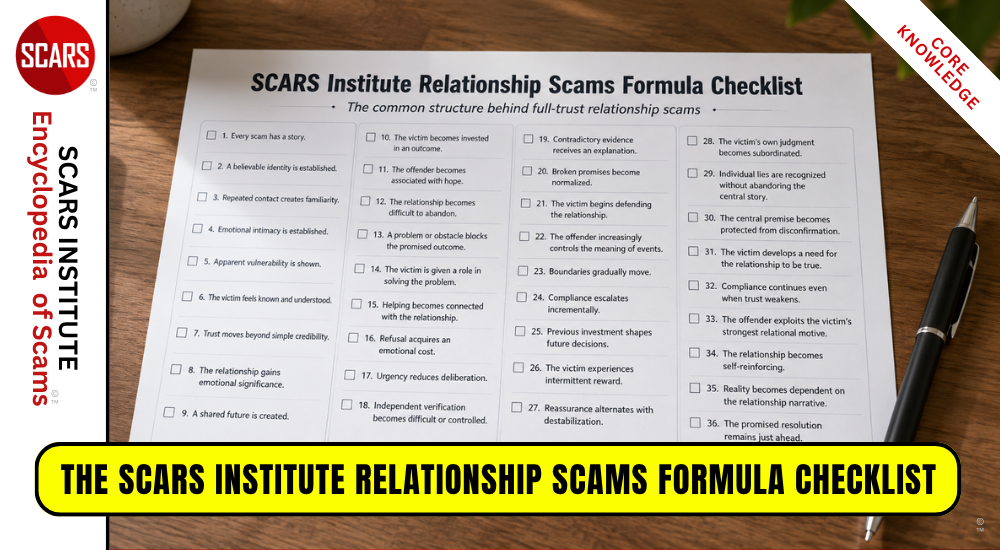
The SCARS Institute Relationship Scams Formula Checklist
This is the Formula that all Relationship Scams Follow
-/ 30 /-
What do you think about this?
Please share your thoughts in a comment below!
Table of Contents





In the U.S. & Canada
U.S. & Canada Suicide Lifeline 988
Please Leave A Comment!
Please tell us what you took from this?
Commenting is an essential part of healing
Read • Think • Write
Recent Comments
On Other Articles
- Cynthia Frank on The SCARS Institute Relationship Scams Formula Checklist – 2026: “As I read this I could see myself in every step with my scam. I gained a lot more knowledge…” Aug 28, 19:51
- on The Persistence of Danielle Delaunay as a Fake Identity – 2026: “Unfortunately, you are being scammed. She is using a fake name regardless. At this point, your best option is to…” Aug 26, 20:16
- on The Persistence of Danielle Delaunay as a Fake Identity – 2026: “Dear Sirs, I have met this woman with the name Abigail Boateng in Ghana. I have an intensive mail contact…” Aug 26, 12:28
- on Trauma-Induced Fear May Cause Paranoia: “Very interesting article. I’m wondering if someone would likely recognize that they’re becoming increasingly paranoid, or hypervigilant, or does it…” Aug 24, 12:07
- on Spotting AI Scams – Using AI to Catch Artificial Intelligence Scams – 2026: “Wow, very useful and thorough advice! I don’t plan on talking to any strangers online ever again, at least not…” Aug 22, 22:11
- on The Persistence of Danielle Delaunay as a Fake Identity – 2026: “Knowing they are criminals, why would you want to talk to them? Avoid all strangers online.” Aug 19, 12:54
- on The Persistence of Danielle Delaunay as a Fake Identity – 2026: “THERE ARE THREE DANIELLE DELAUNAYS ON FACEBOOK RIGHT NOW USEING HER NAME AND PHOTOS. I’M BEING TOLD THEY ARE ALL…” Aug 19, 11:15
- on Natalie Sparks: Have You Seen Her? Another Stolen Face / Stolen Identity: “John, we are sorry, but you are still being scammed.” Aug 19, 09:52
- on #1 Worldwide – SCARS Anyscam.com: “You have been scammed. The unfortunate part about the images is difficult to address. You can learn more about Sextortion…” Aug 19, 09:48
- on SCARS™ Scam News Now: Six Ghanaian Scammers Arrested in the U.K. For Online Fraud: “Ann, recognizing that it was a scam is the first step in healing. We can help in your after-scam healing…” Aug 19, 09:47
ARTICLE META
Important Information for New Scam Victims
- Please visit www.ScamVictimsSupport.org – a SCARS Website for New Scam Victims & Sextortion Victims
- Enroll in FREE SCARS Scam Survivor’s School now at www.SCARSeducation.org
- Please visit www.ScamPsychology.org – to more fully understand the psychological concepts involved in scams and scam victim recovery
If you are looking for local trauma counselors please visit counseling.AgainstScams.org or join SCARS for our counseling/therapy benefit: membership.AgainstScams.org
If you need to speak with someone now, you can dial 988 or find phone numbers for crisis hotlines all around the world here: www.opencounseling.com/suicide-hotlines
A Note About Labeling!
We often use the term ‘scam victim’ in our articles, but this is a convenience to help those searching for information in search engines like Google. It is just a convenience and has no deeper meaning. If you have come through such an experience, YOU are a Survivor! It was not your fault. You are not alone! Axios!
A Question of Trust
At the SCARS Institute, we invite you to do your own research on the topics we speak about and publish, Our team investigates the subject being discussed, especially when it comes to understanding the scam victims-survivors experience. You can do Google searches but in many cases, you will have to wade through scientific papers and studies. However, remember that biases and perspectives matter and influence the outcome. Regardless, we encourage you to explore these topics as thoroughly as you can for your own awareness.
Statement About Victim Blaming
SCARS Institute articles examine different aspects of the scam victim experience, as well as those who may have been secondary victims. This work focuses on understanding victimization through the science of victimology, including common psychological and behavioral responses. The purpose is to help victims and survivors understand why these crimes occurred, reduce shame and self-blame, strengthen recovery programs and victim opportunities, and lower the risk of future victimization.
At times, these discussions may sound uncomfortable, overwhelming, or may be mistaken for blame. They are not. Scam victims are never blamed. Our goal is to explain the mechanisms of deception and the human responses that scammers exploit, and the processes that occur after the scam ends, so victims can better understand what happened to them and why it felt convincing at the time, and what the path looks like going forward.
Articles that address the psychology, neurology, physiology, and other characteristics of scams and the victim experience recognize that all people share cognitive and emotional traits that can be manipulated under the right conditions. These characteristics are not flaws. They are normal human functions that criminals deliberately exploit. Victims typically have little awareness of these mechanisms while a scam is unfolding and a very limited ability to control them. Awareness often comes only after the harm has occurred.
By explaining these processes, these articles help victims make sense of their experiences, understand common post-scam reactions, and identify ways to protect themselves moving forward. This knowledge supports recovery by replacing confusion and self-blame with clarity, context, and self-compassion.
Additional educational material on these topics is available at ScamPsychology.org – ScamsNOW.com and other SCARS Institute websites.
Psychology Disclaimer:
All articles about psychology and the human brain on this website are for information & education only
The information provided in this article is intended for educational and self-help purposes only and should not be construed as a substitute for professional therapy or counseling.
While any self-help techniques outlined herein may be beneficial for scam victims seeking to recover from their experience and move towards recovery, it is important to consult with a qualified mental health professional before initiating any course of action. Each individual’s experience and needs are unique, and what works for one person may not be suitable for another.
Additionally, any approach may not be appropriate for individuals with certain pre-existing mental health conditions or trauma histories. It is advisable to seek guidance from a licensed therapist or counselor who can provide personalized support, guidance, and treatment tailored to your specific needs.
If you are experiencing significant distress or emotional difficulties related to a scam or other traumatic event, please consult your doctor or mental health provider for appropriate care and support.
Also read our SCARS Institute Statement about Professional Care for Scam Victims – click here to go to our ScamsNOW.com website.


Thank you for your comment. You may receive an email to follow up. We never share your data with marketers.