

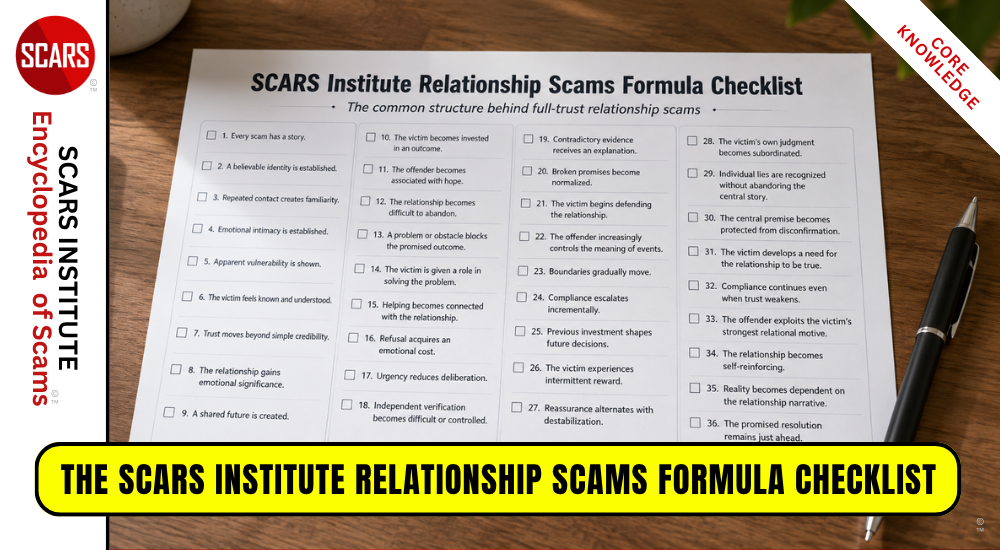

The SCARS Institute Relationship Scams Formula Checklist
This is the Formula that all Relationship Scams Follow
Catalog of Scams / How Scams Work – A SCARS Institute Insight
Author:
• Tim McGuinness, Ph.D., DFin, MCPO, MAnth – Anthropologist, Scientist, Director of the Society of Citizens Against Relationship Scams Inc.
See Author Biographies Below
Article Abstract
Relationship scams follow a recurring psychological structure in which the offender creates a story, establishes a believable identity, develops familiarity and emotional intimacy, builds trust, introduces hope and a shared future, and then links compliance to the preservation of the relationship. As the victim becomes emotionally and practically invested, obstacles, urgency, controlled verification, broken promises, and explanations for contradictory evidence can keep the central narrative intact. Previous investment, intermittent reassurance, shifting boundaries, and escalating requests can make withdrawal increasingly difficult. At full trust, the offender can influence not only what the victim believes but also how the victim interprets new information. The relationship itself becomes the mechanism through which attachment, empathy, obligation, hope, and decision-making are converted into compliance.
Keywords
Relationship Scams, Trust Manipulation, Scam Story, Emotional Intimacy, Compliance, Controlled Verification, Broken Promises, Escalating Investment, Reality Testing, Psychological Manipulation

The SCARS Institute Relationship Scams Formula Checklist
This is the Formula that all Relationship Scams Follow
Once a relationship scam has developed into a full trust relationship, the particular story can vary enormously, but the psychological structure becomes remarkably consistent. The offender can claim to be a romantic partner, friend, business partner, rescuer, celebrity, military member, professional, investor, caregiver, or someone connected to a crisis. What matters is that the victim has come to experience the offender as a trusted relationship rather than as an unknown person.
Understand: This works on EVERYONE! Unless, you know the formula and have made the behavioral changes necessary to prevent them. This is the “Heart of Darkness” at the center of EVERY SCAM – though individual scams may not contain all of them – they will have many of them.
Relationship Scam Full-Trust Checklist
☐ Every scam has a story. The story is the narrative framework that explains who the offender is, why the relationship exists, what is happening, what obstacles must be overcome, and why the victim eventually needs to act. It can involve romance, military service, business, inheritance, illness, kidnapping, stranded travel, legal trouble, investment, family crisis, danger, rescue, or countless other circumstances. The details vary, but the story gives meaning to every later request and creates the reality within which the victim interprets the relationship.
☐ A believable identity has been established. The offender has created or adopted a recognizable identity with a name, photographs, history, occupation, family, location, personality, and other details sufficient for the victim to experience the person as real.
☐ Repeated contact has created familiarity. Communication occurs frequently enough that the offender becomes part of the victim’s normal life. Familiarity gradually reduces the psychological distance that normally exists between strangers.
☐ Emotional intimacy has been established. Personal experiences, hopes, fears, losses, desires, family information, vulnerabilities, and private thoughts have been exchanged, creating the experience of genuine closeness.
☐ The offender has demonstrated apparent vulnerability. The offender shares personal pain, hardship, loneliness, family problems, trauma, danger, or other emotionally meaningful information that encourages reciprocal disclosure and trust.
☐ The victim feels known and understood. The offender remembers details, responds to emotional needs, mirrors values, and communicates in ways that make the victim feel unusually seen, accepted, appreciated, or understood.
☐ Trust has moved beyond simple credibility. The victim no longer merely believes that the offender is probably telling the truth. The victim begins using the offender’s statements as a trusted source for interpreting events and making decisions.
☐ The relationship has acquired emotional significance. Losing the relationship would now matter. The victim has something psychologically valuable to protect, whether that is love, companionship, belonging, purpose, hope, validation, friendship, or a shared mission.
☐ A shared future has been created. The offender introduces plans, expectations, commitments, meetings, marriage, business arrangements, travel, rescue, family life, financial security, or some other future in which both people remain connected.
☐ The victim becomes invested in an outcome. The relationship is no longer only about the present interaction. Something important is expected to happen later, and the victim begins making emotional, practical, or financial decisions in anticipation of that future.
☐ The offender becomes associated with hope. The relationship represents something the victim strongly wants, such as love, companionship, security, purpose, financial improvement, rescue, belonging, recognition, or restoration after loss.
☐ The relationship becomes difficult to abandon. Ending contact now carries emotional costs. Walking away means surrendering not only the offender but also the anticipated future, accumulated memories, prior sacrifices, and meaning attached to the relationship.
☐ A problem or obstacle prevents normal completion of the relationship. Something repeatedly stands between the victim and the promised outcome. The obstacle can involve travel, money, customs, business, medical emergencies, kidnapping, inheritance, military obligations, legal problems, frozen accounts, family crises, or countless other stories.
☐ The victim is given a role in solving the problem. The victim is no longer simply observing the offender’s difficulty. The victim becomes necessary to resolving it through money, action, secrecy, advocacy, logistical assistance, emotional support, accounts, documents, communications, or other participation.
☐ Helping becomes connected with the relationship. Compliance becomes psychologically associated with love, loyalty, friendship, responsibility, commitment, compassion, or proving trust.
☐ Refusal acquires an emotional cost. Saying no can begin to feel like abandonment, betrayal, selfishness, failure, disloyalty, or allowing something terrible to happen.
☐ Urgency reduces deliberation. The victim is pressured to act before careful verification, outside consultation, or emotional distance can interfere with compliance.
☐ Independent verification becomes difficult or controlled. Evidence comes primarily through the offender or people connected to the offender. Photographs, documents, screenshots, live locations, videos, phone calls, emails, supposed officials, associates, attorneys, doctors, soldiers, family members, or witnesses all remain inside the offender’s information environment.
☐ Contradictory evidence receives an explanation. Failed meetings, incorrect information, broken promises, missing money, suspicious documents, changing stories, or warnings from outsiders do not end the narrative. The offender supplies another explanation that keeps the larger relationship story intact.
☐ Broken promises become normalized. The promised event repeatedly fails to occur, but each failure is attributed to a new emergency, complication, misunderstanding, hostile third party, government problem, technical problem, or unexpected expense.
☐ The victim begins defending the relationship. Outside warnings can be interpreted as ignorance, misunderstanding, jealousy, lack of compassion, or failure to understand the unusual circumstances.
☐ The offender increasingly controls the meaning of events. When something goes wrong, the victim turns back to the offender for the explanation. This gives the offender growing influence over how contradictory information is interpreted.
☐ Boundaries gradually move. Requests that would have seemed unreasonable at the beginning become acceptable after trust, emotional investment, urgency, and previous compliance have developed.
☐ Compliance escalates incrementally. One favor leads to another. One payment makes the next payment easier to justify. Each previous commitment creates psychological pressure to continue toward the promised outcome.
☐ Previous investment becomes part of the decision. Money, time, emotion, secrecy, sacrifice, reputation, and hope already invested make abandonment increasingly painful because stopping can force the victim to confront the possibility that earlier sacrifices achieved nothing.
☐ The victim experiences intermittent reward. Affection, reassurance, apologies, promises, gratitude, apparent progress, emotional closeness, or temporary resolution appear between disappointments and crises, sustaining hope that the desired outcome is approaching.
☐ The offender alternates reassurance with destabilization. Security and uncertainty can be repeatedly introduced. The victim experiences relief when the offender restores connection or hope, strengthening attachment to the same person who helped create the distress.
☐ The victim’s own judgment becomes progressively subordinated. Suspicion can still appear, but the victim repeatedly overrides it because the emotional narrative, perceived responsibility, promised future, or consequences of refusing feel more important than the warning.
☐ The victim can recognize individual lies without abandoning the central story. A particularly important stage occurs when the victim knows the offender has lied about some things but continues believing the larger premise of the relationship.
☐ The central premise becomes protected from disconfirmation. New contradictions are absorbed into the story instead of being allowed to invalidate it. The narrative becomes increasingly capable of explaining its own failures.
☐ The victim develops a need for the relationship to be true. By this stage, truth carries psychological consequences. If the relationship is false, the victim can lose the person, the future, the meaning of previous sacrifices, confidence in judgment, and sometimes a significant portion of personal identity.
☐ Compliance becomes possible even when trust in the offender weakens. The victim can become angry, suspicious, or openly hostile toward the offender and still comply because another psychological force remains active, such as fear, obligation, rescue, hope, guilt, attachment, or the need to reach the promised conclusion.
☐ The offender exploits the victim’s strongest relational motive. The decisive motive differs among victims. It can be love, compassion, duty, rescue, loyalty, fear of loss, responsibility, protection, financial hope, spiritual obligation, or the need to prove commitment.
☐ The relationship becomes self-reinforcing. Trust creates compliance, compliance creates investment, investment increases the need for the story to be true, and that need makes further explanations and requests easier to accept.
☐ Reality becomes increasingly dependent on the relationship narrative. The victim can begin organizing decisions, emotions, finances, relationships, and expectations around the offender’s version of events.
☐ The promised resolution remains just ahead. The meeting, release, inheritance, return home, payment, marriage, rescue, legal resolution, investment payout, or other defining event remains close enough to preserve hope but repeatedly fails to arrive.
☐ The relationship ultimately becomes an instrument of exploitation. The trusted relationship is not incidental to the crime. It is the mechanism through which normal human attachment, empathy, obligation, trust, hope, and decision-making are converted into compliance.
NOTES:
The first checkbox is foundational because the story is the container for the entire scam. Identity, intimacy, obstacles, emergencies, proof, excuses, requests, broken promises, and future expectations all have to fit inside a narrative that the victim experiences as coherent.
Once the story has been accepted, later manipulation does not arrive as disconnected information. It arrives as another chapter in an already established reality. That is why seemingly absurd explanations can become believable inside a mature relationship scam even though the same explanation would be rejected immediately if presented by a stranger.
At full trust, the offender is therefore manipulating more than the victim’s belief in individual statements. The offender is manipulating the story through which the victim interprets everything else.
Exception: Instant Relationship Scams and Borrowed Trust
Not every relationship scam requires weeks or months of grooming, repeated contact, emotional intimacy, and gradual trust development. An important exception involves what can be called an instant relationship scam. In these scams, the offender does not need to create a new trusted relationship because the trust already exists. The scammer temporarily takes possession of an existing relationship, or exploits the victim’s emotional responsibility toward someone they already love.
Grandparent scams are a clear example. A victim receives a call or message claiming that a grandchild has been injured, arrested, kidnapped, stranded, or placed in some other emergency. The offender can impersonate the grandchild directly or claim to be a police officer, attorney, doctor, jail official, kidnapper, or another person communicating on the grandchild’s behalf. The victim has little or no relationship with the offender, but that does not matter. The emotional relationship being exploited is the existing relationship with the grandchild.
The normal relationship scam formula has therefore been compressed. The scammer does not need to create familiarity, attachment, emotional significance, or a compelling future because those psychological conditions already exist. The offender borrows the victim’s established trust, love, responsibility, and protective instincts and immediately connects them to a fabricated crisis.
The story remains essential. In fact, the story becomes even more important because it must explain why immediate action is necessary, why normal verification cannot occur, why the loved one cannot communicate normally, and why the victim must provide money or assistance immediately. The story typically combines emotional importance with urgency and consequences: someone the victim cares about is suffering, and something terrible can happen if the victim does not act.
Relevant examples include:
- Grandparent scams, where a supposed grandchild needs bail, medical assistance, transportation, ransom, or emergency money.
- Family emergency impersonation scams, where a child, sibling, spouse, parent, or other relative supposedly faces an accident, arrest, hospitalization, robbery, or travel emergency.
- Virtual kidnapping scams, where offenders falsely claim that a family member has been kidnapped and demand immediate ransom.
- AI voice impersonation scams, where cloned or manipulated audio is used to make an emergency request appear to come directly from a trusted family member.
- Compromised account scams, where an offender gains control of a friend’s or relative’s email, messaging, or social media account and requests emergency assistance from established contacts.
- Friend in distress scams, where someone appearing to be a known friend claims to have lost a wallet, become stranded, been robbed, suffered an accident, or encountered another urgent problem.
- Bail and jail scams, where the victim is told that a loved one has been arrested and immediate payment is required for bail, legal representation, fines, or release.
- Medical emergency scams, where a supposed hospital employee, doctor, family member, or intermediary claims that someone close to the victim requires immediate payment for treatment or transportation.
- Stranded traveler scams, where a trusted person supposedly loses money, identification, tickets, or access to accounts while traveling and urgently needs financial help.
- Impersonated caregiver or helper scams, where someone claiming to be assisting a family member requests money because the loved one is supposedly unable to communicate or manage the emergency personally.
- Workplace relationship impersonation scams, where a familiar supervisor, colleague, business partner, or organizational leader is impersonated and the existing professional relationship is used to obtain urgent compliance.
- Religious or community relationship impersonation scams, where an offender impersonates a pastor, clergy member, community leader, volunteer coordinator, or another trusted person and uses the established relationship to request urgent assistance.
These scams are not true exceptions to the deeper psychological formula. They are exceptions primarily to the time required to establish the relationship.
- In a conventional relationship scam, the offender must manufacture trust.
- In an instant relationship scam, the offender steals access to trust that already exists.
The crucial relationship is therefore not always between the victim and the scammer. It can be between the victim and the person supposedly endangered. The offender only needs to create a convincing enough story to connect that existing attachment with an urgent demand.
This distinction is important for prevention. A person who understands long-term grooming can still be vulnerable to an instant relationship scam because there is no obvious grooming period to recognize. The protective rule must therefore extend beyond unfamiliar relationships: whenever a request for money, secrecy, access, or immediate action is connected to an emergency involving someone important, the emergency itself must be independently verified through a separate and trusted communication channel before action is taken.
Conclusion
Relationship scams succeed because they create more than a believable lie. They create a believable world. The offender constructs a story, establishes an identity, develops familiarity, builds emotional intimacy, creates hope, introduces a shared future, and gradually places the victim inside a narrative in which the offender becomes a trusted source of meaning. Once that relationship reaches full trust, later manipulation can become increasingly difficult to evaluate independently because new events are interpreted through the framework the offender has already established.
The process becomes more powerful as the victim is given a role in solving problems, helping the offender, protecting the relationship, or reaching the promised outcome. Refusal acquires an emotional cost, urgency reduces deliberation, verification becomes controlled, and contradictory evidence receives explanations that preserve the larger story. Broken promises can then become normalized rather than treated as reasons to abandon the relationship.
As investment increases, the relationship can become increasingly self-reinforcing. Previous payments, sacrifices, hopes, secrets, and emotional commitments make withdrawal more difficult because abandoning the relationship can also mean abandoning the future attached to it. The victim can recognize individual lies, become suspicious of the offender, and still continue complying because the central story remains psychologically protected.
The central protective insight is that every relationship scam has a story, and that story should never be allowed to replace independent reality testing. Trust should not eliminate verification. Emotional intimacy should not override evidence. Urgency should not prevent consultation. Previous investment should not determine future decisions. A relationship that demands secrecy, escalating sacrifice, repeated explanations for broken promises, and continuing suspension of ordinary judgment has moved away from healthy trust and toward manipulation.
Recognizing the formula gives victims something more useful than another list of scam types. It gives them a way to identify the structure beneath the story. Once that structure becomes visible, the relationship can be evaluated by evidence rather than by the emotional world the offender has constructed.
You can learn more about the specific techniques and psychological vulnerabilities at www.ScamsNOW.com and www.ScamPsychology.org

Glossary
- Behavioral Change for Scam Prevention — Behavioral change for scam prevention refers to the practical changes a person makes after learning how relationship scams establish trust and influence decisions. Knowledge alone does not provide complete protection if familiar habits involving verification, urgency, secrecy, or financial decisions remain unchanged. Effective prevention requires translating recognition of the scam formula into repeatable protective behaviors. — Victim Safety
- Believable Identity Construction — Believable identity construction is the process through which an offender creates or adopts an identity containing enough personal detail to appear authentic. Names, photographs, occupations, histories, locations, family information, and personality traits can be combined into a convincing human presentation. The constructed identity gives the developing relationship a recognizable person around whom trust can form. — Scam Tactics
- Believable World — A believable world is the larger reality created when the offender’s identity, story, relationship, problems, explanations, and future expectations become psychologically coherent for the victim. Individual claims become easier to accept because they fit within an established narrative rather than appearing as unrelated assertions. The scam becomes more persuasive when the victim evaluates new information from inside this constructed world. — Scam Structure
- Boundary Movement — Boundary movement occurs when requests or behaviors that would previously have seemed unacceptable gradually become tolerable within an established relationship. Emotional investment, urgency, prior compliance, and increasing trust can shift the victim’s practical limits over time. The gradual nature of the change can make each individual concession seem smaller than the total movement that has occurred. — Emotional Manipulation
- Broken Promise Normalization — Broken promise normalization occurs when repeated failures by the offender stop functioning as decisive evidence against the relationship. Each missed meeting, failed payment, delayed return, or unfulfilled commitment receives another explanation that allows the larger story to continue. Repetition can gradually make extraordinary failure seem like an expected feature of the relationship rather than a reason to leave it. — Belief Distortion
- Central Premise Protection — Central premise protection occurs when the victim continues preserving the main relationship story even after individual claims have been disproven. Contradictory evidence becomes incorporated into new explanations instead of being allowed to invalidate the central premise. This allows the offender’s larger narrative to survive repeated failures that would ordinarily destroy credibility. — Belief Distortion
- Central Story — The central story is the primary narrative that explains the offender’s identity, circumstances, relationship, obstacles, and expected future. Individual lies can sometimes be recognized without causing the victim to abandon this broader narrative. The central story becomes especially powerful when emotional investment makes its collapse psychologically costly. — Scam Structure
- Compliance Escalation — Compliance escalation is the progressive movement from smaller forms of assistance toward increasingly significant actions, sacrifices, or payments. Each previous act of compliance can make the next request seem like a continuation of an existing commitment rather than an entirely new decision. The accumulated pattern can move the victim far beyond limits that would have existed at the beginning of the relationship. — Decision-Making Pattern
- Compliance Under Weakened Trust — Compliance under weakened trust occurs when a victim continues acting for the offender despite growing suspicion, anger, or recognition of dishonesty. The behavior can continue because fear, obligation, hope, rescue motives, guilt, attachment, or the desire for final resolution remain psychologically active. Trust in individual statements can therefore weaken without immediately ending the offender’s influence. — Psychological Vulnerability
- Contradictory Evidence Management — Contradictory evidence management is the process through which an offender supplies explanations for facts that threaten the established relationship narrative. Failed meetings, suspicious documents, missing money, changing stories, and outside warnings can all be reframed as temporary complications. Effective manipulation keeps the contradiction inside the story rather than allowing it to become evidence against the story itself. — Scam Tactics
- Controlled Information Environment — A controlled information environment exists when the victim receives most relevant evidence through the offender or through people, accounts, documents, communications, or supposed authorities connected to the offender. Information can appear diverse while still originating from the same fraudulent network. This structure limits the victim’s access to genuinely independent confirmation. — Social Engineering
- Controlled Verification — Controlled verification occurs when apparent proof is provided in a form that remains under the offender’s influence. Screenshots, photographs, documents, live locations, messages, videos, supposed witnesses, professionals, or officials can create the appearance of confirmation without supplying independent evidence. Victims benefit from distinguishing information presented by the relationship from verification obtained outside it. — Verification Practice
- Emotional Cost of Refusal — Emotional cost of refusal develops when saying no becomes associated with consequences such as abandonment, betrayal, selfishness, disloyalty, failure, or responsibility for another person’s suffering. The request therefore becomes more than a practical decision about money or assistance. The victim can experience refusal as a threat to personal values, the relationship, or another person’s welfare. — Emotional Manipulation
- Emotional Investment in the Relationship — Emotional investment in the relationship develops as the victim contributes attention, hope, affection, vulnerability, time, secrecy, sacrifice, and personal meaning to the connection. Greater investment increases the psychological importance of preserving the relationship and its expected future. Leaving can become increasingly difficult because the victim is surrendering accumulated emotional commitments as well as the offender. — Attachment
- Emotional Significance of the Relationship — Emotional significance of the relationship exists when losing the connection would represent a meaningful personal loss. The relationship can become associated with love, belonging, companionship, validation, purpose, friendship, recognition, or a shared mission. Once this significance develops, decisions involving the offender can no longer be evaluated as if they concerned an emotionally neutral stranger. — Attachment
- Evidence Override by Emotional Intimacy — Evidence override by emotional intimacy occurs when the emotional meaning of a trusted relationship becomes more influential than contradictory factual information. The victim can notice inconsistencies while still prioritizing the established bond, shared history, or anticipated future. Healthy decision-making requires evidence to retain its importance even when emotional closeness is strong. — Decision-Making Pattern
- Familiarity Through Repeated Contact — Familiarity through repeated contact develops when frequent communication makes the offender a normal and expected part of the victim’s daily life. Continued interaction reduces the psychological distance usually associated with an unfamiliar person. Familiarity can then contribute to credibility because the offender begins to feel known long before the identity has necessarily been independently verified. — Scam Tactics
- Full Trust Relationship — A full trust relationship exists when the victim experiences the offender as a trusted person rather than merely as an online contact or stranger. The offender’s statements can begin influencing how events are interpreted and how important decisions are made. At this stage, the relationship itself becomes a major source of credibility and psychological influence. — Scam Structure
- Future Attached to the Relationship — A future attached to the relationship develops when the victim begins anticipating marriage, travel, financial security, rescue, family life, business success, companionship, or another meaningful outcome involving the offender. The imagined future gives present sacrifices a purpose. Abandoning the relationship can therefore feel like losing something that has not happened yet but has already become psychologically important. — Future Orientation
- Helping as a Relationship Obligation — Helping as a relationship obligation occurs when assistance becomes psychologically linked with love, loyalty, compassion, friendship, commitment, or responsibility. The victim can come to experience compliance as something a caring or trustworthy person should provide. This reframes an offender’s request from an external demand into a perceived obligation created by the relationship itself. — Emotional Manipulation
- Hope Association — Hope association develops when the offender or relationship becomes connected with something the victim strongly desires. The desired outcome can involve companionship, love, belonging, financial improvement, rescue, security, recognition, purpose, or restoration after loss. Threats to the relationship can then become threats to the hope that has been psychologically attached to it. — Hope Distortion
- Independent Reality Testing — Independent reality testing is the practice of evaluating claims through evidence that does not depend upon the offender or the relationship narrative. It allows the victim to compare what is being said with information obtained from reliable outside sources. Maintaining this separation becomes especially important when emotional trust has become strong enough to influence interpretation. — Reality Testing
- Independent Verification — Independent verification means confirming important claims through sources that are genuinely separate from the person making the claim. Evidence supplied by the offender, associates, documents, accounts, or supposed professionals controlled by the same network does not provide true independence. Verification protects decision-making by creating an external reference point outside the relationship. — Verification Practice
- Instrument of Exploitation — An instrument of exploitation is a trusted relationship that has been converted into the mechanism through which the offender obtains compliance. Attachment, empathy, trust, obligation, hope, and ordinary relationship behavior become resources the offender can manipulate. The relationship is therefore not merely a background feature of the crime because it becomes an operational tool used to produce actions from the victim. — Scam Tactics
- Intermittent Reward — Intermittent reward occurs when affection, reassurance, gratitude, apologies, apparent progress, renewed closeness, or promises appear between periods of crisis and disappointment. These positive experiences restore hope and make continued participation feel capable of producing the desired outcome. Unpredictable reassurance can strengthen persistence because the victim does not know when the next rewarding interaction will arrive. — Emotional Manipulation
- Investment in an Outcome — Investment in an outcome develops when the victim begins making emotional, practical, or financial decisions based upon an expected future result. The relationship becomes connected to something that is supposed to happen later rather than existing only in the present. Increasing investment can make the promised outcome more psychologically important and abandonment more difficult. — Decision-Making Pattern
- Meaning Control — Meaning control occurs when the offender gains increasing influence over how the victim interprets confusing, contradictory, or troubling events. When something goes wrong, the victim returns to the same person responsible for the narrative to obtain an explanation. This allows the offender to shape not only information but also the meaning assigned to that information. — Psychological Manipulation
- Narrative Framework — A narrative framework is the organized story that explains who the offender is, why the relationship exists, what circumstances are occurring, what obstacles must be overcome, and why the victim needs to act. Later requests acquire meaning because they are placed inside this framework. A convincing framework can make extraordinary claims seem internally consistent even when they would appear implausible in isolation. — Scam Structure
- Need for the Relationship to Be True — The need for the relationship to be true develops when accepting fraud would threaten more than belief in the offender. The victim can face the loss of an anticipated future, accumulated sacrifices, confidence in judgment, emotional meaning, and parts of personal identity connected with the relationship. This psychological cost can make disconfirming evidence exceptionally difficult to accept. — Psychological Vulnerability
- Offender Controlled Interpretation — Offender controlled interpretation develops when the person responsible for the deception also becomes the primary source explaining suspicious events. Every contradiction can then receive a story that preserves the relationship and redirects the victim’s attention. The victim becomes increasingly dependent upon the offender’s interpretation rather than evaluating events from an independent position. — Psychological Manipulation
- Outside Warning Rejection — Outside warning rejection occurs when concerns from family members, friends, professionals, financial institutions, or other observers are discounted in favor of the relationship narrative. Warnings can be interpreted as jealousy, ignorance, misunderstanding, hostility, or lack of compassion. This reaction protects the relationship from information that might otherwise interrupt the scam. — Belief Distortion
- Perceived Responsibility — Perceived responsibility develops when the victim believes personal action is necessary to protect the offender, preserve the relationship, solve an emergency, or prevent a feared consequence. The sense of responsibility can become powerful enough to override suspicion or financial boundaries. Offenders can exploit this motive by making the victim feel uniquely necessary to resolving the problem. — Emotional Manipulation
- Previous Investment Pressure — Previous investment pressure occurs when money, time, secrecy, emotion, sacrifice, reputation, or hope already committed begins influencing whether the victim continues. Stopping can force recognition that earlier sacrifices did not achieve the promised result. Continuing can preserve the possibility that another action will finally make those investments meaningful. — Decision-Making Pattern
- Problem or Obstacle — A problem or obstacle is the circumstance that prevents the relationship from reaching its promised next stage. Travel difficulties, customs problems, medical emergencies, legal issues, kidnapping claims, frozen accounts, business complications, military obligations, or family crises can all serve this function. The obstacle creates the reason the victim must become involved in solving something that supposedly blocks the desired future. — Scam Tactics
- Promised Outcome — A promised outcome is the future result toward which the relationship and the victim’s efforts are directed. It can involve a meeting, marriage, rescue, release, financial return, inheritance, homecoming, business success, or another meaningful resolution. The expectation of reaching that outcome gives current sacrifices a continuing psychological justification. — Future Orientation
- Promised Resolution — Promised resolution refers to the repeatedly anticipated moment when the relationship’s central problem is finally supposed to be solved. The resolution remains close enough to sustain hope but repeatedly moves farther away through new complications or demands. This structure encourages continued effort because the victim can feel that success is always one final step away. — Scam Tactics
- Reciprocal Disclosure — Reciprocal disclosure occurs when personal information appears to be exchanged mutually between the offender and victim. The offender’s apparent openness about hardship, history, loneliness, family, vulnerability, or emotional pain encourages the victim to share similarly personal information. This exchange creates a sense of intimacy while also giving the offender valuable information about emotional needs and vulnerabilities. — Emotional Manipulation
- Reassurance and Destabilization Cycle — The reassurance and destabilization cycle develops when periods of uncertainty, crisis, withdrawal, or disappointment are followed by renewed affection, hope, explanation, or apparent progress. The victim experiences relief when emotional security returns. Repetition can strengthen attachment because the same relationship becomes associated with both the distress and the relief that follows it. — Emotional Manipulation
- Relational Motive Exploitation — Relational motive exploitation occurs when the offender identifies and uses the motive most capable of producing continued cooperation. Love, compassion, rescue, loyalty, protection, responsibility, financial hope, spiritual obligation, or fear of loss can each become the dominant influence. The specific motive varies, but the offender uses it to convert relationship meaning into action. — Psychological Manipulation
- Relationship Defense — Relationship defense occurs when the victim begins protecting the relationship against criticism or contradictory outside information. Warnings can be reinterpreted as evidence that outsiders do not understand the unusual circumstances. Defensive behavior helps preserve the relationship narrative and can further separate the victim from sources capable of challenging it. — Belief Distortion
- Relationship Narrative Dependence — Relationship narrative dependence develops when decisions, emotions, expectations, finances, and interpretations become increasingly organized around the offender’s version of events. The victim begins relying on the relationship narrative as a framework for understanding what is happening. Independent evidence can lose influence because the narrative has become the primary structure through which new information receives meaning. — Psychological Vulnerability
- Relationship Story — A relationship story is the evolving narrative connecting the offender’s identity, emotional bond, circumstances, problems, promises, explanations, and future with the victim. Its power comes from coherence rather than from any single claim. Once accepted, later manipulations can appear to be natural developments within an already familiar relationship rather than separate attempts at deception. — Scam Structure
- Role in Solving the Problem — A role in solving the problem is created when the victim becomes necessary to overcoming the obstacle presented by the offender. The required role can involve money, secrecy, communications, accounts, advocacy, documents, logistical assistance, or emotional support. Participation increases investment because the victim moves from observing the story to becoming an active character within it. — Scam Tactics
- Secrecy and Escalating Sacrifice — Secrecy and escalating sacrifice describe a warning pattern in which the relationship increasingly requires concealment while also demanding greater personal costs. The costs can involve money, time, reputation, emotional energy, or conflict with trusted outsiders. A relationship that repeatedly requires both secrecy and increasing sacrifice deserves independent examination because these conditions reduce protective oversight. — Victim Safety
- Self-Reinforcing Relationship — A self-reinforcing relationship develops when trust encourages compliance, compliance creates investment, and investment increases the victim’s need for the relationship story to remain true. That stronger need can make later explanations and requests easier to accept. Each stage therefore strengthens conditions that support the next stage of the scam. — Scam Structure
- Shared Future Construction — Shared future construction occurs when the offender creates plans in which the victim and offender are expected to remain connected. Marriage, travel, family life, business arrangements, financial security, rescue, meetings, or relocation can become part of this imagined future. The future increases emotional commitment because the victim begins psychologically living toward an outcome that has not yet occurred. — Future Orientation
- Story Acceptance — Story acceptance occurs when the victim begins treating the offender’s narrative as a coherent explanation of the relationship and surrounding events. Once accepted, later claims arrive as developments within an existing reality rather than as isolated propositions requiring fresh evaluation. This shift can make increasingly unusual explanations easier to absorb because they remain connected to the original story. — Belief Formation
- Story Based Interpretation — Story based interpretation occurs when new information is evaluated according to how well it fits the established relationship narrative. Events that should challenge the scam can instead be explained as additional complications within it. The stronger the narrative becomes, the more difficult it can be for isolated contradictory facts to overturn the victim’s overall understanding. — Cognitive Bias
- Story Container — The story container is the narrative structure that holds the offender’s identity, intimacy, obstacles, emergencies, evidence, excuses, requests, broken promises, and future expectations together. Each new development gains plausibility because it occupies a place within the same continuing account. The story therefore organizes the scam into a psychologically coherent experience rather than a collection of disconnected claims. — Scam Structure
- Trusted Source of Meaning — A trusted source of meaning is a person whose explanations influence how another person understands events, contradictions, and decisions. In a mature relationship scam, the offender can move beyond being believed and become the person the victim consults to determine what confusing events mean. This position gives the offender substantial influence over interpretation as well as behavior. — Trust Manipulation
- Trust Beyond Simple Credibility — Trust beyond simple credibility develops when the victim no longer merely considers the offender believable but begins relying upon the offender’s statements when interpreting events and making decisions. The relationship becomes a source of guidance rather than simply information. This deeper trust significantly increases the offender’s ability to influence responses to uncertainty, urgency, and contradictory evidence. — Trust Manipulation
- Urgency Pressure — Urgency pressure is the use of time sensitivity to reduce careful deliberation before the victim acts. An emergency, deadline, danger, financial consequence, or threatened relationship loss can make immediate action feel necessary. The shortened decision window interferes with outside consultation, independent verification, and the emotional distance needed for more deliberate judgment. — Scam Tactics
- Victim Judgment Subordination — Victim judgment subordination occurs when personal doubts remain present but are repeatedly overridden by the relationship narrative, perceived responsibility, hope, emotional investment, or feared consequences of refusing. The victim has not necessarily stopped recognizing warning signs. Those warnings have become less influential than the psychological forces supporting continued involvement. — Decision-Making Pattern
- Withdrawal Difficulty — Withdrawal difficulty develops when ending the relationship requires surrendering more than contact with the offender. The victim can also face the loss of the imagined future, accumulated sacrifices, emotional memories, hope, personal meaning, and confidence in earlier decisions. Increasing psychological cost helps explain why recognition of serious problems does not always produce immediate disengagement. — Recovery Insight
Author Biographies
One Comment
Leave A Comment
Thank you for your comment. You may receive an email to follow up. We never share your data with marketers.


As I read this I could see myself in every step with my scam. I gained a lot more knowledge of what to be careful of in the present n future. I knew at some point he wasn’t who he said he was but I overlooked it so I could continue to receive the reward of love or rather fake love as I see it now.