



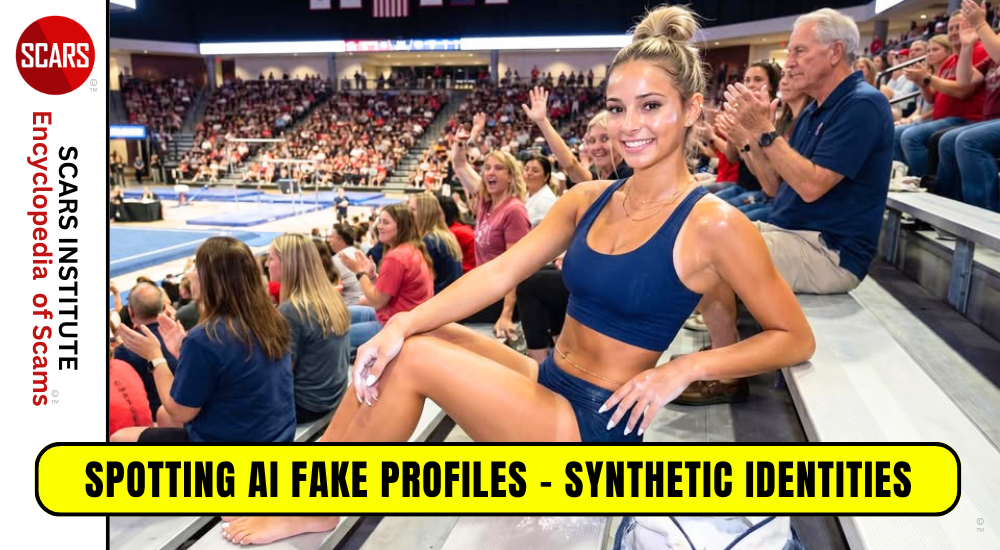

SCARS Institute’s Encyclopedia of Scams™ Published Continuously for 25 Years


The New Era of Synthetic Fake Profiles – Completely AI-Generated
A SCARS Institute Quick Guide:
How to Recognize an AI-Created Fake Social Media Profile
How Scams Work – A SCARS Institute Insight
Article Abstract
AI-generated social media identities require a different approach to verification because realistic photographs and videos no longer provide reliable evidence that a person exists. Synthetic profiles may contain large amounts of polished content while lacking normal signs of an authentic human history, including longstanding relationships, photographs uploaded by others, family interactions, employment records, shared experiences, and independent social connections. Warning signs include recently assembled timelines, engagement bait, audiences dominated by strangers, external links, inconsistent visual details, exaggerated personal desirability, and limited independent corroboration. Follower counts and popularity do not establish authenticity, and reverse-image searches are less useful when images are generated rather than stolen. Effective verification increasingly depends on confirming the claimed identity through independent people, organizations, records, and historical evidence outside the profile itself.
Keywords
AI-Generated Profiles, Synthetic Identities, Fake Social Media Profiles, Identity Verification, Romance Scams, Engagement Bait, Artificial Intelligence, Online Fraud, Social Media Scams, Digital Identity

A SCARS Institute Quick Guide:
How to Recognize an AI-Created Fake Social Media Profile
Author’s Note
Artificial intelligence has fundamentally changed the problem of online identity verification. The growing ability to create realistic faces, voices, photographs, videos, and entire fictional lifestyles means that visual credibility can no longer be treated as evidence of identity. The more important skill is learning to distinguish between a convincing presentation and a verifiable human life. Understanding that difference will become increasingly important for scam prevention as synthetic personas become more sophisticated and more difficult to recognize by appearance alone.
Introduction to Spotting Synthetic Identities on Social Media
AI-generated social media profiles are becoming dramatically more convincing. Criminals and deceptive account operators no longer need to steal photographs from an identifiable real person. Artificial intelligence now allows them to manufacture an entire human identity: photographs, videos, clothing, homes, vacations, restaurants, pets, workplaces, hobbies, and apparently spontaneous moments from a life that never existed.
This changes how fake profiles must be recognized.
For many years, people were taught to inspect photographs for obvious mistakes: strange hands, distorted teeth, mismatched eyes, malformed jewelry, impossible reflections, or text that made no sense. Those clues remain useful when they appear, but they are becoming steadily less dependable. High-quality AI-generated faces and videos can now look extraordinarily realistic.
The more important question is no longer simply: “Does this photograph look real?”
The better question is: “Does this person have a verifiable human life?”
That difference is becoming central to identifying synthetic identities.
Look for an Artificial Life, Not Just an Artificial Photograph
A real person’s social media account usually contains the accumulated disorder of an actual life.
Photographs were taken with different cameras over many years. Lighting changes. Hairstyles change. Weight changes. Friends appear and disappear. Some photographs are flattering and others are terrible. Birthday parties, workplaces, family events, vacations, illnesses, weddings, pets, restaurants, and ordinary afternoons appear without following any particular aesthetic plan.
There are also interactions that were never intended for strangers. A cousin makes a joke nobody else understands. An old friend refers to something that happened ten years ago. Someone tags the person in an unflattering photograph. A coworker comments about yesterday’s meeting. A family member argues about where everyone will meet for Thanksgiving.
A synthetic profile frequently contains enormous amounts of content while possessing remarkably little actual life.
The photographs may be beautiful. The videos may be convincing. The person may appear in dozens of locations. Yet almost everything seems to exist for the audience rather than because something happened in the person’s life.
That distinction is important. AI can manufacture photographs. It is considerably harder to manufacture years of independent human history.
Look for the Missing Ordinary Life
Fake profiles frequently present an unusually polished existence. The person is attractive, the clothing is appealing, the settings are interesting, and the photographs appear designed to generate attention.
- What is missing is frequently more revealing than what is present.
- Where are the mediocre photographs?
- Where are the old school friends?
- Where are photographs uploaded by other people?
- Where are the family members with years of visible interaction?
- Where are old birthday greetings, workplace conversations, ordinary complaints, local events, shared memories, and the thousands of small connections that accumulate around a real human being?
A profile does not need to contain all of these things to be legitimate. Privacy-conscious people maintain very limited accounts. The point is to examine whether the profile’s claimed identity is independently supported.
A person claiming to have lived an active public life for decades should normally leave some evidence beyond photographs uploaded by the account itself.
Examine the Timeline
Time is one of the most useful tools for detecting manufactured identities.
A profile may appear to contain hundreds of photographs while nearly all of them were posted within several days. Sometimes large groups of images appear within days or weeks of one another, creating the impression of a history that was actually assembled very recently.
- Ask how far back the account genuinely goes.
- Do the early posts resemble the same person?
- Are there natural changes over time?
- Were other people interacting with the account years before its current popularity?
- Does the account possess a history, or has someone simply populated it with content?
This becomes particularly important when the biography implies a substantial personal or professional history that is not reflected in the account.
Examine the Social Network, Not the Follower Count
A large follower count does not establish authenticity. An AI-created persona can accumulate thousands or even millions of followers precisely because its content is designed to attract attention.
Instead of asking how many people follow the account, ask what kinds of relationships exist around it.
Ten genuine relationships can tell more about identity than 20,000 followers.
Look for people who clearly know the individual. Their conversations should contain context. They may mention family, shared experiences, workplaces, schools, local places, previous events, or mutual acquaintances.
Then examine the broader audience.
Synthetic personas frequently develop an audience rather than a community. The comments come largely from strangers. Many comments are generic expressions of attraction, admiration, or availability. The supposed account owner rarely interacts as though these people are actual friends.
This distinction between a social network and an audience is extremely useful. Real people generally have both. A fabricated romantic persona may have almost nothing except the audience.
Pay Attention to Engagement Bait
One of the clearest behavioral patterns in many synthetic accounts is repeated solicitation of interaction.
Posts repeatedly ask strangers to say hello, leave a comment, identify where they live, state their age, indicate whether they are single, or declare whether they find the person attractive.
A single post like this means very little. A profile organized around this behavior deserves closer examination.
Messages such as “Say hi,” “Let me know,” “Would you date me?”, “Where are the good men?”, or “Comment if you agree” perform an important function. They cause interested people to identify themselves.
For a deceptive operator, this can be extremely valuable.
- Someone who responds, “I’m single,” has supplied relationship information.
- Someone writing, “I’m 67 and looking for someone,” has supplied age and romantic availability.
- Someone saying, “You’re beautiful, message me,” has announced susceptibility to direct contact.
The profile does not need to search for potential targets individually. The audience begins sorting itself.
This is one reason synthetic romantic personas can be so effective.
Look for the External Funnel
Another important warning sign appears when a profile encourages visitors to leave the original platform.
The account may direct users toward another social network, messaging service, subscription platform, dating site, personal webpage, shortened URL, or unfamiliar service.
An external link by itself does not prove fraud. Millions of legitimate creators and businesses use them.
The important issue is the behavioral sequence.
An attractive persona draws attention.
- The content suggests romantic or personal availability.
- The account encourages interaction.
- The visitor is then directed somewhere else.
That pattern deserves scrutiny because moving a person away from the original platform can reduce moderation, reporting mechanisms, identity verification, and other protections.
The destination should be examined independently before following it or providing personal information.
Compare the Person Across Images
Visual inspection still has value.
Instead of staring at one photograph searching for six fingers, compare many images of the supposed person. Look carefully at facial proportions, ears, teeth, hairline, eye spacing, moles, scars, tattoos, jewelry, body proportions, and apparent age.
A synthetic identity generated across many images may remain remarkably consistent, but small differences sometimes appear.
- The same necklace may subtly change.
- A tattoo may move or disappear.
- The ears may have different shapes.
- Teeth may change between photographs.
- Hair may interact strangely with clothing.
- Age may fluctuate unnaturally.
- In videos, listen carefully to the accent? Does it move from American to Australian to English – even if only subtly?
These are clues, not proof.
AI systems are improving rapidly, so visual inconsistencies should be considered supporting evidence rather than the primary test.
Inspect the World Around the Person
Sometimes the strongest AI clues are not found in the face at all.
- Look at background people, hands, reflections, architecture, written signs, vehicles, furniture, clothing seams, eyeglasses, jewelry, shadows, and objects being held.
- Ask whether reflections correspond to what should be present.
- Look at people standing behind the subject. AI frequently devotes the greatest detail to the central face while treating background people less carefully.
- Examine written language on shirts, buildings, signs, menus, and advertisements.
- Look for objects that merge unnaturally into one another or structures that become geometrically impossible.
Again, these clues are becoming less frequent as generation improves. Their absence should never be interpreted as proof that the image is genuine.
Look for an Identity That Is Almost Too Convenient
Romance-oriented synthetic identities frequently combine a remarkably attractive collection of characteristics.
- The person is physically appealing but lonely.
- Successful but emotionally available.
- Affluent but strangely unable to resolve certain problems.
- Well traveled but difficult to meet.
- Romantic but isolated.
- Interested in strangers but surrounded by very few verifiable real relationships.
There is frequently an explanation for why ordinary verification cannot happen.
The individual may travel constantly, work overseas, have security restrictions, experience repeated emergencies, possess unusual professional obligations, or simply be perpetually unavailable for spontaneous interaction.
Each circumstance individually is possible. The accumulation is what matters.
Verify the Person Outside the Profile
Social media profiles should not be allowed to authenticate themselves.
Search independently.
- Look for the person’s name, employer, occupation, professional licenses, business ownership, school history, publications, sports participation, local organizations, awards, relatives, or other claims.
- Reverse-image searching remains useful when photographs have been stolen from another person. However, synthetic profiles create a new problem: an AI-generated face may have no previous internet history because the person never existed.
- A reverse-image search returning nothing is no longer reassuring.
- Instead, search for evidence of the human being.
If someone claims to be a surgeon, architect, military officer, professor, business owner, engineer, entertainer, model, or executive, there should frequently be some independent evidence associated with that professional life.
Verification should come from sources the account owner does not control.
Do Not Let Popularity Authenticate Identity
This is an increasingly dangerous mistake.
Thousands of reactions do not prove that the person exists. Hundreds of comments do not establish identity. A large follower count proves only that the account has attracted followers.
Artificial personas can become extremely popular precisely because their appearance and content can be optimized for audience response.
AI allows operators to generate almost unlimited photographs and videos without arranging photo shoots, hiring models, traveling, changing clothing, or maintaining any actual lifestyle depicted in the material.
Popularity and authenticity are completely different questions.
Look for Independent Human Corroboration
The most useful test is surprisingly simple.
Who else confirms that this person exists?
- Do real people tag them in photographs that those people uploaded?
- Do friends have old photographs containing them?
- Do relatives interact naturally with them?
- Does their employer independently identify them?
- Do professional organizations acknowledge them?
- Do photographs exist that were taken before the current profile became active?
- Does the person appear in other people’s lives, or only in content generated by their own account?
This is much harder to fake convincingly than a face.
A criminal can generate 500 photographs of an imaginary woman.
Creating fifteen years of independently corroborated human relationships is a very different problem.
The Most Important Question
Recognizing synthetic identities increasingly requires a shift away from image detection toward identity verification.
AI image detection will remain useful, but it will become an arms race. Generation systems will continue improving, and many obvious artifacts will disappear.
Human lives leave broader traces.
They intersect with other people, institutions, workplaces, schools, families, businesses, public records, photographs, conversations, and memories.
This leads to the most useful rule for recognizing AI-created fake profiles:
- Do not ask only whether the photograph looks real.
- Ask whether the person has a verifiable human life.
A convincing face proves very little. A convincing life requires evidence.
Conclusion
AI-generated social media profiles are changing the nature of online identity deception. The old approach of examining a photograph for malformed hands, distorted faces, strange reflections, or obvious visual errors is no longer sufficient. Those clues still have value when they appear, but artificial intelligence is rapidly becoming capable of producing faces, photographs, videos, locations, clothing, and entire apparent lifestyles that look convincing to ordinary viewers.
The more reliable approach is to stop treating the image as the primary evidence of identity. A photograph can show what someone supposedly looks like, but it cannot establish that the person exists.
A genuine human life leaves traces beyond a single account. Real people develop histories involving relatives, friends, schools, employers, organizations, workplaces, photographs taken by other people, shared memories, conversations, local events, and relationships that developed over time. These connections are rarely neat or perfectly curated because real life is not constructed for an audience. Synthetic identities frequently reverse that pattern. They can contain enormous quantities of polished content while offering remarkably little independent evidence of an actual person behind it.
Follower counts, reactions, comments, and attractive photographs should never substitute for identity verification. Popularity demonstrates that content attracts attention. It does not demonstrate that the person depicted is real. The same caution applies to reverse-image searches. A photograph that does not appear elsewhere online once provided some reassurance, but an AI-generated face may have no previous history precisely because the person never existed.
The safest approach is to verify outward rather than inward. Employers, professional organizations, public records, longstanding social relationships, independent photographs, and other sources outside the account provide stronger evidence than anything the profile says about itself.
The central question has changed.
It is no longer enough to ask whether a photograph looks real.
The more important question is whether the person has a verifiable human life.
A convincing face is now easy to manufacture. A convincing life still requires evidence.
Gallery
In the gallery below of images and videos, especially the videos, notice the minor accent changes and the repetitive messaging. Note that these images and videos are evidence of crime.



Glossary
- AI-Created Fake Social Media Profile — An AI-created fake social media profile presents a fabricated or deceptive identity using artificially generated photographs, videos, biographical details, or lifestyle content. The account may appear visually convincing while lacking independently verifiable evidence that the depicted person exists. Recognition depends increasingly on examining the entire identity rather than one image. — Synthetic Identity
- AI-Generated Face — An AI-generated face is a digitally created human appearance that does not necessarily correspond to any real individual. Modern generation systems can produce realistic facial proportions, skin texture, expressions, lighting, and apparent photographic detail. The realism of the face alone does not establish the existence of the person being portrayed. — Artificial Intelligence
- AI-Generated Media — AI-generated media includes photographs, videos, voices, backgrounds, clothing, locations, and other content created or substantially produced through artificial intelligence. Such media can be used to construct the appearance of an ordinary human life without the events depicted ever occurring. Its increasing realism makes identity verification more important than visual judgment alone. — Artificial Intelligence
- AI Image Detection — AI image detection is the effort to determine whether an image was artificially generated by examining technical, visual, or contextual indicators. Obvious defects such as malformed hands, impossible reflections, or distorted text once provided stronger clues than they do today. Improving generation technology means detection should support, rather than replace, broader identity verification. — Visual Analysis
- Artificial Intelligence — Artificial intelligence refers to computational systems capable of generating or modifying realistic text, images, voices, videos, and other forms of digital content. These capabilities allow deceptive operators to create identities that appear to possess homes, careers, relationships, travel histories, and everyday experiences. Artificial intelligence has consequently changed the methods required for detecting fake profiles. — Artificial Intelligence
- Artificial Life — An artificial life is the appearance of a personal history assembled through generated or manipulated content rather than accumulated through genuine lived experience. It may include attractive photographs, travel scenes, workplaces, pets, hobbies, and social activities. The weakness usually becomes visible when independent evidence of relationships, history, and real-world participation is missing. — Synthetic Identity
- Attractive Persona — An attractive persona is a carefully presented identity designed to draw attention through appearance, lifestyle, romantic availability, or other desirable characteristics. Synthetic profiles may combine attractiveness with loneliness, success, wealth, travel, or emotional openness. The accumulation of unusually convenient traits deserves examination when ordinary verification remains difficult. — Audience Manipulation
- Audience — An audience consists of people who watch, follow, react to, or comment on a social media account without necessarily having genuine relationships with the account owner. Synthetic profiles can accumulate large audiences while possessing few meaningful social connections. Audience size demonstrates attention, not the authenticity of the identity being presented. — Social Media Behavior
- Audience Optimization — Audience optimization occurs when content is deliberately designed to generate stronger reactions, comments, followers, or romantic interest from particular groups. Artificial personas can be repeatedly adjusted and supplied with new content according to what attracts engagement. High audience response can therefore reflect effective content design rather than evidence of a genuine person. — Audience Manipulation
- Authenticity — Authenticity refers to whether a claimed social media identity corresponds to a real person with a genuine history and independently supported relationships. Attractive photographs, large follower counts, and convincing videos do not establish authenticity by themselves. Stronger evidence comes from longstanding social connections, independent records, shared history, and information outside the account’s control. — Identity Verification
- Background Inconsistencies — Background inconsistencies are visual irregularities appearing in people, objects, architecture, reflections, signs, furniture, vehicles, or other elements surrounding the central subject. Artificial intelligence may render the main person carefully while producing weaker secondary details. These inconsistencies provide supporting evidence, but their absence does not prove that an image is authentic. — Visual Analysis
- Biography — A biography is the collection of personal claims a profile makes about the individual’s identity, occupation, education, location, history, interests, or relationships. A substantial claimed biography should normally correspond with evidence elsewhere in the person’s social and professional life. Large gaps between the biography and independently verifiable history deserve additional scrutiny. — Identity Verification
- Comment Context — Comment context refers to the shared knowledge visible when genuine friends, relatives, coworkers, or acquaintances communicate with someone online. Authentic interactions frequently reference past experiences, family members, workplaces, locations, jokes, or events that outsiders would not understand. Generic compliments from strangers provide far less evidence that a real relationship exists. — Social Network Analysis
- Community — A community consists of people connected through meaningful, continuing relationships rather than merely following or reacting to content. Genuine profiles frequently show interaction among relatives, friends, coworkers, neighbors, and other people sharing recognizable history. Synthetic romantic profiles may display a large audience while showing very little evidence of an actual community. — Social Network Analysis
- Convincing Presentation — A convincing presentation is the outward appearance of credibility created through realistic photographs, videos, biographies, social activity, and other profile elements. Artificial intelligence allows deceptive operators to make fictional identities appear increasingly believable. A convincing presentation remains different from independently verified evidence that the person and claimed life actually exist. — Synthetic Identity
- Deceptive Account Operator — A deceptive account operator is a person or group managing a social media identity in a misleading manner. The operator may use artificial intelligence, fabricated personal information, engagement strategies, or external links to create interest and interaction. The individual displayed in the profile may have little or no connection to the person actually controlling the account. — Online Deception
- Engagement Bait — Engagement bait is content designed primarily to provoke comments, reactions, or disclosures from viewers. Posts may ask strangers to say hello, reveal their age, state whether they are single, or indicate romantic interest. Repeated engagement bait can help a deceptive operator identify people who are especially receptive to further contact. — Audience Manipulation
- Evidence of the Human Being — Evidence of the human being consists of information demonstrating that the claimed person exists beyond the social media account presenting them. This evidence can include longstanding relationships, independent photographs, employment records, organizational affiliations, and historical interactions. Verification becomes stronger when those sources are outside the control of the account owner. — Identity Verification
- External Destination — An external destination is another website, messaging service, subscription platform, dating service, or digital location to which a profile directs its visitors. Moving users away from the original platform can reduce access to moderation, reporting systems, and other platform protections. The destination should be independently examined before personal information or trust is extended. — Online Safety
- External Funnel — An external funnel is a sequence in which a social media persona attracts attention, encourages personal or romantic engagement, and then directs interested users elsewhere. The process may begin with appealing content and seemingly harmless interaction. Its significance lies in moving receptive individuals toward an environment controlled more directly by the account operator. — Audience Manipulation
- External Link — An external link directs a social media user to content or services outside the original platform. Legitimate creators and businesses use external links routinely, so the presence of a link does not establish deception. Greater concern arises when romantic availability, engagement bait, and pressure to continue interaction elsewhere appear together. — Online Safety
- Fake Profile — A fake profile is a social media account that falsely represents the identity, life, or characteristics of the person it claims to portray. Modern fake profiles may use entirely generated media rather than stolen photographs from an existing individual. Detection requires examining history, relationships, corroboration, behavior, and outside evidence in addition to appearance. — Online Deception
- Follower Count — A follower count records how many accounts have chosen to follow a social media profile. A high number can create an impression of legitimacy, popularity, or social importance. Followers do not establish identity because synthetic personas and deceptive accounts can attract very large audiences through visually compelling or emotionally targeted content. — Social Media Behavior
- Human Corroboration — Human corroboration occurs when other identifiable people independently provide evidence that a claimed individual exists and participates in their lives. Examples include longstanding photographs, family interactions, shared events, workplace references, and conversations containing genuine history. Corroboration becomes particularly valuable because artificial media can manufacture appearance much more easily than sustained human relationships. — Identity Verification
- Human History — Human history refers to the accumulated record created as a person moves through relationships, education, work, family life, local communities, and ordinary events. Genuine history usually contains irregularities, changes, old connections, and experiences not designed for public display. Synthetic identities frequently appear visually rich while lacking this deeper chronological continuity. — Identity Verification
- Identity Verification — Identity verification is the process of determining whether a claimed person actually exists and whether important claims about that person are supported independently. Effective verification extends beyond photographs and profile statements. Employers, organizations, records, longstanding relationships, and independently uploaded media provide stronger evidence than information controlled by the profile itself. — Scam Prevention
- Independent Evidence — Independent evidence is information supporting an identity claim that does not originate solely from the account being evaluated. It can include professional listings, public records, external photographs, organizational references, or longstanding interactions involving other people. Independence matters because a deceptive profile can manufacture multiple pieces of internally consistent content. — Identity Verification
- Independent Human History — Independent human history consists of evidence created through years of interaction between a person and other people, institutions, workplaces, schools, families, and communities. Such history develops naturally rather than being generated for an audience. Reproducing many years of independently corroborated relationships is substantially harder than generating hundreds of attractive images. — Identity Verification
- Independent Source — An independent source provides information about a claimed person without relying upon the profile owner’s own statements or media. Employers, licensing bodies, educational institutions, professional organizations, public records, and other people’s longstanding accounts can provide such confirmation. Multiple independent sources strengthen confidence that an identity has genuine external continuity. — Identity Verification
- Life History — A life history is the chronological accumulation of experiences, relationships, locations, employment, education, family events, and ordinary changes visible across time. Genuine life histories usually contain inconsistency and mundane detail because they were not constructed as a single presentation. Profiles lacking normal historical depth deserve closer examination when they claim substantial personal backgrounds. — Identity Verification
- Manufactured Identity — A manufactured identity is an apparently complete personal identity assembled through fabricated claims, generated media, manipulated content, or other deceptive methods. It may include a name, face, career, relationships, travel history, and lifestyle. The identity appears coherent within the profile while lacking sufficient confirmation in the world outside it. — Synthetic Identity
- Missing Ordinary Life — Missing ordinary life refers to the absence of mundane experiences normally visible across a genuine person’s long social history. Examples include mediocre photographs, old friends, routine family interactions, workplace conversations, local events, and ordinary changes in appearance. Their absence becomes more significant when the profile otherwise presents an unusually polished and active life. — Synthetic Identity
- Online Identity Deception — Online identity deception occurs when digital content is used to create a false or materially misleading impression of who a person is. Artificial intelligence greatly expands the amount and realism of material available for this purpose. Detection increasingly requires comparison between the identity presented online and evidence available through independent sources. — Online Deception
- Personal Availability Signals — Personal availability signals are statements or prompts suggesting that an account owner is romantically interested, lonely, single, or receptive to strangers. Synthetic romantic profiles may use these signals to attract responses from people seeking companionship. Responses can reveal age, relationship status, emotional interest, and willingness to continue contact. — Audience Manipulation
- Popularity — Popularity reflects the amount of attention a profile receives through followers, reactions, shares, or comments. High popularity can make an account appear trustworthy even when the underlying identity has not been verified. Artificial personas can become highly popular because their appearance and content are designed specifically to generate audience response. — Social Media Behavior
- Professional Verification — Professional verification involves checking claims about occupation, employment, qualifications, licensing, business ownership, publications, or professional affiliation through independent sources. A person claiming a substantial professional identity will frequently leave records outside social media. The absence of expected professional evidence can become relevant when combined with other inconsistencies. — Identity Verification
- Profile Timeline — A profile timeline is the chronological record of posts, photographs, videos, and interactions visible on a social media account. Examining how far the timeline extends can reveal whether an apparent history developed naturally or was populated rapidly. Large amounts of recent content can create the appearance of depth without demonstrating longstanding identity. — Social Media Analysis
- Public Records — Public records are independently maintained records that can sometimes help confirm claims about a person’s business, professional activity, location, licensing, or other aspects of identity. They are useful because the profile owner does not directly control their contents. Their relevance depends on whether the person’s claimed circumstances would reasonably produce such records. — Identity Verification
- Reverse-Image Search — A reverse-image search attempts to locate other online appearances of a photograph or visually similar image. It remains useful for identifying photographs stolen from real people and reused by deceptive accounts. Its value is reduced when the face or image was generated specifically for the fake profile and therefore has no previous online history. — Verification Method
- Romance-Oriented Synthetic Identity — A romance-oriented synthetic identity is a fabricated persona designed to attract emotional or romantic attention from potential targets. Such profiles may combine physical attractiveness, apparent success, loneliness, travel, emotional openness, and repeated invitations for interaction. The profile becomes more suspicious when genuine relationships and independent verification remain limited. — Romance Scam Prevention
- Scam Prevention — Scam prevention involves identifying risk indicators and verifying identities before trust, personal information, money, or emotional commitment is extended. Synthetic identities create new challenges because visual realism no longer reliably distinguishes real people from fabricated ones. Prevention increasingly depends on corroborating the claimed human life through independent evidence. — Scam Prevention
- Social Media Profile — A social media profile is the collection of identity claims, media, biography, interactions, followers, and historical activity associated with an account. A profile can present a highly convincing person without independently proving that person exists. Effective evaluation examines the profile as a complete system rather than treating individual photographs as sufficient evidence. — Social Media Analysis
- Social Network — A social network consists of the relationships connecting an individual with friends, relatives, coworkers, acquaintances, organizations, and communities. Genuine networks frequently show reciprocal interaction and shared history extending across time. A profile dominated by unknown admirers rather than recognizable relationships provides weaker evidence of an authentic personal identity. — Social Network Analysis
- Synthetic Identity — A synthetic identity is a fabricated or artificially constructed persona presented as though it represents a real human being. Artificial intelligence allows such identities to include convincing photographs, videos, voices, workplaces, hobbies, travel scenes, and apparent everyday experiences. Verification depends on finding evidence that exists independently of the manufactured presentation. — Synthetic Identity
- Timeline — A timeline is the chronological sequence through which a social media account’s history can be examined. Natural timelines usually show gradual changes in appearance, relationships, activities, locations, and social interactions. A recently created concentration of polished content can simulate a long personal history without actually demonstrating one. — Social Media Analysis
- Verification Outside the Profile — Verification outside the profile means checking identity claims through sources that the account itself does not control. Searchable employment records, professional organizations, public records, other people’s photographs, and longstanding relationships provide stronger evidence than self-published material. This approach prevents the profile from functioning as its own proof of authenticity. — Identity Verification
- Visual Credibility — Visual credibility is the impression of authenticity created when photographs or videos appear realistic and internally consistent. Artificial intelligence increasingly produces media capable of meeting ordinary expectations for photographic realism. Visual credibility should therefore be treated as presentation quality rather than proof that the depicted person actually exists. — Visual Analysis
- Visual Inconsistency — A visual inconsistency is a mismatch appearing across generated images or within details of a single image. Differences may involve teeth, ears, tattoos, jewelry, hairlines, body proportions, apparent age, reflections, or surrounding objects. Repeated inconsistencies strengthen suspicion, although individual irregularities should not be treated as conclusive proof. — Visual Analysis
- Visual Inspection — Visual inspection is the deliberate examination of photographs and videos for signs of artificial generation, manipulation, or inconsistency. It includes comparing facial details across images and examining backgrounds, reflections, clothing, objects, people, and written text. Visual inspection remains useful, but it should form only one part of identity verification. — Visual Analysis
- Visual Realism — Visual realism is the degree to which artificially generated media resembles genuine photography or video. Improvements in artificial intelligence have made realistic faces, environments, clothing, lighting, and motion increasingly easy to create. As visual realism improves, viewers need to rely more heavily on historical, social, and independent evidence of identity. — Artificial Intelligence
- World Around the Person — The world around the person consists of the background details surrounding the central subject in photographs and videos. Background people, architecture, reflections, signs, vehicles, furniture, shadows, and objects can reveal generation errors that are less obvious in the main face. These details provide useful supporting evidence when evaluating potentially synthetic media. — Visual Analysis
-/ 30 /-
What do you think about this?
Please share your thoughts in a comment below!
Table of Contents
To Understand All Scams
Read This
The SCARS Institute Relationship Scams Formula Checklist
This is the Formula that all Relationship Scams Follow


In the U.S. & Canada

U.S. & Canada Suicide Lifeline 988

Recent Comments
On Other Articles
- SCARS Institute Editorial Team on United States – Federal Bureau of Investigations [FBI]: “It is only that way because of the shame you feel. The reality is that it was not your fault.…” Sep 30, 15:36
- on United States – Federal Bureau of Investigations [FBI]: “yhisis humiliating experience e and isembarassassing to to own up to peolealreadyassume u are not to bright because Arnold and…” Sep 30, 12:28
- on United States – Federal Bureau of Investigations [FBI]: “should be better known by public live in assisiwdlivi g apartment many manyinstancresof Romance scams here ano.us ederly l” Sep 30, 12:24
- on Is It A Scam? Phone Scam Diagnostic – v1: “I tried the this test Is it a phone scam? Mine was. I think this is a helpful tool to…” Sep 30, 10:34
- on Is It A Scam? Romance Scam Diagnostic – v2: “Carole, as you move forward with your recovery, you will learn how this all works. It was not your fault.…” Sep 29, 17:37
- on Is It A Scam? Romance Scam Diagnostic – v2: “I was blinded by such clever manipulation” Sep 29, 15:15
- on The SCARS Institute Relationship Scams Formula Checklist – 2026: “As I read this I could see myself in every step with my scam. I gained a lot more knowledge…” Aug 28, 19:51
- on The Persistence of Danielle Delaunay as a Fake Identity – 2026: “Unfortunately, you are being scammed. She is using a fake name regardless. At this point, your best option is to…” Aug 26, 20:16
- on The Persistence of Danielle Delaunay as a Fake Identity – 2026: “Dear Sirs, I have met this woman with the name Abigail Boateng in Ghana. I have an intensive mail contact…” Aug 26, 12:28
- on Trauma-Induced Fear May Cause Paranoia: “Very interesting article. I’m wondering if someone would likely recognize that they’re becoming increasingly paranoid, or hypervigilant, or does it…” Aug 24, 12:07

Thank you for your comment. You may receive an email to follow up. We never share your data with marketers.