



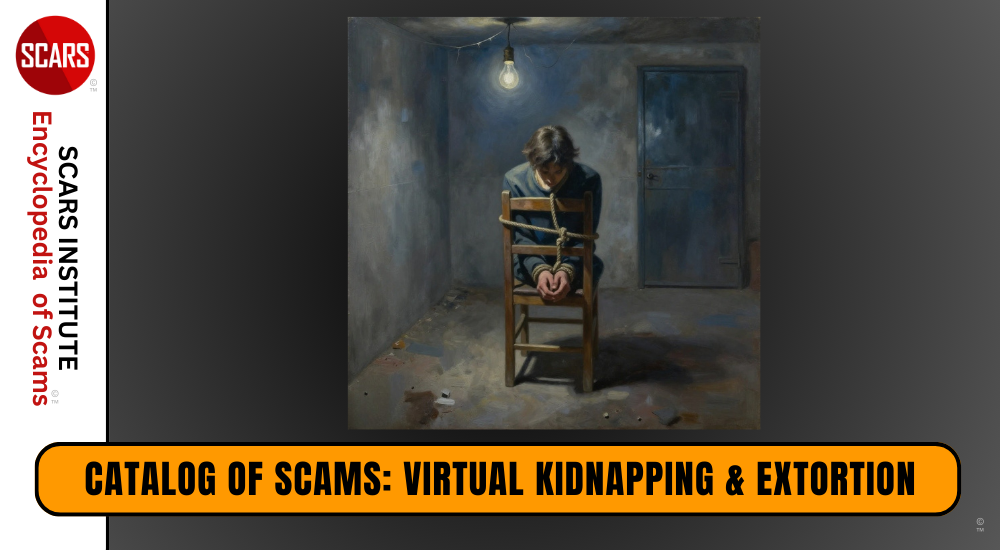

SCARS Institute’s Encyclopedia of Scams™ Published Continuously for 25 Years



Virtual Kidnapping & Extortion – Proof of Life Images or Videos
When Images Become Weapons: How Altered Proof-of-Life Media Drives Virtual Kidnapping and Ransom Scams
How Scams Work – A SCARS Institute Insight
Article Abstract
Virtual kidnapping and ransom scams use deception rather than physical abduction to extort victims by convincing them that a loved one is in immediate danger. Criminals increasingly rely on altered proof of life photos or videos sourced from social media and modified with artificial intelligence tools to create believable evidence under extreme time pressure. These scams exploit fear-driven threat responses that reduce critical thinking and discourage verification. Common warning signs include urgency, secrecy demands, and visual inconsistencies in images. Protective measures include limiting public exposure of personal information, establishing family code words, attempting direct contact, preserving evidence, and avoiding immediate payment. Even without financial loss, victims may experience lasting psychological distress, making education, support, and trauma-informed recovery essential.

When Images Become Weapons: How Altered Proof-of-Life Media Drives Virtual Kidnapping and Ransom Scams
In recent years, scammers have refined a particularly cruel form of extortion known as virtual kidnapping and ransom scams.
Unlike traditional kidnapping, no one is physically abducted. Instead, criminals use fear, speed, and deception to convince victims that a loved one is in immediate danger. One of the most alarming developments in this crime is the use of altered proof-of-life photos or videos, often sourced from social media, to make the threat feel real.
According to warnings issued by the Federal Bureau of Investigation, these scams are increasing in sophistication. Criminal actors now manipulate images of real people using AI and present them as evidence that a kidnapping has already occurred. For scam victims and their families, the psychological impact can be overwhelming, especially when fear overrides the ability to pause, verify, or seek help.
What Virtual Kidnapping Really Is
Virtual kidnapping is an extortion scheme built entirely on deception. The criminals do not have custody of the alleged victim. Instead, they rely on convincing storytelling, threats of violence, and manufactured evidence to create the illusion of an ongoing emergency.
Typically, the scam begins with an unexpected message or phone call. The criminal claims that a family member or loved one has been kidnapped and that harm will occur if a ransom is not paid immediately. The demand often includes strict instructions about secrecy, payment methods, and time limits.
What separates modern virtual kidnapping from earlier versions is the use of images and videos that appear to confirm the claim. These proof-of-life materials are designed to silence doubt and push the victim into rapid compliance.
How Criminals Obtain and Alter Proof-of-Life Media
Most altered proof-of-life images originate from publicly available sources, such as social media platforms, online profiles, and shared photos, which provide criminals with a rich library of personal material. Even accounts set to private may still expose images through tagged posts, profile photos, or secondary sharing by friends and relatives.
Criminals download these images and manipulate them using common AI editing tools. In some cases, they add restraints, change backgrounds, or crop images to remove context. In more advanced cases, artificial intelligence tools are used to modify facial expressions or generate short video clips that appear authentic at first glance.
The goal is not perfection. The goal is plausibility under pressure and to increase the emotional and cognitive load that prevents victims from asking questions. Criminals understand that victims are not calmly evaluating details. They are reacting to fear.
Common Inaccuracies in Fake Proof-of-Life Images
While these images are designed to look convincing, they often contain subtle errors. The FBI notes several recurring inconsistencies that may be visible upon closer inspection, including:
- Missing or altered tattoos, scars, or birthmarks that are known to exist.
- Incorrect body proportions that do not match the real person.
- Clothing or accessories that the person does not own.
- Lighting or shadows that do not align naturally.
- Backgrounds that seem generic or inconsistent with known locations.
- Any text in the image may be distorted or nonsensical.
To reduce the chance that these flaws are noticed, criminals often use timed message features. These settings cause images or videos to disappear after a few seconds, preventing careful review or comparison on platforms such as WhatsApp, Signal, or Telegram.
Why These Scams Feel So Real
Virtual kidnapping scams exploit fundamental human survival mechanisms. When a person believes a loved one is in danger, the brain shifts into a threat-response state. Logical reasoning narrows, attention becomes fixated, and the urge to act immediately intensifies.
For scam victims, this response is a normal biological reaction to perceived danger. Criminals intentionally create urgency because urgency disables skepticism. The faster the victim acts, the less likely they are to verify information or consult others.
Threats of violence further escalate the emotional impact. Criminals often describe harm in vivid terms, not because they intend to carry it out, but because fear accelerates compliance.
The Role of Social Media in Exposure
Social media has transformed how people share their lives, but it has also expanded the attack surface for criminals. Photos that seem harmless can become tools for extortion when placed in a false narrative.
Missing person posts present a particular risk. While intended to mobilize help, these posts publicly confirm emotional vulnerability and provide criminals with images, names, and family connections. Scammers may contact families pretending to have information, sometimes escalating into ransom demands supported by altered media.
This does not mean families should never seek help online. It does mean that awareness and caution are necessary when sharing personal details in public forums.
Psychological Impact on Victims
Victims of virtual kidnapping often describe the experience as one of the most terrifying moments of their lives. Even after learning that the threat was fake, many continue to experience lingering distress, guilt, and self-blame.
Common emotional effects include:
- Persistent anxiety and hypervigilance.
- Shame about being deceived.
- Difficulty trusting digital communications.
- Intrusive memories of the threats or images.
- Fear of future targeting.
For individuals who have previously experienced scams or trauma, these effects can be amplified. The brain may struggle to distinguish between real and perceived danger when similar patterns reappear.
Why Criminals Emphasize Speed and Secrecy
Criminal actors often instruct victims not to contact police, family members, or the alleged victim. They may claim that any delay or outside involvement will result in immediate harm.
This tactic serves two purposes. First, it isolates the victim emotionally. Second, it prevents reality checks that would quickly expose the lie. A single unanswered call to the supposed victim might raise an alarm. A confirmed conversation would end the scam.
Speed is essential because truth requires time. Criminals know that verification collapses their narrative.
Practical Steps to Reduce Risk
While no strategy can eliminate risk entirely, several measures significantly reduce vulnerability to virtual kidnapping scams.
Limit Public Exposure
Be thoughtful about what personal images and details are shared publicly. Review privacy settings regularly and be cautious about tagging locations or routines in real time.
Use Family Code Words
Establish a simple code word or phrase known only within the family. This can be used to confirm identity in emergencies and instantly reveal deception.
Pause and Assess
Urgency is a manipulation tool. Taking even a few minutes to breathe and think can restore clarity. Ask whether the claims logically align with known facts.
Attempt Direct Contact
Always try to contact the alleged victim directly through known phone numbers or messaging platforms. Many virtual kidnapping cases are resolved within minutes once contact is made.
Preserve Evidence
If possible, screenshot or record any images, videos, phone numbers, or messages. This information can be critical for law enforcement and may help prevent future incidents.
Avoid Immediate Payment
Ransom demands are designed to bypass verification. Payment does not guarantee safety and often encourages repeat targeting.
What To Do If You Are Targeted
If someone believes they are the target of a virtual kidnapping scam, the following steps are recommended:
- Attempt immediate contact with the loved one.
- Reach out to trusted family members or friends.
- Contact local law enforcement and report the incident.
- The FBI in the U.S. is responsible for kidnapping and extortion crimes; call their local office.
- Preserve all communications from the criminal.
- Avoid engaging further once the scam is identified.
Law enforcement agencies are increasingly familiar with these schemes and can provide guidance and support.
Recovery After the Threat Passes
Even when no money is lost, the emotional aftermath can be significant. Victims may replay the event repeatedly, questioning their reactions or judgment. Recovery involves understanding that the response was human and appropriate given the perceived threat.
Education plays a critical role in healing. Learning how these scams operate helps victims reframe the experience as a crime of manipulation rather than a personal failure.
Support from professionals, peer communities, or victim advocacy organizations can also help restore a sense of safety and confidence. Professional therapy is always recommended.
A Crime That Evolves With Technology
Virtual kidnapping scams demonstrate how criminals adapt quickly to new tools. As image editing and artificial intelligence technologies become more accessible, proof-of-life manipulation will likely grow more convincing.
This reality underscores the importance of public awareness. Understanding the mechanics of the scam reduces its power. When individuals recognize urgency, isolation, and manufactured evidence as warning signs, the illusion begins to fracture.
Closing Perspective
Virtual kidnapping is not about kidnapping at all. It is about fear, speed, and belief. Altered proof-of-life media transforms ordinary images into weapons of psychological coercion, targeting the deepest human bonds.
For scam victims and their families, knowledge is a form of protection. Awareness restores choice. Verification restores control. And understanding that these crimes exploit normal human responses helps replace shame with clarity.
Conclusion
Virtual kidnapping and ransom scams that rely on altered proof of life media represent a significant escalation in psychological manipulation rather than a new form of physical crime. These schemes succeed because they exploit predictable human responses to perceived danger, especially the instinct to protect loved ones at any cost. When fear is combined with speed, isolation, and convincing visual material, even cautious and informed individuals can struggle to think clearly or verify information. The use of artificial intelligence and image editing tools increases the emotional impact of these scams, but it does not change their underlying structure. They depend on urgency, secrecy, and the suppression of verification.
Understanding this structure is essential for prevention and recovery. Awareness allows individuals to recognize manipulation techniques before panic takes over. Simple protective steps such as limiting public exposure, using family code words, and pausing to attempt direct contact can disrupt the scam’s momentum. These actions restore time, and time restores judgment. For those who have already experienced a virtual kidnapping attempt, recovery involves recognizing that the response was driven by biology, not personal failure. Fear-based decision-making under perceived threat is a normal human reaction.
As technology continues to evolve, these crimes will continue to adapt. Ongoing education, public awareness, and trauma-informed responses remain the most effective defenses. By understanding how altered proof of life media is used as a weapon, individuals and families are better equipped to protect themselves, respond effectively, and recover without shame or self-blame.
The most important message is simple. A pause can save a life, a bank account, and a sense of safety. Criminals depend on panic. Victims regain power by slowing down, checking facts, and reaching out for help.

Glossary
- Altered proof-of-life media — Altered proof-of-life media refers to photos or videos that have been digitally manipulated to falsely suggest a person is being held captive or harmed. These materials are designed to overwhelm victims emotionally and suppress verification, making deception feel urgent and real.
- Artificial intelligence image manipulation — Artificial intelligence image manipulation involves using automated tools to change facial expressions, body features, or scenes in photos and videos. Criminals use these tools to create convincing but false visual evidence that increases fear and accelerates compliance.
- Attack surface expansion — Attack surface expansion describes how increased online sharing creates more opportunities for criminals to gather personal information. Social media activity unintentionally provides images, names, and relationships that can be exploited in extortion schemes.
- Biological threat response — Biological threat response is the autonomic nervous system reaction that occurs when danger is perceived. This response narrows attention, increases urgency, and reduces critical thinking, which criminals deliberately exploit.
- Cognitive load increase — Cognitive load increase refers to overwhelming the brain with stress, fear, and urgency. Criminals rely on this overload to prevent victims from analyzing inconsistencies or seeking confirmation.
- Compliance acceleration — Compliance acceleration is the deliberate pressure applied to force rapid decision-making. Criminals shorten time frames so victims act before verification or reflection can occur.
- Convincing storytelling — Convincing storytelling involves crafting a believable narrative of danger and control. Criminals use emotional language and specific details to make the false scenario feel credible.
- Digital evidence distortion — Digital evidence distortion occurs when authentic images are altered to misrepresent reality. Victims may trust visual information instinctively, making this tactic especially powerful.
- Direct contact verification — Direct contact verification is the act of attempting to reach the alleged victim through known communication channels. This step often exposes the scam quickly by collapsing the false narrative.
- Emotional isolation — Emotional isolation is created when criminals instruct victims to keep the situation secret. Isolation prevents outside perspectives that could challenge the deception.
- Extortion demand — An extortion demand is a request for money made under threat of harm. In virtual kidnapping scams, the threat is fabricated but presented as immediate and unavoidable.
- Fabricated captivity — Fabricated captivity refers to the false claim that a person is being held against their will. Criminals rely on imagery and threats rather than physical control.
- Fear-based decision making — Fear-based decision making occurs when choices are driven by panic rather than analysis. This state is intentionally induced by criminals to bypass rational judgment.
- Family code word — A family code word is a prearranged phrase known only to trusted members. It serves as a rapid verification tool during emergencies or suspicious communications.
- False urgency — False urgency is the manufactured pressure that demands immediate action. Criminals claim that the delay will result in harm to suppress verification.
- Image plausibility — Image plausibility refers to how believable a manipulated image appears under stress. Perfection is unnecessary when victims are emotionally overwhelmed.
- Inconsistent body proportions — Inconsistent body proportions are visual errors where a person’s physical features do not match their known appearance. These flaws often appear in altered images.
- Law enforcement reporting — Law enforcement reporting involves notifying authorities about extortion attempts. Reporting helps document patterns and may prevent further victimization.
- Manipulated facial expression — A manipulated facial expression is an altered emotional display created through editing tools. Criminals use this to simulate distress or fear.
- Manufactured evidence — Manufactured evidence consists of false materials created to support a deceptive claim. In virtual kidnapping, this evidence replaces actual physical control.
- Missing identifying marks — Missing identifying marks include absent tattoos, scars, or birthmarks that should be present. These omissions can reveal image manipulation.
- Narrative collapse — Narrative collapse occurs when verification exposes the scam’s falsehood. Criminals work aggressively to prevent this outcome.
- Online profile exposure — Online profile exposure refers to personal information visible through social platforms. Even limited visibility can provide enough material for exploitation.
- Perceived immediate danger — Perceived immediate danger is the belief that harm is imminent. This perception activates fear responses regardless of actual risk.
- Persistence of distress — Persistence of distress describes lingering emotional reactions after the scam is exposed. Victims may continue to feel fear, guilt, or shame.
- Psychological coercion — Psychological coercion is the use of fear and manipulation rather than force. Virtual kidnapping relies entirely on mental pressure.
- Public image harvesting — Public image harvesting involves collecting photos from open online sources. Criminals use these images to construct false proof-of-life materials.
- Ransom payment pressure — Ransom payment pressure is the insistence on rapid financial transfer. Criminals discourage delays that could expose the deception.
- Reality verification suppression — Reality verification suppression involves discouraging fact-checking or communication. Criminals isolate victims to maintain control.
- Secondary image sharing — Secondary image sharing occurs when friends or relatives repost images. This expands availability beyond the original account’s privacy settings.
- Secrecy instruction — Secrecy instruction is a directive to avoid contacting others. Criminals frame secrecy as necessary for the loved one’s safety.
- Social media exploitation — Social media exploitation is the misuse of shared content for criminal purposes. Platforms unintentionally enable visual access to victims’ networks.
- Stress-induced narrowing — Stress-induced narrowing is the reduction of attention and reasoning under fear. Victims focus on threats rather than inconsistencies.
- Timed message feature — A timed message feature causes images or videos to disappear automatically. Criminals use this to prevent careful analysis.
- Trauma amplification — Trauma amplification occurs when previous victimization intensifies emotional reactions. Prior scams or trauma increase vulnerability.
- Trust erosion — Trust erosion is the loss of confidence in digital communication after a scam. Victims may struggle to rely on messages or images.
- Verification delay avoidance — Verification delay avoidance is the criminal strategy of eliminating time for checks. Speed maintains deception.
- Victim self-blame — Victim self-blame involves internalizing responsibility for being deceived. Education helps reframe the experience as manipulation, not failure.
- Virtual kidnapping — Virtual kidnapping is an extortion scheme that simulates abduction without physical captivity. It relies entirely on deception, fear, and false evidence.
- Visual credibility bias — Visual credibility bias is the tendency to trust images more than words. Criminals exploit this bias through altered proof-of-life media.
- Weaponized imagery — Weaponized imagery refers to ordinary photos turned into tools of coercion. These images target emotional bonds to control behavior.
- Zero custody deception — Zero custody deception describes extortion without physical possession of a victim. Criminals maintain control through belief rather than force.
-/ 30 /-
What do you think about this?
Please share your thoughts in a comment below!
Table of Contents





Rapid Report Scammers

In the U.S. & Canada
U.S. & Canada Suicide Lifeline 988
LEAVE A COMMENT?
Recent Comments
On Other Articles
- Wendy Guiher on 15 Things That Nearly Every Online and Phone Scams Have In Common – 2026: “Very concise, direct information. When I look back on the crime against me I now can see ALL of the…” Apr 1, 06:24
- on The Danger of Using AI in Law Enforcement – The Grandmother Wrongly Arrested as a Fraudster – 2026: “Excellent article – I can’t imagine the terror Angela most certainly experienced. Compound this with the lack of accountability by…” Mar 24, 09:20
- on The Crazy Gregor MacGregor and the Country of Poyais Scam – History of Scams – 2026: “interesting” Mar 23, 19:24
- on BEC Fraud Reaches $43 Billion Per Year: “oh my gosh so much of an increase in the fraud I pray the officials can continue tracking and make…” Mar 23, 15:09
- on Establishing The United States Task Force To Eliminate Fraud – 2026: “Make Online Safe Again!” Mar 17, 19:11
- on Establishing The United States Task Force To Eliminate Fraud – 2026: “Finally an administration takes the initiative to help solve the gigantic situation. Make America Safe Again, thank you!” Mar 17, 15:41
- on What Is The Difference Between A Scam Victim And A Scam Survivor? [Updated]: “Due to my scams I don’t fully trust anyone online and I shouldn’t even those people I knew in high…” Mar 7, 12:46
- on SCARS 3 Steps For New Scam Victims 2024: “I was very fearful “he” would come to my home because I was knew my address, I spoke to someone…” Mar 7, 09:50
- on Sadness & Scam Recovery: “Before my scam, my mom passed away and I got a divorce, so I was dealing with the loss of…” Mar 7, 09:37
- on The Story Of Kira Lee Orsag (aka Dani Daniels) [Updated]: “There is NO evidence and she is not, she is a victim too. Sebastian, stop letting your anger think for…” Mar 6, 23:18
ARTICLE META
Important Information for New Scam Victims
- Please visit www.ScamVictimsSupport.org – a SCARS Website for New Scam Victims & Sextortion Victims
- Enroll in FREE SCARS Scam Survivor’s School now at www.SCARSeducation.org
- Please visit www.ScamPsychology.org – to more fully understand the psychological concepts involved in scams and scam victim recovery
If you are looking for local trauma counselors please visit counseling.AgainstScams.org or join SCARS for our counseling/therapy benefit: membership.AgainstScams.org
If you need to speak with someone now, you can dial 988 or find phone numbers for crisis hotlines all around the world here: www.opencounseling.com/suicide-hotlines
A Note About Labeling!
We often use the term ‘scam victim’ in our articles, but this is a convenience to help those searching for information in search engines like Google. It is just a convenience and has no deeper meaning. If you have come through such an experience, YOU are a Survivor! It was not your fault. You are not alone! Axios!
A Question of Trust
At the SCARS Institute, we invite you to do your own research on the topics we speak about and publish, Our team investigates the subject being discussed, especially when it comes to understanding the scam victims-survivors experience. You can do Google searches but in many cases, you will have to wade through scientific papers and studies. However, remember that biases and perspectives matter and influence the outcome. Regardless, we encourage you to explore these topics as thoroughly as you can for your own awareness.
Statement About Victim Blaming
SCARS Institute articles examine different aspects of the scam victim experience, as well as those who may have been secondary victims. This work focuses on understanding victimization through the science of victimology, including common psychological and behavioral responses. The purpose is to help victims and survivors understand why these crimes occurred, reduce shame and self-blame, strengthen recovery programs and victim opportunities, and lower the risk of future victimization.
At times, these discussions may sound uncomfortable, overwhelming, or may be mistaken for blame. They are not. Scam victims are never blamed. Our goal is to explain the mechanisms of deception and the human responses that scammers exploit, and the processes that occur after the scam ends, so victims can better understand what happened to them and why it felt convincing at the time, and what the path looks like going forward.
Articles that address the psychology, neurology, physiology, and other characteristics of scams and the victim experience recognize that all people share cognitive and emotional traits that can be manipulated under the right conditions. These characteristics are not flaws. They are normal human functions that criminals deliberately exploit. Victims typically have little awareness of these mechanisms while a scam is unfolding and a very limited ability to control them. Awareness often comes only after the harm has occurred.
By explaining these processes, these articles help victims make sense of their experiences, understand common post-scam reactions, and identify ways to protect themselves moving forward. This knowledge supports recovery by replacing confusion and self-blame with clarity, context, and self-compassion.
Additional educational material on these topics is available at ScamPsychology.org – ScamsNOW.com and other SCARS Institute websites.
Psychology Disclaimer:
All articles about psychology and the human brain on this website are for information & education only
The information provided in this article is intended for educational and self-help purposes only and should not be construed as a substitute for professional therapy or counseling.
While any self-help techniques outlined herein may be beneficial for scam victims seeking to recover from their experience and move towards recovery, it is important to consult with a qualified mental health professional before initiating any course of action. Each individual’s experience and needs are unique, and what works for one person may not be suitable for another.
Additionally, any approach may not be appropriate for individuals with certain pre-existing mental health conditions or trauma histories. It is advisable to seek guidance from a licensed therapist or counselor who can provide personalized support, guidance, and treatment tailored to your specific needs.
If you are experiencing significant distress or emotional difficulties related to a scam or other traumatic event, please consult your doctor or mental health provider for appropriate care and support.
Also read our SCARS Institute Statement about Professional Care for Scam Victims – click here to go to our ScamsNOW.com website.


Thank you for your comment. You may receive an email to follow up. We never share your data with marketers.