


![United States Military ID Cards - How To Spot Fakes - [UPDATED 2025] - on the SCARS Institute RomanceScamsNOW.com - the Encyclopedia of Scams™](https://romancescamsnow.com/wp-content/uploads/2022/03/fake-military-id-cards.png "United States Military ID Cards - How To Spot Fakes - [UPDATED 2025] fake military id cards")

SCARS Institute’s Encyclopedia of Scams™ Published Continuously for 25 Years


Article Abstract
Spotting a fake military ID card is straightforward when you understand the rules and details. Any United States military member who sends you a photo of their ID is breaking regulations, which means it is almost certainly fraudulent. Military ID cards have strict designs, eligibility requirements, and security features that are difficult to duplicate. Knowing the different types of cards, how they are issued, and the security elements they contain helps you identify forgeries quickly. Visual inconsistencies, poor printing quality, incorrect ranks, and altered photographs are all warning signs. Feeling the card’s texture, verifying its information, and watching the holder’s body language can reveal further clues. Real service members know their details without hesitation, while impostors often appear nervous or evasive. Understanding these checks gives you a strong advantage and helps you protect yourself from scammers using military impersonation to gain your trust.

Spotting Military ID Cards Is Not Hard
If Someone Sends You A Photo Of Their Military ID Cards They Are A Scammer!
That is because it is illegal for United States Military personnel to copy their ID cards. It is that simple!
Spotting fake military ID cards is not difficult. If someone sends you a photo of a military ID, you can always assume they are a scammer.
United States military personnel are not allowed to copy or share images of their ID cards under any circumstances. That rule is strict and non-negotiable. If you are shown one, it is a violation of military regulations, which means it is almost certainly fake.
Many people still want to know exactly how to identify a fake card, so we have put together guidance to help you recognize them. This information is meant to help you protect yourself and avoid falling victim to military impersonation scams.
For security reasons, this page is not accessible from all locations. It blocks all of Africa and most of the Middle East to reduce exposure to known scammer regions. Even with these precautions, understand that scammers are often slow to adapt. Once they learn a method that works, they tend to keep using it rather than updating their approach. This delay gives you an advantage when you understand the signs of a fake card and stay alert.
1. Next Generation Uniformed Services ID Card
The United States Department of Defense replaced its older paper-based Uniformed Services Identification (USID) card with a more secure, modern version called the Next Generation USID card. This updated card features a new design, enhanced security elements to reduce counterfeiting and fraud, and is printed on durable plastic cardstock.
Issuing of the Next Generation USID card began on July 31, 2020, at select Department of Defense ID card facilities. The rollout expanded in phases to all facilities and was completed by December 2020. The card is provided to retired and reserve members, dependent family members of uniformed service members, and other eligible individuals under Department of Defense policy. It is used to access benefits, privileges, and Department of Defense bases. The updated design did not change who is eligible to receive the card.
Older USID cards are still valid until their printed expiration date. However, if your older card shows an indefinite (INDEF) expiration date, you may replace it with the Next Generation USID card at any time.
Next Generation USID Card Type
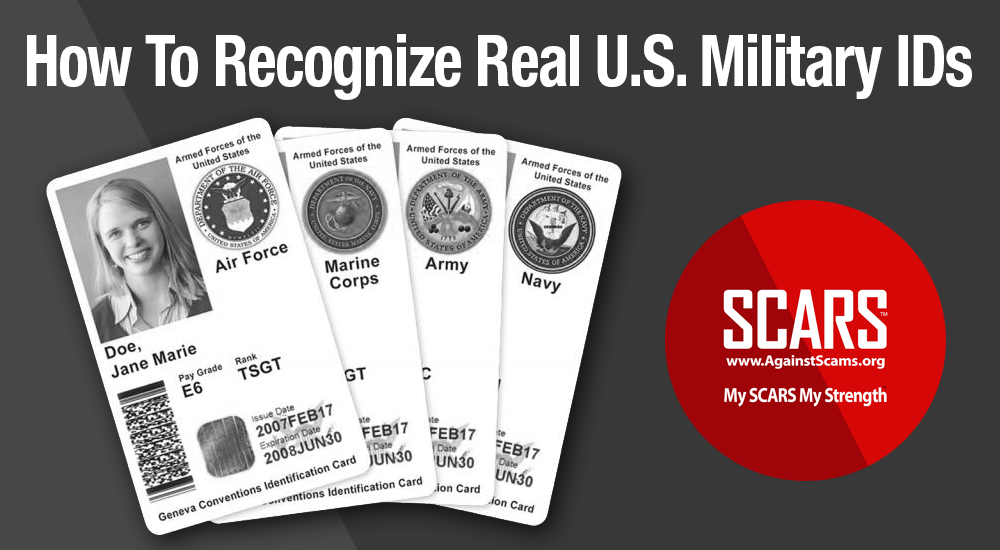
Notice that the latest cards are HORIZONTAL and no longer VERTICAL.
Armed Forces of the United States – Geneva Conventions Identification Card
Members of the Individual Ready Reserves and Inactive National Guard. Non-CAC-eligible civilian noncombatant personnel deployed in conjunction with military operations overseas
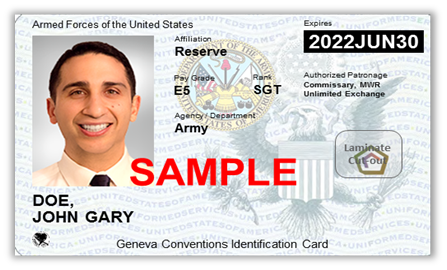
U.S. Department of Defense / Uniformed Services – Sponsor Identification and Privilege Card
- Retired members who are entitled to retired pay
- Members of the Temporary Disability Retired List (TDRL)
- Members of the Permanent Disability Retired List (PDRL)
- Retired members of the Reserves and National Guard
- Medal of Honor recipients
- 100% Disabled Veterans
- Former members in receipt of retired pay
- Transitional Health Care Member (TAMP)
- Full-time paid United Service Organizations (USO) personnel when serving OCONUS
- United Seaman’s Service (USS) Personnel OCONUS
- Officers and Crews of MSC vessels deployed to foreign countries
- Other benefits-eligible categories as described in DoD policy
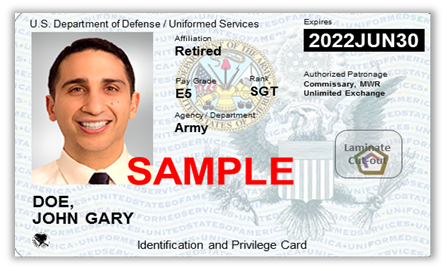
U.S. Department of Defense / Uniformed Services – Dependent Identification and Privilege Card
Dependents of:
- Active duty Service members of the regular components
- Reserve component Service members on active duty for more than 30 days
- Retirees
- Medal of Honor recipients
- Former members in receipt of retired pay
- Transitional Health Care Members (TAMP)
- 100% Disabled Veterans
- Ship’s Officers and Crewmembers of NOAA Vessels
- Reserve members not on active duty or in receipt of retired pay
- Former members not in receipt of retired pay
- Reserve Service members who die after receipt of NOE
Surviving Dependents of:
- Active duty and retired Service members
- Medal of Honor recipients
- Other benefits-eligible categories as described in DoD policy
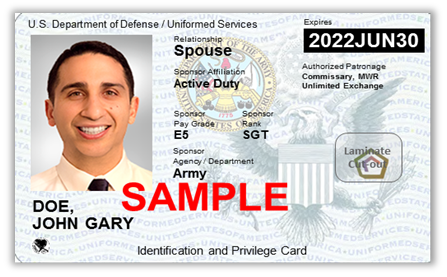
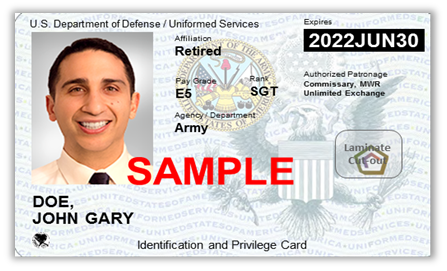
Color Coding
White: Current/Former Uniformed Service Members, their Dependents, and All Remaining Personnel
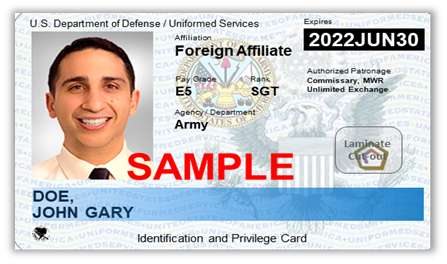
Blue Bar: Non-U.S. Citizen Sponsors and their Dependents
2. Old Style United States Military ID Cards Are Called “CAC” – Common Access Cards
Common Access Card (CAC): The CAC Military ID Card (a “smart” card about the size of a credit card), is the standard identification for active duty uniformed Service personnel, Selected Reserve, U.S. Department of Defence [DoD] civilian employees, and eligible contractor personnel. It is also the principal card used to enable physical access to buildings and controlled spaces, and it provides access to DoD computer networks and systems.
![United States Military ID Cards - How To Spot Fakes - [UPDATED 2025] guide to how to recognize real us2](https://romancescamsnow.com/wp-content/uploads/2018/11/guide-to-how-to-recognize-real-us2.png "United States Military ID Cards - How To Spot Fakes - [UPDATED 2025] guide to how to recognize real us2")
CAC Military ID Cards Types & Eligibility
The four different types of Military ID Cards are listed below. The card you will be eligible for will be determined by your “Sponsor,” the person affiliated with the DoD or other federal agency responsible for verifying and authorizing your need for an ID card. The uses of the card depend on the component/Command that you support. Each component/Command can customize the CAC to meet its specific needs.
![United States Military ID Cards - How To Spot Fakes - [UPDATED 2025] 1](https://romancescamsnow.com/wp-content/uploads/2018/11/1.png "United States Military ID Cards - How To Spot Fakes - [UPDATED 2025] 1") Armed Forces of the United States Geneva Conventions Military ID Cards
Armed Forces of the United States Geneva Conventions Military ID Cards
The standard card for active duty personnel in accordance with Geneva Conventions requirements.
-
- Active Duty Armed Forces
- Selected Reserves
- Reserve and National Guard Members on active duty for more than 30 days
- Contracted Reserve Officer Training Corps (ROTC) cadets
- National Oceanic and Atmospheric Administration (NOAA)
- U.S. Public Health Services (PHS)
Affiliation:
-
- Displays Branch Of Service
![United States Military ID Cards - How To Spot Fakes - [UPDATED 2025] 2](https://romancescamsnow.com/wp-content/uploads/2018/11/2.png "United States Military ID Cards - How To Spot Fakes - [UPDATED 2025] 2") U.S. DoD and/or Uniformed Services Military ID Cards
U.S. DoD and/or Uniformed Services Military ID Cards
The standard card for qualifying civilian employees, contractors, and foreign national affiliates who need access to DoD installations, and computer systems.
-
- DoD and uniformed Services civilian employees (appropriated and non-appropriated)
- Eligible DoD, USCG, and NOAA contractors
- Non-DoD civilian employees to include: USCG and NOAA, state employees working in support of the National Guard, Intergovernmental Personnel Act employees, and non-DoD federal employees working in support of DoD
Affiliation:
-
- Senior Executive Service (SES)
- Civilians
- Civilian affiliates
- Federal affiliates
- Military affiliates
![United States Military ID Cards - How To Spot Fakes - [UPDATED 2025] 3](https://romancescamsnow.com/wp-content/uploads/2018/11/3.png "United States Military ID Cards - How To Spot Fakes - [UPDATED 2025] 3") U.S. DoD and/or Uniformed Services Geneva Conventions Military ID Cards for Civilians Accompanying the Armed Forces
U.S. DoD and/or Uniformed Services Geneva Conventions Military ID Cards for Civilians Accompanying the Armed Forces
The standard card for civilians accompanying the Armed Forces.
-
- Emergency-essential civilian employees
- Contingency contractor personnel
Affiliation:
-
- Senior Executive Service (SES)
- Civilians
- Contractors
![United States Military ID Cards - How To Spot Fakes - [UPDATED 2025] 4](https://romancescamsnow.com/wp-content/uploads/2018/11/4.png "United States Military ID Cards - How To Spot Fakes - [UPDATED 2025] 4") U.S. DoD and/or Uniformed Services Military ID Cards and Privilege Card
U.S. DoD and/or Uniformed Services Military ID Cards and Privilege Card
The standard card grants applicable benefits and privileges for civilian employees, contractors, and foreign national military, as well as other eligible personnel.
-
- DoD and uniformed Services civilian employees (appropriated and non-appropriated) when residing on a military installation within the United States and U.S. Territories and Possessions, or when stationed or employed and residing in foreign countries for at least 365 days
- DoD contractors when stationed or employed and residing in foreign countries for at least 365 days
- DoD Presidential appointees
- Uniformed and non-uniformed full-time paid personnel of the Red Cross assigned to duty with the uniformed Services within the United States and U.S. Territories and Possessions when residing on a military installation, or in foreign countries
- Eligible foreign military
Affiliation:
-
- Senior Executive Service (SES)
- Civilians
- Contractors
- Civilian affiliates
- Federal affiliates
- Military affiliates
- Images are kept small to help prevent potential abuse.
CAC Military ID Cards Color Coding
-
Blue Bar: Non-U.S. Citizen
![United States Military ID Cards - How To Spot Fakes - [UPDATED 2025] 5](https://romancescamsnow.com/wp-content/uploads/2018/11/5.png "United States Military ID Cards - How To Spot Fakes - [UPDATED 2025] 5")
-
Green Bar: Contractors
![United States Military ID Cards - How To Spot Fakes - [UPDATED 2025] 6](https://romancescamsnow.com/wp-content/uploads/2018/11/6.png "United States Military ID Cards - How To Spot Fakes - [UPDATED 2025] 6")
-
White: All Remaining Personnel
![United States Military ID Cards - How To Spot Fakes - [UPDATED 2025] 7](https://romancescamsnow.com/wp-content/uploads/2018/11/7.png "United States Military ID Cards - How To Spot Fakes - [UPDATED 2025] 7")
3. Legacy Card Types
This style of cards is no longer in use, and no longer valid.
![United States Military ID Cards - How To Spot Fakes - [UPDATED 2025] reserve dd form 21](https://romancescamsnow.com/wp-content/uploads/2022/03/reserve-dd-form-21.png "United States Military ID Cards - How To Spot Fakes - [UPDATED 2025] reserve dd form 21")
![United States Military ID Cards - How To Spot Fakes - [UPDATED 2025] retired dd form 21](https://romancescamsnow.com/wp-content/uploads/2022/03/retired-dd-form-21.png "United States Military ID Cards - How To Spot Fakes - [UPDATED 2025] retired dd form 21")
![United States Military ID Cards - How To Spot Fakes - [UPDATED 2025] reserve retired dd form 21](https://romancescamsnow.com/wp-content/uploads/2022/03/reserve-retired-dd-form-21.png "United States Military ID Cards - How To Spot Fakes - [UPDATED 2025] reserve retired dd form 21")
![United States Military ID Cards - How To Spot Fakes - [UPDATED 2025] dd form 11731](https://romancescamsnow.com/wp-content/uploads/2022/03/dd-form-11731.png "United States Military ID Cards - How To Spot Fakes - [UPDATED 2025] dd form 11731")
![United States Military ID Cards - How To Spot Fakes - [UPDATED 2025] dd form 1173 11](https://romancescamsnow.com/wp-content/uploads/2022/03/dd-form-1173-11.png "United States Military ID Cards - How To Spot Fakes - [UPDATED 2025] dd form 1173 11")
4. It Is Unlawful To Photograph, Scan, Photocopy, or Otherwise Duplicate United States Military ID Cards
It is the same for ALL United States Government ID Cards
The law reads, “Whoever manufactures, sells, or possesses any badge, identification card or other insignia of the design prescribed by the head of any department or agency of the United States for use by any officer or employee thereof, or any colorable imitation thereof, or photographs, prints, or in any other manner makes or executes any engraving, photograph, print, or impression in the likeness of any such badge, identification card, or other insignia, or any colorable imitation thereof, except as authorized under regulations made pursuant to law, shall be fined under this title or imprisoned not more than six months, or both.”
Commercial establishments can ask to see your card to verify military affiliation or to provide government rates for services, but they can’t photocopy it. So if they ask to do so, tell them no. Give them a state driver’s license or another form of photo identification instead.
Photocopied cards might be used for counterfeiting purposes, with no real safeguards against it. Since criminals and terrorists value U.S. government IDs when they’re trying to plan acts against the U.S. military, civilians, or other persons it is best to not give them that chance. Thus, any stranger you meet online who shows you a government ID card is automatically a scammer.
This law does NOT apply to medical establishments like hospitals and doctor’s offices that are allowed to make a copy for filing insurance claims. It also doesn’t apply to other government agencies that are using the copied ID to perform official government business.
5. How To Spot A Fake Military ID Card
This applies to physical ID carts that might be presented to you, but can provide insights when you see an illegal photo of an ID card.
5 Steps To Follow
It only takes a few basic steps to tell a fake military ID from a real one. Once you understand these steps, you can recognize pretenders who are trying to take advantage of you.
Step 1: Learn the Different Types of Military ID Cards
The first step is knowing which ID cards active duty personnel, veterans, and their families use to access benefits. Each branch of the military issues specific identification, and these cards have defined purposes. If you understand what a legitimate card should look like and who is entitled to it, it becomes much harder for someone to fool you.
Common Access Card (CAC)
The Common Access Card is the standard ID for active duty members, Selected Reserve, and certain Department of Defense employees. About the size of a credit card, it provides access to secure network systems and identifies the holder’s affiliation. Some civilian employees and contractors also receive CACs if their role requires it.
Armed Forces of the United States Geneva Conventions Identification Card
Issued by the Department of Defense, this card identifies members of the Armed Forces and their dependents. It allows access to bases, commissaries, and medical care either through the military health system or TRICARE.
U.S. Department of Defense or Uniformed Services Identification Card
This card is given to family members, retirees, reservists, inactive National Guard members, members on the Temporary or Permanent Disability Retired List, retired reserve not yet drawing pay, and 100% disabled veterans. It is also issued to certain eligible civilians, foreign military personnel, and support staff serving overseas.
U.S. DoD or Uniformed Services Geneva Conventions Identification Card for Civilians
This card is for civilian employees and contractors who need limited access to military facilities based on their duties.
Uniformed Services ID (USID) Card
Also called the Next Generation USID Card, this version was introduced in July 2020. It is usually issued to retirees and family members to confirm eligibility for military benefits and privileges.
Step 2: Conduct a Visual Inspection of the Card
Begin by looking closely at the card’s overall appearance. Pay attention to its markings, design elements, and any visible security features. Genuine military ID cards are created with precision to prevent forgery, and a fake card will often show obvious warning signs. These may include:
Inconsistent fonts or colors. If the lettering style varies in unusual ways or the color patterns appear uneven, you are likely looking at a fake card. Watch for smudged or bleeding colors that suggest poor-quality printing.
Spelling errors. Authentic military ID cards are produced with care. Even the smallest typo would be unacceptable. If you spot spelling mistakes or grammatical errors, consider it a red flag.
Poor-quality photograph. The photo on a legitimate card will be a clear, front-facing portrait taken against a plain white background. If the person is turned to the side, or if the background contains visible objects, the image was likely altered or pulled from an unrelated source.
Incorrect pay grade or rank. Many counterfeiters do not understand proper rank and pay grade structure. If the rank shown does not match the claimed position, or other details appear inconsistent, the card is likely fake.
Consistency is key. A genuine military ID will have uniform, professional details. Any irregularities should prompt further verification.
Step 3: Check the Card’s Texture
Hold the card in your hand and feel both sides, including the edges. An authentic military ID will have a smooth, durable surface without bumps, ridges, or raised spots. Signs of tampering, such as overlays, glue residue, or peeling edges, suggest the card has been altered. If the surface feels uneven or if the layers begin to separate when you run a fingernail along the edge, it is not genuine.
Step 4: Verify the Information
Someone who truly serves in the military will know every detail printed on their ID. Ask the cardholder direct questions about the card’s contents while you are holding it. Purposely mispronounce or slightly alter a detail. A genuine service member will quickly correct you without hesitation.
You can also ask questions about their service history. Authentic members can share information easily and without stumbling because it is part of their lived experience. If the answers are vague, inconsistent, or overly rehearsed, you have reason to doubt the card’s authenticity.
Step 5: Observe Their Body Language and Behavior
You can often identify someone pretending to be military by watching how they carry themselves and respond to questions. Certain behaviors can reveal dishonesty, such as avoiding eye contact, pausing too long before answering, or trying to project intimidation or indifference to mask uncertainty.
A person who is posing as military may also show signs of nervousness or unease. They might fidget, shift their posture frequently, or appear tense when asked about their service. This is because they know there are serious consequences for impersonating a service member and fear being exposed.
Pay attention to these cues. While body language alone does not prove someone is lying, it can be a strong indicator when combined with other red flags you have already identified.
-/ 30 /-
What do you think about this?
Please share your thoughts in a comment below!
Table of Contents
To Understand All Scams
Read This
The SCARS Institute Relationship Scams Formula Checklist
This is the Formula that all Relationship Scams Follow


In the U.S. & Canada
U.S. & Canada Suicide Lifeline 988

Recent Comments
On Other Articles
- on United States – Federal Bureau of Investigations [FBI]: “It is only that way because of the shame you feel. The reality is that it was not your fault.…” Sep 30, 15:36
- on United States – Federal Bureau of Investigations [FBI]: “yhisis humiliating experience e and isembarassassing to to own up to peolealreadyassume u are not to bright because Arnold and…” Sep 30, 12:28
- on United States – Federal Bureau of Investigations [FBI]: “should be better known by public live in assisiwdlivi g apartment many manyinstancresof Romance scams here ano.us ederly l” Sep 30, 12:24
- on Is It A Scam? Phone Scam Diagnostic – v1: “I tried the this test Is it a phone scam? Mine was. I think this is a helpful tool to…” Sep 30, 10:34
- on Is It A Scam? Romance Scam Diagnostic – v2: “Carole, as you move forward with your recovery, you will learn how this all works. It was not your fault.…” Sep 29, 17:37
- on Is It A Scam? Romance Scam Diagnostic – v2: “I was blinded by such clever manipulation” Sep 29, 15:15
- on The SCARS Institute Relationship Scams Formula Checklist – 2026: “As I read this I could see myself in every step with my scam. I gained a lot more knowledge…” Aug 28, 19:51
- on The Persistence of Danielle Delaunay as a Fake Identity – 2026: “Unfortunately, you are being scammed. She is using a fake name regardless. At this point, your best option is to…” Aug 26, 20:16
- on The Persistence of Danielle Delaunay as a Fake Identity – 2026: “Dear Sirs, I have met this woman with the name Abigail Boateng in Ghana. I have an intensive mail contact…” Aug 26, 12:28
- on Trauma-Induced Fear May Cause Paranoia: “Very interesting article. I’m wondering if someone would likely recognize that they’re becoming increasingly paranoid, or hypervigilant, or does it…” Aug 24, 12:07

![United States Military ID Cards - How To Spot Fakes - [UPDATED 2025] niprc1.png1 150x1501 11](https://scamsnow.com/wp-content/uploads/2025/04/niprc1.png1_-150x1501-11.webp "United States Military ID Cards - How To Spot Fakes - [UPDATED 2025] niprc1.png1 150x1501 11")
Hi,
We come from Spain; my mother was connected by a USA army major. He has sent her an CaC card, some pictures and told her about his life for abour a month. He never has asked for money, but he said he wants to come to our house on next week.
I don’t know what to think about rhis.
The fact that he showed his ID means he is a scammer. That is all the proof you need.https://romancescamsnow.com/dating-scams/rsn-guide-how-to-spot-fake-united-states-military-id-cards/
This saved me from getting scammed! Thank you!
You can start here by reading our SCARS 3 Steps Guide for New Scam Victims: https://romancescamsnow.com/for-new-scam-victims/
Thank you so much for sharing this invaluable information! So many scammers are claiming to be a widow(er) that are service personnel.
I’ll be bookmarking this page for the next time a friend or neighbor is contacted by one of these scammers.
I truly appreciate all that you do, and have done, to help educate others so that they can protect themselves and others!
Thank you
I’m trying to figure out if a picture I got sent of a U.S. military ID card is real
By definition, if it was sent to you – it is fake. It is against U.S. law to photograph a military ID card. Read this: https://romancescamsnow.com/dating-scams/rsn-guide-how-to-spot-fake-united-states-military-id-cards/
Please look at our home page for more information – everything you need to be safe is there. But also, stop talking to strangers online – almost all of them are going to scammers if they are contacting you,
Is General Adriano BIANCHI
0 – 10 still communicating ?
As his twitter account was hacked, HOW do I know IF he is writing me or scammers
You are being scammed. It is very simple.
HI, i need to cross verify one us armed force id card soon, need ur urgent help
Actually it is very simple. It is against U.S. law for a soldier to copy or photograph a military ID card. That means all IDs you might have been sent are fake. It is a scam.
Va multumesc mult ,.si eu am fost pacalita , nu vreau sa mai sufere nimeni , stop hotiei
Faceti bine va multumesc cu respect