

SCARS Institute’s Encyclopedia of Scams™ Published Continuously for 25 Years

Most Victims Stay In A Scam Far Too Long!
This is because while they suspect it is a scam, they do not have the confidence to cut it off.
The reason that they lack confidence is partner because of the extended period of time they were being manipulated, and specifically Gaslighted to undermine their confidence. But it is also because they are looking for concrete proof that it is a scam.
The proof is unnecessary because if you suspect it is a scam – then simply it is! However, for those that cannot accept this simple fact, the following will help trap scammers into giving away their Nigerian origins.
Ghanaians use a lot of local dialects, slang, and shorthand words for one another, these words and phrases are not only from their indigenous Nigerian languages but sometimes they are also in Pidgin English or are English terms with the meaning corrupted.
To learn more about how Scammers Use Endearments and Why click here.
How To Use?
Your scammer is going to use texts and email as their primary communication method. This means a mountain of written conversations.
During your conversations, it is easy to slip in certain trap words or phrases into your replies. Most of the time, they will not even be noticed, since they are in their native tongue. When the scammer replies as tough they understood and does not question the word or phrase, you can be sure – at least after a couple of setups that you are speaking with a Ghanaian.
Just be careful not to flood the conversation with Ghana terms. Use one or two in critical passages of text, and see what happens. You can use one or two in each message, but not too many or your scammers will catch on!
Also remember that Nigerian is a country of 31 million people, and has 50 languages and 7 major ones, so everything depends on what language they natively speak. Many phrases are universal in Ghana.
Ghana Terms, Words, & Phrases
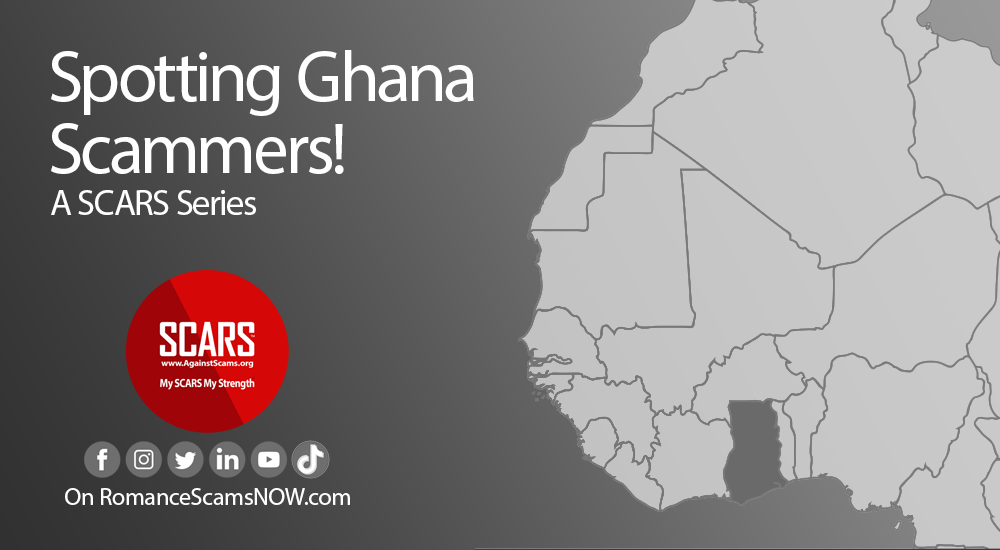
Ghana is a country with seven major languages: Twi, Ga, Fanti, Ewe, Dangbe, Hausa, and English.
Many Ghanaians speak English or Pidgin English mixed in with words from these local languages to create a distinctive way of speaking that is unique to Ghana.
Although many Africans and people of African descent speak Pidgin English it is different in every country.
Ghana Terms Of Endearment
Twi Language |
English |
|---|---|
| odo | love |
| me do | my love |
| odofoo | loved one; beloved; lover |
| me dofo | my loved one; my beloved; my lover |
| odo ye wu | LITERALLY: love is death (worth-dying-for love; eternal love) |
| akoma mu tofe; akomam’ tofe | sweetheart (LITERALLY: candy of the heart) |
| ohemmaa | queen |
| me hemmaa | my queen |
| ahoofe | beauty |
| ahoofe dua | beauty tree (embodiment of beauty) |
| me bibini | my African/black person |
| me buroni | my Caucasian/white person |
| me bibini-buroni | my African-Caucasian; my black-white person |
| ahwene pa | good (precious) bead(s) |
| obaa pa | good woman |
| m’ade pa | my good thing |
TWI Language |
ENGLISH |
| me wiase | my world |
| me do | my love |
| me do wiase | the love of my world |
| me wura | my husband (lit: my owner) |
| me kunu | my husband |
| okunu pa | good husband |
| m’ade pa | my good thing |
| me biribiara | my everything |
| me bibini | my African/black person; handsome |
| me buroni | my Caucasian/white person; handsome |
| me bibini-buroni | my African-Caucasian; handsome |
| ohene | king |
| me hene | my king |
| ahoofe | handsome |
| m’ahoofe | my handsome |
| akoma mu tofe; akomam tofe | sweetheart |
| m’akomam tofe | my sweetheart |
| m’anigyee | my happiness |
| me botantim | my solid rock |
| m’aborodwomaa | my potato |
| m’aborobe | my pineapple |
Ghana Slang And Tribal Terms
Below is a simplified guide to some slang and tribal terms commonly used among Ghanaians.
Akwaaba – Welcome
Alata: A term commonly used to describe Nigerians, to their great displeasure as it means pepper seller in their language. (Derived from the Yoruba language)
Aunty: In West Africa the title aunty is given to any older woman to whom deference is shown.
Awam: The word awam, meaning fake, is derived from the abbreviation for the Association of West African Merchants that duped citizens out of their hard earned money.
Azaa: Dubious
Boga: A Ghanaian living abroad, this word originated from the word Hamburger after residents of Hamburg many of who are of Ghanaian origin.
Chalewotey: the word for Flip-flops. ‘Chale’ in Ga means friend or buddy and ‘Wote’ means ‘let’s go.’ So literally the word Chalewotey means ‘my friend let’s go’ and is a perfect description for the ease with which flip-flops are worn. (Ga term)
Chop bar: A restaurant that operates mainly by the roadside and serves a variety of local dishes.
Eti sen: An equivalent to a ‘hi, how are you?’ but is literally translated as ‘how is it?’ to which the response would be ‘eye’ (eh-yeh) ‘it’s good’ or ‘it’s fine’. (Akan term)
Hot: to be under pressure; ‘chale I’m hot!’, ‘I’m under pressure!’
Jot: Cigarette
Kubolor: Someone that enjoys wandering and ‘roaming’. (Ga term)
Obroni: White man or white person.
Obroni waawu: Secondhand clothing. It literally means ‘the dead white man’, to signify the clothes that came from Europe.
Saa: ‘Is that so?’ (Akan term).
Sankofa: A popular adinkra proverb derived from the twi language that literally means ‘go back and get it’. For example, if you’ve forgotten your roots you can always go back and retrace your steps. (Akan term)
Skin pain: Jealousy
Tro tro: Also ‘trosky’, a mini bus used for public transportation. Tro tro drivers are notorious for their bad driving. They usually have some interesting slogan or the other inked on the rear windscreen. (Ga term)
More Terms:
A beg: I beg, Please:
– ‘A beg no wound me’
– ‘Please don’t hurt me’
See: On the English speaking West Coast of Africa people often use the word ‘see’ in place of the usual ‘look at’. ‘
– Oh chale, see the way he is dancing! He wan embarrass us oh!
– ‘Oh dude, look at the way he’s dancing! He’s trying to embarrass us!’
Akata (n): a foreigner usually an African-American
Akpeteshie: This locally brewed spirit is made from highly fermented palm wine and is highly intoxicating (like moonshine) also known as Apio.
Asem: Problem(s) (Akan term)
Babylon: England
Chale: Friend (Ga term)
Chao: a lot, plenty
Chichinga: Khebabs
Cho: Food
– ‘Where de (the) cho dey?’
– ‘Where is the food?’
Kelewele: Ripe plantains diced and marinated in ginger, onions and chili and then fried. Ghana’s equivalent to fast food.
Pee – a Coca Cola knock off
Red Red: Fried ripened plantains with beans usually made with palm oil.
Sakora: Bald headed; a totally shaven head.
Shito: A spicy pepper sauce, which is black in color and made wit crayfish.
Tatale: Ripe plantain crushed and mixed with flour chili, onion, ginger and spices then fried.
Waatse: Black eye peas cooked with rice and served with shito (Ga traditional food)
Ghana Names For Girls
1. Ababio (Ghanaian origin) means “child that keeps coming”. Famous last name bearer: fashion designer Joyce Ababio.
2. Abina (Ghanaian origin) means “one born on a Thursday”.
3. Abla (Ghanaian origin) meaning “born on a Wednesday”. Is a short and simple name.
4. Adjua (Ghanaian origin) means “the one born on Monday”.
5. Adofo (Ghanaian origin) means “warrior”. Is a beautiful name for Ghanaian girls.
6. Adwoa (Ghanaian origin) means “one born on a Monday”. Is one of the sweetest female day names in Ghana.
7. Afreyea (Ghanaian origin ) meaning “born during good times”. Such beautiful Ghana girl names are suitable for a sweet-tempered child.
8. Ajoba (Ghanaian origin) means “one who is born on Monday”. Can be kept as a day name.
9. Akuba (Ghanaian origin) means “one who is born on Wednesday”.
10. Antobam (Ghanaian origin) means “the posthumous child”. Such Ghanaian female names are unique, rare, and beautiful.
11. Araba (Ghanaian origin) means “the one who is born on a Tuesday”. Is the most popular day name.
12. Awusi (Ghanaian origin) means “the one who is born on a Sunday”. Ghanaian people normally use this name as a child’s first name.
13. Caimile (Ghanaian origin) meaning “a family is born”. Is one of the most beautiful Ghanaian baby names.
14. Dogbeda (Ghanaian origin) means “pray”. Is a unique and special name for girls.
15. Dzifa (Ghanaian origin) means “one is at peace”. Famous name bearer: Dutch film actor Dzifa Kusenuh.
16. Effia (Ghanaian origin) meaning “born on a Friday”. The name is short and simple and is a popular day name.
17. Efie (Ghanaian origin) meaning “born on a Friday”. Is one of the most used day names in Ghana.
18. Efua (Ghanaian origin) means “they are born on a Friday”.
19. Ejo (Ghanaian origin) means “a girl born on Monday”. Sometimes such cute names are also used as Ghanaian nicknames.
20. Ekuwa (Ghanaian origin) meaning “born on a Wednesday”.
21. Esi (Ghanaian origin) means “one who is born on Sunday”. Such Ghanaian girl names can make a beautiful nickname for Elizabeth or Elisa.
22. Gifty (Ghanaian origin) meaning “a very beautiful tall girl”.
23. Kisi (Ghanaian origin) meaning “born on a Sunday”. This is a popular name in Ghana.
24. Kukua (Ghanaian origin) meaning “born on a Wednesday”. The name sounds sweet and simple.
25. Tawiah (Ghanaian origin) means “the first child born after twins”.
26. Thema (Ghanaian origin) meaning “Queen”. Is a powerful name for girls in Ghana.
27. Yaaba (Ghanaian origin) means “one who is born on Thursday”.
28. Yihana (Ghanaian origin) meaning “congratulations”.
Ghanaian Names For Boys
29. Abeeku (Ghanaian origin) means “one who is born on Wednesday”. The name is very popular and commonly used in Ghana.
30. Aboagye (Ghanaian origin) means “one who is powerful and complete”.
31. Acheampong (Ghanaian origin) means “one that gave birth to the King”. Famous name bearer: Ghanaian footballer Frank Acheampong.
32. Addae (Ghanaian origin) means “the morning sun”. The name is most suitable for Ghanaian boys.
33. Adekorafo (Ghanaian origin) means “treasurer”.
34. Adjua (Ghanaian origin) meaning “born on a Monday”. Is one of the Ghanaian days names.
35. Adofo (Ghanaian origin) meaning “warrior”. A Ghanaian name that is very popular.
36. Adom (Ghanaian origin) meaning “help from God”. Such Ghanaian first names are very popular in the United States too.
37. Adric (Ghanaian origin) means “one who is a blessed ruler”.
38. Adwenpa (Ghanaian origin) means “one who gives good ideas”.
39. Afram (Ghanaian origin) meaning “Afram river in Ghana”.
40. Agyei (Ghanaian origin) meaning “messenger from God”. Such names are very common in other countries in West Africa too.
41. Agyenim (Ghanaian origin) means “the great one from God”.
42. Bubune (Ghanaian origin) means “honor to him”.
43. Coblah (Ghanaian origin) means “one who is born on Tuesday”. This is one of the most unique Ghanaian male names.
44. Danquah (Ghanaian origin) means “eternal life”.
45. Dziedzorm (Ghanaian origin) means “I was glad”.
46. Ekow (Ghanaian origin) meaning “born on a Thursday”.
47. Fodjour (Ghanaian origin) meaning “fourth born”.
48. Fram (Ghanaian origin) meaning “Ofram tree”.
49. Fynn (Ghanaian origin) meaning “Offin river”.
50. Gyasi (Ghanaian origin) meaning “wonderful child”. Such gorgeous Ghanaian baby names can also be used as middle names.
51. Kobby (Ghanaian origin) meaning “born on a Tuesday”.
52. Kobena (Ghanaian origin) meaning “born on a Tuesday”.
53. Kofi (Ghanaian origin) meaning “born on Friday”.
54. Kojo (Ghanaian origin) means “someone who is born on Monday”.
55. Kplorm (Ghanaian origin) means “guide me”.
56. Krobo (Ghanaian origin) meaning “name of a river in Ghana”.
57. Kwaku (Ghanaian origin) means “born on Wednesday”. Famous name bearer: Ghanaian actor Kwaku Manu.
58. Kwame (Ghanaian origin) meaning “born on a Saturday”.
59. Kwami (Ghanaian origin) meaning “born on a Saturday”.
60. Madonudenu (Ghanaian origin) means “my confidence is in him (God)”.
61. Mawufeasi (Ghanaian origin) means “God’s hand”.
62. Mawusi (Ghanaian origin) meaning “in the hands of God”. Such Ghanaian baby names are very popular in Ghana.
63. Nyakpoo (Ghanaian origin) means “a calm answer”.
64. Tano (Ghanaian origin) meaning “Tano river”.
65. Tuaco (Ghanaian origin) meaning “eleventh born child”.
66. Twia (Ghanaian origin) meaning “born after twins”.
67. Yaw (Ghanaian origin) meaning “born on Thursday”.
68. Yokow (Ghanaian origin) meaning “born on Thursday”. Such Ghanaian boy names are unique and will surely make a good name for your son.
Ghana Non-Gender First Names
69. Afuom (Ghanaian origin) means “on the field”. Is one of the most popular Ghanaian gender neutral names.
70. Ashanti (Ghanaian origin) means “undefeated”, “divine”, and “peace”
71. Baako (Ghanaian origin) means “first born child”. Is a unique name and can be used as a neutral gender name.
72. Deladem (Ghanaian origin) means “redeemed by the savior”.
73. Dzifa (Ghanaian origin) means “one is at peace”. Such Ghanaian neutral gender names are rare and beautiful.
74. Hunu (Ghanaian origin) means “sun”. The name can be used for both genders and is a popular one, we can see why!
Ghana Last Names
75. Addo (Ghanaian origin) means “King of the road”. Is among the most popular surnames used in Ghana.
76. Adjei (Ghanaian origin) means “talkative and charming”. Famous last name bearer: footballer Daniel Adjei.
77. Agyapong (Ghanaian origin) means “God’s completeness”. Famous last name bearer: sprinter Finette Agyapong.
78. Akuffo (Ghanaian and Akuapem-Akropong origin) is a patronymic surname. Famous last name bearer: wrestler Ohenewa Akuffo.
79. Amihere (Ghanaian origin) means “audacity, meticulousness, and sincerity”. Famous last name bearer: Ghanaian politician Isaac Abraham Amihere.
80. Antwi (Ghanaian origin) means “powerful and complete”.
81. Appiah (Ghanaian origin) means “Prince or first”.
82. Asamoah (Ghanaian origin) means “apostles”. This name can also be used as a first name.
83. Asante (Ghanaian origin) means “thank you”.
84. Asare (Ghanaian origin) means “warrior” or “conqueror”.
85. Boakye (Ghanaian origin) means “helper”. Famous last name bearer: Ghanaian footballer Emmanuel Boakye.
86. Boakye-Yiadom (Ghanaian origin) means “show grace”.
87. Boateng (Ghanaian origin) means “humble person who is holy to God”.
88. Frimpong (Ghanaian origin) means “blessings”.
89. Gbeho (Ghanaian origin) means “leader, visionary, or powerful”. Famous last name bearer: Ghanaian lawyer, politician and diplomat James Victor Gbeho.
90. Hudson-Odoi (Ghanaian origin) means “sensitive and imaginative”. Famous last name bearer: two footballing brothers Bradley Hudson-Odoi and Callum Hudson-Odoi.
91. Kwei-Armah (Ghanaian origin) means “to find the way”. Famous last name bearer: actor and comedian Kwame Kwei-Armah OBE.
92. Mensah (Ghanaian origin) means “born third”.
93. Obeng (Ghanaian origin) means “smart or brilliant”.
94. Odamtten (Ghanaian origin) is a patronymic surname. Famous last name bearer: Ghanaian mycologist George Tawia Odamtten.
95. Ofori (Ghanaian origin) means “light of knowledge”. Famous last name bearer: Ghanaian physician and medical researcher David Ofori-Adjei.
96. Ollennu (Ghanaian origin) is a patronymic surname. Famous last name bearer: Ambassador of Ghana to Denmark, Amerley Ollennu Awua-Asamoa.
97. Opoku (Ghanaian origin) means “the name of an ancient Ashanti King”. Famous last name bearer: Ghanaian singer, songwriter and dancer Dorcas Opoku Dakwa.
98. Oppong (Ghanaian origin) means”kind”. Famous last name bearer: Ghanaian-born Canadian soccer player Dominic Oppong.
99. Osei (Ghanaian origin) means “noble or honorable”. Famous last name bearer: Ghanaian association football player Emmanuel Osei.
100. Owusu (Ghanaian origin) means “strong willed and determined”.
101. Quansah (Ghanaian origin) means “God is watching”. Such Ghanaian surnames are unique and rare.
102. Quaye (Ghanaian origin) Ghanaian footballer Abdullah Quaye has this surname.
103. Sai (Ghanaian origin) a patronymic surname. Famous last name bearer: Ghanaian boxer Obodai Sai.
104. Tetteh (Ghanaian origin) means “grace”.
105. Yeboah (Ghanaian origin) means “cheerful giver”.
-/ 30 /-
What do you think about this?
Please share your thoughts in a comment below!
Table of Contents
Rapid Report Scammers

In the U.S. & Canada
U.S. & Canada Suicide Lifeline 988
LEAVE A COMMENT?
Recent Comments
On Other Articles
- Wendy Guiher on 15 Things That Nearly Every Online and Phone Scams Have In Common – 2026: “Very concise, direct information. When I look back on the crime against me I now can see ALL of the…” Apr 1, 06:24
- on The Danger of Using AI in Law Enforcement – The Grandmother Wrongly Arrested as a Fraudster – 2026: “Excellent article – I can’t imagine the terror Angela most certainly experienced. Compound this with the lack of accountability by…” Mar 24, 09:20
- on The Crazy Gregor MacGregor and the Country of Poyais Scam – History of Scams – 2026: “interesting” Mar 23, 19:24
- on BEC Fraud Reaches $43 Billion Per Year: “oh my gosh so much of an increase in the fraud I pray the officials can continue tracking and make…” Mar 23, 15:09
- on Establishing The United States Task Force To Eliminate Fraud – 2026: “Make Online Safe Again!” Mar 17, 19:11
- on Establishing The United States Task Force To Eliminate Fraud – 2026: “Finally an administration takes the initiative to help solve the gigantic situation. Make America Safe Again, thank you!” Mar 17, 15:41
- on What Is The Difference Between A Scam Victim And A Scam Survivor? [Updated]: “Due to my scams I don’t fully trust anyone online and I shouldn’t even those people I knew in high…” Mar 7, 12:46
- on SCARS 3 Steps For New Scam Victims 2024: “I was very fearful “he” would come to my home because I was knew my address, I spoke to someone…” Mar 7, 09:50
- on Sadness & Scam Recovery: “Before my scam, my mom passed away and I got a divorce, so I was dealing with the loss of…” Mar 7, 09:37
- on The Story Of Kira Lee Orsag (aka Dani Daniels) [Updated]: “There is NO evidence and she is not, she is a victim too. Sebastian, stop letting your anger think for…” Mar 6, 23:18
ARTICLE META
Important Information for New Scam Victims
- Please visit www.ScamVictimsSupport.org – a SCARS Website for New Scam Victims & Sextortion Victims
- Enroll in FREE SCARS Scam Survivor’s School now at www.SCARSeducation.org
- Please visit www.ScamPsychology.org – to more fully understand the psychological concepts involved in scams and scam victim recovery
If you are looking for local trauma counselors please visit counseling.AgainstScams.org or join SCARS for our counseling/therapy benefit: membership.AgainstScams.org
If you need to speak with someone now, you can dial 988 or find phone numbers for crisis hotlines all around the world here: www.opencounseling.com/suicide-hotlines
A Note About Labeling!
We often use the term ‘scam victim’ in our articles, but this is a convenience to help those searching for information in search engines like Google. It is just a convenience and has no deeper meaning. If you have come through such an experience, YOU are a Survivor! It was not your fault. You are not alone! Axios!
A Question of Trust
At the SCARS Institute, we invite you to do your own research on the topics we speak about and publish, Our team investigates the subject being discussed, especially when it comes to understanding the scam victims-survivors experience. You can do Google searches but in many cases, you will have to wade through scientific papers and studies. However, remember that biases and perspectives matter and influence the outcome. Regardless, we encourage you to explore these topics as thoroughly as you can for your own awareness.
Statement About Victim Blaming
SCARS Institute articles examine different aspects of the scam victim experience, as well as those who may have been secondary victims. This work focuses on understanding victimization through the science of victimology, including common psychological and behavioral responses. The purpose is to help victims and survivors understand why these crimes occurred, reduce shame and self-blame, strengthen recovery programs and victim opportunities, and lower the risk of future victimization.
At times, these discussions may sound uncomfortable, overwhelming, or may be mistaken for blame. They are not. Scam victims are never blamed. Our goal is to explain the mechanisms of deception and the human responses that scammers exploit, and the processes that occur after the scam ends, so victims can better understand what happened to them and why it felt convincing at the time, and what the path looks like going forward.
Articles that address the psychology, neurology, physiology, and other characteristics of scams and the victim experience recognize that all people share cognitive and emotional traits that can be manipulated under the right conditions. These characteristics are not flaws. They are normal human functions that criminals deliberately exploit. Victims typically have little awareness of these mechanisms while a scam is unfolding and a very limited ability to control them. Awareness often comes only after the harm has occurred.
By explaining these processes, these articles help victims make sense of their experiences, understand common post-scam reactions, and identify ways to protect themselves moving forward. This knowledge supports recovery by replacing confusion and self-blame with clarity, context, and self-compassion.
Additional educational material on these topics is available at ScamPsychology.org – ScamsNOW.com and other SCARS Institute websites.
Psychology Disclaimer:
All articles about psychology and the human brain on this website are for information & education only
The information provided in this article is intended for educational and self-help purposes only and should not be construed as a substitute for professional therapy or counseling.
While any self-help techniques outlined herein may be beneficial for scam victims seeking to recover from their experience and move towards recovery, it is important to consult with a qualified mental health professional before initiating any course of action. Each individual’s experience and needs are unique, and what works for one person may not be suitable for another.
Additionally, any approach may not be appropriate for individuals with certain pre-existing mental health conditions or trauma histories. It is advisable to seek guidance from a licensed therapist or counselor who can provide personalized support, guidance, and treatment tailored to your specific needs.
If you are experiencing significant distress or emotional difficulties related to a scam or other traumatic event, please consult your doctor or mental health provider for appropriate care and support.
Also read our SCARS Institute Statement about Professional Care for Scam Victims – click here to go to our ScamsNOW.com website.

Thank you for your comment. You may receive an email to follow up. We never share your data with marketers.