

SCARS Institute’s Encyclopedia of Scams™ Published Continuously for 25 Years

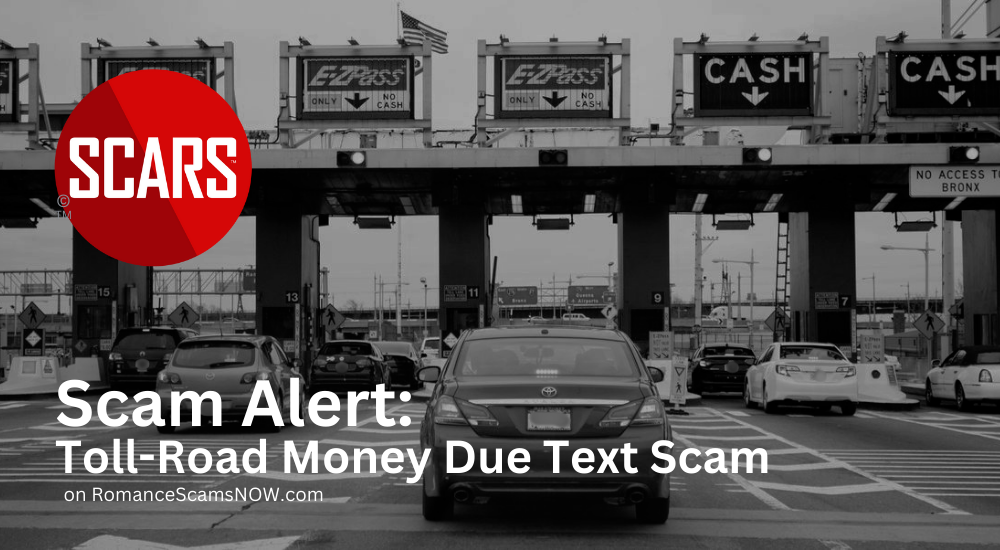
Scam Alert: Toll-Road Money Due Scam – U.S./Canada
Beware of Messages, Texts, and Phone Calls Claiming You Owe Toll-Road Fines!
How Scams Work – A SCARS Insight
Author:
• SCARS Editorial Team – Society of Citizens Against Relationship Scams Inc.
Article Abstract
Scammers are targeting travelers in the United States and Canada. They are employing a new toll-road money-due scam, reaching victims via phone calls, messages, and texts, all in an effort to extract money for fake fines and tolls. These scams typically involve false notifications claiming recipients owe money for unpaid tolls, often accompanied by urgent language and threats of legal repercussions.
Victims are then directed to make payments through specific methods, such as wire transfers or prepaid gift or debit cards, to resolve the supposed debt. The scam may also include fake documentation and an absence of the ability to verify, making it challenging for victims to discern the legitimacy of the communication.
According to the FBI, there has been a surge in complaints related to fraudulent texts representing toll collection services, with over 2,000 reports since early March 2024.
To avoid falling victim to these scams, individuals are advised to verify the source of any communications, question unsolicited messages demanding immediate payment, refrain from providing personal information, and report any suspicious activity to relevant authorities. By remaining vigilant and exercising caution, individuals can protect themselves from financial losses and other adverse consequences associated with toll-road money due scams.
SCARS Recommended Books
People Across the United States and Canada are being Scammed with Toll-Road Money Due Scam – by Phone, Message, and Text Scammers are Trying to Collect Money for Fake Fines and Tolls
A toll-road money-due scam involves fraudsters attempting to deceive individuals into paying fake fines or fees related to alleged violations on toll roads.
The texts or messages, or even phone calls claim the recipient owes money for unpaid tolls and contain almost identical language. The “outstanding toll amount” is similar to the complaints reported to the FBI. However, the link provided within the text is created to impersonate the state’s toll service name, and phone numbers appear to change between states.
Example Toll-Road Money Due Scam Message
(State Toll Service Name): We’ve noticed an outstanding toll amount of $12.51 on your record. To avoid a late fee of $50.00, visit https://myturnpiketollservices.com to settle your balance.
Here’s how the scam typically unfolds:
- False Notification: Victims receive communication, often via email, text message, or phone call, claiming to be from a toll road authority or a collection agency representing them. The message informs the recipient that they owe money due to a violation, such as failing to pay a toll or exceeding the speed limit on a toll road.
- Urgency and Threats: The communication usually emphasizes urgency and may include threats of legal action, license suspension, or increased fines if the alleged debt is not paid promptly. Scammers rely on intimidation tactics to pressure victims into immediate action without questioning the validity of the claims.
- Payment Request: Victims are instructed to make payments through specific methods, such as wire transfers, prepaid gift or debit cards, or cryptocurrency, to resolve the supposed debt. Scammers often provide instructions for making payments that are difficult to trace or reverse, making it easier for them to evade detection.
- Fake Documentation: In some cases, scammers may provide fake documentation, such as official-looking notices or invoices, to lend credibility to their claims. However, these documents are typically forged or misleading and do not represent legitimate fines or fees owed to toll road authorities.
- Absence of Verification: Victims may find it challenging to verify the legitimacy of the communication, especially if they are unfamiliar with the toll road in question or if the scammer provides convincing-sounding details. Often, toll fees and fines can only be seen on a specific authority website. However, legitimate toll road authorities typically have established procedures for handling violations and do not resort to aggressive or deceptive tactics to collect payment.
According to the FBI
The FBI has issued a warning about fraudulent text messages attempting to scam toll road and bridge users.
Since early-March 2024, the FBI Internet Crime Complaint Center (IC3) has received over 2,000 complaints reporting fake texts/smishing texts representing road toll collection service from at least three states. IC3 complaint information indicates the scam may be moving from state-to-state.
If you’re road tripping as the weather gets nice there’s a chance you’ll pass a toll if you’re heading somewhere far. And in this case, you could become a target for this latest scam.
Here’s what the Toll-Road Money Due Scam/fraud looks like:
You get a text that says you owe money for unpaid tolls. They may ask you for sensitive data, and credit card information.
“It goes on and says if you don’t pay now, there will be additional penalties. They want you to respond back or click on the link and not really think about it too much and make that payment. Then there’s a payment link at the bottom and that payment link is a website that closely resembles the toll authority but it’s obviously not the real toll authority,” said Toby Braun, managing partner of American Special Investigative Group.
If you Receive One of these Texts, Messages, or Calls
The following is suggested:
- File a complaint with the IC3, www.ic3.gov, be sure to include:
- The phone number from where the text or message or phone call originated.
- The website link listed within the text
- Check your own account using the toll service’s legitimate website, or contact the toll service’s customer service phone number.
- Delete any fake/smishing texts received.
- If you clicked any link or provided your information, make efforts to secure your personal information and financial accounts – change logins and passwords immediately. Dispute any unfamiliar charges.
Avoiding these Scams
To avoid falling victim to toll-road money due scams, individuals should:
- Next answer unknown phone numbers!
- Verify the Source: Contact the toll road authority directly using official contact information obtained from their website or official correspondence to confirm the validity of any notices or claims received, or search Google for the official website.
- Question Unsolicited Communications: Be cautious of unsolicited communications demanding immediate payment and threatening consequences for non-compliance. Legitimate authorities usually provide multiple opportunities for individuals to address violations before escalating enforcement actions.
- Do Not Provide Personal Information: Avoid sharing sensitive personal or financial information, such as Social Security numbers or credit card details, in response to unsolicited requests, especially if they come from unfamiliar or suspicious sources.
- Report Suspicious Activity: Report any suspected scams or fraudulent communications to relevant authorities, such as the FBI, Federal Trade Commission (FTC), local law enforcement agencies, or consumer protection agencies, to help prevent others from falling victim to similar schemes. See reporting.AgainstScams.org for more information on reporting.
By staying vigilant and exercising caution when dealing with requests for payment related to toll roads, individuals can protect themselves from falling prey to toll-road money due scams and avoid financial losses and other adverse consequences.
More Text & Message Scams:
- Robocalls and Text Scams – How To Stop Them – A SCARS Guide (romancescamsnow.com)
- “Hello” Text Message Scams (romancescamsnow.com)
- Venmo Text Scam (romancescamsnow.com)
- Identify and Stop Scam/Spam Text Messages (romancescamsnow.com)
- Text Message Scam Warning (romancescamsnow.com)
- FluBot: Package Delivery Text Message Shipping Scam (romancescamsnow.com)
- Don’t Click Links In Unknown Text Messages! Ever! (romancescamsnow.com)
-/ 30 /-
What do you think about this?
Please share your thoughts in a comment below!
Table of Contents
- Beware of Messages, Texts, and Phone Calls Claiming You Owe Toll-Road Fines!
- Article Abstract
- People Across the United States and Canada are being Scammed with Toll-Road Money Due Scam – by Phone, Message, and Text Scammers are Trying to Collect Money for Fake Fines and Tolls
- Example Toll-Road Money Due Scam Message
- According to the FBI
- If you Receive One of these Texts, Messages, or Calls
- Avoiding these Scams
- More Text & Message Scams:

Rapid Report Scammers

In the U.S. & Canada
U.S. & Canada Suicide Lifeline 988
LEAVE A COMMENT?
Recent Comments
On Other Articles
- Wendy Guiher on 15 Things That Nearly Every Online and Phone Scams Have In Common – 2026: “Very concise, direct information. When I look back on the crime against me I now can see ALL of the…” Apr 1, 06:24
- on The Danger of Using AI in Law Enforcement – The Grandmother Wrongly Arrested as a Fraudster – 2026: “Excellent article – I can’t imagine the terror Angela most certainly experienced. Compound this with the lack of accountability by…” Mar 24, 09:20
- on The Crazy Gregor MacGregor and the Country of Poyais Scam – History of Scams – 2026: “interesting” Mar 23, 19:24
- on BEC Fraud Reaches $43 Billion Per Year: “oh my gosh so much of an increase in the fraud I pray the officials can continue tracking and make…” Mar 23, 15:09
- on Establishing The United States Task Force To Eliminate Fraud – 2026: “Make Online Safe Again!” Mar 17, 19:11
- on Establishing The United States Task Force To Eliminate Fraud – 2026: “Finally an administration takes the initiative to help solve the gigantic situation. Make America Safe Again, thank you!” Mar 17, 15:41
- on What Is The Difference Between A Scam Victim And A Scam Survivor? [Updated]: “Due to my scams I don’t fully trust anyone online and I shouldn’t even those people I knew in high…” Mar 7, 12:46
- on SCARS 3 Steps For New Scam Victims 2024: “I was very fearful “he” would come to my home because I was knew my address, I spoke to someone…” Mar 7, 09:50
- on Sadness & Scam Recovery: “Before my scam, my mom passed away and I got a divorce, so I was dealing with the loss of…” Mar 7, 09:37
- on The Story Of Kira Lee Orsag (aka Dani Daniels) [Updated]: “There is NO evidence and she is not, she is a victim too. Sebastian, stop letting your anger think for…” Mar 6, 23:18
ARTICLE META
Important Information for New Scam Victims
- Please visit www.ScamVictimsSupport.org – a SCARS Website for New Scam Victims & Sextortion Victims
- Enroll in FREE SCARS Scam Survivor’s School now at www.SCARSeducation.org
- Please visit www.ScamPsychology.org – to more fully understand the psychological concepts involved in scams and scam victim recovery
If you are looking for local trauma counselors please visit counseling.AgainstScams.org or join SCARS for our counseling/therapy benefit: membership.AgainstScams.org
If you need to speak with someone now, you can dial 988 or find phone numbers for crisis hotlines all around the world here: www.opencounseling.com/suicide-hotlines
A Note About Labeling!
We often use the term ‘scam victim’ in our articles, but this is a convenience to help those searching for information in search engines like Google. It is just a convenience and has no deeper meaning. If you have come through such an experience, YOU are a Survivor! It was not your fault. You are not alone! Axios!
A Question of Trust
At the SCARS Institute, we invite you to do your own research on the topics we speak about and publish, Our team investigates the subject being discussed, especially when it comes to understanding the scam victims-survivors experience. You can do Google searches but in many cases, you will have to wade through scientific papers and studies. However, remember that biases and perspectives matter and influence the outcome. Regardless, we encourage you to explore these topics as thoroughly as you can for your own awareness.
Statement About Victim Blaming
SCARS Institute articles examine different aspects of the scam victim experience, as well as those who may have been secondary victims. This work focuses on understanding victimization through the science of victimology, including common psychological and behavioral responses. The purpose is to help victims and survivors understand why these crimes occurred, reduce shame and self-blame, strengthen recovery programs and victim opportunities, and lower the risk of future victimization.
At times, these discussions may sound uncomfortable, overwhelming, or may be mistaken for blame. They are not. Scam victims are never blamed. Our goal is to explain the mechanisms of deception and the human responses that scammers exploit, and the processes that occur after the scam ends, so victims can better understand what happened to them and why it felt convincing at the time, and what the path looks like going forward.
Articles that address the psychology, neurology, physiology, and other characteristics of scams and the victim experience recognize that all people share cognitive and emotional traits that can be manipulated under the right conditions. These characteristics are not flaws. They are normal human functions that criminals deliberately exploit. Victims typically have little awareness of these mechanisms while a scam is unfolding and a very limited ability to control them. Awareness often comes only after the harm has occurred.
By explaining these processes, these articles help victims make sense of their experiences, understand common post-scam reactions, and identify ways to protect themselves moving forward. This knowledge supports recovery by replacing confusion and self-blame with clarity, context, and self-compassion.
Additional educational material on these topics is available at ScamPsychology.org – ScamsNOW.com and other SCARS Institute websites.
Psychology Disclaimer:
All articles about psychology and the human brain on this website are for information & education only
The information provided in this article is intended for educational and self-help purposes only and should not be construed as a substitute for professional therapy or counseling.
While any self-help techniques outlined herein may be beneficial for scam victims seeking to recover from their experience and move towards recovery, it is important to consult with a qualified mental health professional before initiating any course of action. Each individual’s experience and needs are unique, and what works for one person may not be suitable for another.
Additionally, any approach may not be appropriate for individuals with certain pre-existing mental health conditions or trauma histories. It is advisable to seek guidance from a licensed therapist or counselor who can provide personalized support, guidance, and treatment tailored to your specific needs.
If you are experiencing significant distress or emotional difficulties related to a scam or other traumatic event, please consult your doctor or mental health provider for appropriate care and support.
Also read our SCARS Institute Statement about Professional Care for Scam Victims – click here to go to our ScamsNOW.com website.

Thank you for your comment. You may receive an email to follow up. We never share your data with marketers.