



SCARS Institute’s Encyclopedia of Scams™ Published Continuously for 25 Years


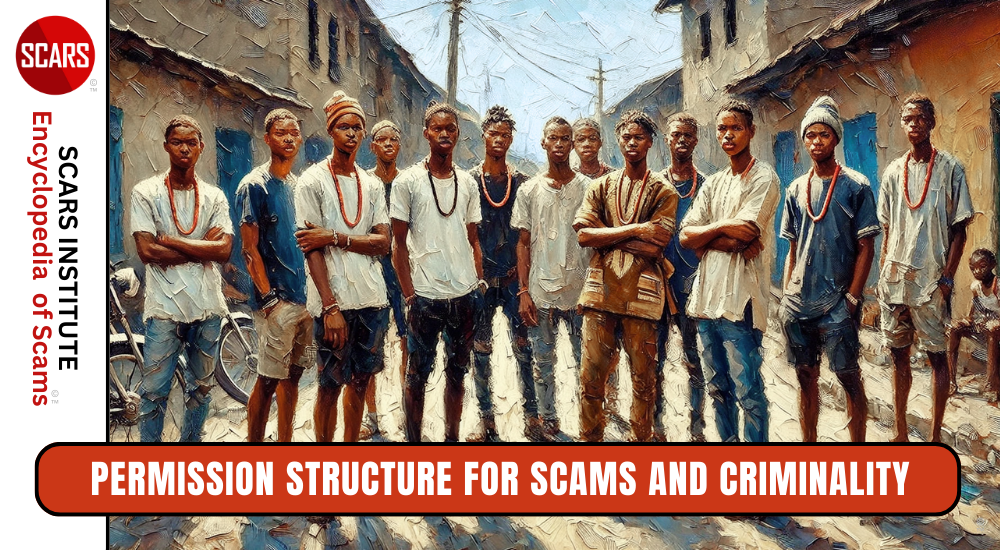
The Permission Structure that Accommodates Scams and Online Criminality
Permission Structures and West African Online Fraud: Social Scripts, Moral Economies, and Paths to Prevention
Criminology – A SCARS Institute Insight
Author:
• Tim McGuinness, Ph.D., DFin, MCPO, MAnth – Anthropologist, Scientist, Director of the Society of Citizens Against Relationship Scams Inc.
See Author Biographies Below
Article Abstract
Permission structures are the shared stories, signals, and routines that make online fraud appear normal or admirable across parts of West Africa where youth precarity, hustle culture, and weak guardianship intersect. Neutralizations such as denying harm, blaming victims, and appealing to family duty recast theft as ingenuity or obligation, while music, nightlife, and selective spiritual messages convert sudden wealth into status. Platform switching, encrypted chat, identity masking, and cross-border cash-out reduce empathy and increase scale, and distance turns victims into handles, invoices, and codes. Evidence-informed responses include protective friction on platforms and payments, swift and certain consequences for organizers and cash-out networks, recoding status toward lawful skill, expanding credible earning paths, mobilizing faith and civic leadership, teaching youth refusal norms, and measuring progress with outcomes that reflect real harm reduction. When these strands align, social permission narrows, recruitment slows, and communities gain safer digital spaces and steadier livelihoods.

Scam Victim Trigger Warning
The following content discusses the operations, recruitment methods, and internal structures of scam organizations. It provides insight into how these groups function, including their deceptive tactics, manipulation strategies, and the psychological techniques they use to exploit victims.
If you have been a victim of a scam, reading about these details may be emotionally triggering. Discussions of financial loss, deception, and betrayal can bring up feelings of distress, anger, shame, or anxiety. It is important to prioritize your emotional well-being while engaging with this content.
If you feel overwhelmed or uncomfortable at any point, consider taking a break or seeking support from a trusted friend, family member, or professional counselor. There are also victim support organizations that provide assistance, guidance, and resources to help those affected by fraud recover emotionally and financially. You can sign up for a free SCARS Institute Support Group at support.AgainstScams.org
Permission Structures and West African Online Fraud: Social Scripts, Moral Economies, and Paths to Prevention
Author’s Note
The following explores an aspect of the scamming and organized criminal cultures of Africa known as “Permission Structures.” This is not intended to be a comprehensive catalog of every aspect of these criminal organizations or their subcultures, but rather an introduction to the concepts of cultural and moral enablement that, in effect, promotes and permits this criminal behavior.
What is a Permission Structure?
In criminology, a permission structure refers to the set of social stories, moral justifications, and community signals that make offending feel acceptable or even expected. These narratives often rely on familiar techniques of neutralization, including denying harm, shifting blame to victims, appealing to higher loyalties, and claiming that “everyone does it.” When such explanations circulate among peers and families, on local streets, and across social media, they lower restraint, reshape moral judgment, and turn profitable crime into a routine career path. The result is not a single excuse but a shared script that allows offenders to act while still seeing themselves as decent, loyal, or entrepreneurial.
Current concerns center on online fraud ecosystems linked to West Africa, particularly in Nigeria and Ghana. Prominent schemes include romance fraud that exploits intimacy and trust, business email compromise that targets organizational routines, and investment swindles, including so-called pig-butchering, that blend social grooming with staged profits. These crimes travel easily across borders, affect individuals and small businesses on every continent, and place a heavy strain on families, employers, banks, payment platforms, and public agencies. Harm appears as direct financial loss, prolonged psychological injury, and a slow erosion of confidence in digital communication and commerce.
A clear map of the forces that build permission structures helps explain persistence and growth. Key drivers include youth unemployment, status competition, and informal economies that reward visible wealth; clan and peer loyalties that normalize “helping one’s own”; music and media that celebrate outsmarting outsiders; weak or delayed accountability; and easy access to social-engineering scripts, malware, money mules, and laundering channels. Effective prevention requires pressure on both stories and systems. Targeted deterrence, financial frictions that remove easy payout paths, community counter-narratives that restore moral boundaries, and practical education for families, schools, and employers can narrow the social permission that keeps these crimes attractive and profitable.
The goal is to provide an introductory map of the cultural, economic, political, and technological conditions that shape these permission structures, then outline practical ways to weaken them. The analysis looks at youth unemployment, status competition, and informal economies that reward visible wealth. It also considers clan and peer loyalties, music and media that celebrate outsmarting outsiders, weak or delayed accountability, and the ready availability of scripts, malware, and social-engineering toolkits. Finally, it reviews prevention paths that combine targeted deterrence, financial-system frictions that remove easy payout channels, community-level counter-narratives that restore moral boundaries, and education that helps families, schools, and employers recognize early signals. By addressing both stories and systems, stakeholders can reduce the social permission that keeps these crimes profitable.
Conceptual Grounding
Moral economy and permission structures
Communities often build moral worlds that recast online fraud as ingenuity, hustle, or necessary survival. In neighborhoods where formal opportunity feels scarce and visible success confers safety and status, stories arise that praise the quick thinker who “outsmarts” distant outsiders. Family conversations, peer jokes, and popular lyrics can turn deceit into a mark of creativity, while the material signs of success, such as a new phone or a renovated home, reinforce the tale that talent, not harm, produced the gain. Over time, this narrative matures into a permission structure: a set of shared explanations and signals that make participation feel normal, admired, and safe to discuss inside one’s circle.
These explanations echo classic neutralizations. Denial of injury frames the victim’s losses as trivial, insured, or easily absorbed by companies and banks. Denial of the victim paints targets as greedy, careless, or complicit, which strips them of sympathy and softens moral brakes. Condemnation of the condemners casts law enforcement, foreign firms, and politicians as corrupt or hypocritical, so their criticism loses authority. Appeal to higher loyalties promotes obligations to family, clan, or hometown, claiming that providing school fees or medical bills justifies breaking rules set by distant powers. In many West African settings, these moves adapt to post-colonial grievances and everyday corruption critiques. Young people who see officials prosper without consequence often conclude that rule-bending is the real operating system. When that conclusion meets tight kin obligations and scarce jobs, fraud acquires a moral wrapper: protection of one’s own, correction of global unfairness, and proof of personal worth.
The permission structure also contains practical scripts. Older peers teach newcomers how to open accounts, rehearse romance or investor storylines, and manage money flows through compliant intermediaries. Small wins are celebrated publicly, while setbacks are explained as bad luck rather than warnings. Local entrepreneurs sell tools, data, and “formats,” turning the moral economy into a marketplace. Step by step, the boundary between enterprise and crime blurs, and the social cost of abstaining grows as friends advance and families expect contributions.
Socio-technical opportunity
Demography and infrastructure widen the on-ramp. A youth bulge places many school-leavers into cities where underemployment, urban informality, and weak wage growth limit upward mobility. Affordable smartphones, cheap data bundles, and round-the-clock access to social platforms provide a low-barrier path into cyber-enabled schemes. Shared apartments and co-working rooms become training grounds where scripts, templates, and contacts circulate quickly. In this environment, the first steps into deception require little capital, and the feedback loop is fast: an effective message or profile can yield funds within days, which confirms the surrounding stories about talent and hustle.
Platform architecture further amplifies scale. Offenders invite targets to switch from public platforms to encrypted apps, where identity checks are rare and message threads feel private. Multiple channels, including email, voice-over-internet calls, and social messengers, allow coordinated handoffs that mimic corporate workflows, increase perceived legitimacy, and fracture the memory of red flags across contexts. Cheap virtual numbers, disposable domains, and anonymized wallets lower the risk of exposure. Cross-border money channels, including money mules, trade-based movements, and informal value transfer, turn local schemes into export industries. The social media economy adds reach by selling lists, followers, and engagement, which shortens the time between recruitment, grooming, and payout.
These socio-technical conditions interact with the moral economy in reinforcing ways. Quick earnings validate the narrative that fraud is clever work, not violence. Screens distance offenders from victims, which makes the denial of injury feel plausible. Encrypted groups create echo chambers where peers share tips, mock warnings, and celebrate “wins,” so counter-messages struggle to land. Weak or delayed accountability allows the most visible examples of success to remain on display, while quieter stories of arrest, family strain, or long-term fear rarely travel as far. Together, these forces stabilize the permission structure: a lived world where deception seems rational, loyalty to one’s own feels honorable, and technology supplies the tools to act at scale with limited immediate risk.
Nigeria: “Yahoo Boys,” Hustle Ideology, and Normalization
Socialization into fraud networks
In many Nigerian cities, entry into online fraud often begins with close peer mentoring. Older friends or cousins teach basic scripts, show sample chats, and explain how to open accounts that appear legitimate. On university campuses and in crowded urban neighborhoods, small groups form around shared devices and late-night sessions, where newcomers learn roles and routines by watching others. Semi-organized cells emerge from this steady contact. Some members act as “pickers,” who identify vulnerable targets and collect contact details. Others serve as “loaders,” who prepare storylines, images, and counterfeit documents for romance, investment, or business email compromise schemes. “Spammers” handle volume messaging and platform switching, while “mules” move funds through local and cross-border channels. The work is divided by skill and risk, which allows a beginner to start with low-barrier tasks and then climb toward higher-payout roles.
Visibility in daily life strengthens recruitment. When proceeds are used to purchase a used car, a renovated room, or new clothes, neighbors notice the change and ask questions. Music videos, shout-outs, and club scenes often display the symbols of quick success, which turn private gains into public signals. A clear feedback loop forms. The display draws admiration, admiration brings new recruits, and new recruits receive training that points back to the same symbols of status. Within these circles, advice travels fast. Members share lists, tools, and “formats,” which are step-by-step scripts for courting, grooming, and closing. Short-term wins receive attention, while losses are framed as bad luck or poor execution rather than as warnings about harm or risk.
Mentoring also includes social rules. Silence outside the circle is presented as loyalty. Sharing with family is presented as a duty. Many novices hear that the real danger is not the crime but the mistake of trusting the wrong person. This message shifts fear away from victims, who remain distant and abstract, toward peers or rivals who might expose the group. Over time, the group becomes the main source of technical knowledge, money tips, and moral cues, which makes exit harder and outside voices weaker.
Moral narratives that license offending
Moral narratives help transform fraud from a prohibited act into an acceptable practice. A common script claims that elites steal first and set the rules second. If officials, contractors, or corporate actors misuse funds without consequence, then deceiving outsiders becomes a form of balance rather than a breach. This idea frames the online target as part of a larger system that already treats the community unfairly. The target becomes a symbol, not a person. Denial of injury follows easily from that distance. Losses are dismissed as insured, or as a minor event for a large company, or as the price of doing business in a world that already tilts against the local poor.
Denial of the victim also appears when offenders label targets as greedy, careless, or complicit. If a stranger expects unrealistic investment returns, the story paints the stranger as a willing player in a risky game. That label removes sympathy and reduces internal conflict. Condemnation of condemners adds another layer. Critics are described as hypocrites who profit from extractive histories, unfair trade, or local corruption. When this view takes hold, local enforcement and foreign warnings lose moral force, because the messenger is already judged.
Appeals to higher loyalties complete the license. Young men describe the need to pay a sibling’s school fees, replace a parent’s roof, or meet expectations during holiday visits. Patrons who provide introductions or protection expect gifts in return. Community events display generosity as proof of adulthood and success. In this setting, sending money home is not only a kindness. It is a requirement, and it yields honor. When online fraud meets these obligations, the act can feel dutiful, and refusal can feel like a betrayal of family. The result is a moral economy where loyalty to kin, hometown, and patrons outweighs abstraction about distant harms.
Institutional and economic drivers
Economic conditions widen the channel that these narratives flow through. Many educated young adults face unemployment or underemployment after graduation. Wage work absorbs a small share of the labor supply, and informal trading often cannot match rising household costs. The internet, cheap data, and social platforms create a low-cost path to try online schemes, and early success confirms the choice. Episodic crackdowns occur, yet the certainty of detection often feels low. Arrests may be selective or delayed, and cases move slowly. When a friend appears to earn freely while a classmate waits months for a small salary, patience wears thin, and risk calculus changes.
Policing and justice constraints reinforce this pattern. Specialized cyber units exist, yet they work with heavy caseloads, limited tools, and cross-border complications. Local stations concentrate on physical crime and public order, while cyber complaints require technical capacity and long coordination chains. These limits reduce visible consequences in the short term. Communities then read the absence of visible outcomes as a signal that “smartness” wins. That message travels quickly in group chats and meeting places, where members trade stories about near misses, helpful contacts, and ways to avoid attention.
The broader environment adds pressure. Currency swings, price spikes, and periods of political uncertainty make future planning hard. Families lean on the household member who seems most likely to provide. The person who joins an online crew gains income, attention, and influence within the family, which further normalizes the path. At the same time, rule-of-law gaps allow status goods purchased with fraud proceeds to circulate without scrutiny. Clubs, car lots, and landlords accept cash without strong checks, which turns illicit gains into everyday consumption that others can see and desire.
Normalization grows when these forces combine. Peer mentoring supplies skills and belonging. Music and nightlife provide symbols and a stage. Moral stories remove blame and elevate duty. Weak labor markets and slow justice lower the perceived cost. In this mix, abstaining feels lonely, and compliance feels naïve. The permission structure becomes self-sustaining, because it rewards members socially and financially, while outsiders struggle to present a credible alternative.
Shifting this landscape requires attention to every layer. Communities need visible pathways where talent earns lawful status and income. Families need reasons to praise steady work, not only quick gains. Police and courts need predictable, fair outcomes that are seen and understood, not only occasional high-profile raids. Platforms need steadier cooperation with local partners to limit recruitment, grooming, and cash-out tools. When these pieces begin to move together, the local story about “smartness” can change. Fraud then loses its glamour, the group loses its pull, and young adults can choose different routes that still meet obligations to kin and community without harm to strangers.
Ghana: “Sakawa,” Spiritual Frames, and Hybrid Justifications
Integration of Spirituality with Online Fraud
In Ghana, the term “sakawa” commonly refers to blends of internet fraud with ritual practice, where spiritual frames are used to explain risk, reward, and protection. Participants visit spiritual intermediaries, recite specific success phrases, and perform offerings that are said to cleanse pathways or silence misfortune. These rituals provide a cosmological cover that reframes deception as a managed transaction within a spiritual economy, rather than as a straightforward criminal act.
Religious syncretism strengthens this frame. Prosperity messages, drawn from charismatic preaching and traditional belief, can recode sudden wealth as a sign of favor. When a windfall appears after prayers, fasting, or consultation, some observers interpret the outcome as confirmation that spiritual alignment produced the gain. In this narrative, ethical questions about method recede, while obedience to ritual instruction rises in importance. The result is a moral translation where illicit proceeds feel blessed, expected, and protected, which lowers internal resistance to continued offending.
Ritual language also orders daily practice. Specific days, colors, and incantations are linked to “opening roads,” attracting trusting contacts, or closing cases. Calendars, perfumes, clothing, and charms become tools that signal readiness and protection. These routines reduce fear, supply a sense of control, and justify persistence when scams encounter setbacks. When doubts surface, the answer often lies in renewing the ritual rather than revising the ethics.
Popular Culture as Carrier of Permission
Film, music, and social media spread a recognizable figure: the clever online trickster who outwits distant, wealthy marks. Storylines highlight wit, patience, and digital skill, then cap the arc with images of houses, cars, and public generosity. In these portrayals, the trickster stands against systems judged as unfair or extractive, which flips sympathy toward the local actor and away from the foreign target. Visuals of status goods and community giving build admiration, and admiration feeds imitation.
Public display turns proceeds into teaching tools. Lyrics, skits, and influencer reels showcase methods, vocabulary, and platform shifts in ways that feel entertaining while also instructive. When jokes land well and scenes draw applause, the social cost of fraud falls further. Young viewers see not only wealth but also belonging, humor, and courage against the odds. That blend recruits without overt recruitment, because it tells a hopeful story about agency in a tight economy.
Online audiences add a second channel. Comment threads create mini-classrooms where tactics, scripts, and “formats” circulate with little friction. Success stories receive likes, shares, and praise that function as micro-rewards. Criticism, when it appears, is often reframed as envy or hypocrisy. Over time, popular culture and peer feedback work together to normalize persistence, diminish remorse, and keep attention on the next score.
Socioeconomic Context
Ghana’s youthful population faces uneven labor absorption, rising living costs, and limited formal employment, especially in fast-growing urban corridors. Many young adults pursue informal digital work that ranges from legitimate freelance tasks to gray-market services and onward to fraud. The boundaries blur when skills used for search engine promotion, bulk messaging, or account setup can be repurposed for romance scams, investment lures, or business email compromise. A laptop, a phone, and cheap data create a low barrier to entry, while peer groups provide on-the-job training.
Migration aspirations add pressure. Families expect remittances, and peers celebrate those who “make it,” whether abroad or at home, through online income. When visas, fees, and foreign work options remain out of reach, digital schemes appear to offer a parallel route to the same social goals. The person who returns to a hometown with gifts, school fees, and event sponsorship gains honor and influence, regardless of the income source. That honor loops back into permission, because community benefits mask the upstream harm.
Market structure also matters. Informal money channels, cash-based purchases, and lightly monitored asset markets allow illicit proceeds to settle quickly into vehicles, rentals, and inventories. Retailers, landlords, and club owners often lack incentives or tools to scrutinize cash origins. This frictionless conversion of online gains into offline status reduces visible risk and magnifies the appeal of fast income. When formal justice appears slow or selective, the perceived difference between legal hustle and illegal hustle narrows further.
How Permission Consolidates and What Can Shift It
In the Ghanaian setting, permission consolidates through the intersection of spiritual frames, cultural narratives, and economic incentives. Rituals answer fear and supply meaning. The media glamorizes the outcome and frames the target as distant and undeserving. Local economies absorb the proceeds with little challenge, while families reward visible generosity. Together, these elements build a durable license to offend that feels coherent, admired, and financially rational.
Shifting the story requires movement at each layer. Community leaders can reaffirm spiritual messages that link blessing with lawful work, honesty, and care for strangers, while naming deception as inconsistent with those values. Creators can elevate alternative heroes who build businesses, teach skills, and support families through transparent income, then connect those stories to the same symbols of status and belonging. Urban programs that turn digital talent toward verified freelance markets, secure payments, and entrepreneurial mentoring can replace gray tasks with lawful gigs that still deliver speed and dignity.
Justice systems, platforms, and financial actors can increase the certainty and clarity of consequences without sweeping crackdowns that punish poverty rather than organized deception. When cases move visibly and fairly, and when cash-out points and account farms face predictable disruption, the allure of quick success fades. Families and patrons can help by praising steady gains, not only sudden ones, and by rewarding integrity alongside generosity. In time, the same skills that once composed “sakawa” scripts can support respected digital careers, while spiritual, cultural, and economic signals align around honest practice.
Scammers in the Ivory Coast, Burkina Faso, Togo, Gambia, and Benin
Socialization and Network Structure
Across the Ivory Coast, Burkina Faso, Togo, Gambia, and Benin, newcomers often learn online fraud through tight peer circles that operate from neighborhoods, campuses, and shared apartments. Older participants teach scripts, platform tactics, and cash-out methods, then assign tasks that match skill levels such as list building, account creation, messaging, or moving funds. Small crews branch into semi-organized cells with flexible roles, which allows quick adaptation when platforms change rules or banks tighten controls. Cybercafés, phone-repair stalls, and mobile-money kiosks serve as informal classrooms where tools, contacts, and success stories circulate. English and French language skills widen reach, so crews target multiple regions and shift easily between romance schemes, advance-fee offers, fake logistics invoices, and small-business investment pitches.
Moral Narratives and Local Justifications
Permission structures in these countries draw on overlapping narratives that recast fraud as hustle, ingenuity, or survival in the face of limited opportunity. Offenders frame foreign victims as distant and privileged, which reduces empathy and supports a denial of injury. Corruption, unequal trade, and visa barriers become talking points that reposition deception as payback or leveling. Obligations to parents, siblings, and patrons join the story, since visible contribution to school fees, rent, or ceremonies earns respect and soften moral questions. When elders or peers praise generosity and outcomes, rather than methods, the social cost of fraud falls, and the license to continue strengthens.
Socioeconomic and Infrastructural Drivers
Youth unemployment and underemployment remain persistent across the five countries, particularly in fast-growing urban corridors such as Abidjan, Ouagadougou, Lomé, Serrekunda, and Cotonou. Informal work dominates entry-level options, while wages lag behind living costs, data plans, and family remittance expectations. A basic kit that includes a smartphone, a laptop, and reliable data creates a low barrier to entry compared with formal jobs that require certifications or connections. Mobile-money ecosystems ease domestic transfers, while cross-border couriers, cash-in and cash-out agents, and crypto on-ramps lower friction for moving gains into goods, rent, or vehicles. Weak certainty of punishment and slow case processing reduce perceived risk, which shifts focus from whether to offend to how to scale.
Popular Culture and Visibility
Music, comedy skits, and social media reels in French and English portray the clever trickster who beats distant marks by mastering platforms, accents, and time zones. Fashion, nightlife, and visible purchases turn proceeds into status signals that recruit by example. Short videos teach practical steps in a playful tone, including how to switch apps, warm up targets, and frame false urgency. When applause follows displays of generosity at family events, public praise fuses with private training, which deepens the feedback loop that converts online earnings into local prestige.
Country Notes and Local Texture
In Ivory Coast, the figure of the internet fraudster circulates under local labels that highlight charm, improvisation, and digital reach. Abidjan’s mixed French and English media space connects crews to markets in Europe, North America, and Francophone Africa. In Burkina Faso, urban migration and regional displacement place young adults in crowded housing with intermittent work, where shared devices and late-night shifts normalize script practice and target hunting. Togo’s trading culture and port access blend with a growing tech scene, so digital skills move fluidly between gray markets and outright scams, with mobile-money agents and informal retailers serving as points where online income becomes tangible assets. In Gambia, a small population and a strong tourism footprint support romance and advance-fee variants that exploit seasonal flows, diaspora ties, and multilingual outreach. In Benin, Cotonou’s role as a commercial hub and its position on major trade corridors support cross-border crews that borrow tactics from both Francophone and Anglophone scenes. French language networks reach Europe and West Africa, while proximity to Nigeria and Togo eases the movement of devices, cards, and cash. Student networks in Cotonou and Porto-Novo provide recruits with language skills and platform familiarity, and resale markets convert digital profits into goods with few questions.
Cross-Border Methods and Money Flows
Crews rely on platform switching to fragment memory and reduce scrutiny. A contact starts on a dating site or marketplace, then moves to an encrypted app, then shifts to a voice call, a wallet link, or a social-media profile that looks legitimate. Multiple identities circulate within a single operation, so a supervisor, an auditor, or a courier can step in to increase pressure or plausibility. Money moves through layered channels that include mobile wallets, prepaid cards, informal couriers, and crypto exchanges, with quick conversion into cash, consumer electronics, and vehicles. Resale markets absorb these items with few questions, which closes the loop between online deception and offline status.
How Permission Consolidates and What Can Shift It
Permission consolidates when social admiration, economic payoff, and weak deterrence align. Families praise visible support, peers celebrate cleverness, and communities accept sudden wealth at face value. When local role models display success that appears to come from digital hustle, the line between legitimate gig work and fraud blurs further. Shifting this environment requires steady signals that link status to lawful achievement, celebrate transparent income, and raise the certainty of proportionate and fair consequences for deception. Urban programs that convert platform skills into verified freelance work, secure payment channels, and small-business support can redirect talent without stripping dignity. Retailers, landlords, and vehicle dealers who adopt basic verification for large cash purchases raise friction for laundering gains. Community and faith leaders who connect honor with honest work, patience, and care for strangers can reset moral cues that now excuse exploitation. Over time, as lawful digital paths become visible, dependable, and respected, the social license that once supported online fraud weakens, and the same skills find durable, legitimate use.
Regional Terrorist Organizations and Cyber-Enabled Fraud
Terrorist organizations across the Sahel, Lake Chad Basin, the Horn of Africa, and parts of Central Africa have incorporated online fraud and cybercrime into their financing and influence portfolios. These groups adapt familiar criminal techniques to fragile security environments, weak digital safeguards, and expanding mobile-money ecosystems. They treat deception-driven revenue as a flexible stream that complements taxation of local trade, control of smuggling routes, kidnapping, and protection rackets. The result is a mixed economy in which scams, extortion, and information operations reinforce one another and extend reach across borders.
Financing Through Fraud and Digital Theft
Groups such as JNIM, ISGS, and Ansar Dine in the central Sahel, Boko Haram and ISWAP in the Lake Chad region, Al-Shabaab in the Horn of Africa, and IS-DRC in eastern Congo have each experimented with cyber-enabled schemes. Their operators use romance and confidence scams, charity and disaster appeals, fake investment offers, and phishing campaigns to extract funds from distant targets who cannot easily verify claims. Proceeds flow through mobile-money agents, prepaid cards, hawala brokers, or cryptocurrency exchanges, then reappear as cash, vehicles, fuel, and supplies. Fraud fits these networks because entry costs are low, proof of concept arrives quickly, and the activity can be segmented across small cells that are hard to disrupt.
Tactics, Platforms, and Laundering Paths
Operational playbooks borrow from transnational scam crews while adding insurgent discipline. Handlers script conversations, rotate identities and devices, and switch platforms to fracture oversight. Business email compromise, fake procurement, and spoofed security alerts target companies and municipal offices that lack authentication controls. Social media pages present fabricated relief projects, orphan appeals, or scholarship drives that invite small donations at scale. Local cash-out relies on trusted intermediaries near markets, bus stations, border towns, and mining sites, where value can shift rapidly from digital wallets into tradable goods. In contested areas, telecom outages, SIM recycling, and document scarcity complicate due diligence, which increases the utility of low-value, high-volume fraud.
Recruitment, Permission Structures, and Messaging
Cybercrime also serves as a recruitment and cohesion tool. Propaganda reframes scams as asymmetric warfare, restitution for state abuses, or a practical duty that funds defense and social services in areas under control. Young followers learn scripts and basic operational security before graduating to logistics or combat roles, which creates an internal ladder of advancement. Public displays of generosity, such as food distributions or funeral support funded by online takings, convert deception into community credit and blunt moral objections. In this environment, fraud is not only tolerated, it is narrated as service, which lowers the social cost of participation.
Regional Profiles and Adaptation
In the Sahel, JNIM and ISGS operate across vast rural corridors with limited state presence, so cyber-enabled fraud complements cattle taxation, road tolls, and artisanal mining levies. The groups leverage multilingual skills to reach Francophone and Anglophone audiences and use diaspora connections for remittance intermediaries. In the Lake Chad Basin, Boko Haram and ISWAP run dispersed cells around islands and border towns where mobile money and cross-lake trade intersect. Fraud and extortion finance fuel, motorcycles, and food, while device theft and SIM swaps feed identity abuse at scale. In Somalia and neighboring states, Al-Shabaab pairs digital fundraising with classic protection schemes on trucking, ports, and markets. The group’s media units adapt charity and zakat narratives to solicit small transfers from sympathizers and unknowing donors. In eastern DRC, IS-DRC exploits displacement, porous borders, and mineral routes. Fraud proceeds move alongside gold, coltan, and timber, which provide cover and rapid conversion into cash.
Convergence With Organized Crime and Corruption
Terrorist cells intersect with criminal entrepreneurs who specialize in carding, malware rental, and cash-out services. Facilitators supply forged documents, mule accounts, and money changers who can move value across borders without formal banking. Corrupt officials who sell identity data, police checkpoints, or access to seized devices accelerate fraud pipelines and reduce the perceived risk of arrest. This convergence blurs lines between ideological violence and profit-driven crime, which broadens the talent pool and stabilizes revenue even when battlefield dynamics shift.
Implications for Disruption and Resilience
Effective disruption requires narrowing the space where online fraud turns into usable resources. Payment providers that tighten tiered KYC, velocity checks, geofencing, and merchant onboarding make laundering slower and riskier. Telecom hygiene, including stricter SIM registration and rapid blocking of recycled numbers tied to abuse, reduces impersonation and phishing success. Public agencies and businesses that adopt verification rituals for invoices, procurement changes, and emergency transfers close common doors for business email compromise. Community programs that expand legitimate digital work, apprenticeship, and micro-enterprise options reduce the appeal of scam training as a pathway to income or status. Clerics, elders, and media voices who link honor to transparent earnings and care for outsiders can shift moral cues that currently excuse deception.
A Regional Pattern With Local Faces
Although tactics overlap, each theater shows distinctive blends of grievance, opportunity, and control. What unites these cases is the strategic use of low-cost digital deception to fund operations, test recruits, and shape narratives. As connectivity deepens and mobile money expands, the boundary between distant victims and local battlefields grows thinner. Countering that trend depends on practical financial frictions, credible local livelihoods, and social messaging that treats fraud as harm rather than cleverness. Over time, consistent pressure on cash-out points, cleaner digital identity systems, and community standards that reject deception can reduce the returns that make cyber-enabled fraud attractive to armed groups.
Black Axe: Cult Origins, Global Reach, and Cyber-Enabled Crime
Black Axe, also known as the Neo-Black Movement of Africa, began as a campus confraternity in Nigeria during the late twentieth century and later evolved into a transnational criminal network. Members organize through chapters that mirror student “temples,” with regional and international zones that report to senior coordinators. The group uses rituals, secrecy, and oaths to build loyalty, while social clubs and alumni associations provide respectable fronts for meetings, money movement, and recruitment. Over time, the organization expanded beyond campus violence into fraud, extortion, trafficking, and political muscle, which increased its resources and reach.
Recruitment follows predictable paths. Young men encounter members in universities, neighborhoods, and diaspora communities, where promises of protection, income, and status are persuasive. New recruits learn a shared language, hand signs, and initiation practices that reinforce identity and obedience. Older members act as handlers and trainers, passing along scripts, contact lists, and access to devices. This socialization process turns ordinary skills, such as chatting online or managing spreadsheets, into tools for deception. A sense of brotherhood and obligation reduces internal dissent and keeps operations running even when leaders are arrested.
Cyber-enabled fraud sits at the center of the group’s income strategy. Cells specialize in romance scams, business email compromise, fake investment offers, and recovery-room schemes. Handlers teach platform switching, time zone rotation, and persona building, so a single operation can run around the clock. Writers craft stories that appeal to empathy and urgency, while “loaders” seed stolen credentials into new accounts. Money mules, sometimes recruited through job ads or coerced through debt, move funds across borders using mobile money, prepaid cards, cryptocurrency exchanges, and hawala corridors. Each role is simple on its own, yet the combined system produces steady payouts with low overhead.
The organization converts online proceeds into local power. Cash purchases of vehicles, property, and nightlife enterprises give members status and safe meeting places. Visible spending on parties, music events, and fashion advertises success to potential recruits and masks illicit sources of wealth. Selective charity, such as donations to funerals, school fees, or community projects, builds goodwill and weakens resistance. These gestures function as permission structures that reframe fraud as hustle, ingenuity, or payback against unfair systems. When communities accept these narratives, the social cost of offending falls, and participation appears less risky.
Political links increase protection. During election cycles, local strongmen hire members as enforcers and crowd managers. These relationships open doors to officials who can warn about police operations, speed the release of detained members, or sell access to identity records that feed new scams. The perceived certainty of punishment drops when bribes, favors, and influence can blunt investigations. This environment rewards boldness and normalizes a pattern in which cleverness and aggression are prized over lawful work.
Operations adapt quickly to law-enforcement pressure. When one platform tightens verification, operators shift to another. When a money corridor closes, funds route through tourism hubs, mining towns, and border markets where documentation is weak. Cells also diversify into parallel crimes that support fraud, including device theft, SIM swaps, phishing kits, and counterfeit documents. The group maintains redundancies, so the arrest of a handler or the seizure of a laptop slows a cell but does not halt the wider network. International takedowns force short retreats, followed by a return under new names, new accounts, and revised scripts.
Diaspora chapters extend capacity. Members in Europe, North America, and southern Africa provide bank accounts, shipping addresses, and face-to-face contact with victims or intermediaries. They also recruit local mules, rent short-term offices for shell companies, and arrange cash-out through secondhand car markets and small import-export firms. Because these activities sit near legitimate trade and service work, they can hide in plain sight until financial anomalies or victim reports trigger scrutiny.
The harm spreads across continents. Victims lose savings, pensions, and business capital. Families face shame and conflict. Small companies and public agencies suffer invoice fraud and payroll redirection that drain budgets and disrupt services. Communities in source countries experience cycles of violence and retaliation when rival groups fight for territory and allegiance. The cycle deepens when young people view fraud as the only path to mobility, while honest work appears slow, risky, and unrewarded.
Pressure points exist. Financial controls that limit rapid account opening, enforce tiered “know your customer” rules, and flag velocity spikes disrupt cash-out. Mobile-money providers that tighten agent audits, SIM registration, and device fingerprints reduce impersonation and mule churn. Universities and diaspora associations that enforce clear codes of conduct and deny space to cult-linked groups shrink recruitment pipelines. Public messaging that connects romance and business email compromise to real local costs weakens the glamour that flashy spending projects. Consistent prosecutions that follow the money to handlers and coordinators raise the perceived risk above the street level.
Black Axe illustrates how a closed brotherhood can professionalize online fraud and multiply its effects through culture, politics, and diaspora reach. The combination of social discipline, digital skill, and adaptable laundering makes the enterprise resilient. Countering it requires steady financial friction, credible local livelihoods, campus and community gatekeeping, and social narratives that honor lawful ingenuity over deceptive gain. When those elements align, recruitment slows, cash-out shrinks, and the group’s permission structures begin to erode.
Cross-Cutting Permission Narratives
Reparations and Reversal Stories
Across several West African settings, offenders often tell a story that reframes fraud as repayment. They argue that extraction ran for generations and that today’s unequal markets still drain opportunity from their communities. In that frame, a foreign victim becomes a symbol rather than a person, and the loss looks like a small return rather than a fresh harm. The narrative lowers empathy because the target is distant, wealthy, and imagined as part of an unfair system. It also invites contempt for outside critics, who are portrayed as hypocrites lecturing from comfortable positions. Once this story takes hold, the moral weight of the act shifts. Instead of deception against a neighbor, the crime looks like balance against a faceless world that never played fair. That shift removes the ordinary brakes of shame and pity, and makes repetition easier each time money moves without visible consequences.
Smartness, Hustle, and Anti-Naivety
A second narrative celebrates tactical cleverness as proof of worth. In crowded urban economies, quick thinking and crisp timing gain respect, while slow responses can bring ridicule. Within that culture, fraud can appear as a demanding skill, not a breach. Codes for spotting a mark, switching platforms, and reading emotional cues are taught as practical arts that separate winners from the naive. Public displays of success then reinforce the lesson. A rented car, a sponsored party, and a sudden move to a nicer neighborhood mark the person as smart in a hostile market. Young people watching from the edge learn that speed, nerve, and improvisation pay sooner than patience and study. Over time, this admiration acts like a permission slip. If cleverness equals competence, and if the market rewards only those who seize chances, then exploiting a stranger begins to look like proof of readiness for the real world. The more this code spreads, the less room remains for steady work, because steady work looks slow, and slow reads as foolish.
Familial Obligation and Social Pressure
A third narrative grows from duty. Families expect help with school fees, rent, medical bills, and ceremonies that anchor social life. Parents carry pride in public, and young adults carry the cost in private. When jobs are scarce, the pressure to provide can eclipse legal caution. A successful score becomes a story of care, not a confession. Money pays a sibling’s tuition, stocks a small shop for an aunt, or rebuilds a parent’s house after a flood. Each act of giving buys silence and praise, which then becomes a new form of push. Peers ask for advice, cousins seek entry, and older patrons expect returns. The circle tightens until saying no feels like betrayal of kin. In that environment, “higher loyalties” operate like a moral override. The law speaks in the abstract, while a mother’s pharmacy bill sits on the table. When family and patron networks reward the proceeds and absorb the risk, the next decision often follows the path of least resistance.
Religious Normalization
A fourth narrative draws on selective religious messages that pair wealth with approval. When a person arrives at a service in new clothes and later pays for community needs, some observers read material gain as blessing. Leaders who preach prosperity without equal emphasis on lawful means can soften stigma without intending to do so. Testimonies then recode suspect earnings as evidence of faith and favor. In this atmosphere, giving becomes a shield. Donations fund building repairs, youth events, and food drives, which places the giver in a public role that discourages questions. The community enjoys real benefits, while the source of the money fades into background noise. Over time, habit closes the gap between stated values and daily practice. People learn to look at outcomes, not methods. That shift turns spiritual language into a social lubricant for crime. It does not require formal endorsement, only a steady pattern of visible generosity and polite silence.
How the Narratives Reinforce One Another
These four stories do not operate in isolation. They combine into a moral economy that sorts acts by who gains, who loses, and who watches. Reparations language reduces empathy for distant targets. Hustle culture raises the value of quick, tactical success. Family duty supplies a ready audience for proceeds and a steady demand for more. Selective religious framing cleans the public face of a private breach. Together, they lower the social cost of deception, raise the status return, and spread the work through networks that feel like home. Each arrest then becomes a tale of bad luck rather than a warning, because the next person believes they will be smarter, faster, or better protected.
Paths to Reversing the Narratives
Shifting a permission structure requires visible alternatives that carry equal or greater social rewards. Communities respond when lawful ingenuity earns the same respect as quick deception. Local employers, trade schools, and digital-skills programs can showcase credible earners in the same neighborhoods where fraud networks recruit. Families can honor steady contributions that arrive through transparent work, rather than only celebrating sudden windfalls. Faith leaders can pair support for struggling members with clear teaching that separates generosity from illicit gain. Neighborhood associations can mark milestones that come from legitimate enterprise, such as first contracts, first exports, or new apprenticeships placed with honest firms.
Public language matters as well. Stories that center victims as people, not symbols, restore empathy and reduce the distance that allows harm. Media that follows the money back to its local cost shows how fraud undermines clinics, schools, and small businesses on both ends. When communities see that deception weakens the very support systems they value, the glamour begins to fade. Consistent, fair enforcement that reaches handlers, recruiters, and corrupt facilitators raises the perceived risk and removes the myth that only the unlucky face consequences. Over time, these counterweights can shift admiration toward lawful success, reduce pressure to join offending networks, and rebuild a public sense that dignity and skill belong on the same side as the law.
Organization, Skill, and Routine Activities
Division Of Labor And Operational Learning
Across many West African fraud networks, participants organize their work with clear roles, steady routines, and evolving playbooks. Crews often include role specialists who source leads, write first-contact messages, maintain long exchanges, handle spoofed documents, or move funds through layered accounts. Some members focus on research, building profiles from public data and social media. Others refine scripts that mirror affection, urgency, or authority, and they test variants to see which patterns hold attention longer and push targets toward the next step.
Teams treat social engineering as a skill set that can be taught, practiced, and improved. New recruits learn taxonomies of tactics, such as pretexting, baiting, quid pro quo, and authority mimicry, then apply them within structured conversations that escalate by design. Crews hold informal reviews where they grade tone, pacing, and timing, and they rewrite phrasing that produced resistance. Writers polish templates that appear personal, yet carry proven cues, while callers work on voice control, silence, and questions that lead targets to fill in missing details. Technical members maintain infrastructure, including domain registrations, website clones, relay services, and basic malware to harvest credentials.
Operational learning moves through chat groups, shared cloud folders, and in-person mentoring. When a platform changes policies, a subset tests new routes, then circulates short guides on what still works. Teams also track law-enforcement activity and platform warnings, adjust keywords, and switch to private channels that reduce detection. The most successful crews embed quality checks into the routine. A second set of eyes reviews a high-value conversation before a payment push, and a simple checklist confirms that screenshots, receipts, and status updates stay consistent across all channels. This disciplined approach reduces mistakes, limits telltale contradictions, and raises the yield per contact.
Opportunity Structures
Routine activity patterns explain why these crimes scale across borders. Offenders remain motivated by status, obligations, and quick returns in tight economies. Suitable targets appear wherever people manage money, affection, or opportunity through screens. The modern communication stack supplies a constant flow of reachable strangers who will respond to a message, a call, or a pop-up that looks official. Absent capable guardianship completes the triangle when platforms struggle to verify identity across services, payment rails allow rapid movement with weak name matching, and retail environments provide kiosks where value converts into hard-to-recover forms.
Crews design playbooks that thread through these weak points. They start on a social platform that tolerates new accounts, move the conversation to an encrypted app that resists moderation, and then push the target into a banking interface, a gift-card aisle, or a crypto kiosk. Each shift reduces oversight, resets the context, and increases pressure to act. Money mules, shell vendors, and freelance exchangers provide the final links that wash proceeds into cash, goods, or offshore wallets. When a platform closes one path, crews adapt by changing keywords, using look-alike domains, or staging a new “verification” site that sits outside routine monitoring.
Guardianship gaps persist in physical spaces as well. Busy retail staff may not question large gift-card purchases. Kiosk locations may lack clear warnings or trained attendants who can spot scripted phone coaching. Bank branches vary in how they flag abnormal transfers, especially when a client insists that the rush is personal. These gaps create a predictable landscape in which offenders schedule work, rotate shifts, and measure results by day and week.
The organization grows stronger when teams standardize their steps and record outcomes. Simple dashboards track contact rates, conversation length, conversion percentages, and average loss per case. Leaders assign targets by timezone, language, and platform, so coverage remains continuous. Regular debriefs capture what failed and why, which prevents repeated errors and spreads effective phrasing to the entire crew. This blend of clear roles, shared learning, and routine activity across low-guardianship spaces allows small groups to operate like call centers, yet with fewer costs and fewer checks. Until platforms, payment systems, and retail points increase capable guardianship, these opportunity structures will continue to reward disciplined, organized deception.
Victim Dehumanization and Transnational Distance
Distance As Moral Solvent
Transnational fraud networks draw power from distance. Geographic separation turns a living person into a distant account, a country code, or a time zone on a dashboard. Cultural and linguistic gaps widen that separation by making everyday emotions, routines, and hardships of the target population feel abstract. Offenders describe victims with neutral or mocking labels, such as “lead,” “case,” or “prospect,” which strips away individuality and makes harm feel like routine work. The more distant the victim appears, the less empathy pushes back against the script, and the easier it becomes to treat deception as a game of persuasion rather than an attack on a person.
Crews operationalize this moral distance with careful training. Recruits learn to replace names with numbers (which is one major reason that scammers never use the real names of their victims in conversation), and stories with categories, which transforms people into objects that move through a pipeline. Payment requests are framed as tasks, not as extractions from a stressed human being. Supervisors reward conversions, not conversations, so attention drifts toward technique and away from impact. When a victim hesitates, the script offers stereotypes about “rich foreigners” who will not miss the money, which further weakens any remaining concern. Humor reinforces the same effect. Memes, slang, and in-group jokes about “slow” or “naive” marks circulate in chat rooms, turning empathy into a risk rather than a value.
Language distance adds another solvent. Many crews work in a second or third language, which flattens nuance and dulls the cues that make a voice feel real. Grammar templates and canned replies replace spontaneous talk, so the exchange becomes a pattern-matching exercise. When an emotion does break through, such as grief or fear, it appears as text to be handled, not a signal to rethink the plan. Translators and text tools sit in the workflow, which allows operators who do not understand the target’s world to continue a persuasive performance without ever hearing an unfiltered voice.
Role segmentation deepens detachment. One person warms the target, another delivers the pitch, a third handles the “verification,” and a fourth moves the money. Each role touches a small part of the harm, which makes responsibility feel diluted. Money mules and exchangers operate in yet another country and rarely know the name of anyone involved. This chain spreads the burden so no single person feels the full weight of what the victim is losing. The structure mirrors a call center, yet the product is betrayal, and the distance between steps makes that betrayal feel technical rather than personal.
Platform Architecture
Platform design and device habits increase psychological distance. Offenders begin on sites that encourage short introductions and quick judgments. They then shift targets into private channels with disappearing messages, encrypted calls, and unsearchable group chats. Each move reduces visibility, breaks the audit trail, and creates a fresh context where skepticism resets. Avatars, stock images, voice changers, and rented identities allow a single operator to play many roles across multiple platforms without leaving a stable footprint. The person on the other end becomes a handle on a screen, and the harm becomes a sequence of tasks that must be completed before a shift ends.
Identity obfuscation tools make detachment easier to maintain. Look-alike domains, cloned dashboards, and spoofed caller IDs create a stage where credibility can be manufactured on demand. When the scene changes, the relationship resets under a new mask, which prevents genuine human familiarity from forming. Operators keep separate profiles for affection, authority, and support, and they switch among them to manage doubt. This rotation builds a sense of momentum inside the operation while preventing any one operator from sitting long enough with a victim’s fear to feel responsible for it.
Payment systems add a final layer of abstraction. Gift card codes, cryptocurrency addresses, and wire forms convert lived savings into alphanumeric strings that move across screens without context. The tactile moment of taking cash from a person never occurs. Instead, the operator copies a code, pastes a wallet address, or confirms a transaction status. The absence of face-to-face contact removes the natural brakes that human presence can apply. Retail environments and kiosks complete the process with automated prompts and minimal staff oversight, which means no witness steps in to slow the moment or ask a protective question.
Transnational distance also changes time. Different time zones create working windows where operators feel anonymous and unreachable. A late-night call in one country happens during a crowded afternoon in another, which diffuses any sense that authorities could intervene. The lag between a victim’s report and a cross-border response teaches crews that consequences arrive, if at all, long after the funds have moved. That lag becomes part of the permission structure by reinforcing the belief that the only real risk comes from operational errors, not from moral cost.
All of these features converge to lower empathy and normalize harm. Distance reframes the victim as an object, platform design turns conversation into workflow, and identity tools remove human texture from the exchange. Division of labor spreads responsibility, payment rails erase the feel of money, and time zones give the illusion of safety. The combined effect is a moral solvent that allows ordinary people to carry out repeated acts of deception while feeling clever, efficient, and untouchable. Until those distances shrink through design changes, protective routines, and credible cross-border responses, the architecture of detachment will continue to license harm at scale.
Evidence-Informed Interventions to Disrupt Permission Structures
Increase Capable Guardianship
Platforms, payment systems, and telecommunications providers can raise the cost of deception by embedding protective friction at predictable choke points. Account creation needs identity verification that ties profiles to real people, with tiered privileges that unlock only after a demonstrable history of safe behavior. High-risk behaviors, such as rapid platform switching, mass outreach to new contacts, or repeated requests for off-platform payments, can trigger cooling-off intervals, secondary verification, or human review. Default settings can keep conversations inside verifiable channels where records exist, while clear, in-flow warnings alert users when a counterpart pushes for secrecy, gift cards, cryptocurrency, or remote-access tools. Carriers can rate-limit spoofed caller IDs and label suspected scam calls with plain on-screen language. Retailers and kiosks can add prompts that ask purpose, reinforce common scam patterns, and require staff acknowledgement for high-risk transactions. When these safeguards work together, seamless handoffs become harder to exploit, and targets gain time to think, check, and decline.
Raise Certainty of Consequence
Deterrence strengthens when enforcement focuses on organizers, trainers, infrastructure owners, and cash-out networks, not only on visible front-end actors. Cross-agency task forces can map roles across recruitment, scripting, social engineering, and money movement, then prioritize the nodes that make crimes scalable. Payment providers, fintechs, and crypto exchanges can supply structured data that links wallets, merchant accounts, and mule clusters to known scripts and playbooks. Mutually recognized evidence packages, standard legal templates, and predictable timelines shorten the path from complaint to coordinated action. When authorities use lawful tools to freeze assets quickly, seize devices, and disrupt training houses, crews learn that risk attaches to the entire chain. Public reporting that summarizes successful prosecutions without sensationalism reinforces the message that consequence arrives with speed and reach. Over time, credible enforcement recalibrates risk calculations inside networks that previously assumed distance and delay would shield them.
Recode Status Signals
Permission structures weaken when communities stop rewarding the social theater that surrounds fraud proceeds. Local campaigns that treat sudden wealth with healthy skepticism, highlight victims’ stories without shaming, and name the local costs of scams can lower applause for flashy displays. Creative industries, including music, film, comedy, and digital art, can present counter-narratives where admired characters earn respect through persistence, service, and lawful skill, not through “quick money.” Youth-focused content can show how short-term gains collapse under debt, police attention, and broken ties, while peers who choose steady paths build credit, support families, and travel without fear. Community leaders, club promoters, and venue owners can decline to platform obvious money-laundering spectacles, reducing the feedback loop that links nightlife status to online fraud. When admiration shifts toward verifiable craft, entrepreneurship, and community contribution, the social payoff for deception shrinks, and recruiting loses power.
Economic And Educational Pathways
Many young adults meet entry barriers that make fraudulent work appear to be the only fast option. Practical alternatives need to be visible, attainable, and dignified. Digital-skills apprenticeships that lead to paid roles in customer support, secure coding, content operations, analytics, and device repair can convert existing talents into lawful income. Short, stackable credentials tied to local employers reduce time out of work and build confidence. Micro-enterprise support can help small teams formalize services such as social media management, online sales, logistics, and refurbishing, with mentorship on contracts, taxes, and quality control. Payment providers can set credible gatekeeping standards for higher-risk features, such as cross-border transfers, while offering clear pathways for compliant businesses to qualify. Community hubs with shared equipment, reliable internet, and business clinics provide the infrastructure that informal workers need to move into stable markets. When legitimate earnings match daily needs and offer growth, the “hustle” story loses appeal.
Faith And Civil Society Engagement
Religious leaders, youth mentors, neighborhood associations, and survivor advocates hold strong influence over moral language and daily choices. Sermons, study groups, and counseling sessions can clarify that wealth obtained through deceit is not a blessing, and that restitution, reconciliation, and lawful work restore dignity. Civil society organizations can host forums where families, returnees, and survivors speak openly about harm, remorse, and repair without spectacle. Volunteer projects that direct energy toward visible local needs, such as school improvements or clinic support, allow potential recruits to experience status through service. Community dispute-resolution panels can mediate small debts and conflicts that often trigger deeper involvement with criminal patrons. When faith communities and civic groups deliver consistent messages, celebrate honest milestones, and provide concrete help for those leaving fraud networks, the social permission to offend erodes.
Youth-Focused Prevention
Schools, campuses, and vocational centers are decisive environments for prevention. Curriculum modules can explain social engineering step by step, demonstrate how scripts manipulate emotion, and show students how to recognize platform migrations, identity masks, and pressure tactics. Ethics in digital work can be taught alongside practical skills, using case studies that examine the long-term costs of deceptive earnings. Entrepreneurship programs can include units on consent in commerce, contract clarity, and customer protection, so legitimacy becomes part of professional identity. Peer-led clubs and competitions can reward authentic projects that solve community problems with technology, which channels ambition toward constructive recognition. Counseling services can identify students at risk of recruitment and connect them with stipends, internships, and mentorships that meet immediate needs. Alumni networks can return to classrooms with credible stories about lawful careers, creating a bridge between aspiration and reality. When young people encounter clear refusal norms, attractive alternatives, and adults who back those choices, recruitment pipelines weaken.
Integrated Implementation And Feedback
These interventions gain strength when implemented together and measured with care. A regional coordination cell can track complaint volumes, platform migration patterns, mule-account detections, kiosk prompts, and asset freezes, then share aggregated trends with partners. Rapid-cycle testing allows platforms and retailers to compare different warning phrases, hold durations, and verification flows to see which combinations reduce losses without blocking legitimate activity. Community surveys and focus groups can assess whether status signals are shifting and whether messages land without stigma. Workforce programs can publish placement and retention data, so families trust that lawful pathways work. Faith and civil society partners can record participation and follow-up, then adapt programming to reach groups that remain skeptical. Transparent feedback loops build public confidence, reduce rumor, and keep efforts aligned with lived realities.
Sustained Political Will And Practical Support
Permission structures do not collapse after a single campaign or enforcement action. They change when leaders maintain steady attention, resource the right teams, and protect reforms from capture. Governments can fund specialized cyber units, judicial training, and modern forensic labs, while streamlining processes that move cases across borders. Platforms can publish clear safety roadmaps and invest in country-level trust and safety staff who speak local languages and understand local scripts. Donors can support multiyear programs that blend enforcement, livelihoods, and community engagement, with milestones that reward demonstrated results rather than short-term outputs. When political will aligns with practical support, the message becomes consistent: fraud is not ingenuity, communities do not applaud it, and credible alternatives exist.
Bringing The Pieces Together
Effective disruption rests on a simple idea carried out with discipline. Make deception harder to execute, faster to punish, and less rewarding to display, while making lawful paths easier to enter, prouder to share, and more reliable to sustain. Increase guardianship where scams thrive, raise the certainty of consequence for those who organize and profit, recode status so communities admire honest skill, expand economic and educational doors that pay on time, empower faith and civil groups to speak plainly about harm and repair, and equip the next generation to reject recruitment. When these strands move together, permission structures thin, recruitment slows, and everyday safety grows.
Research Gaps and Cautions
Current knowledge about permission structures in West African online fraud remains uneven, and several gaps limit the precision of policy and practice. Many studies still focus on older email formats, while contemporary blends of romance grooming, investment pitches, crypto cash-outs, and social-media migration evolve in months, not years. Field-based research that documents real scripts, role hierarchies, and cash-out routines across cities and towns would improve accuracy. Longitudinal designs that follow participants through recruitment, peak activity, and exit would clarify which pressures sustain involvement and which supports enable departure.
Sampling and measurement challenges also require attention. Much of the available material draws from arrests, media cases, or platform takedowns, which bias samples toward visible actors and loud failures. Quiet operators, money facilitators, and recruiters who avoid exposure remain underrepresented. Researchers need transparent methods for capturing hidden roles, including mules, script writers, and identity brokers, while protecting privacy and safety. Measures of harm should extend beyond financial loss to include psychological injury, community trust erosion, and the opportunity costs borne by families and local businesses.
Technology shifts complicate attribution and trend analysis. Platform switching, encrypted messaging, and layered identity services fragment trails, which encourages overreliance on a single data source. Comparative, cross-platform datasets that link outreach patterns, payment attempts, and cash-out endpoints would allow more reliable inferences. Researchers will also need shared taxonomies for scam typologies, since local jargon changes quickly and different teams may describe the same tactic with different terms. Without clear definitions, policymakers risk chasing labels rather than behaviors.
Cultural interpretation requires equal care. Analyses that flatten Nigeria, Ghana, or neighboring states into single moral worlds miss crucial variation within regions, cities, and neighborhoods. Economic pressure, political conditions, and community norms differ widely across places, and these differences shape permission structures in distinct ways. Research must avoid cultural essentialism by foregrounding structural drivers such as unemployment, uneven state services, and volatile markets, while documenting the many community responses that condemn and resist fraud. Local voices, including faith leaders, educators, returnees, and survivors, should inform frames and findings so that recommendations fit lived realities.
Ethical safeguards matter throughout. Studies that probe social networks, earnings, and spiritual rationales can place participants at risk if handled carelessly. Clear consent, data minimization, and anonymization should be standard, along with plans for referral to support services when interviews surface harm, coercion, or active danger. Researchers must anticipate retaliation risks for both participants and field staff, and should use secure communication practices that match the threat environment. Publication choices need the same caution, since glamorous narratives can inadvertently validate harmful status cues.
Evaluation of interventions remains thin. Programs that aim to reduce recruitment, recode status, or improve guardianship often report outputs rather than outcomes. Rigorous tests that compare warning language, cooling-off periods, kiosk prompts, or school modules would identify what changes behavior without blocking legitimate activity. Community campaigns and faith partnerships likewise need clear metrics that capture shifts in social approval, not just attendance or distribution counts. Cost and scalability should appear alongside impact, so governments and donors can back options that endure beyond pilot phases.
Finally, policy transfer requires restraint. A tactic that proves effective in one city may fail elsewhere due to different payment rails, telecom rules, or local power dynamics. Researchers should document context conditions that make an intervention work, including staffing, partnerships, and legal authorities, so others can adapt rather than copy. By filling these gaps with careful, field-grounded, and ethically sound studies, the evidence base can support responses that reduce harm, respect communities, and narrow the permission structures that enable online fraud.
Conclusion
Permission structures for online fraud in West Africa grow where moral economy, youth precarity, popular culture, and weak guardianship intersect. Community narratives recast deceit as ingenuity, redress, or duty, which lowers the moral cost of harming distant targets. High youth unemployment, underemployment, and informal digital work create steady entry points into online schemes. Music, film, and social media often celebrate sudden wealth and tactical cleverness, turning illicit proceeds into public status signals that attract new recruits. Platform design, payment rails, and limited enforcement capacity leave too many seams to exploit, so low risk meets high social reward and the cycle repeats.
Narrowing these permission structures requires aligned work that reaches both supply and demand. Platforms can add friction at known handoffs, verify identities for high-risk actions, and keep important conversations in channels that are easier to record and audit. Law enforcement can prioritize organizers, facilitators, and cash-out networks, use fast cooperation with peers across borders, and track outcomes by cases disrupted rather than announcements made. Faith and community leaders can recode status by highlighting local harms, honoring honest earnings, and promoting restitution where possible. Schools and campuses can teach social-engineering awareness, ethical digital work, and refusal norms that make recruitment harder. Labor markets and training programs can expand lawful earning routes with real apprenticeships, micro-enterprise support, and employer partnerships that compete with illicit income.
Progress should be measured, not assumed. Useful indicators include declines in recruitment reports from schools, drops in cash-out success at kiosks and payment gateways, reductions in cross-platform handoffs during scam sequences, and community attitudinal shifts away from celebrating fraud proceeds. When platforms, investigators, civic leaders, and employers act in concert, social permission narrows, status scripts shift, and the perceived payoff falls. Communities then gain safer digital spaces, steadier livelihoods, and stronger trust, which together reduce the appeal and the reach of online fraud.

Glossary
- Appeal to higher loyalties — You may hear offenders justify scams as service to family or community. This story asks you to see theft as duty, which lowers empathy for victims and erodes your own boundaries.
- Black Axe — You may encounter references to a Nigerian confraternity that evolved into a transnational crime network. Understanding its structured roles and diaspora links helps you recognize organized patterns behind romance, investment, and business scams.
- Business email compromise (BEC) — You see invoices, payroll, or vendor instructions that look normal but redirect money to criminals. Verifying changes on a known phone number before paying protects your organization and your job.
- Capable guardianship — You add protections that make scams harder to execute. Strong verification habits, recorded channels, and staffed checkpoints create the oversight that criminals try to avoid.
- Cash-out network — You face criminals who rely on mules, agents, kiosks, and resellers to turn digital theft into cash and goods. Knowing these handoffs exist reminds you to slow transfers and question unusual payment routes.
- Clan and community obligation — You may feel pressure to provide fast money for school fees, medical costs, or ceremonies. That pressure can be weaponized to excuse fraud; naming it clearly helps you choose lawful support.
- Condemnation of condemners — You may hear claims that police, banks, or foreign firms are corrupt, so their warnings do not count. This script asks you to ignore safeguards; staying with verification protects you anyway.
- Cross-border money channels — You may be pushed toward couriers, hawala, crypto, or prepaid cards. When payment leaves familiar rails, your chance of recovery drops, so you pause and use official paths only.
- Cross-platform handoff — You get moved from a public site to encrypted chat, then to a phone call or a wallet link. Each switch resets your skepticism; holding the conversation in one verifiable channel keeps you safer.
- Cyber-enabled fraud — You meet scams that blend social engineering with easy online payments. Treat every urgent request as unverified until you confirm through a trusted source.
- Denial of injury — You may hear that “companies are insured” or “this is small money.” Harm still lands on real people and services; your refusal protects them and you.
- Denial of the victim — You may be told the target is greedy or careless, so the scam is fair. This story strips empathy; remembering the human on the other side preserves your values.
- Diaspora assistance networks — You can see overseas contacts used to open accounts, receive parcels, or meet victims. Requests that lean on distant “helpers” deserve extra checks before you act.
- Digital identity obfuscation — You face look-alike domains, fake dashboards, spoofed caller IDs, and stock photos. Independent verification on official sites breaks these illusions.
- Encrypted messaging — You may be asked to move into private apps where messages vanish. If a request cannot survive a recorded channel, you treat it as unsafe.
- Fraud playbook — You encounter scripts and templates criminals refine and share. Recognizing repeated phrases, fast intimacy, and pressure timelines helps you step out before money moves.
- Friction by design — You benefit from speed bumps that stop quick losses. Cooling-off periods, flagged keywords, and second approvals give you time to spot a setup.
- Gift-card cash-out — You may be told to buy cards and send codes to “solve” a problem. This is a red flag; you never use gift cards for payment to anyone outside a store.
- Guardianship gaps — You will notice weak ID checks, unstaffed kiosks, and rushed counters. You slow the moment, ask questions, and move back to official channels.
- Hustle ideology — You may hear fraud praised as cleverness in a tough economy. Admiration can recruit you; you protect yourself by honoring lawful skill, not deceptive gain.
- Informal economy — You live where cash, side gigs, and resales blur origins of money. Clear receipts, banked payments, and written terms keep your deals on safe ground.
- Know Your Customer (KYC) tiers — You see accounts with limits that unlock after checks. Accepting those checks on official systems makes laundering harder and protects your funds.
- Money mule — You may be asked to “help move money” for a fee. Moving funds for strangers can make you liable; you decline and report the approach.
- Moral economy — You hear local stories that call fraud survival, not harm. Naming these stories out loud helps you resist social permission to cross legal lines.
- Neutralization techniques — You will recognize common excuses criminals teach each other. When you label denial, blame-shifting, or “everyone does it,” you keep your judgment clear.
- Peer mentoring — You may meet friend-to-friend training that spreads scripts and tools. Choosing verified education and lawful mentors redirects your skills to safe work.
- Permission structure — You face a web of stories, signals, and routines that make crime feel acceptable. You weaken it by using verification, refusing secrecy, and celebrating honest wins.
- Platform switching — You get urged to leave a monitored site for a private app. You say no and keep important communication where records and support exist.
- Prosperity preaching — You may see sudden wealth framed as blessing, not theft. Healthy faith pairs generosity with lawful income; you support messages that keep both together.
- Psychological distance — You notice how screens turn people into handles and invoices. Bringing back the human—by calling a known number—restores your caution.
- Quality control inside crews — You should know criminals review chats, stage screenshots, and coach calls. Extra polish does not equal truth; independent checks still reveal lies.
- Remittance pressure — You may feel expected to send money home or fund events. Budgeting, honest timelines, and small steady help prevent desperate choices.
- Routine activity pattern — You can predict where risk peaks: fast chats, private apps, late-night requests, and unfamiliar payments. Planning safe defaults for these moments lowers loss.
- Ritual frames (sakawa) — You may see fraud wrapped in spiritual language and practice. You respect belief while keeping clear that deception is not protected or justified.
- Role segmentation — You may talk with different “advisors,” “auditors,” or “couriers.” Multiple roles can be one crew; one trusted callback number breaks the act.
- Sakawa — You will hear a Ghanaian term for blends of internet fraud and ritual practice. Recognizing this label helps you spot cultural cover that normalizes harm.
- Smartness norms — You may feel shamed for being “slow” or cautious. In safety work, slow is smart; you choose deliberate steps over rushed compliance.
- Social engineering — You face tactics that pull on trust, urgency, fear, or love to move money. Simple scripts—“I only act after independent verification”—protect you every time.
- Status displays — You may see flashy spending and public charity used to sanitize stolen money. You learn to value transparent work over spectacle.
- Trade-based value transfer — You can see goods, cars, and electronics used to move and clean proceeds. Insisting on lawful invoices and verified sellers keeps you out of that chain.
- Transnational distance — You deal with operators in other time zones and languages. Distance delays help; you use that time to confirm identities on official channels.
- Underemployment and youth bulge — You live in places where many young adults lack good jobs. Free training, apprenticeships, and verified gigs offer safer paths than risky “quick money.”
- Urban informality — You work around cash markets, rentals, and pop-up businesses that skip checks. Written agreements and banked payments reduce your exposure.
- Verification rituals — You keep one routine for money and account changes: stop, call a known number, check on the official site, and wait. Repeating the same steps saves you under pressure.
- Victim dehumanization — You may be talked about as a “case” or “lead” to mute empathy. You reverse that tactic by insisting on names, callbacks, and recorded channels.
- Visibility laundering — You will see criminals buy status and goodwill to hide the source of funds. You ask how money was earned, not only how it is spent.
- Wallet and account hopping — You may be pushed to send to new accounts at the last minute. Any last-second change is a stop sign; you re-verify before moving a cent.
- Youth bulge — You live in regions with many school-leavers and few formal jobs. Community programs and real earning tracks matter; you seek them and share them with peers.
Reference
- Tade, O., & Aliyu, I. (2019). Social organization of internet fraud among university undergraduates in Nigeria. International Journal of Cyber Criminology. https://www.cybercrimejournal.com/tadealiyujan2011ijcc.pdf Global Initiative
- Akullo, R., et al. (2023). Romance scamming, reparations, and the moral economy in Ghana. African Studies Review (Cambridge University Press). https://www.cambridge.org/core/journals/african-studies-review SpringerLink
- Sykes, G. M., & Matza, D. (1957). Techniques of neutralization. American Sociological Review. https://www.jstor.org/stable/2089195 UNODC
- African Center for Strategic Studies. African Lessons in Cyber Strategy (overview of state capacity needs). https://africacenter.org/spotlight/african-lessons-in-cyber-strategy/ Africa Center
- Global Threat Assessment materials and Africa-focused threat briefings. https://www.unodc.org/documents/commissions/CCPCJ/CCPCJ_Sessions/CCPCJ_30/Kyoto_Thematic/D1_INTERPOL.pdf UNODC
- World Bank or regional labor-market analyses on youth unemployment and informality in West Africa (to anchor socioeconomic context). Example entry point: Nigeria and Ghana labor overviews via World Bank country diagnostics. https://www.worldbank.org/ (use country pages for statistics) Global Initiative
- Scholarly treatments of “sakawa” and spirituality in fraud culture. Example survey pieces and literature reviews within the African Studies Review corpus and related academic outputs. https://www.cambridge.org/core/journals/african-studies-review com
Author Biographies
-/ 30 /-
What do you think about this?
Please share your thoughts in a comment below!
Table of Contents




Rapid Report Scammers

In the U.S. & Canada

U.S. & Canada Suicide Lifeline 988
LEAVE A COMMENT?
Thank you for your comment. You may receive an email to follow up. We never share your data with marketers.
Recent Comments
On Other Articles
- on The Danger of Using AI in Law Enforcement – The Grandmother Wrongly Arrested as a Fraudster – 2026: “Excellent article – I can’t imagine the terror Angela most certainly experienced. Compound this with the lack of accountability by…” Mar 24, 09:20
- on The Crazy Gregor MacGregor and the Country of Poyais Scam – History of Scams – 2026: “interesting” Mar 23, 19:24
- on BEC Fraud Reaches $43 Billion Per Year: “oh my gosh so much of an increase in the fraud I pray the officials can continue tracking and make…” Mar 23, 15:09
- on Establishing The United States Task Force To Eliminate Fraud – 2026: “Make Online Safe Again!” Mar 17, 19:11
- on Establishing The United States Task Force To Eliminate Fraud – 2026: “Finally an administration takes the initiative to help solve the gigantic situation. Make America Safe Again, thank you!” Mar 17, 15:41
- on What Is The Difference Between A Scam Victim And A Scam Survivor? [Updated]: “Due to my scams I don’t fully trust anyone online and I shouldn’t even those people I knew in high…” Mar 7, 12:46
- on SCARS 3 Steps For New Scam Victims 2024: “I was very fearful “he” would come to my home because I was knew my address, I spoke to someone…” Mar 7, 09:50
- on Sadness & Scam Recovery: “Before my scam, my mom passed away and I got a divorce, so I was dealing with the loss of…” Mar 7, 09:37
- on The Story Of Kira Lee Orsag (aka Dani Daniels) [Updated]: “There is NO evidence and she is not, she is a victim too. Sebastian, stop letting your anger think for…” Mar 6, 23:18
- on The Story Of Kira Lee Orsag (aka Dani Daniels) [Updated]: “There is real evidence that behind these two people there is something that not many people know. This woman is…” Mar 4, 03:58
ARTICLE META
Important Information for New Scam Victims
- Please visit www.ScamVictimsSupport.org – a SCARS Website for New Scam Victims & Sextortion Victims
- Enroll in FREE SCARS Scam Survivor’s School now at www.SCARSeducation.org
- Please visit www.ScamPsychology.org – to more fully understand the psychological concepts involved in scams and scam victim recovery
If you are looking for local trauma counselors please visit counseling.AgainstScams.org or join SCARS for our counseling/therapy benefit: membership.AgainstScams.org
If you need to speak with someone now, you can dial 988 or find phone numbers for crisis hotlines all around the world here: www.opencounseling.com/suicide-hotlines
A Note About Labeling!
We often use the term ‘scam victim’ in our articles, but this is a convenience to help those searching for information in search engines like Google. It is just a convenience and has no deeper meaning. If you have come through such an experience, YOU are a Survivor! It was not your fault. You are not alone! Axios!
A Question of Trust
At the SCARS Institute, we invite you to do your own research on the topics we speak about and publish, Our team investigates the subject being discussed, especially when it comes to understanding the scam victims-survivors experience. You can do Google searches but in many cases, you will have to wade through scientific papers and studies. However, remember that biases and perspectives matter and influence the outcome. Regardless, we encourage you to explore these topics as thoroughly as you can for your own awareness.
Statement About Victim Blaming
SCARS Institute articles examine different aspects of the scam victim experience, as well as those who may have been secondary victims. This work focuses on understanding victimization through the science of victimology, including common psychological and behavioral responses. The purpose is to help victims and survivors understand why these crimes occurred, reduce shame and self-blame, strengthen recovery programs and victim opportunities, and lower the risk of future victimization.
At times, these discussions may sound uncomfortable, overwhelming, or may be mistaken for blame. They are not. Scam victims are never blamed. Our goal is to explain the mechanisms of deception and the human responses that scammers exploit, and the processes that occur after the scam ends, so victims can better understand what happened to them and why it felt convincing at the time, and what the path looks like going forward.
Articles that address the psychology, neurology, physiology, and other characteristics of scams and the victim experience recognize that all people share cognitive and emotional traits that can be manipulated under the right conditions. These characteristics are not flaws. They are normal human functions that criminals deliberately exploit. Victims typically have little awareness of these mechanisms while a scam is unfolding and a very limited ability to control them. Awareness often comes only after the harm has occurred.
By explaining these processes, these articles help victims make sense of their experiences, understand common post-scam reactions, and identify ways to protect themselves moving forward. This knowledge supports recovery by replacing confusion and self-blame with clarity, context, and self-compassion.
Additional educational material on these topics is available at ScamPsychology.org – ScamsNOW.com and other SCARS Institute websites.
Psychology Disclaimer:
All articles about psychology and the human brain on this website are for information & education only
The information provided in this article is intended for educational and self-help purposes only and should not be construed as a substitute for professional therapy or counseling.
While any self-help techniques outlined herein may be beneficial for scam victims seeking to recover from their experience and move towards recovery, it is important to consult with a qualified mental health professional before initiating any course of action. Each individual’s experience and needs are unique, and what works for one person may not be suitable for another.
Additionally, any approach may not be appropriate for individuals with certain pre-existing mental health conditions or trauma histories. It is advisable to seek guidance from a licensed therapist or counselor who can provide personalized support, guidance, and treatment tailored to your specific needs.
If you are experiencing significant distress or emotional difficulties related to a scam or other traumatic event, please consult your doctor or mental health provider for appropriate care and support.
Also read our SCARS Institute Statement about Professional Care for Scam Victims – click here to go to our ScamsNOW.com website.


An indepth analysis of permission structures that perpetuate online criminality.
In all, rising poverty rates often clashes with harsh economic realities of the region, while greed seizes the opportunity to thrive not minding whose ox is gored.
Youth empowerment is a strategic solution to online criminality but this in itself is an isolated solution except rooted in how well the entire region unlocks it’s vast potential for conomic growth and development.
Some brilliant research and insights into what is becoming a very dangerous and sinister criminal eco system
Very thought-provoking reflections on how scams and online crime rely on ‘permission structures.’ One caution I’d add is that narrowing these dynamics to particular cultures can be problematic. Even within regions often spoken of as though they are homogeneous, such as West Africa, there are diverse societies and cultural contexts — many of which do not reflect the permission structures being described.
Cybercrime is better understood as a global phenomenon shaped by multiple drivers, and I look forward to seeing similar analyses applied to other regions where evidence consistently shows high levels of involvement. That broader lens would give us a much more balanced and constructive basis for understanding and responding to the challenge.
Thanks for sharing!