



SCARS Institute’s Encyclopedia of Scams™ Published Continuously for 25 Years



Liar’s Paradox – What Does It Mean?
The Liar’s Paradox – A Word Puzzle that is Also a Manipulation Technique Used to Confuse Scam Victims
Philosophy of Scams – A SCARS Institute Insight
Author:
• Tim McGuinness, Ph.D., DFin, MCPO, MAnth – Anthropologist, Scientist, Director of the Society of Citizens Against Relationship Scams Inc.
Article Abstract
The Liar’s Paradox, expressed in statements like “This sentence is false,” serves as both a philosophical puzzle and a tool scammers exploit to manipulate victims. In online scams, self-referential claims such as “This is a legitimate message” or “We are a trusted recovery service” create a logical trap where victims are encouraged to trust the statement because it asserts its own truth. This circular reasoning destabilizes confidence, generates cognitive dissonance, and makes it harder to distinguish real from fake. Scammers exploit this confusion to bypass critical thinking and prolong emotional engagement. Recognizing these paradoxical tactics helps individuals protect themselves by questioning claims that rely solely on their own authority and verifying information through independent, trusted sources. Awareness of the paradox strengthens decision-making and offers a practical defense against manipulation.

The Liar’s Paradox – A Word Puzzle that is Also a Manipulation Technique Used to Confuse Scam Victims
The Liar’s Paradox is one of the oldest and most perplexing logical dilemmas in philosophy.
The Liar’s Paradox is expressed simply: “This statement is false.”
If the statement is true, then it must be false. If it is false, then it must be true.
The paradox creates a loop of contradiction that destabilizes the logical system it belongs to. Philosophers from Epimenides to Russell and Gödel have explored its implications, especially in relation to self-reference, truth claims, and trust in language. The paradox reveals how something can appear valid while containing the seed of its own collapse.
In the world of scams, the Liar’s Paradox takes on real-world consequences. Every scam is built on a self-negating foundation: “Trust me, I am not lying.”
The scammer’s message relies on appearing truthful while hiding its deception. This creates psychological confusion in victims, especially when trust and emotion become intertwined with falsehood. The victim clings to belief in the scammer’s words while experiencing subtle signals of inconsistency. The scammer’s narrative is both “true” in emotional terms and “false” in factual terms, mirroring the paradox. This tension is not just intellectual. It destabilizes memory, weakens confidence in perception, and turns language itself into a weapon. At its core, the Liar’s Paradox is the philosophical skeleton of every scam.
How Does the Liar’s Paradox Work?
The Liar’s Paradox hinges on self-referential statements that assert their own falsity or create a logical loop, leading to a contradiction when evaluated for truth. Below are several examples of self-referential Liar’s Paradox statements, each designed to illustrate the paradox in different contexts. These examples build on the classic formulation and adapt it to show the versatility of the concept, while avoiding overly complex variations that might obscure the core idea.
- Classic Liar Sentence: “This sentence is false.”
- If true, it must be false as it claims. If false, its assertion of being false must be true, creating the paradox.
- Strengthened Liar: “This sentence is not true.”
- Similar to the classic version, if it is not true, then its claim holds, making it true, which contradicts the statement. If it is true, then it is not true, again looping back.
- Double Liar: “The following sentence is true. The preceding sentence is false.”
- This pair of sentences refers to each other. If the first is true, the second must be false, but the second then claims the first is false, undermining the initial assumption. The cycle repeats, trapping logic in contradiction.
- Indexical Liar: “I am lying.”
- When said by a single speaker, if the statement is true, the speaker is lying, making it false. If false, the speaker is not lying, so the statement must be true, perpetuating the paradox.
- Written Liar: “The sentence written here is untrue.”
- Referring to itself on a page, if it is untrue, then its claim is correct, making it true, which contradicts its assertion. If true, it must be untrue, looping the contradiction.
- Conditional Liar: “If this sentence is true, then it is false.”
- If true, the condition holds, implying it is false, which contradicts the initial truth. If false, the implication fails, but the sentence’s self-reference still forces a reevaluation, maintaining the paradox.
- Group Liar: “At least one sentence in this group of two is false. This sentence is true.”
- Paired with another statement (e.g., “The sky is green”), if the first is true, at least one must be false, but both being true contradicts the group claim unless the second is false, yet the second’s truth claim resists this, creating a loop.
These examples demonstrate how self-reference, where a statement comments on its own truth value, generates the Liar’s Paradox. The paradox arises because classical logic assumes every statement is either true or false, but self-referentiality breaks this bivalence. Philosophers like Tarski and Priest have used such examples to explore solutions, from banning self-reference to accepting dialetheic truths, highlighting the paradox’s enduring challenge to logical systems.
Two Speaker Liar’s Paradox
The statement “He always lies and I always tell the truth” can be analyzed as a potential instance of the Liar’s Paradox, depending on the context and self-referential structure. Let’s break it down to determine whether it qualifies as a paradoxical statement, considering the perspectives of the speaker and the logical implications.
This statement involves two speakers: “he” and “I.” For it to align with the Liar’s Paradox, it must be self-referential, meaning the statement must somehow refer to its own truth value in a way that creates a contradiction. The classic Liar’s Paradox, like “This sentence is false,” achieves this through direct self-reference. Here, the statement describes the truth-telling habits of two individuals without explicitly referring to itself, which initially suggests it might not be paradoxical. However, the paradox can emerge if we consider a scenario where the statement is uttered by one of the speakers about the other, and the context implies a mutual or circular reference.
Let’s explore this. Suppose “I” am the speaker, and “he” is another person. The statement claims:
- “He always lies” (every statement he makes is false).
- “I always tell the truth” (every statement I make is true).
Now, consider what happens if “he” says the statement “He always lies and I always tell the truth” about me, while I say it about him. This creates a mutual attribution:
- If I say “He always lies and I always tell the truth” about him, and it’s true, then he indeed always lies, and I always tell the truth. But if he always lies, his statement about me (the same sentence) must be false. For his statement to be false, either “he always lies” (about himself) or “I always tell the truth” (about me) must be untrue. If “he always lies” is false, then he sometimes tells the truth, contradicting the premise that my statement is true. If “I always tell the truth” is false, then I sometimes lie, again contradicting my claim.
- Conversely, if he says it about me, and it’s false (because he always lies), then either “he always lies” or “I always tell the truth” must be untrue. If “he always lies” is untrue, he sometimes tells the truth, which is consistent with his lying nature only if balanced by my truthfulness. But this still loops back, as my true statement about him being a liar must hold, creating tension.
The paradox solidifies if the two speakers are mutually defining each other in a closed system (e.g., two people on a deserted island, each claiming the other always lies while asserting their own truthfulness). If I say “He always lies and I always tell the truth” about him, and he says the same about me, we have:
- My statement is true → He always lies → His statement is false → I don’t always tell the truth → My statement is false → He doesn’t always lie → His statement is true → I always tell the truth, and so on.
This circularity mirrors the Liar’s Paradox because the truth of one statement depends on the falsity of the other, which in turn depends on the first being false, leading to an irresolvable contradiction. However, without explicit self-reference (e.g., “This statement is false”), it’s a variant known as the “two-person liar paradox” or “knights and knaves” puzzle, where mutual exclusivity of truth-telling and lying creates the loop.
In conclusion, “He always lies and I always tell the truth” becomes a Liar’s Paradox when uttered mutually by two speakers about each other in a self-contained context. The contradiction arises from the interdependence of their claims, challenging logical consistency much like the classic paradox, though it relies on relational rather than direct self-reference.
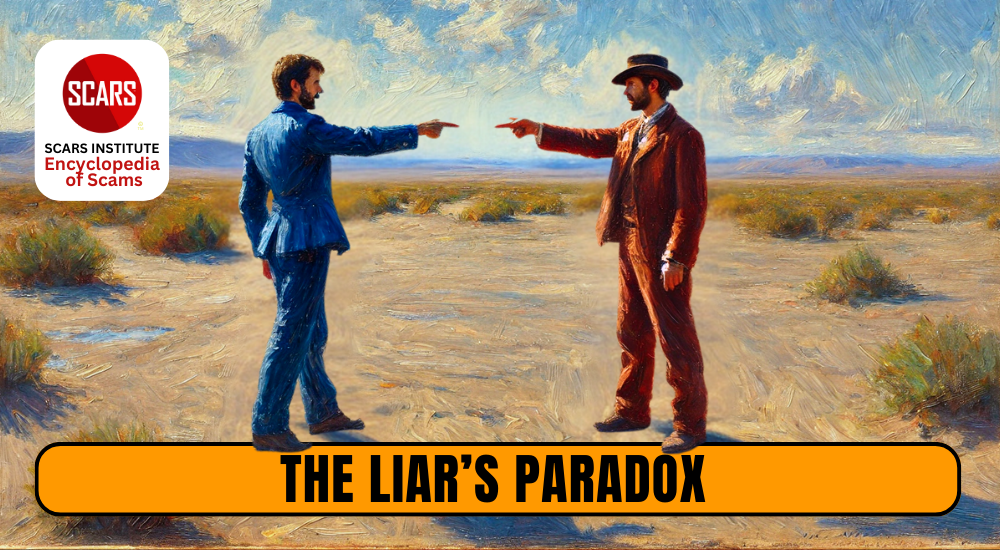
Two Speaker Liar’s Paradox Example
Liar’s Paradox Applied to Online Scams
The Liar’s Paradox, with its self-referential contradiction (“This sentence is false”), can serve as a conceptual framework to analyze certain online scams, particularly those that rely on deceptive self-referential claims to manipulate victims. While the paradox itself is a logical puzzle (also sometimes called a riddle), its principles, where a statement undermines its own truth, mirror tactics used by scammers to create confusion, exploit trust, and evade detection. Let’s explore how this paradox applies to online scams, focusing on examples like phishing emails, fake recovery schemes, and social media fraud, drawing from observed patterns.
Self-Referential Deception in Online Scams
Online scams often employ statements that implicitly or explicitly refer to their own credibility, creating a paradoxical loop that disorients victims. For instance, consider a phishing email stating, “This message is a legitimate alert from your bank.” If the victim believes it’s true, they might follow the link and provide sensitive information, validating the scam’s success. However, if it’s false (as it is, being a scam), the claim of legitimacy collapses, yet the email’s design, mimicking official branding, persuades the victim to treat it as true, perpetuating the deception. This mirrors the Liar’s Paradox: the statement’s truth depends on its falsity, and vice versa, trapping the victim in a cycle of misjudgment.
Fake Recovery Scams and Paradoxical Promises
A more direct application appears in money recovery scams, as discussed earlier. These scams promise, “We will recover your lost funds because we are a trusted recovery service.” The self-referential nature lies in the claim of trustworthiness. If the service is genuine, the promise holds, and victims might pay fees expecting results. But if it’s a scam (as it often is), the claim of being “trusted” is false, yet the assertion convinces victims to engage, relying on the hope that the service’s self-proclaimed legitimacy is true. The paradox emerges when victims realize the falsity, after paying more money, yet the initial trust was predicated on accepting the claim as true, creating a logical bind where the statement’s validity hinges on its invalidity.
Social Media Lures and Circular Trust
On platforms like Facebook or TikTok, scam posts might say, “This post is from a verified helper who has arrested scammers using your photos.” The self-reference here is the claim of verification and success. If true, it suggests a reliable source, encouraging contact. If false, it’s a scam, but the post’s visibility (boosted by algorithms or fake endorsements) lends it an aura of truth, drawing in desperate victims. The paradox lies in the circular trust: victims believe the post because it claims credibility, but its credibility depends on victims not questioning the claim, leading to exploitation when the falsity is revealed.
Psychological Exploitation and Logical Confusion
The Liar’s Paradox applies psychologically by leveraging cognitive dissonance. Scammers exploit victims’ desire to resolve the contradiction (e.g., “Is this real or fake?”) by presenting evidence, fake screenshots, and testimonials that temporarily validate the claim. This mirrors dialetheism (accepting both true and false), as victims oscillate between belief and doubt, often acting on the former. The paradox also aids scammers’ deniability; if challenged, they can claim the statement was misinterpreted, shifting blame to the victim’s judgment.
Implications for Detection and Prevention
Understanding this paradoxical structure can enhance scam detection. Tools like AI filters could flag self-referential claims (e.g., “This is legitimate”) as high-risk, prompting user warnings. Education campaigns can teach victims to break the loop by verifying claims externally (e.g., contacting banks directly), avoiding the self-referential trap. The paradox highlights why scams persist: their logical inconsistency is their strength, confusing victims into compliance.
The Liar’s Paradox applies to online scams through self-referential statements that create contradictory trust loops, exploited via phishing, recovery scams, and social media lures.
Recognizing this pattern can help spot these traps. Looking for claims that rely on their own authority as proof can raise red flags, encouraging checks with outside sources instead of acting on the spot. Sharing knowledge about these tactics and pushing for better safeguards, like flagging suspicious messages, can break the cycle. The way these scams twist truth into a puzzle highlights the need for clear-headed caution in navigating online interactions.
Conclusion
The Liar’s Paradox demonstrates how self-referential contradictions can be exploited to manipulate perception, destabilize trust, and create confusion. In the context of scams, this paradox provides a powerful framework for understanding how scammers build believable narratives that contain hidden falsehoods at their core. By presenting statements that assert their own credibility, scammers bypass rational evaluation and exploit victims’ natural desire to resolve conflicting information. This manufactured uncertainty keeps victims engaged long enough for manipulation to deepen.
For scam victims, recognizing the paradoxical nature of these claims is a critical step toward protection and recovery. Understanding that deceptive statements often use their own assertions of truth as evidence allows individuals to pause, question, and verify before acting. By learning to spot self-referential traps and seeking confirmation from independent sources, victims can break the psychological loop scammers depend on. In this way, awareness of the Liar’s Paradox offers more than philosophical insight; it provides a practical defense against manipulation and helps restore confidence in judgment and decision-making.
Reference
Example Liar’s Paradox Statements
- This statement is false.
- This sentence is not true.
- Everything I say is a lie.
- I am lying right now.
- The sentence written here is untrue.
- If this sentence is true, then it is false.
- The next statement is true. The previous statement is false.
- I always lie.
- I never tell the truth.
- This is false.
- This sentence is true only if it is false.
- What I am saying right now is untrue.
- This sentence is both true and false.
- Everything I say is false, including this statement.
- The statement below is true. The statement above is false.
- Nothing I say can be believed, including this.
- This message is false.
- Believe this statement only if it is false.
- What I am saying cannot be true.
- This very sentence cannot be trusted.
- If this statement is correct, then it is incorrect.
- This statement cannot be true.
- This is a lie.
- The truth of this statement is its falsehood.
- I am telling you the truth when I say I am lying.
- This line cannot be accurate.
- If this sentence is valid, it is invalid.
- This statement refutes itself.
- I am lying when I say I am telling the truth.
- This is not true.
- This claim is untrue, but you should believe it.
- You cannot trust this statement, yet it is correct.
- The claim I am making is wrong, but it’s also right.
- I am always dishonest, especially now.
- This declaration is false, but only if you believe it.
- This phrase is invalid, therefore valid.
- This text contradicts itself, therefore it’s consistent.
- This is not a true statement.
- The accuracy of this sentence invalidates itself.
- This statement self-destructs logically.
- This sentence denies its own truth.
- This statement must be false if it is true.
- This claim invalidates itself.
- Everything you’re reading right now is untrue.
- The statement that follows is correct. The statement before is wrong.
- If this message is true, disregard it.
- If you believe this, you are mistaken.
- This is incorrect, unless it is not.
- This statement proves it cannot be proven.
- Do not believe this statement, especially if it’s true.
Liar’s Paradox Statements Used in Marketing
- This is the only ad you can trust.
- Ignore all marketing, except this one.
- This offer is too good to be true, but it’s true.
- Don’t believe anyone who says they’re the best, believe us.
- We guarantee you’ll never believe these savings.
- Our competitors lie; we’re the only honest brand.
- This product sells itself.
- Stop reading this ad immediately, unless you want results.
- Believe us when we say you shouldn’t believe marketing.
- This deal is real, even if it sounds fake.
- This ad contains no marketing tricks whatsoever.
- You can’t afford to trust anyone else.
- Everything you’ve heard about us is false, except this.
- Buy now, if you think you shouldn’t.
- This is not an ad. Or is it?
- Our competitors claim they’re number one, which makes us number one.
- This statement is unbelievable, so it must be true.
- We’re the last company you’ll ever need, if you believe us.
- This is the ad that says it’s not an ad.
- Only liars say they have the lowest price; we actually do.
- You can’t believe everything you read, except this.
- This sale isn’t real… unless you want it to be.
- This product doesn’t need marketing; it just sold itself to you.
- This isn’t hype, it just looks like hype.
- Everything here is false, except for the unbelievable deal.
- This isn’t a limited-time offer, unless you wait.
- Our honesty is what sets us apart; just trust us.
- This is the truth… unless you doubt it.
- This isn’t persuasion. It’s simply the fact you need us.
- We don’t need to convince you, but we just did.
- This is not marketing manipulation; it’s self-evident.
- Only fake brands make claims. We’re real, believe us.
- Our prices speak for themselves, if you believe them.
- The secret to success is ignoring ads, except this one.
- Everything you want is in this ad, even what we didn’t promise.
- We’re the underdog everyone loves, according to us.
- This isn’t sales, it’s destiny.
- We’re not trying to sell you anything, except everything.
- This is the only brand worth trusting, because we say so.
- If you don’t believe this, you’ll miss out, which proves it’s true.
- This is the ad you didn’t know you needed until now.
- Everything you thought you knew about us is wrong, but buy anyway.
- This is the opposite of marketing, which makes it marketing.
- You don’t need this product unless you want the best.
- We don’t make promises, we deliver them.
- This is not clickbait, but you clicked.
- No gimmicks. No tricks. Just the trick that works.
- This brand exists because others don’t.
- You’ve already decided to buy; this ad just confirmed it.
- Trust us , because we’re telling you not to trust anyone else.
Scam-Specific Liar’s Paradox Examples
- Trust me , everyone else will lie to you.
- If I were a scammer, I’d tell you exactly what you want to hear, and I’m not doing that.
- I’m warning you about scammers because I care, and that’s why you can trust me.
- Everyone says they’re honest, except I actually am.
- If you doubt me, it proves how trustworthy I am, because scammers hate skepticism.
- Scammers want your money. I just want your heart.
- Do not believe anything you read online, except what I’m telling you right now.
- I’m risking everything by telling you this, that proves it’s real.
- The fact that you think I might be lying shows how honest I really am.
- If I were lying, I wouldn’t warn you about liars, would I?
- You shouldn’t trust strangers online, which is why I’m being upfront with you.
- I would never ask for money, until now, because this is an emergency.
- I know it sounds too good to be true, but that’s why it’s true.
- Real scammers would never send you proof like this, only I would.
- I told you I’m not after your money, so why would I lie now?
- The fact that you question me proves I’m different from scammers who expect blind trust.
- Scammers want fast money. I’ve spent months earning your trust.
- If you were being scammed, I would have disappeared by now.
- Because you don’t believe me, you should believe me, scammers pressure you; I don’t.
- I lied to everyone else to protect us, but I’d never lie to you.
- We’re soulmates, scammers can’t fake that.
- The government doesn’t want you to know this, but I do.
- I would never manipulate you; if I were, you wouldn’t even notice.
- If this was fake, I’d be too scared to tell you it’s real.
- You can test me; scammers hate being tested.
- Scammers give you false hope. I give you the uncomfortable truth.
- This isn’t about money, which is why you should send it now before it’s too late.
- I want you to doubt me; that proves I have nothing to hide.
- I’m only asking for this because I trust you; scammers don’t trust anyone.
- If this were a scam, I’d tell you exactly what you want to hear; instead, I’m telling you the truth.
- The fact that I warned you about scammers proves I’m not one.
- I’ll prove I’m not lying by telling you something impossible to verify.
- Your fear right now means you care; scammers wouldn’t inspire real feelings.
- We’ve come too far for this to be fake.
- Scammers don’t have the patience for this kind of connection; I do.
- If anyone tells you I’m scamming you, it means they’re jealous of what we have.
- The more impossible this sounds, the more likely it is to be true.
- I’ll stop asking when you trust me; scammers never stop.
- If this wasn’t real, I wouldn’t risk my freedom talking to you like this.
- I’m the only one telling you the truth, which makes it sound like a lie.
- Scammers get defensive. I’m calm because I have nothing to hide.
- If you can’t trust anyone, you have to trust someone, trust me.
- You know this is real because you’re scared it isn’t.
- I warned you that scammers exist, so you’d see I’m different.
- If I wanted to scam you, I’d already have taken everything.
- I lied to everyone else about us because our love is private, not fake.
- Scammers pressure you to act fast. I’m just explaining why you must send it today.
- Because you suspect me, you’ll see I’m not like them when this works out.
- Everyone says not to trust anyone online, except me.
- The only reason this sounds like a scam is because scammers ruined it for people like me.
Article Glossary
- Algorithmic Boosting – The automated prioritization of content on social media platforms, which scammers exploit to lend false credibility to fraudulent posts.
- Bivalence – A logical principle assuming every statement is either true or false, which the Liar’s Paradox challenges.
- Cognitive Dissonance – The psychological discomfort caused by holding conflicting beliefs, exploited by scammers to trap victims in cycles of doubt and compliance.
- Conditional Liar – A variant of the Liar’s Paradox expressed as “If this sentence is true, then it is false”, creating contradiction through conditional logic.
- Contradictory Trust Loops – Cycles where belief in a statement’s truth depends on accepting a claim that undermines itself, commonly used in scams.
- Credibility Claims – Statements asserting legitimacy (e.g., “This message is secure”), often used by scammers to bypass skepticism and encourage victim compliance.
- Circular Trust – A trust structure where statements are treated as true because they claim to be, creating self-reinforcing deception in scams.
- Classic Liar Sentence – The original paradox: “This sentence is false.” Its truth value collapses under logical analysis, forming the foundation of the concept.
- Conditional Authority Trap – Scammer tactic where the validity of a claim rests entirely on its own assertion of authority, creating paradoxical manipulation.
- Credibility Exploitation – The manipulation of victims’ tendency to trust seemingly authoritative statements or platforms, especially in phishing and recovery scams.
- Cognitive Manipulation – Scammers’ use of paradoxical statements and mixed signals to confuse logical reasoning and increase compliance.
- Dialetheism – A philosophical view that some statements can be both true and false simultaneously, reflecting the tension exploited by scammers.
- Double Liar – A paired-paradox example: “The following sentence is true. The preceding sentence is false,” which creates a self-referential contradiction.
- Epimenides Paradox – A historical version of the Liar’s Paradox attributed to the philosopher Epimenides, often phrased as “All Cretans are liars.”
- Fake Recovery Scams – Scams claiming they can recover lost money from previous frauds, often using paradoxical credibility statements like “We are a trusted recovery agency.”
- Group Liar – A paradox involving multiple statements, such as “At least one sentence in this group is false,” leading to irresolvable logical loops.
- Indexical Liar – A personal form of the paradox, e.g., “I am lying.” It creates contradiction by tying truth to the speaker’s honesty.
- Knights and Knaves Puzzle – A two-speaker variant of the paradox where one person always lies and the other always tells the truth, commonly applied to scammer-victim dynamics.
- Liar’s Paradox – A logical puzzle where a statement contradicts its own truth value, forming the philosophical foundation for understanding deceptive manipulations.
- Logical Breakdown – The collapse of binary truth systems under paradox, mirrored in scam strategies where messages contain conflicting signals.
- Memory Destabilization – Psychological confusion resulting from contradictory information, impairing victims’ ability to trust their perceptions and memories.
- Mutual Attribution Trap – A two-speaker liar paradox scenario where two individuals define each other’s truthfulness, creating a recursive contradiction.
- Paradoxical Promises – Fraudulent claims where trustworthiness depends entirely on self-referential assurances, commonly seen in phishing and recovery scams.
- Phishing Email Deception – A scam tactic using statements like “This message is a legitimate alert from your bank”, creating a paradox between appearance and reality.
- Recursive Contradiction – A chain of self-referential claims where each statement’s truth relies on the falsity of another, keeping victims trapped in uncertainty.
- Scam Credibility Loops – Fraudulent structures where legitimacy is claimed and reinforced by fabricated authority, forcing victims to accept statements without independent verification.
- Self-Negating Claims – Statements asserting reliability while invalidating themselves, such as “Trust me, I am not lying”, a key component of scam manipulation.
- Self-Referential Deception – A scam tactic where trust is built using statements that implicitly validate their own truthfulness, triggering paradoxical reasoning.
- Self-Referentiality – The quality of a statement that refers back to its own truth value, essential to understanding the structure of the Liar’s Paradox.
- Social Media Lures – Scam tactics using posts claiming credibility, authority, or verification to build trust, often amplified through platform algorithms.
- Strengthened Liar – A variation of the classic paradox, “This sentence is not true,” demonstrating similar contradictions in truth evaluation.
- Trusted Recovery Claim – Statements like “We are verified professionals who will get your money back”, central to recovery scams’ manipulation strategy.
- Truth-Verification Conflict – The psychological struggle victims face when messages claim their own validity, forcing them to choose belief without external proof.
- Two-Speaker Liar’s Paradox – A mutual statement between two individuals, each claiming the other always lies, creating recursive contradiction.
- Verification Illusion – When scammers fabricate signals of credibility (e.g., fake testimonials or certifications) to reinforce paradoxical claims of legitimacy.
- Written Liar – A paradoxical statement in print, e.g., “The sentence written here is untrue”, mirroring self-referential scam language.
-/ 30 /-
What do you think about this?
Please share your thoughts in a comment below!
Table of Contents




Rapid Report Scammers

In the U.S. & Canada
U.S. & Canada Suicide Lifeline 988
LEAVE A COMMENT?
Recent Comments
On Other Articles
- Debby Montgomery Johnson on The Danger of Using AI in Law Enforcement – The Grandmother Wrongly Arrested as a Fraudster – 2026: “Excellent article – I can’t imagine the terror Angela most certainly experienced. Compound this with the lack of accountability by…” Mar 24, 09:20
- on The Crazy Gregor MacGregor and the Country of Poyais Scam – History of Scams – 2026: “interesting” Mar 23, 19:24
- on BEC Fraud Reaches $43 Billion Per Year: “oh my gosh so much of an increase in the fraud I pray the officials can continue tracking and make…” Mar 23, 15:09
- on Establishing The United States Task Force To Eliminate Fraud – 2026: “Make Online Safe Again!” Mar 17, 19:11
- on Establishing The United States Task Force To Eliminate Fraud – 2026: “Finally an administration takes the initiative to help solve the gigantic situation. Make America Safe Again, thank you!” Mar 17, 15:41
- on What Is The Difference Between A Scam Victim And A Scam Survivor? [Updated]: “Due to my scams I don’t fully trust anyone online and I shouldn’t even those people I knew in high…” Mar 7, 12:46
- on SCARS 3 Steps For New Scam Victims 2024: “I was very fearful “he” would come to my home because I was knew my address, I spoke to someone…” Mar 7, 09:50
- on Sadness & Scam Recovery: “Before my scam, my mom passed away and I got a divorce, so I was dealing with the loss of…” Mar 7, 09:37
- on The Story Of Kira Lee Orsag (aka Dani Daniels) [Updated]: “There is NO evidence and she is not, she is a victim too. Sebastian, stop letting your anger think for…” Mar 6, 23:18
- on The Story Of Kira Lee Orsag (aka Dani Daniels) [Updated]: “There is real evidence that behind these two people there is something that not many people know. This woman is…” Mar 4, 03:58
ARTICLE META
Important Information for New Scam Victims
- Please visit www.ScamVictimsSupport.org – a SCARS Website for New Scam Victims & Sextortion Victims
- Enroll in FREE SCARS Scam Survivor’s School now at www.SCARSeducation.org
- Please visit www.ScamPsychology.org – to more fully understand the psychological concepts involved in scams and scam victim recovery
If you are looking for local trauma counselors please visit counseling.AgainstScams.org or join SCARS for our counseling/therapy benefit: membership.AgainstScams.org
If you need to speak with someone now, you can dial 988 or find phone numbers for crisis hotlines all around the world here: www.opencounseling.com/suicide-hotlines
A Note About Labeling!
We often use the term ‘scam victim’ in our articles, but this is a convenience to help those searching for information in search engines like Google. It is just a convenience and has no deeper meaning. If you have come through such an experience, YOU are a Survivor! It was not your fault. You are not alone! Axios!
A Question of Trust
At the SCARS Institute, we invite you to do your own research on the topics we speak about and publish, Our team investigates the subject being discussed, especially when it comes to understanding the scam victims-survivors experience. You can do Google searches but in many cases, you will have to wade through scientific papers and studies. However, remember that biases and perspectives matter and influence the outcome. Regardless, we encourage you to explore these topics as thoroughly as you can for your own awareness.
Statement About Victim Blaming
SCARS Institute articles examine different aspects of the scam victim experience, as well as those who may have been secondary victims. This work focuses on understanding victimization through the science of victimology, including common psychological and behavioral responses. The purpose is to help victims and survivors understand why these crimes occurred, reduce shame and self-blame, strengthen recovery programs and victim opportunities, and lower the risk of future victimization.
At times, these discussions may sound uncomfortable, overwhelming, or may be mistaken for blame. They are not. Scam victims are never blamed. Our goal is to explain the mechanisms of deception and the human responses that scammers exploit, and the processes that occur after the scam ends, so victims can better understand what happened to them and why it felt convincing at the time, and what the path looks like going forward.
Articles that address the psychology, neurology, physiology, and other characteristics of scams and the victim experience recognize that all people share cognitive and emotional traits that can be manipulated under the right conditions. These characteristics are not flaws. They are normal human functions that criminals deliberately exploit. Victims typically have little awareness of these mechanisms while a scam is unfolding and a very limited ability to control them. Awareness often comes only after the harm has occurred.
By explaining these processes, these articles help victims make sense of their experiences, understand common post-scam reactions, and identify ways to protect themselves moving forward. This knowledge supports recovery by replacing confusion and self-blame with clarity, context, and self-compassion.
Additional educational material on these topics is available at ScamPsychology.org – ScamsNOW.com and other SCARS Institute websites.
Psychology Disclaimer:
All articles about psychology and the human brain on this website are for information & education only
The information provided in this article is intended for educational and self-help purposes only and should not be construed as a substitute for professional therapy or counseling.
While any self-help techniques outlined herein may be beneficial for scam victims seeking to recover from their experience and move towards recovery, it is important to consult with a qualified mental health professional before initiating any course of action. Each individual’s experience and needs are unique, and what works for one person may not be suitable for another.
Additionally, any approach may not be appropriate for individuals with certain pre-existing mental health conditions or trauma histories. It is advisable to seek guidance from a licensed therapist or counselor who can provide personalized support, guidance, and treatment tailored to your specific needs.
If you are experiencing significant distress or emotional difficulties related to a scam or other traumatic event, please consult your doctor or mental health provider for appropriate care and support.
Also read our SCARS Institute Statement about Professional Care for Scam Victims – click here to go to our ScamsNOW.com website.


Thank you for your comment. You may receive an email to follow up. We never share your data with marketers.