



SCARS Institute’s Encyclopedia of Scams™ Published Continuously for 25 Years


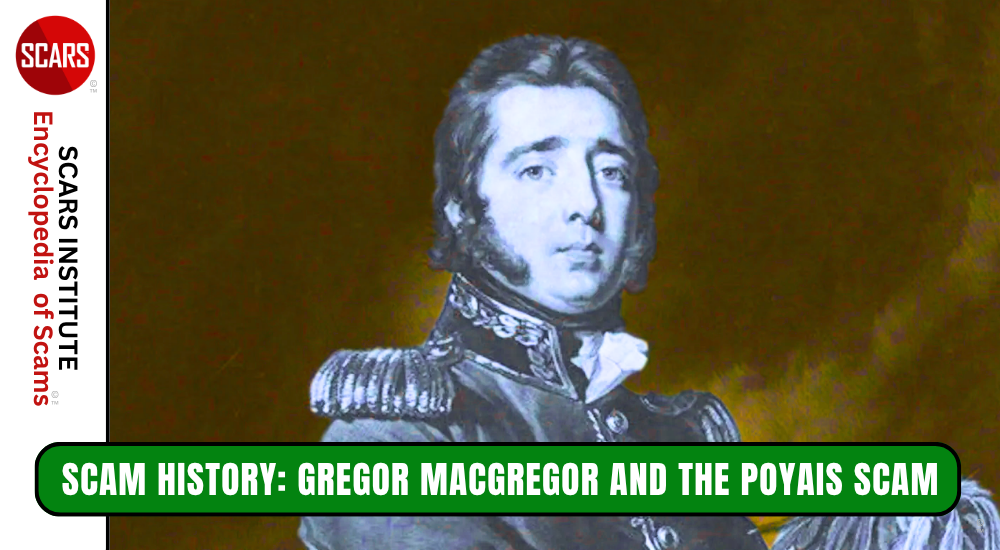
The Crazy Gregor MacGregor and the Country of Poyais Scam
The Poyais Scheme: When a Man Invented a Country, and Hundreds Paid the Price
History of Scams – A SCARS Institute Insight
Authors:
• Tim McGuinness, Ph.D., DFin, MCPO, MAnth – Anthropologist, Scientist, Director of the Society of Citizens Against Relationship Scams Inc.
Article Abstract
Gregor MacGregor, a Scottish adventurer with a mixed record of military service in South America, created a fictional Central American country called Poyais in the early nineteenth century and convinced British investors and settlers that it was a developed and prosperous territory. He constructed a detailed national identity, issued currency and land grants, and leveraged his perceived authority and social credibility to build trust. Hundreds invested, and some traveled to the region, where they found no infrastructure or support, leading to widespread hardship and death. The scheme relied on narrative construction, authority, and alignment with economic optimism. Its collapse exposed the vulnerability of individuals to structured deception and highlighted enduring psychological patterns that continue to shape modern scams.

The Poyais Scheme: When a Man Invented a Country and Hundreds Paid the Price
Gregor MacGregor & Poyais: A Nation That Never Existed
In the early nineteenth century, during a period of economic optimism and global expansion, a Scottish adventurer named Gregor MacGregor carried out one of the most elaborate frauds in modern history. He did not simply sell land, promote an investment, or impersonate a wealthy figure. He created an entire country that did not exist and convinced hundreds of people to invest in it, move to it, and build their futures upon it.
The result was not only financial ruin but also human catastrophe. Dozens, and likely more than a hundred, people died as a direct consequence of the deception.
This case offers more than a historical curiosity. It reveals enduring patterns of manipulation, belief, and vulnerability that continue to shape modern scams.
The Man Behind the Illusion
Gregor MacGregor did not emerge suddenly as a master fraudster. His later deception grew out of a life that combined ambition, opportunism, real military experience, and a consistent pattern of exaggeration and reinvention. Understanding his time in South America, particularly in Venezuela and neighboring regions, reveals how he built the credibility that later made the Poyais confidence scheme possible.
MacGregor was born in Scotland in 1786 and entered the British Army as a young man, serving during the Napoleonic Wars. His early career gave him a foundation of legitimacy. He held a commission, participated in real campaigns, and learned how to present himself as an officer of authority. However, even during this period, there were signs of embellishment. He cultivated titles and status beyond what he had actually earned, a pattern that would define much of his later life.
After leaving the British Army around 1810, MacGregor sought opportunity elsewhere. Like many European adventurers of the time, he was drawn to South America, where independence movements against Spanish rule created both chaos and possibility. In 1812, he arrived in Venezuela, presenting himself as “Sir Gregor” (a Knight of the Realm) and offering his services to the revolutionary leader Francisco de Miranda.
Miranda and other revolutionary leaders welcomed foreign officers, especially those with British military backgrounds, who were seen as invaluable. MacGregor quickly secured a commission as a colonel and was placed in command of a cavalry unit. His foreign status and confident self-presentation gave him immediate credibility, even though his actual experience and effectiveness were uneven.
When the Venezuelan revolutionary effort faltered and Miranda was captured, MacGregor adapted quickly. He moved between regions and allegiances, offering his services wherever opportunity existed. He joined forces in New Granada, present-day Colombia, where he commanded a substantial force of around 1,200 men.
During this period, MacGregor demonstrated a mix of competence and instability. Some reports suggest he improved discipline among troops using European military methods, while others describe dissatisfaction among those under his command. His leadership style appeared inconsistent, marked by moments of apparent effectiveness followed by questionable decisions.
MacGregor later rejoined the Venezuelan revolutionary cause under Simón Bolívar, one of the most notable figures in South American independence. Bolívar initially accepted him, and MacGregor rose to the rank of brigadier general. His most notable achievement came during a difficult retreat through northern Venezuela in 1816, where he successfully led forces through hostile territory over an extended period.
This retreat became central to his reputation. It was widely praised and later exaggerated, contributing to his image as a daring and capable leader. In social settings, particularly among British merchants and expatriates, MacGregor expanded on these stories, portraying himself as a key figure in major victories and campaigns.
At the same time, his record included serious failures. In at least two campaigns in New Granada (Colombia), he abandoned his troops under difficult conditions, leaving them to face surrender or defeat without leadership. These actions damaged his reputation among some contemporaries and contributed to a growing perception that he was unreliable under fire and self-serving.
MacGregor’s ambitions extended beyond military service. In 1817, he became involved in the Amelia Island affair, an attempt to seize Spanish Florida with a private force. He briefly declared a “Republic of the Floridas,” positioning himself as a leader of a new political entity.
This episode is significant because it foreshadowed the “Poyais” scheme. It showed that MacGregor was willing to create political structures, claim authority, and present himself as the head of a new nation, even when the reality was unstable or unsupported.
His South American campaigns also revealed a pattern of financial mismanagement and overpromising. When recruiting troops from Britain and Ireland, he offered high pay and incentives that he could not deliver. In one instance, soldiers approached mutiny when promised payments failed to materialize.
Despite these issues, MacGregor maintained a network of supporters and admirers. His charisma, storytelling ability, and association with well-known revolutionary figures allowed him to preserve an image of importance. He married into a prominent Venezuelan family, further strengthening his social connections and legitimacy.
After a series of mixed successes and failures, MacGregor eventually left South America and returned to Britain in the early 1820s. By that time, he had accumulated a reputation that was complex but useful. He was seen as a veteran of foreign wars, a general in revolutionary armies, and a man with firsthand knowledge of emerging territories.
This reputation became the foundation for the Poyais con game scheme. When he later claimed to be the ruler of a Central American territory, his audience did not see an unknown figure making an extraordinary claim. They saw a man who had already operated in distant lands, commanded troops, and participated in nation-building efforts.
Years later, after the collapse of the Poyais fraud and his activities in Europe, MacGregor returned once again to Venezuela. In 1839, he sought recognition and financial support for his earlier military service. Remarkably, he was accepted. Venezuelan authorities restored his rank as a general, granted him a pension, and recognized him as a citizen.
He spent his final years in Caracas, where he lived with relative respectability. When he died in 1845, he was buried with full military honors, attended by senior government and military officials.
This ending highlights a striking contrast. In Europe, MacGregor was known as the architect of one of the most audacious frauds in history. In Venezuela, he was remembered primarily as a participant in the struggle for independence.
His life in South America was not separate from his later deception. It was the foundation of it. His real experiences, combined with exaggeration and selective storytelling, created a persona that others found credible. That credibility made it possible for him to sell something that did not exist.
The story of Gregor MacGregor illustrates how truth and fabrication can become intertwined. His military service was real, but uneven. His achievements were sometimes genuine, but often inflated. His authority was partly earned, but largely constructed.
This combination proved powerful. It allowed him to move between roles, reshape his identity, and ultimately convince others to believe in a country that existed only in his words.
The Creation of the Fake Country of Poyais
In 1820, Gregor MacGregor claimed that he had secured rights to a vast territory along the Mosquito Coast, in what is now Honduras and Nicaragua. He named this supposed country Poyais and declared himself its ruler, adopting the title “Cazique,” which means chief, that he presented as equivalent to a sovereign prince. He asserted that the land had been granted to him by a local Indigenous ruler, a claim that had little verifiable basis but sounded plausible to distant investors who lacked direct knowledge of the region.
What followed was not a simple deception but a fully constructed illusion. MacGregor did not merely describe land. He built an entire national identity. He claimed that Poyais had a stable government, a formal constitution, a legal system, and established institutions ready to support settlers. He described a capital city, St. Joseph, complete with paved streets, public buildings, and organized commerce. He spoke of fertile agricultural land, accessible rivers, and abundant timber, gold, and other natural resources.
He extended the illusion into every practical detail. MacGregor issued Poyaisian currency, printed official-looking land grants, and sold thousands of acres to investors and prospective settlers. He also arranged government bonds, marketed through respected financial channels in London, which gave the appearance of legitimacy and structure.
To strengthen belief, he commissioned a detailed guidebook, often attributed to a supposed expert, that described Poyais in rich, specific terms. The publication outlined climate, economy, governance, and daily life, presenting the country as orderly, prosperous, and welcoming. These materials gave readers the sense that they were not imagining an opportunity but evaluating a real one.
At the time, Britain experienced intense interest in overseas investment. Political changes in Latin America created a perception of new markets and untapped wealth. Many individuals sought opportunities beyond Europe, particularly in regions associated with independence movements and expansion.
MacGregor did not invent that desire. He recognized it, shaped it, and directed it toward something that did not exist.
The Power of Narrative and Authority
The success of the scheme depended heavily on narrative construction. MacGregor did not present Poyais as a vague or uncertain prospect. He described it as a structured, functioning society that already existed and simply awaited development. He positioned it as both exotic and accessible, distant enough to feel exciting, yet organized enough to feel safe. It offered the promise of land ownership, financial growth, and a fresh start in a new world, all within a framework that appeared stable and legitimate.
He reinforced this narrative through deliberate use of authority. MacGregor presented himself as an experienced military leader with direct knowledge of the region. He spoke with confidence, used formal titles, and referenced his involvement in South American independence movements. These elements gave the impression that he possessed insider access to opportunities not yet widely known.
Social proof played a critical role. His presence in respected social circles, along with endorsements and associations, created the appearance that others had already accepted the legitimacy of Poyais. Printed materials, including official-looking documents and detailed descriptions, added another layer of credibility. The consistency across these sources made the story feel verified rather than speculative.
This combination of authority and storytelling created a powerful psychological effect. Individuals did not feel as though they were making a risky decision. They felt informed, prepared, and aligned with a broader movement of expansion and opportunity. The narrative reduced uncertainty and replaced it with confidence, allowing belief to take hold where skepticism might otherwise have emerged.
The Journey to Nowhere
In 1822 and 1823, groups of settlers departed from Britain with a strong sense of purpose and expectation. They carried Poyaisian currency, land grants, and official documents that they believed secured their place in a promising new colony. Many sold their possessions before leaving, committed to building a new life in what they understood to be an organized and prosperous settlement.
After a long and difficult transatlantic journey, they arrived on the Mosquito Coast expecting to find a structured community waiting for them. Instead, they encountered an undeveloped and largely uninhabited stretch of coastline. There were no roads, no government buildings, no homes, and no visible signs of the thriving capital city they had been promised.
The environment presented immediate challenges. The tropical climate, unfamiliar terrain, and lack of infrastructure created conditions for rapid deterioration. The settlers had limited supplies, and what they carried was not sufficient for long-term survival. There was no established system for food distribution, no medical facilities, and no leadership to organize their efforts.
Disease spread quickly in these conditions, including malaria and other tropical illnesses that the settlers were not prepared to face. Malnutrition and exhaustion weakened resistance. As days passed, the absence of support turned uncertainty into crisis. Attempts to establish order failed under the pressure of illness, scarcity, and confusion.
Rescue came only when passing ships encountered survivors and transported them away from the region. Of the approximately 250 settlers who made the journey, fewer than half survived.
The gap between expectation and reality was not simply a matter of disappointment. It represented a complete breakdown of trust, information, and preparation. For many, that gap proved fatal.
The Collapse of the Scheme
As reports of the disaster reached Britain, the illusion of Poyais began to unravel. Survivors returned with accounts of the conditions they had endured. Investigations exposed the lack of evidence supporting MacGregor’s claims.
Despite this, the collapse was not immediate or complete. Some individuals continued to defend MacGregor or believe in the legitimacy of Poyais. In part, this reflected the strength of the narrative he had constructed and the difficulty of accepting such a profound deception.
MacGregor himself did not immediately face lasting consequences. He left Britain, attempted to restart the scheme in France, and even faced legal proceedings, though he was ultimately acquitted.
The absence of accountability reinforced a troubling reality. The effectiveness of the scam did not depend on its sustainability. It depended on its initial success.
The Relationship between Poyais and British Honduras (Modern-day Belize)
The relationship between Poyais and British Honduras (modern-day Belize) is indirect but important for understanding how Gregor MacGregor’s fraud appeared believable.
Poyais was entirely fictional as a functioning nation, but MacGregor anchored his claims in a real geographic region known as the Mosquito Coast. This coastline stretches across parts of present-day Honduras and Nicaragua and lies south of what later became British Honduras (Belize). At the time in the early 1800s, this broader region was poorly mapped, loosely governed, and not well understood by the British public.
British Honduras itself was a real British settlement and logging colony, primarily focused on mahogany extraction. It did not become a formal crown colony until later in the 19th century, but British presence there already gave the impression that Britain had influence throughout the surrounding coastline.
MacGregor exploited this ambiguity.
He claimed that Poyais existed within this same general sphere of British interest and implied that it had legitimacy similar to or connected with British Honduras. Because British Honduras was real, and because British settlers and merchants already operated in nearby areas, investors and settlers found it easier to accept that another organized territory could exist just beyond it.
In reality, there was no administrative, legal, or political connection between Poyais and British Honduras. Poyais had no functioning government, no infrastructure, and no recognition from Britain or any other state. It existed only in MacGregor’s descriptions, documents, and promotional materials.
The key relationship is psychological and contextual rather than political. British Honduras provided a credible geographic anchor that made the fictional Poyais seem plausible. The existence of one real colony helped disguise the nonexistence of the other.
Psychological Dynamics Behind the Fraud
The Poyais scheme illustrates several psychological dynamics that remain relevant in understanding both historical and modern scams. These dynamics do not depend on time period or technology. They reflect consistent patterns in how people form beliefs, evaluate information, and respond to perceived opportunity.
First, the scheme shows how authority and credibility influence belief. MacGregor presented himself as a military officer with direct experience in South America and connections to recognized leaders. He used titles, confidence, and social positioning to signal legitimacy. These signals reduced skepticism and increased trust. People often rely on perceived authority when evaluating unfamiliar situations, especially when independent verification is difficult.
Second, the scheme demonstrates the power of detailed storytelling. MacGregor did not describe Poyais in vague terms. He provided specific details about its government, infrastructure, economy, and daily life. This level of detail created a sense of realism. When information appears complete and consistent, the mind tends to accept it as credible. The story becomes easier to visualize, and therefore easier to believe.
Third, the scheme highlights the role of emotional and economic context. During this period, Britain experienced strong interest in overseas expansion and investment. Political changes in Latin America created the perception of new markets and rapid growth. People were actively looking for opportunities that promised advancement. When an idea aligns with existing expectations and desires, it encounters less resistance and gains faster acceptance.
Fourth, the scheme reveals how commitment strengthens belief. Once individuals invested money, made plans, or publicly aligned themselves with Poyais, their psychological investment increased. Admitting doubt or error would require accepting loss and uncertainty. As a result, many individuals maintained belief even when inconsistencies began to appear. This process reflects a common human tendency to protect prior decisions.
Finally, the scheme shows how multiple reinforcing factors can operate at once. Authority, narrative detail, social validation, and economic context did not act separately. They worked together to create a coherent and persuasive illusion. Each element supported the others, making the overall structure more difficult to question.
These dynamics are not limited to the nineteenth century. They continue to appear in modern scams, where different tools and platforms deliver the same underlying patterns of influence and belief formation.
Parallels to Modern Scams
While the scale and structure of the Poyais scheme were unique, its underlying mechanisms are familiar.
Modern scams frequently involve the creation of convincing narratives, the use of perceived authority, and the targeting of existing desires or vulnerabilities. Investment scams, cryptocurrency fraud, and even certain types of relationship scams rely on similar principles.
The concept of a “perfect opportunity” remains central. Whether it is a new technology, a financial product, or a personal relationship, the promise of transformation often overrides caution.
The Poyais case also illustrates the risks of information imbalance. In MacGregor’s time, verifying claims about distant territories was difficult. Today, information is more accessible, but the volume and complexity of data create new challenges in distinguishing truth from deception.
The form has changed. But the psychology has not.
Lessons for Understanding Victimization
The story of Poyais challenges simplistic assumptions about victims. The individuals who invested in the scheme were not inherently naïve or irrational. They were responding to information, context, and incentives that appeared credible.
They made decisions based on what they believed to be accurate representations of reality. The deception was systematic, deliberate, and reinforced through multiple channels.
Understanding this is important. It shifts the focus from blaming individuals to examining the mechanisms of manipulation.
This perspective aligns with modern approaches to victim support, which emphasize context, coercion, and psychological influence rather than personal failure.
Conclusion
The Poyais scheme stands as a clear demonstration of how deception operates at the intersection of credibility, narrative, and human need. Gregor MacGregor did not succeed by relying on a single false claim. He built a complete system of belief that aligned with the expectations, ambitions, and limited knowledge of his audience. His background, partially real and partially exaggerated, provided the authority. His detailed descriptions provided the structure. The broader economic climate provided the willingness to believe.
The consequences reveal the true cost of such deception. The victims did not simply lose money. They lost time, stability, trust, and in many cases, their lives. The collapse of Poyais exposed not only the absence of a country but the collapse of a carefully constructed reality that people had organized their futures around.
This case also highlights a critical principle in understanding scams. The effectiveness of fraud does not depend on the intelligence of the victim. It depends on how well the deception fits existing beliefs and desires. When information appears credible and aligns with opportunity, skepticism decreases and commitment increases.
Recovery, whether from historical or modern scams, begins with recognizing these dynamics. It requires separating the mechanism of manipulation from personal responsibility. When individuals understand how their beliefs were shaped and reinforced, they regain the ability to see clearly and rebuild trust in their own judgment.
The story of Poyais is not an isolated event. It reflects a pattern that continues to appear in different forms. Awareness of that pattern remains essential for prevention, protection, and recovery.
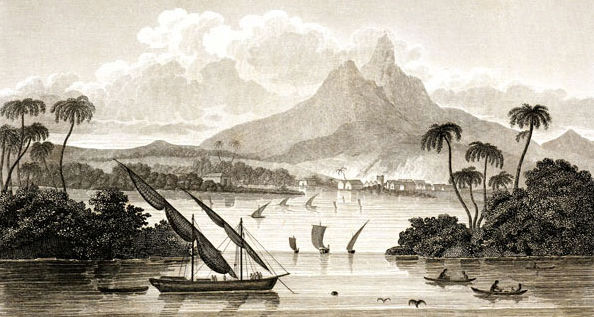
Poyais
The Fake Country of Poyais

Glossary
- Amelia Island Affair — The Amelia Island Affair was an attempted seizure of Spanish Florida led by Gregor MacGregor, where he declared a short-lived political entity. This event demonstrated an early pattern of constructing false authority and national identity, which later expanded into the Poyais scheme. It shows how initial, smaller deceptions can evolve into larger, more complex frauds.
- Authority Signal Construction — Authority signal construction refers to the deliberate use of titles, uniforms, language, and social positioning to create perceived legitimacy. MacGregor used military rank and aristocratic presentation to reduce skepticism among investors and settlers. This process helps explain how individuals place trust in appearances rather than verified facts.
- Belief Commitment Escalation — Belief commitment escalation describes the increasing psychological attachment individuals develop after investing time, money, or identity into a decision. In the Poyais scheme, early commitment made it difficult for individuals to question or withdraw from the opportunity. This pattern contributes to continued belief even when warning signs emerge.
- Brigadier General Identity — Brigadier General identity refers to MacGregor’s recognized rank within South American revolutionary forces, which he used to strengthen credibility. Although partially legitimate, this title was often exaggerated in importance and influence. This blending of truth and exaggeration made his claims more convincing.
- British Investment Expansion Climate — British investment expansion climate describes the early nineteenth-century environment in which overseas ventures attracted significant interest. Political changes in Latin America created the perception of new economic opportunities. This climate increased willingness to accept unfamiliar and poorly verified investment claims.
- Capital City St. Joseph Fabrication — Capital city St. Joseph fabrication refers to the detailed but entirely fictional description of a developed urban center in Poyais. MacGregor described infrastructure, government buildings, and organized commerce to create a sense of readiness and stability. This level of detail reduced skepticism and increased perceived legitimacy.
- Caribbean Coastal Anchoring — Caribbean coastal anchoring describes the use of a real geographic region, the Mosquito Coast, to support a fictional narrative. By tying false claims to an actual location, MacGregor increased plausibility. This technique made it more difficult for individuals to distinguish between reality and fabrication.
- Cazique Title Adoption — Cazique title adoption refers to MacGregor’s use of an Indigenous term meaning chief to suggest sovereign authority. He presented the title as equivalent to a European princely role. This adaptation of unfamiliar terminology added perceived authenticity while avoiding direct scrutiny.
- Charismatic Persuasion Pattern — Charismatic persuasion pattern describes the use of confidence, storytelling, and personal presence to influence belief. MacGregor’s communication style created emotional engagement and trust. This pattern often reduces critical evaluation and increases acceptance of claims.
- Colonial Opportunity Expectation — Colonial opportunity expectation refers to the widespread belief that new territories offered immediate prosperity and stability. This expectation shaped how individuals evaluated overseas opportunities. It reduced perceived risk and increased willingness to invest or relocate.
- Confidence Scheme Structure — Confidence scheme structure refers to a form of fraud that relies on trust, credibility, and persuasive narrative rather than coercion. The Poyais scheme depended on voluntary participation based on belief. This structure makes victims active participants in their own deception.
- Credibility Through Association — Credibility through association describes how MacGregor strengthened his reputation by linking himself to recognized figures such as Simón Bolívar. These associations created the impression of legitimacy and insider access. This process reduces skepticism by transferring trust from known figures to the individual.
- Currency Issuance Deception — Currency issuance deception refers to the creation of Poyaisian money to reinforce the illusion of a functioning nation. Physical currency provided tangible evidence that supported the belief. This tactic increased confidence by making the fictional country appear economically structured.
- Detailed Guidebook Persuasion — Detailed guidebook persuasion describes the use of written materials that presented Poyais in specific and organized terms. These descriptions included governance, climate, and daily life. The detail created a sense of realism that made the opportunity appear credible.
- Economic Opportunity Alignment — Economic opportunity alignment refers to the way the Poyais scheme matched existing desires for wealth, land ownership, and advancement. When an opportunity aligns with expectations, it encounters less resistance. This alignment increases acceptance and reduces critical evaluation.
- Emotional Investment Attachment — Emotional investment attachment describes the psychological connection formed when individuals link their hopes and future plans to a decision. In the Poyais scheme, this attachment strengthened commitment. It made it more difficult to reassess or withdraw from the situation.
- Environmental Reality Shock — Environmental reality shock refers to the experience of encountering conditions that differ drastically from expectations. Settlers arriving in Poyais faced undeveloped land instead of a functioning colony. This shock created confusion, distress, and rapid recognition of deception.
- Exaggerated Achievement Narrative — Exaggerated achievement narrative describes the expansion of real events into more impressive or influential accounts. MacGregor amplified his military successes to enhance credibility. This selective storytelling increased perceived authority and influence.
- Financial Bond Offering — Financial bond offering refers to the sale of investment instruments tied to the fictional nation. These bonds were marketed through established financial channels. Their structure gave the appearance of legitimacy and institutional support.
- Geographic Knowledge Limitation — Geographic knowledge limitation describes the lack of accurate information about distant regions during the early nineteenth century. This limitation made it difficult to verify claims about Poyais. It increased vulnerability to deception based on location-based assertions.
- Identity Reinvention Pattern — Identity reinvention pattern refers to MacGregor’s repeated reshaping of his personal narrative to suit different contexts. He adjusted titles, achievements, and affiliations to maintain credibility. This flexibility allowed him to sustain belief across environments.
- Information Imbalance Condition — Information imbalance condition describes a situation where one party possesses more or better information than another. MacGregor controlled the narrative about Poyais while investors lacked independent sources. This imbalance enabled effective manipulation.
- Land Grant Certificate Fabrication — Land grant certificate fabrication refers to the creation of official-looking documents that claimed ownership of property in Poyais. These documents appeared legitimate and legally binding. They provided a false sense of security to investors and settlers.
- Leadership Inconsistency Pattern — The leadership inconsistency pattern describes MacGregor’s mixed record of competence and failure during his military career. He experienced both successful campaigns and significant setbacks. This inconsistency was often minimized in his public narrative.
- London Market Legitimacy Signal — London market legitimacy signal refers to the use of established financial markets to distribute Poyais investments. Access to these markets increased perceived credibility. It suggested that the opportunity had been reviewed and accepted by trusted institutions.
- Mosquito Coast Context — Mosquito Coast context refers to the real geographic region used to anchor the Poyais narrative. The area was poorly understood and loosely governed at the time. This ambiguity allowed false claims to appear plausible.
- Narrative Coherence Construction — Narrative coherence construction describes the creation of a consistent and detailed story that supports belief. MacGregor ensured that all elements of Poyais aligned logically. This coherence reduced doubt and increased acceptance.
- New Granada Military Command — New Granada (now Colombia) military command refers to MacGregor’s leadership of forces in present-day Colombia. This role contributed to his reputation as a capable leader. It provided a foundation for later claims of authority.
- Overpromised Compensation Pattern — Overpromised compensation pattern describes the offering of rewards or benefits that cannot be delivered. MacGregor used this approach when recruiting troops and investors. This pattern increased participation but led to eventual dissatisfaction.
- Perceived Sovereign Authority Claim — Perceived sovereign authority claim refers to MacGregor’s assertion that he ruled over Poyais as a legitimate leader. This claim supported his ability to issue documents and sell land. It created the impression of lawful governance.
- Physical Evidence Reinforcement — Physical evidence reinforcement describes the use of tangible items such as currency and documents to support belief. These items made abstract claims feel concrete. They increased confidence in the legitimacy of the scheme.
- Political Structure Fabrication — Political structure fabrication refers to the invention of governance systems, laws, and institutions within Poyais. These structures created the appearance of order and stability. They reinforced the illusion of a functioning nation.
- Post-Discovery Belief Persistence — Post-discovery belief persistence describes the continuation of belief even after contradictory evidence emerges. Some individuals continued to support MacGregor despite exposure. This persistence reflects psychological investment and resistance to loss.
- Promised Infrastructure Illusion — Promised infrastructure illusion refers to claims that roads, buildings, and systems already existed in Poyais. These claims reduced perceived effort and risk. They encouraged individuals to commit to relocation and investment.
- Recruitment Incentive Misrepresentation — Recruitment incentive misrepresentation describes the offering of benefits to attract participants without the ability to deliver them. MacGregor used promises of land and prosperity to recruit settlers. This tactic increased participation and commitment.
- Revolutionary Association Credibility — Revolutionary association credibility refers to MacGregor’s connection to independence leaders such as Bolívar. These associations enhanced his perceived legitimacy. They created the impression of insider knowledge and authority.
- Selective Storytelling Amplification — Selective storytelling amplification describes the emphasis on positive achievements while minimizing failures. MacGregor highlighted successes and omitted setbacks. This selective presentation shaped perception and increased trust.
- Settlement Survival Crisis — Settlement survival crisis refers to the extreme hardship faced by settlers upon arrival in Poyais. Lack of resources, infrastructure, and preparation led to illness and death. This outcome revealed the consequences of misinformation.
- Social Proof Perception — Social proof perception describes the belief that others have accepted or validated a claim. MacGregor’s social connections and endorsements created this effect. It reduced independent evaluation and increased trust.
- South American Independence Context — South American independence context refers to the political environment of change and opportunity during the early nineteenth century. This context increased interest in new territories. It made investment schemes appear more plausible.
- Structured Deception System — A structured deception system describes the coordinated use of narrative, authority, and physical evidence to create a convincing fraud. Each component reinforced the others. This system made the deception more resilient and persuasive.
- Survivor Testimony Exposure — Survivor testimony exposure refers to the accounts of individuals who experienced the reality of Poyais. These testimonies played a key role in revealing the truth. They provided direct evidence of the scheme’s consequences.
- Tropical Disease Vulnerability — Tropical disease vulnerability describes the increased risk of illness due to unfamiliar environmental conditions. Settlers faced diseases such as malaria without preparation. This vulnerability contributed significantly to mortality.
- Verification Barrier Condition — Verification barrier condition refers to the difficulty of confirming claims due to distance and limited information. Investors could not easily verify the existence of Poyais. This barrier increased susceptibility to deception.
- Venezuelan Recognition Outcome — Venezuelan recognition outcome refers to MacGregor’s later acceptance and recognition in Venezuela. Despite his fraudulent activities elsewhere, he was granted status and honors. This outcome highlights the complexity of his historical legacy.
Author Biographies
-/ 30 /-
What do you think about this?
Please share your thoughts in a comment below!
Table of Contents
- The Poyais Scheme: When a Man Invented a Country, and Hundreds Paid the Price
- The Poyais Scheme: When a Man Invented a Country and Hundreds Paid the Price
- Gregor MacGregor & Poyais: A Nation That Never Existed
- The Man Behind the Illusion
- The Creation of the Fake Country of Poyais
- The Power of Narrative and Authority
- The Journey to Nowhere
- The Collapse of the Scheme
- The Relationship between Poyais and British Honduras (Modern-day Belize)
- Psychological Dynamics Behind the Fraud
- Parallels to Modern Scams
- Lessons for Understanding Victimization
- Conclusion
- Poyais
- Glossary




Rapid Report Scammers

In the U.S. & Canada

U.S. & Canada Suicide Lifeline 988
LEAVE A COMMENT?
Thank you for your comment. You may receive an email to follow up. We never share your data with marketers.
Recent Comments
On Other Articles
- on The Crazy Gregor MacGregor and the Country of Poyais Scam – History of Scams – 2026: “interesting” Mar 23, 19:24
- on BEC Fraud Reaches $43 Billion Per Year: “oh my gosh so much of an increase in the fraud I pray the officials can continue tracking and make…” Mar 23, 15:09
- on Establishing The United States Task Force To Eliminate Fraud – 2026: “Make Online Safe Again!” Mar 17, 19:11
- on Establishing The United States Task Force To Eliminate Fraud – 2026: “Finally an administration takes the initiative to help solve the gigantic situation. Make America Safe Again, thank you!” Mar 17, 15:41
- on What Is The Difference Between A Scam Victim And A Scam Survivor? [Updated]: “Due to my scams I don’t fully trust anyone online and I shouldn’t even those people I knew in high…” Mar 7, 12:46
- on SCARS 3 Steps For New Scam Victims 2024: “I was very fearful “he” would come to my home because I was knew my address, I spoke to someone…” Mar 7, 09:50
- on Sadness & Scam Recovery: “Before my scam, my mom passed away and I got a divorce, so I was dealing with the loss of…” Mar 7, 09:37
- on The Story Of Kira Lee Orsag (aka Dani Daniels) [Updated]: “There is NO evidence and she is not, she is a victim too. Sebastian, stop letting your anger think for…” Mar 6, 23:18
- on The Story Of Kira Lee Orsag (aka Dani Daniels) [Updated]: “There is real evidence that behind these two people there is something that not many people know. This woman is…” Mar 4, 03:58
- on Signs of Good & Bad Scam Victim Emotional Health: “ty this helps me with knowing why I cant quit eating when I am not hungry and when I crave…” Mar 2, 20:43
ARTICLE META
Important Information for New Scam Victims
- Please visit www.ScamVictimsSupport.org – a SCARS Website for New Scam Victims & Sextortion Victims
- Enroll in FREE SCARS Scam Survivor’s School now at www.SCARSeducation.org
- Please visit www.ScamPsychology.org – to more fully understand the psychological concepts involved in scams and scam victim recovery
If you are looking for local trauma counselors please visit counseling.AgainstScams.org or join SCARS for our counseling/therapy benefit: membership.AgainstScams.org
If you need to speak with someone now, you can dial 988 or find phone numbers for crisis hotlines all around the world here: www.opencounseling.com/suicide-hotlines
A Note About Labeling!
We often use the term ‘scam victim’ in our articles, but this is a convenience to help those searching for information in search engines like Google. It is just a convenience and has no deeper meaning. If you have come through such an experience, YOU are a Survivor! It was not your fault. You are not alone! Axios!
A Question of Trust
At the SCARS Institute, we invite you to do your own research on the topics we speak about and publish, Our team investigates the subject being discussed, especially when it comes to understanding the scam victims-survivors experience. You can do Google searches but in many cases, you will have to wade through scientific papers and studies. However, remember that biases and perspectives matter and influence the outcome. Regardless, we encourage you to explore these topics as thoroughly as you can for your own awareness.
Statement About Victim Blaming
SCARS Institute articles examine different aspects of the scam victim experience, as well as those who may have been secondary victims. This work focuses on understanding victimization through the science of victimology, including common psychological and behavioral responses. The purpose is to help victims and survivors understand why these crimes occurred, reduce shame and self-blame, strengthen recovery programs and victim opportunities, and lower the risk of future victimization.
At times, these discussions may sound uncomfortable, overwhelming, or may be mistaken for blame. They are not. Scam victims are never blamed. Our goal is to explain the mechanisms of deception and the human responses that scammers exploit, and the processes that occur after the scam ends, so victims can better understand what happened to them and why it felt convincing at the time, and what the path looks like going forward.
Articles that address the psychology, neurology, physiology, and other characteristics of scams and the victim experience recognize that all people share cognitive and emotional traits that can be manipulated under the right conditions. These characteristics are not flaws. They are normal human functions that criminals deliberately exploit. Victims typically have little awareness of these mechanisms while a scam is unfolding and a very limited ability to control them. Awareness often comes only after the harm has occurred.
By explaining these processes, these articles help victims make sense of their experiences, understand common post-scam reactions, and identify ways to protect themselves moving forward. This knowledge supports recovery by replacing confusion and self-blame with clarity, context, and self-compassion.
Additional educational material on these topics is available at ScamPsychology.org – ScamsNOW.com and other SCARS Institute websites.
Psychology Disclaimer:
All articles about psychology and the human brain on this website are for information & education only
The information provided in this article is intended for educational and self-help purposes only and should not be construed as a substitute for professional therapy or counseling.
While any self-help techniques outlined herein may be beneficial for scam victims seeking to recover from their experience and move towards recovery, it is important to consult with a qualified mental health professional before initiating any course of action. Each individual’s experience and needs are unique, and what works for one person may not be suitable for another.
Additionally, any approach may not be appropriate for individuals with certain pre-existing mental health conditions or trauma histories. It is advisable to seek guidance from a licensed therapist or counselor who can provide personalized support, guidance, and treatment tailored to your specific needs.
If you are experiencing significant distress or emotional difficulties related to a scam or other traumatic event, please consult your doctor or mental health provider for appropriate care and support.
Also read our SCARS Institute Statement about Professional Care for Scam Victims – click here to go to our ScamsNOW.com website.


interesting