




SCARS Institute’s Encyclopedia of Scams™ Published Continuously for 25 Years

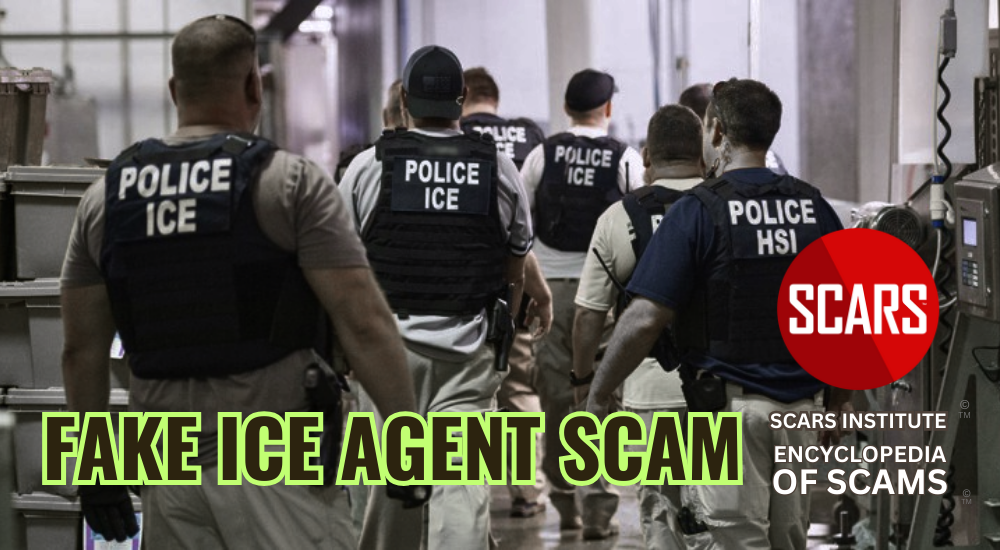
U.S. Immigration ICE Agent Imposter Scam
Federal Immigration Agent Impersonation Scam
How Scams Work – A SCARS Institute Insight
Author:
• SCARS Institute Encyclopedia of Scams Editorial Team – Society of Citizens Against Relationship Scams Inc.
Article Abstract
Immigrant communities across the United States are being targeted by scammers pretending to be agents from U.S. Immigration and Customs Enforcement (ICE) or local police. These fraudsters intimidate victims by claiming they have violated immigration laws and face immediate arrest and deportation.
Using threatening tactics, they coerce victims into providing sensitive personal information, such as Social Security numbers and credit card details, and demand thousands of dollars to dismiss fake investigations or arrest warrants. Scammers often use fake Caller ID numbers and even reference official ICE websites to appear legitimate.
ICE and local police do not call individuals to warn of arrests, request personal financial information, or demand payment. Victims of these scams are urged to report incidents to the Department of Homeland Security, local police, or the FBI. Reporting these crimes is safe and will not lead to deportation, even for those who have entered the U.S. illegally.

Federal Immigration ICE Agent Impersonation Scam
The ICE Agent Impersonation Phone Scam
This is a warning for all immigrant communities in the United States to be on the alert for con artists/scammers pretending to be agents of the U.S. Department of Homeland Security (DHS), Immigration and Customs Enforcement (ICE), or local police.
How the ICE Agent Scam Works
An immigrant gets a telephone call from someone pretending to be an ICE agent. The agent informs the victim that he or she has violated immigration law(s) and is in immediate danger of arrest and deportation. In a threatening tone, the agent scares the immigrant victim into revealing their date of birth, social security number, credit card number and other personally identifiable information. The scammer tells the victim that the only way to avoid arrest and deportation is by paying thousands of dollars in immigration fees and fines.
Con artists/scammers will often call from a phone that will appear on Caller ID as an official ICE number. They can even use the official ICE website to convince their victims of their authenticity. While the ICE agent impersonator is on the phone with the victim, another scammer pretending to be a local police officer will call the victim using a fake telephone number that looks like a police number. The police impersonator states, in a very intimidating manner, that an arrest warrant has been issued and that officers are on their way to place the victim under arrest (sometimes the recorded sound of police sirens can be heard in the background).
The fake ICE Agent/police officer proceeds to tell the victim to cooperate and pay whatever amount the fake ICE agent is requesting; only by paying ICE can the victim avoid immediate arrest and deportation. The panicked victim is instructed to navigate to the official ICE website and read the immigration bond form. An immigration bond is commonly used to help release a noncitizen from ICE custody pending their deportation hearing.
At this point, the fake ICE agent demands that the victim pay $3,999 or some other amount to stop the investigation and vacate the arrest warrant. The terrified victim complies by sending the money to the scammers, which is then lost and not recoverable.
Remember
- ICE Agents and local police do not call immigrants on the phone to warn them that they are about to be arrested and deported for violating immigration laws;
- Agents do not request financial information (e.g., bank account and credit card account information) or demand money from someone to dismiss an investigation or vacate an arrest warrant.
You can report suspected ICE agent fraud to the Department of Homeland Security Office of Inspector General at 1-800-323-8603, and police officer impersonation to the Local Police Department Financial Crimes and Fraud Unit. You may also report them to the FBI.
If you have entered the U.S. illegally, reporting these scams will not get you deported. You can report anonymously if you prefer.
-/ 30 /-
What do you think about this?
Please share your thoughts in a comment below!
Table of Contents




Rapid Report Scammers

In the U.S. & Canada
U.S. & Canada Suicide Lifeline 988
LEAVE A COMMENT?
Thank you for your comment. You may receive an email to follow up. We never share your data with marketers.
Recent Comments
On Other Articles
- on Establishing The United States Task Force To Eliminate Fraud – 2026: “Make Online Safe Again!” Mar 17, 19:11
- on Establishing The United States Task Force To Eliminate Fraud – 2026: “Finally an administration takes the initiative to help solve the gigantic situation. Make America Safe Again, thank you!” Mar 17, 15:41
- on What Is The Difference Between A Scam Victim And A Scam Survivor? [Updated]: “Due to my scams I don’t fully trust anyone online and I shouldn’t even those people I knew in high…” Mar 7, 12:46
- on SCARS 3 Steps For New Scam Victims 2024: “I was very fearful “he” would come to my home because I was knew my address, I spoke to someone…” Mar 7, 09:50
- on Sadness & Scam Recovery: “Before my scam, my mom passed away and I got a divorce, so I was dealing with the loss of…” Mar 7, 09:37
- on The Story Of Kira Lee Orsag (aka Dani Daniels) [Updated]: “There is NO evidence and she is not, she is a victim too. Sebastian, stop letting your anger think for…” Mar 6, 23:18
- on The Story Of Kira Lee Orsag (aka Dani Daniels) [Updated]: “There is real evidence that behind these two people there is something that not many people know. This woman is…” Mar 4, 03:58
- on Signs of Good & Bad Scam Victim Emotional Health: “ty this helps me with knowing why I cant quit eating when I am not hungry and when I crave…” Mar 2, 20:43
- on The SCARS Institute Top 50 Celebrity Impersonation Scams – 2025: “You should probably add Lawrence O’donnell as a scam also. I clicked on a site on tic tok for msnbc,…” Mar 2, 08:41
- on Finally Tax Relief for American Scam Victims is on the Horizon – 2026: “I just did my taxes for 2025 my tax account said so far for romances scam we cd not take…” Feb 25, 19:50
ARTICLE META
Important Information for New Scam Victims
- Please visit www.ScamVictimsSupport.org – a SCARS Website for New Scam Victims & Sextortion Victims
- Enroll in FREE SCARS Scam Survivor’s School now at www.SCARSeducation.org
- Please visit www.ScamPsychology.org – to more fully understand the psychological concepts involved in scams and scam victim recovery
If you are looking for local trauma counselors please visit counseling.AgainstScams.org or join SCARS for our counseling/therapy benefit: membership.AgainstScams.org
If you need to speak with someone now, you can dial 988 or find phone numbers for crisis hotlines all around the world here: www.opencounseling.com/suicide-hotlines
A Note About Labeling!
We often use the term ‘scam victim’ in our articles, but this is a convenience to help those searching for information in search engines like Google. It is just a convenience and has no deeper meaning. If you have come through such an experience, YOU are a Survivor! It was not your fault. You are not alone! Axios!
A Question of Trust
At the SCARS Institute, we invite you to do your own research on the topics we speak about and publish, Our team investigates the subject being discussed, especially when it comes to understanding the scam victims-survivors experience. You can do Google searches but in many cases, you will have to wade through scientific papers and studies. However, remember that biases and perspectives matter and influence the outcome. Regardless, we encourage you to explore these topics as thoroughly as you can for your own awareness.
Statement About Victim Blaming
SCARS Institute articles examine different aspects of the scam victim experience, as well as those who may have been secondary victims. This work focuses on understanding victimization through the science of victimology, including common psychological and behavioral responses. The purpose is to help victims and survivors understand why these crimes occurred, reduce shame and self-blame, strengthen recovery programs and victim opportunities, and lower the risk of future victimization.
At times, these discussions may sound uncomfortable, overwhelming, or may be mistaken for blame. They are not. Scam victims are never blamed. Our goal is to explain the mechanisms of deception and the human responses that scammers exploit, and the processes that occur after the scam ends, so victims can better understand what happened to them and why it felt convincing at the time, and what the path looks like going forward.
Articles that address the psychology, neurology, physiology, and other characteristics of scams and the victim experience recognize that all people share cognitive and emotional traits that can be manipulated under the right conditions. These characteristics are not flaws. They are normal human functions that criminals deliberately exploit. Victims typically have little awareness of these mechanisms while a scam is unfolding and a very limited ability to control them. Awareness often comes only after the harm has occurred.
By explaining these processes, these articles help victims make sense of their experiences, understand common post-scam reactions, and identify ways to protect themselves moving forward. This knowledge supports recovery by replacing confusion and self-blame with clarity, context, and self-compassion.
Additional educational material on these topics is available at ScamPsychology.org – ScamsNOW.com and other SCARS Institute websites.
Psychology Disclaimer:
All articles about psychology and the human brain on this website are for information & education only
The information provided in this article is intended for educational and self-help purposes only and should not be construed as a substitute for professional therapy or counseling.
While any self-help techniques outlined herein may be beneficial for scam victims seeking to recover from their experience and move towards recovery, it is important to consult with a qualified mental health professional before initiating any course of action. Each individual’s experience and needs are unique, and what works for one person may not be suitable for another.
Additionally, any approach may not be appropriate for individuals with certain pre-existing mental health conditions or trauma histories. It is advisable to seek guidance from a licensed therapist or counselor who can provide personalized support, guidance, and treatment tailored to your specific needs.
If you are experiencing significant distress or emotional difficulties related to a scam or other traumatic event, please consult your doctor or mental health provider for appropriate care and support.
Also read our SCARS Institute Statement about Professional Care for Scam Victims – click here to go to our ScamsNOW.com website.


Thank you for this article. It is going to occur in other countries too as soon as they see they make money out of it.
How to do a video call with Daniela ftv& Leslie
Faking video calls now is easy. But if you are not technical it does not matter how, all you need to understand is that it is a scam. You are talking to a team of scammers, probably in Africa. Please visit http://www.ScamVictimsSupport.org to learn what you need to know.