



SCARS Institute’s Encyclopedia of Scams™ Published Continuously for 25 Years

Phishing scheme targets unemployment insurance benefits and PII
Scam Victims Need To Be Especially Careful
Have you gotten an alarming text message about your unemployment insurance benefits from what seems to be your state workforce agency? You’re not alone. Identity thieves are targeting millions of people nationwide with scam phishing texts aimed at stealing personal information, unemployment benefits, or both.
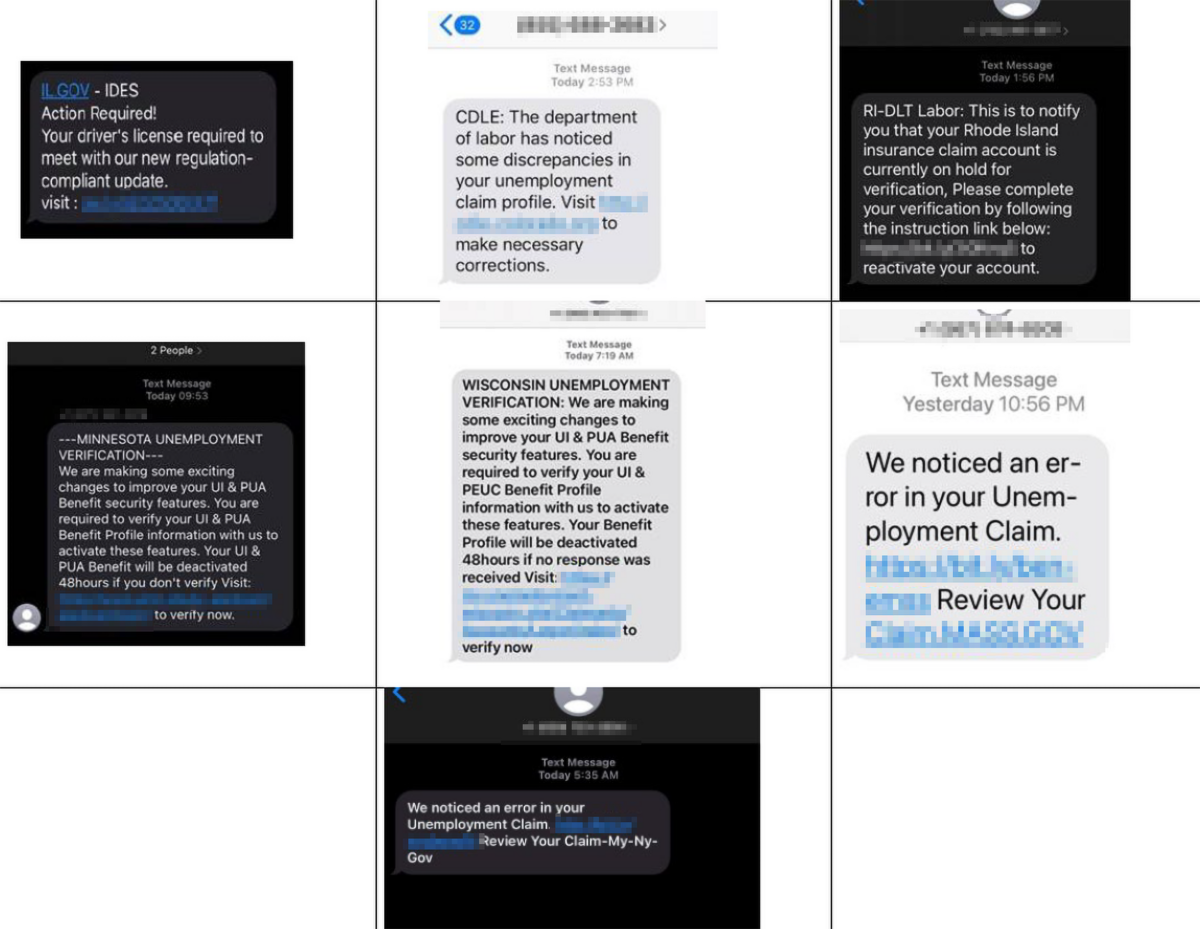
The phishing texts try to dupe you to click a link to “make necessary corrections” to your unemployment insurance (UI) claim, “verify” your personal information, or “reactivate” your UI benefits account. The link takes you to a fake state workforce agency (SWA) website that may look very real. There, you’re asked to input your website credentials and personal information, like your Social Security number. Fraudsters can use the information to file fraudulent UI benefits claims or for other identity theft.
If You Were The Victim Of A Scam?
If you were the victim of a scam then the scammers already know you, and they may know a lot about you! In fact, they already have used your identity to file a fraudulent unemployment claim under your name!
If you have been involved in a scam it is important that you protect your financial identity, but especially with your state. After all, if the state believes that you have committed unemployment fraud they will send the police to your door to arrest you! Avoid that by calling your state agency and asking about your current unemployment account status. You can use the directory below to contact them.
Phishing Examples
Here are examples of some of the phishing texts:
A Surge In Fraudulent Unemployment Claims
U.S. States have experienced a surge in fraudulent unemployment claims filed by organized crime rings using stolen identities that were accessed or purchased from past data breaches, the majority of which occurred in previous years and involved larger criminal efforts unrelated to unemployment. Criminals are using these stolen identities to fraudulently collect benefits across multiple states.
For information and reporting other types of unemployment fraud, including claimant fraud or employer fraud, visit our Report Unemployment Fraud page.
Protect yourself. Know that state agencies do not send text messages asking for personal information. If you get an unsolicited text or email message that looks like it’s from an SWA, don’t reply or click any link. If you’re not sure, contact the SWA directly using the State Directory below for Reporting Unemployment Identity Theft.
If you think you may have entered your personal information into a fraudulent website, visit IdentityTheft.gov to find out how to make it harder for an identity thief to misuse your information.
You can report a suspicious text message or email claiming to be from an SWA to the National Center for Disaster Fraud (NCDF) by completing an NCDF Complaint Form or by calling (866) 720-5721. You can also report this at ReportFraud.ftc.gov.
Signs That You May Be A Victim Of Unemployment Identity Theft
Most victims of unemployment identity theft are unaware that claims have been filed and/or that benefits have been collected using their identities. Many people only find out unemployment identity theft occurred when they receive something in the mail, such as a payment or state issued 1099-G tax form that’s incorrect or for benefits not received.
Sample form from the IRS.gov website: IRS form Certain Government Payments 1099-G
You may be a victim of unemployment identity theft if you received:
- Mail from a government agency about an unemployment claim or payment and you did not recently file for unemployment benefits. This includes unexpected payments or debit cards and could be from any state.
- A 1099-G tax form reflecting unemployment benefits you weren’t expecting. Box 1 on this form may show unemployment benefits you did not receive or an amount that exceeds your records for the unemployment benefits you did receive. The form itself may be from a state in which you do not live or did not file for benefits.
- While you are still employed, a notice from your employer indicating that your employer received a request for information about an unemployment claim in your name.
Are You A Victim Of Unemployment Identity Theft?
- Report unemployment identity theft to the state where it occurred. Use the directory below, to report it to the state.
- You may not receive an immediate confirmation from the state when you submit a report. Time estimates for how long this process takes vary by state.
- The state may require additional documentation (like filing a police report or a sworn affidavit) in order to open an investigation; they will review your case and make a determination. Each state has different requirements and a different process for investigating identity theft.
- If you received a 1099-G tax form for benefits you didn’t receive, the state will need to issue you a corrected 1099-G tax form and will update the tax record with the IRS on your behalf.
- When you file your income taxes, ONLY include income you actually received. Do not wait to receive a corrected 1099-G to file your taxes.
- The processing of your tax return should not be delayed while your report of unemployment identity theft is under investigation.
- If you have not filed your taxes yet, do not report the incorrect 1099-G income on your tax return.
- If you have already filed your taxes, do not file an amended return. The IRS will issue additional guidance regarding your next steps. Refer to the Identity Theft and Unemployment Benefits page on IRS.gov for updates and additional tax filing information.
- Check your credit report for suspicious activity or unauthorized lines of credit opened. You can request free credit reports every week from each of the three credit bureaus (Equifax, Experian, Transunion) through AnnualCreditReport.com or call 1- 877-322-8228; you will need to provide your name, address, social security number, and date of birth to verify your identity.
- Consider freezing your credit. It’s the best way you can protect against having new accounts opened in your name. Visit the Credit Freeze page on the Federal Trade Commission (FTC) website.
- Report unemployment identity theft that occurred during the COVID-19 pandemic to the U.S. Department of Justice’s National Center for Disaster Fraud. In addition to reporting with the state, reporting with the National Center for Disaster Fraud helps law enforcement stop future unemployment identity theft. Filing this report with the National Center for Disaster Fraud will also notify the U.S. Department of Labor’s Office of Inspector General, which is the primary agency responsible for investigating unemployment fraud. You may not receive a response back after submitting this information.
Report Unemployment Identity Theft
State Directory for Reporting Unemployment Identity Theft
Refer to each state’s specific guidance around reporting unemployment identity theft. Some states may refer to unemployment as “reemployment assistance” or may refer to identity theft as “imposter fraud”.
Never send personal information or documents to unverified sites or in response to requests from social media. The resources below have been verified by state and federal governments.
State Directory
| State | Online Reporting | Phone Number |
|---|---|---|
| Alabama | Report Unemployment Identity Theft | 1-800-392-8019 |
| Alaska | uifraud@alaska.gov | 1-877-272-4635 |
| Arizona | Report Unemployment Identity Theft | 1-800-251-2436 |
| Arkansas | Report Unemployment Identity Theft | 501-682-1058 |
| California | Report Unemployment Identity Theft | Identity Theft: 1-800-229-6297 1099-G Identity Theft: 1-866-401-2849 |
| Colorado | Report Unemployment Identity Theft | 303-318-9035 |
| Connecticut | Report Unemployment Identity Theft | 1-800-894-3490 |
| Delaware | BPC_FRAUD_UNIT@delaware.gov | 302-761-8397 |
| District of Colombia | BPC.UM@dc.gov | 1-877-372-8360 |
| Florida | Report Unemployment Identity Theft | 1-833-352-7759 |
| Georgia | Report Unemployment Identity Theft | 404-232-3440 |
| Hawaii | 1-833-901-2272 (Toll Free) 1-833-901-2275 (Toll Free) 808-762-5751 (Local) 808-762-5752 (Local) |
|
| Idaho | Report Unemployment Identity Theft | 1-877-540-8638 |
| Illinois | Report Unemployment Identity Theft | 1-800-814-0513 |
| Indiana | Report Unemployment Identity Theft | 1-800-891-6499 |
| Iowa | Report Unemployment Identity Theft | 1-866-239-0843 |
| Kansas | Report Unemployment Identity Theft | 785-291-6059 |
| Kentucky | Report Unemployment Identity Theft | |
| Louisiana | Report Unemployment Identity Theft | 1-800-201-3362 |
| Maine | Report Unemployment Identity Theft | 207-621-5154 |
| Maryland | Report Unemployment Identity Theft | 1-800-492-6804 |
| Massachusetts | Report Unemployment Identity Theft | 1-877-626-6800 |
| Michigan | Report Unemployment Identity Theft | 1-866-500-0017 |
| Minnesota | Report Unemployment Identity Theft | 651-296-8715 |
| Mississippi | safe@mdes.ms.gov | 601-493-9427 |
| Missouri | Report Unemployment Identity Theft | 573-751-4058, Option 5 |
| Montana | Report Unemployment Identity Theft | 1-888-556-4677 |
| Nebraska | Report Unemployment Identity Theft | |
| Nevada | Report Unemployment Identity Theft | 775-684-0475 |
| New Hampshire | Report Unemployment Identity Theft | 1-800-852-3400 ext. 84016 |
| New Jersey | Report Unemployment Identity Theft | 609-777-4304 |
| New Mexico | id.verify@state.nm.us | 1-877-664-6984 |
| New York | Report Unemployment Identity Theft | |
| North Carolina | Report Unemployment Identity Theft | 984-465-9224 |
| North Dakota | 701-328-1680 | |
| Ohio | Report Unemployment Identity Theft | 1-833-658-0394 |
| Oklahoma | Report Unemployment Identity Theft | Identity Theft: 405-525-1500 1099-G Identity Theft: 405-521-6099 |
| Oregon | Report Unemployment Identity Theft | 1-877-668-3204 |
| Pennsylvania | Report Unemployment Identity Theft | 1-800-692-7469 |
| Puerto Rico | Report Unemployment Identity Theft Report Pandemic Unemployment Identity Theft |
|
| Rhode Island | Report Unemployment Identity Theft | |
| South Carolina | Report Unemployment Identity Theft | 1-866-831-1724 |
| South Dakota | RAFraud@state.sd.us | 605-626-7649 |
| Tennessee | bpc.investigations@tn.gov | 615-645-3893 |
| Texas | Report Unemployment Identity Theft | 1-800-252-3642 |
| Utah | Report Unemployment Identity Theft | 1-888-848-0688 |
| Vermont | Report Unemployment Identity Theft | 802-828-4104 |
| Virginia | Report Unemployment Identity Theft | 1-800-782-4001 |
| Virgin Islands | 1-340-715-5711 | |
| Washington | Report Unemployment Identity Theft | 1-800-246-9763 |
| West Virginia | reportunemploymentfraud@wv.gov | 304-433-8790 1-800-252-JOBS, Option 5 |
| Wisconsin | Report Unemployment Identity Theft | 1-800-909-9472 |
| Wyoming | Report Unemployment Identity Theft | 307-235-3658 |
Tell your friends. By sharing your experience and knowledge about fraud, you can help someone else avoid these traps!
-/ 30 /-
What do you think about this?
Please share your thoughts in a comment below!
Table of Contents




Rapid Report Scammers

In the U.S. & Canada
U.S. & Canada Suicide Lifeline 988
LEAVE A COMMENT?
Recent Comments
On Other Articles
- Wendy Guiher on 15 Things That Nearly Every Online and Phone Scams Have In Common – 2026: “Very concise, direct information. When I look back on the crime against me I now can see ALL of the…” Apr 1, 06:24
- on The Danger of Using AI in Law Enforcement – The Grandmother Wrongly Arrested as a Fraudster – 2026: “Excellent article – I can’t imagine the terror Angela most certainly experienced. Compound this with the lack of accountability by…” Mar 24, 09:20
- on The Crazy Gregor MacGregor and the Country of Poyais Scam – History of Scams – 2026: “interesting” Mar 23, 19:24
- on BEC Fraud Reaches $43 Billion Per Year: “oh my gosh so much of an increase in the fraud I pray the officials can continue tracking and make…” Mar 23, 15:09
- on Establishing The United States Task Force To Eliminate Fraud – 2026: “Make Online Safe Again!” Mar 17, 19:11
- on Establishing The United States Task Force To Eliminate Fraud – 2026: “Finally an administration takes the initiative to help solve the gigantic situation. Make America Safe Again, thank you!” Mar 17, 15:41
- on What Is The Difference Between A Scam Victim And A Scam Survivor? [Updated]: “Due to my scams I don’t fully trust anyone online and I shouldn’t even those people I knew in high…” Mar 7, 12:46
- on SCARS 3 Steps For New Scam Victims 2024: “I was very fearful “he” would come to my home because I was knew my address, I spoke to someone…” Mar 7, 09:50
- on Sadness & Scam Recovery: “Before my scam, my mom passed away and I got a divorce, so I was dealing with the loss of…” Mar 7, 09:37
- on The Story Of Kira Lee Orsag (aka Dani Daniels) [Updated]: “There is NO evidence and she is not, she is a victim too. Sebastian, stop letting your anger think for…” Mar 6, 23:18
ARTICLE META
Important Information for New Scam Victims
- Please visit www.ScamVictimsSupport.org – a SCARS Website for New Scam Victims & Sextortion Victims
- Enroll in FREE SCARS Scam Survivor’s School now at www.SCARSeducation.org
- Please visit www.ScamPsychology.org – to more fully understand the psychological concepts involved in scams and scam victim recovery
If you are looking for local trauma counselors please visit counseling.AgainstScams.org or join SCARS for our counseling/therapy benefit: membership.AgainstScams.org
If you need to speak with someone now, you can dial 988 or find phone numbers for crisis hotlines all around the world here: www.opencounseling.com/suicide-hotlines
A Note About Labeling!
We often use the term ‘scam victim’ in our articles, but this is a convenience to help those searching for information in search engines like Google. It is just a convenience and has no deeper meaning. If you have come through such an experience, YOU are a Survivor! It was not your fault. You are not alone! Axios!
A Question of Trust
At the SCARS Institute, we invite you to do your own research on the topics we speak about and publish, Our team investigates the subject being discussed, especially when it comes to understanding the scam victims-survivors experience. You can do Google searches but in many cases, you will have to wade through scientific papers and studies. However, remember that biases and perspectives matter and influence the outcome. Regardless, we encourage you to explore these topics as thoroughly as you can for your own awareness.
Statement About Victim Blaming
SCARS Institute articles examine different aspects of the scam victim experience, as well as those who may have been secondary victims. This work focuses on understanding victimization through the science of victimology, including common psychological and behavioral responses. The purpose is to help victims and survivors understand why these crimes occurred, reduce shame and self-blame, strengthen recovery programs and victim opportunities, and lower the risk of future victimization.
At times, these discussions may sound uncomfortable, overwhelming, or may be mistaken for blame. They are not. Scam victims are never blamed. Our goal is to explain the mechanisms of deception and the human responses that scammers exploit, and the processes that occur after the scam ends, so victims can better understand what happened to them and why it felt convincing at the time, and what the path looks like going forward.
Articles that address the psychology, neurology, physiology, and other characteristics of scams and the victim experience recognize that all people share cognitive and emotional traits that can be manipulated under the right conditions. These characteristics are not flaws. They are normal human functions that criminals deliberately exploit. Victims typically have little awareness of these mechanisms while a scam is unfolding and a very limited ability to control them. Awareness often comes only after the harm has occurred.
By explaining these processes, these articles help victims make sense of their experiences, understand common post-scam reactions, and identify ways to protect themselves moving forward. This knowledge supports recovery by replacing confusion and self-blame with clarity, context, and self-compassion.
Additional educational material on these topics is available at ScamPsychology.org – ScamsNOW.com and other SCARS Institute websites.
Psychology Disclaimer:
All articles about psychology and the human brain on this website are for information & education only
The information provided in this article is intended for educational and self-help purposes only and should not be construed as a substitute for professional therapy or counseling.
While any self-help techniques outlined herein may be beneficial for scam victims seeking to recover from their experience and move towards recovery, it is important to consult with a qualified mental health professional before initiating any course of action. Each individual’s experience and needs are unique, and what works for one person may not be suitable for another.
Additionally, any approach may not be appropriate for individuals with certain pre-existing mental health conditions or trauma histories. It is advisable to seek guidance from a licensed therapist or counselor who can provide personalized support, guidance, and treatment tailored to your specific needs.
If you are experiencing significant distress or emotional difficulties related to a scam or other traumatic event, please consult your doctor or mental health provider for appropriate care and support.
Also read our SCARS Institute Statement about Professional Care for Scam Victims – click here to go to our ScamsNOW.com website.


Thank you for your comment. You may receive an email to follow up. We never share your data with marketers.