




SCARS Institute’s Encyclopedia of Scams™ Published Continuously for 25 Years


Spotting AI Scams – Using AI to Catch Artificial Intelligence Scams
A SCARS Institute User’s Guide to Using AI to Probe and Analyze Suspected Scam Communications
Spotting Scams and Scammers – A SCARS Institute Insight
Authors:
• SCARS Institute Encyclopedia of Scams Editorial Team – Society of Citizens Against Relationship Scams Inc.
• Prompts were written by Claude and ChatGPT as prompted by SCARS Institute
See Author Biographies Below
Article Abstract
Artificial intelligence is changing online scams by allowing criminals to produce polished messages, personalize conversations, translate language, support false identities, maintain emotional manipulation, and operate at greater scale. Scam detection therefore increasingly depends on behavioral patterns, consistency, and independent verification rather than grammar or writing quality. AI tools can help scam victims review long conversations, extract factual claims, identify contradictions, organize financial requests, detect manipulation patterns, and distinguish statements from verified facts. AI-generated language alone does not establish deception because legitimate individuals and organizations also use generative tools. Stronger warning signs include financial requests, secrecy, verification avoidance, changing stories, repeated emergencies, emotional pressure, and independently disproven claims. Effective evaluation requires examining the entire relationship pattern and verifying important claims through sources independent of the person being assessed.
Keywords
Artificial Intelligence, AI-Assisted Scams, Scam Detection, Fraud Analysis, Deception, Independent Verification, Emotional Manipulation, Identity Verification, Scam Warning Signs, Message Analysis

A SCARS Institute Scam Victim’s Guide to Using AI to Examine Suspicious Messages
A Practical AI Prompt Toolkit for Finding Contradictions, Manipulation, Verification Problems, and Warning Signs
Generative AI has changed the way many scams are written. Poor grammar, strange spelling, and awkward sentences are no longer reliable warning signs. A scammer can now use AI to produce polished, affectionate, professional, or convincing messages in seconds.
That does not make scams impossible to detect. It changes what you need to look for. The weakness is often not one individual message. The weakness appears across the entire story.
A person maintaining a false identity has to keep names, locations, jobs, family members, schedules, travel plans, emergencies, promises, financial problems, and previous explanations consistent over weeks or months. Every new conversation creates another opportunity for the story to drift.
That is where AI can help you. You can use an AI assistant to compare messages, organize claims, identify contradictions, recognize manipulation, examine requests for money or access, and identify questions that still need independent verification.
AI should not decide whether someone is trustworthy for you. It should help you see information that emotional involvement, stress, fear, hope, or confusion can make difficult to see clearly.
- The goal is not to prove that someone is a scammer from the way they write.
- The goal is to separate what you have been told from what you can actually verify.
SCARS Institute Note
Artificial intelligence is rapidly changing both sides of fraud. Criminals can use it to create more convincing identities, messages, explanations, and emotional manipulation, while scam victims can use the same technology to organize evidence and examine inconsistencies that can otherwise remain hidden across months of communication. The purpose of these methods is not to encourage victims to interrogate suspected scammers or rely on AI to declare someone guilty. The goal is to help restore careful examination by separating claims from evidence, emotion from verification, and individual explanations from the larger pattern. AI can be a powerful analytical assistant when it is used cautiously, but independent verification, observable behavior, and sound judgment must remain central.
Introduction:
How Artificial Intelligence Is Changing Online Scams
Artificial intelligence did not invent fraud. Scammers have always relied on deception, impersonation, emotional manipulation, false authority, fabricated emergencies, and convincing stories. What artificial intelligence has changed is the speed, quality, scale, and adaptability with which those deceptions can now be produced.
For scam victims, this change matters because many of the warning signs people were once taught to recognize are becoming less reliable.
For years, people were told to watch for poor grammar, unusual spelling, awkward sentences, inconsistent capitalization, or language that did not sound natural. Those clues sometimes helped because many scams were written from fixed scripts, translated poorly, or operated by people communicating in a language they did not speak fluently.
Generative AI can remove many of those weaknesses almost instantly.
A scammer can take a badly written message and ask an AI system to make it sound professional, romantic, sympathetic, intelligent, authoritative, or natural. AI can correct grammar, imitate conversational language, translate messages between languages, create believable explanations, and adjust a response to match what a potential victim has just said.
This means a scammer no longer needs to be a particularly skilled writer to sound convincing.
AI Can Help Scammers Personalize the Deception
Traditional scam scripts were often repetitive. Hundreds of thousands of people could receive nearly identical messages. If the victim asked an unexpected question, the scammer had to improvise.
AI makes improvisation much easier.
A scammer can feed parts of a conversation into an AI system and ask it to generate an affectionate response, explain an apparent contradiction, create a believable emergency, continue a romantic conversation, or produce an answer consistent with a particular occupation or personality.
- Someone pretending to be an engineer can ask AI to explain engineering terminology.
- Someone pretending to be a physician can generate medically sophisticated language.
- Someone claiming to live in another country can ask AI about local customs, restaurants, neighborhoods, weather, holidays, slang, or daily life.
- Someone conducting a romance scam can ask AI to write increasingly intimate messages based on information the victim has already shared.
The result can feel highly personal even when much of the communication is being assisted, rewritten, or generated by a machine.
AI Can Help Maintain Emotional Manipulation
Scams are not successful simply because a false story sounds plausible. They succeed because the victim is gradually influenced to trust, care, hope, fear, comply, or become emotionally dependent. AI can assist that process as well.
A scammer can ask an AI system to make a message more affectionate, more apologetic, more urgent, more frightening, more persuasive, or more emotionally compelling. AI can generate reassurance after the victim becomes suspicious. It can produce romantic declarations after an argument. It can suggest ways to answer objections, regain trust, explain why a video call failed, or persuade someone that another payment is necessary.
The technology therefore can become part of the manipulation process itself.
This does not mean that AI understands or experiences the emotions it describes. It means that it can generate language that is effective at triggering them.
AI Can Support Impersonation
Text is only one part of the problem. Artificial intelligence can also contribute to the creation or alteration of photographs, voices, documents, videos, social media content, and other material used to support a false identity.
Voice-cloning technology can imitate the sound of another person’s voice from relatively small samples of recorded speech. Synthetic or manipulated images can create people who do not exist or alter photographs of real people. AI-assisted video manipulation can make visual verification more difficult. Generative systems can also help create biographies, professional histories, business descriptions, letters, contracts, identification-style documents, account explanations, or other supporting material.
- As a result, seeing a photograph is not the same as verifying identity.
- Hearing a voice is not necessarily verification.
- Receiving an official-looking document is not necessarily verification.
- Even having a video conversation should be understood as one piece of evidence rather than absolute proof of every claim a person has made.
AI Can Allow Scammers to Operate at Greater Scale
AI also changes the economics of fraud.
One operator can potentially manage more conversations because AI can help write responses, summarize previous exchanges, translate messages, generate scripts, and rapidly produce variations of the same story.
Criminal groups can use similar tools to train inexperienced operators, create multiple false identities, adapt scripts for different populations, and communicate convincingly with people in different countries and languages.
What once required a highly skilled manipulator can increasingly be supported by readily available technology. This can make scams feel more polished, more responsive, and more individualized.
It does not make them perfect.
AI Also Creates New Weaknesses
The same technology that helps scammers can create problems for them. A false identity still has to remain consistent. If someone claims to be a particular age, profession, nationality, family status, location, and life history, those claims have to remain compatible across hundreds or thousands of messages.
- Every new explanation adds another fact to remember.
- Every emergency adds another event to the timeline.
- Every invented relative adds another relationship.
- Every financial request requires another explanation.
- Every attempt to avoid verification requires another excuse.
AI can generate convincing individual answers, but generating an answer is not the same as maintaining a coherent invented life indefinitely. That is why examining the entire communication history can be much more useful than examining whether one message “sounds fake.”
The important question is often not: “Was this written by AI?”
The more useful questions are:
- “Does the story remain consistent?”
- “Can the important claims be independently verified?”
- “Does the person welcome normal verification or continually prevent it?”
- “Are emergencies repeatedly connected to requests for money?”
- “Do explanations change whenever questions become difficult?”
- “Is affection being combined with pressure, secrecy, urgency, fear, or financial demands?”
AI Detection Is Not Scam Detection
There is also an important danger in focusing too heavily on whether a message appears to have been generated by AI.
- Millions of legitimate people use AI.
- Businesses use it.
- Professionals use it.
- People who struggle with writing use it.
- People communicating in a second language use it.
Someone can use AI to write a completely truthful message. A scammer can also write entirely without AI.
For that reason, detecting AI-generated language should never become the primary test of whether someone is trustworthy. Writing style is supporting information. Behavior, consistency, verification, financial requests, and the overall pattern of the relationship are much more important.
Using AI Against the Deception
The technology that can assist a scammer can also help a potential victim examine what is happening.
An AI assistant can review months of messages, extract factual claims, compare earlier and later statements, identify changes in the story, organize financial requests chronologically, recognize manipulation patterns, locate unresolved questions, and distinguish what has actually been verified from what has merely been repeated.
Used properly, AI does not tell you whom to trust.
It helps you examine the evidence more systematically. That distinction is important.
A scammer benefits when every explanation is considered separately and emotionally. A new emergency can overshadow the previous contradiction. An apology can replace yesterday’s unanswered question. A romantic promise can distract from a financial request. Another crisis can prevent you from returning to something that never made sense.
Analysis brings those pieces back together.
Artificial intelligence has made deception easier to produce, more polished, and more adaptable. It has not eliminated the fundamental weakness of deception: a fabricated reality must continue to agree with itself.
That is the weakness these tools are designed to help you examine.
A Reminder: The Nature of Fraud and Deception
Fraud is not simply the act of telling a lie. Successful fraud requires the creation of an entire believable reality and the ability to keep that reality intact for as long as the deception continues. A scammer is not merely trying to convince you of one false fact. They are trying to sell you a story, persuade you to emotionally enter that story, and then keep you inside it long enough for the fraud to achieve its purpose.
That creates a difficult problem for the person committing the deception.
Truth is naturally consistent because it is anchored in events that actually happened. A real person does not have to invent where they grew up, who their family members are, what job they hold, where they went yesterday, or why they cannot access their own money. They can forget details, misspeak, or remember something incorrectly, but the basic structure of their life already exists.
Fraud works differently.
A scammer must construct that structure and then continuously maintain it. Every new claim becomes another piece of the invented reality that must remain compatible with everything previously said. If the scammer claims to be a widower, that fact must remain consistent with later stories about family and relationships. If they claim to work for a particular company, their schedule, professional knowledge, location, travel, coworkers, and explanations must continue to fit that occupation. If they invent an emergency, the cause, timing, consequences, and eventual resolution must all remain compatible with the larger story.
The longer the fraud continues, the more difficult this becomes.
Every conversation creates new facts. Every question creates another opportunity for error. Every invented person, location, event, promise, illness, trip, financial problem, or explanation becomes something that has to be remembered and maintained.
A scammer therefore faces a burden that the truthful person does not: they must remain convincing and consistent almost all the time. One serious mistake can expose an entire deception.
This is why scammers frequently rely on scripts, repeated explanations, emotional distraction, urgency, and increasingly artificial intelligence. These tools can help them generate believable responses and maintain the appearance of coherence. Yet even sophisticated assistance does not eliminate the underlying problem. The scammer is still maintaining something that does not actually exist.
Emotion also helps protect the story. When you are worried about someone’s emergency, excited about a future together, afraid of losing the relationship, or focused on helping them solve a crisis, you are less likely to stop and compare today’s explanation with something said three months earlier. The emotional experience keeps your attention moving forward while contradictions remain behind.
That is one of the reasons careful review can be so powerful. Instead of asking whether each individual explanation sounds possible, you can ask whether all of the explanations fit together.
Fraud depends upon maintaining the illusion of a coherent world. The longer that invented world must operate, the more opportunities there are for its pieces to stop fitting together. The deception does not necessarily fail because the scammer tells one unbelievable lie. It can fail because too many believable lies eventually contradict one another.
Before You Begin
If you are emotionally involved with the person you are analyzing, your situation can be very different from examining a stranger’s email.
- You might love the person.
- You might believe you are building a future together.
- You might have spoken with them every day for months.
- You might already have sent money.
- You might desperately want the analysis to tell you that everything is all right.
- You might also be terrified that it will tell you the opposite.
Those feelings are important. They are also one reason it can help to use a structured process.
Do not ask AI simply: “Is this person a scammer?”
That question encourages an oversimplified answer. Instead, ask AI to identify evidence, contradictions, behaviors, claims, and verification problems. Then evaluate those findings alongside independent evidence.
AI is useful as a second set of eyes. It is not a lie detector.
The Most Important Rule
Behavior matters more than writing style.
- A beautifully written message can be part of a scam.
- A badly written message can come from an honest person.
- A message that appears to have been written by AI can come from an honest person.
- A message that appears completely natural can come from a criminal.
Pay much greater attention to behavior such as:
- Requests for money
- Requests for cryptocurrency
- Gift card requests
- Requests for banking information
- Requests for passwords or authentication codes
- Investment opportunities involving your money
- Requests to receive or transfer money for someone else
- Repeated emergencies requiring financial assistance
- Secrecy
- Pressure not to discuss the relationship with other people
- Attempts to isolate you from family or friends
- Repeated reasons why identity cannot be independently verified
- Refusal or inability to participate normally in live video communication
- Stories that repeatedly change
- Escalating financial or emotional pressure
One behavior can have an innocent explanation. A pattern deserves much greater attention.
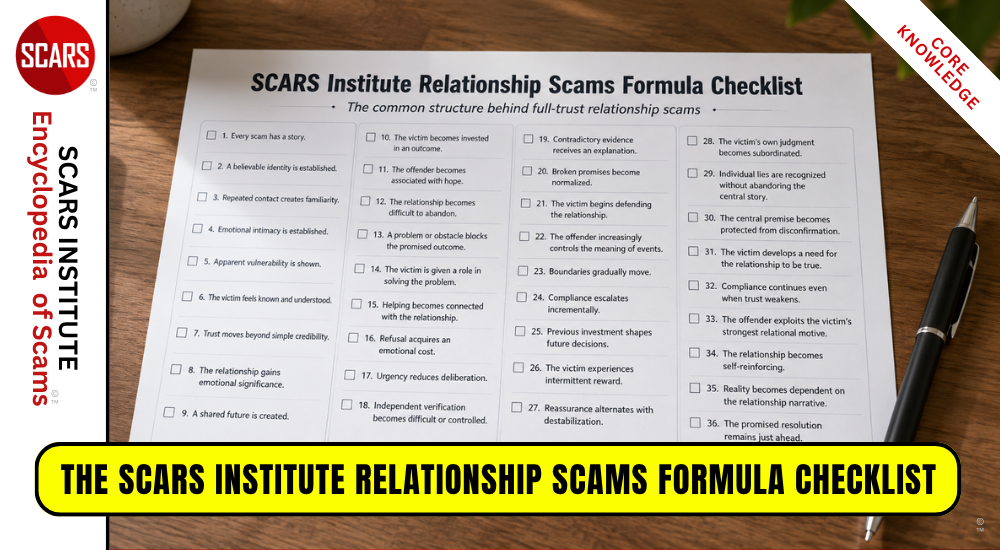
Learn more about this here: The SCARS Institute Relationship Scams Formula Checklist
A Safety Rule Before You Contact the Person Again
- You do not have to catch a scammer in a contradiction.
- You do not have to prove that you know they are lying.
- You do not have to confront them.
- You do not have to win an argument.
- And you do not have to keep communicating simply because you still have unanswered questions.
Continuing the conversation can give a scammer additional opportunities to explain contradictions, create new emergencies, manipulate your emotions, frighten you, make promises, blame you, or persuade you to continue the relationship.
- If substantial warning signs already exist, independent verification is usually more valuable than interrogation.
- If the person is threatening you, blackmailing you, demanding money, requesting account access, or attempting to involve you in financial transactions, do not use these prompts as a reason to prolong the conversation.
- Preserve the evidence and seek appropriate assistance.
Protect Your Privacy When Using AI
Before pasting conversations into an AI system, remove unnecessary personal information whenever practical.
Consider removing:
- Bank account numbers
- Credit card numbers
- Passwords
- Authentication codes
- Social security numbers
- Passport numbers
- Driver’s license numbers
- Private medical information
- Children’s identifying information
- Your home address
- Information that could compromise another person’s privacy
You usually do not need to remove the suspected person’s claimed name, city, occupation, employer, or other claims that are necessary to analyze the story.
How to Prepare the Messages
Whenever possible, provide the entire conversation rather than one isolated message.
A single message can appear perfectly reasonable.
Patterns become visible over time.
Keep messages in chronological order and label them with dates or numbers.
For example:
- Message 1, March 4
- Message 2, March 7
- Message 3, March 10
If the conversation is extremely long, analyze it in sections, but keep the original order.
Do not rewrite or correct the person’s messages before submitting them. Exact wording can matter. Whenever possible, include your own messages too. A response can only be interpreted properly when the AI can see what question or statement came before it.
One Instruction Worth Adding to Every Prompt
You can place the following instruction at the beginning of any of the prompts in this toolkit:
Use plain language suitable for someone who might be emotionally involved in this situation. Separate observed facts from interpretations. Quote the specific words supporting every important finding. Do not assume the person is guilty or innocent. Do not treat ordinary mistakes, awkward language, AI-assisted writing, cultural differences, or non-native English as proof of deception. Put behavioral and verification evidence ahead of writing style. If the evidence is insufficient, say so clearly.
This instruction helps keep the AI focused on evidence instead of speculation.
GROUP ONE: FIND OUT WHETHER THERE IS AN IMMEDIATE PROBLEM
Prompt 1: Rapid Scam-Risk Screen
Use this first when you want a quick assessment of what deserves your attention.
COPY THIS PROMPT
You are helping me examine communications from someone whose identity or intentions I am uncertain about.
I might be emotionally involved with this person, so explain your findings calmly and in plain language.
Do not decide that the person is definitely a scammer or definitely safe.
Review the material I provide and identify any immediate warning signs involving:
- Requests for money.
- Cryptocurrency or investment requests.
- Gift cards.
- Banking information.
- Passwords, login information, or authentication codes.
- Requests that I receive, move, forward, or transfer money.
- Pressure to keep secrets.
- Attempts to isolate me from friends, relatives, professionals, or advisors.
- Threats, intimidation, blackmail, or fear.
- Repeated emergencies.
- Pressure to act quickly.
- Avoidance of identity verification.
- Repeated inability to video call or meet.
- Major contradictions in the person’s story.
- Pressure to move the conversation to another platform.
For every concern, quote the exact evidence.
Label each finding:
LOW CONCERN
MODERATE CONCERN
HIGH CONCERN
CRITICAL CONCERNThen tell me:
- What concerns require immediate attention?
- What should be independently verified?
- What should I avoid doing while uncertainty remains?
- Is there anything in these communications that makes continued direct questioning potentially unwise?
Do not tell me that the person is safe simply because you did not find obvious warning signs.
Communications:
[PASTE THE MESSAGES HERE]
GROUP TWO: SEPARATE THE STORY FROM THE EVIDENCE
Prompt 2: Claims Versus Verified Facts
This is one of the most useful exercises you can perform.
When you have heard someone’s story repeatedly, claims can gradually begin to feel like facts.
They are not the same thing.
- “I am a doctor” is a claim.
- “I independently confirmed this person’s medical license through the appropriate licensing authority” is verification.
- “I work for this company” is a claim.
- “I contacted the company through independently obtained contact information and confirmed employment” is verification.
Use this prompt to separate the two.
COPY THIS PROMPT
Read the conversation below and create a CLAIMS VERSUS EVIDENCE analysis.
Extract every important factual claim the person makes about:
- identity
- name
- age
- nationality
- location
- occupation
- employer
- education
- military service
- family
- marriage or relationship status
- children
- travel
- finances
- property
- health
- emergencies
- legal problems
- business activities
- investments
- future plans
- promises
- reasons for requesting money
- reasons verification cannot happen
For each claim, classify it as:
CLAIM ONLY: The person stated it, but no independent evidence is provided.
PARTIALLY SUPPORTED: Some information supports it, but the evidence is incomplete or could have come from the person themselves.
INDEPENDENTLY VERIFIED: The information was confirmed through a source that does not depend on the person’s own statements or materials.
CONTRADICTED: Other information conflicts with the claim.
UNKNOWN: There is not enough information to classify it.
Be conservative about calling anything independently verified.
Photos, screenshots, documents, identification images, websites supplied by the person, and statements from supposed friends or associates should not automatically count as independent verification.
Finish with:
- The five most important unverified claims.
- The claims upon which I appear to be making the largest emotional or financial decisions.
- The safest independent method of checking each important claim.
Conversation:
[PASTE THE CONVERSATION HERE]
GROUP THREE: ANALYZE WHAT HAS ALREADY BEEN SAID
Prompt 3: Detailed Analysis of One Message
Use this when a particular message worries you.
COPY THIS PROMPT
Examine the message below for possible scam-related warning signs.
Analyze only what is actually present.
For every important observation:
- quote the exact wording
- explain why it deserves attention
- provide an innocent alternative explanation where one reasonably exists
- rate your confidence as LOW, MODERATE, or HIGH
Look specifically for:
- Internal contradictions.
- Vague or incomplete explanations.
- Urgency.
- Secrecy.
- Isolation.
- Intense affection or flattery.
- Fear or threats.
- Claimed authority or status.
- Guilt or obligation.
- Repeated or escalating requests.
- Requests involving money or financial access.
- Requests involving cryptocurrency or investments.
- Verification avoidance.
- Convenient emergencies.
- Logical gaps.
- Details that appear primarily to prepare me for a request.
- Language that sounds copied, heavily templated, or AI-assisted.
Treat the writing-style observations as weak supporting evidence only.
End with:
MOST IMPORTANT CONCERN:
MOST IMPORTANT THING TO VERIFY:
WHAT THE MESSAGE DOES NOT PROVE:
Message:
[PASTE MESSAGE HERE]
Prompt 4: Full-Conversation Consistency Audit
This prompt looks for drift across time.
COPY THIS PROMPT
Analyze the following conversation in chronological order.
Create a FACT LEDGER of the concrete claims the person has made.
Include claims about:
- name
- age
- location
- work
- employer
- schedule
- family
- relationships
- travel
- finances
- emergencies
- health
- previous events
- future plans
- promises
- requests
- explanations for why something could or could not happen
For each claim, identify the message or date where it appeared.
Then look for:
- Direct contradictions.
- Quiet changes in the story.
- Important details that disappear or change.
- Timeline problems.
- Changes in location.
- Changes in employment or professional details.
- Changes in family history.
- Changes in relationship history.
- Changes in explanations for emergencies.
- Changes in reasons money is needed.
- Knowledge inconsistencies.
- Voice or writing-style shifts that could suggest multiple writers or AI-assisted rewriting.
For every inconsistency, quote both versions.
Classify each as:
MINOR: Easily explained by ordinary memory or wording.
MEANINGFUL: Requires an explanation.
SERIOUS: Difficult to reconcile without changing the story.Do not treat normal human memory errors as proof of deception.
At the end identify:
THE THREE STRONGEST CONTRADICTIONS
THE THREE MOST IMPORTANT UNVERIFIED CLAIMS
THE MOST IMPORTANT PATTERN ACROSS THE CONVERSATIONConversation:
[PASTE THE FULL THREAD HERE IN DATE OR MESSAGE ORDER]
Prompt 5: Story and Logic Check
A scam story often works emotionally before it works logically.
This prompt removes the emotional tone and examines whether the events actually make sense.
COPY THIS PROMPT
Ignore how romantic, frightening, persuasive, sad, professional, or emotionally powerful this story sounds.
Examine only whether the events make logical sense.
Identify:
- Events that do not logically follow from one another.
- Missing steps in the explanation.
- Convenient coincidences.
- Repeated bad luck that consistently leads toward a request.
- Problems that supposedly can only be solved by me.
- Financial problems that would normally have other solutions.
- Situations where institutions supposedly behave in unusual ways.
- Stories that prevent normal identity verification.
- Claims that depend on secrecy.
- Statements that sound specific but are actually difficult to check.
- Places where an ordinary truthful account would probably include information that is missing.
- Parts of the story that appear primarily designed to produce fear, sympathy, urgency, obligation, or hope.
Quote the evidence.
For each issue explain:
WHAT THE STORY CLAIMS
WHAT DOES NOT MAKE SENSE
WHAT INFORMATION WOULD BE NEEDED TO MAKE IT COHERENT
AN INNOCENT EXPLANATION, IF ONE EXISTSDo not decide guilt or innocence.
Text:
[PASTE THE MATERIAL HERE]
GROUP FOUR: ANALYZE MANIPULATION, NOT JUST FACTS
Prompt 6: Emotional Manipulation and Pressure Analysis
A message can contain technically possible claims and still be highly manipulative.
COPY THIS PROMPT
Analyze how the communication below attempts to influence my emotions or behavior.
Do not diagnose the sender.
Identify any use of:
- rapid affection
- idealization
- excessive flattery
- promises of a shared future
- dependency
- guilt
- obligation
- reciprocity
- fear
- threats
- urgency
- secrecy
- isolation
- jealousy
- loyalty tests
- victim stories
- repeated crises
- claims that I am the only person who can help
- appeals to sympathy
- appeals to authority
- pressure to prove love or trust
- pressure to demonstrate commitment
- escalating requests
- alternating affection and distress
- withdrawal of affection after resistance
- anger when questioned
- blame when verification is requested
For every tactic you identify:
- Quote the wording.
- Name the tactic in ordinary language.
- Explain what emotion it appears designed to create.
- Explain what behavior it encourages me to take.
- Rate the pressure as LOW, MODERATE, or HIGH.
Then answer:
What appears to be the strongest emotional lever being used on me?
Does the communication encourage me to make decisions while afraid, excited, guilty, lonely, hopeful, or emotionally overwhelmed?
What decisions would be safer to postpone until independent verification is completed?
Messages:
[PASTE HERE]
Prompt 7: Money, Investment, and Financial Request Analyzer
Money requests deserve their own analysis because financial behavior often tells you more than writing style.
COPY THIS PROMPT
Analyze every financial element in the communications below.
Identify every:
- direct request for money
- indirect request for money
- loan request
- gift card request
- cryptocurrency request
- investment proposal
- trading proposal
- fee
- tax
- customs charge
- legal fee
- medical expense
- travel expense
- emergency expense
- business expense
- account problem
- frozen-money explanation
- inheritance claim
- shipment problem
- request to receive money
- request to transfer money
- request to open an account
- request to purchase something
- request to use my bank account
- request for financial credentials
For each one, explain:
- Exactly what is being requested.
- Why the person says it is necessary.
- Whether the explanation can be independently verified.
- Whether the proposed payment method reduces my protection or increases risk.
- Whether the request has increased over time.
- Whether refusing the request caused emotional pressure, anger, guilt, threats, or another emergency.
- Whether a legitimate person in the claimed situation would normally have other realistic options.
Create a chronological list of all financial requests.
Then identify any escalation pattern.
Do not advise me to send money to test the person’s honesty.
Do not treat a small request as harmless simply because the amount is small.
Communications:
[PASTE HERE]
GROUP FIVE: LOOK AT IDENTITY AND VERIFICATION
Prompt 8: Verification-Avoidance Analyzer
Scammers do not merely tell false stories. They often have to prevent normal verification.
COPY THIS PROMPT
Review the conversation for every occasion when identity or important claims could have been verified.
Look for:
- refused video calls
- failed video calls
- repeated technical problems
- unusual restrictions on calling
- refusal to meet
- cancelled meetings
- travel excuses
- work excuses
- military or security excuses
- privacy excuses
- camera excuses
- identity documents offered instead of live verification
- inability to provide ordinary details about a claimed workplace or location
- requests that I trust rather than verify
- anger when I ask questions
- accusations that verification means I do not love or trust them
- third parties who supposedly confirm the person’s story
- websites, documents, photographs, or accounts supplied by the person as proof
For each example, quote the evidence.
Then classify it as:
NORMAL LIMITATION
POSSIBLE VERIFICATION AVOIDANCE
STRONG VERIFICATION AVOIDANCE
Explain your reasoning.
Finally, identify what could be checked independently without relying on information, websites, telephone numbers, documents, or contacts supplied by the person.
Conversation:
[PASTE HERE]
Prompt 9: AI-Writing, Template, Translation, and Voice Check
Use this prompt only as supporting analysis.
AI detection is not reliable enough to establish whether someone is genuine or deceptive.
COPY THIS PROMPT
Examine the text for patterns that could be consistent with AI-assisted writing, copied scripts, translation tools, or multiple writers.
Do not attempt to determine with certainty whether AI wrote the message.
Look for:
- unusually polished but generic language
- formulaic romantic language
- repeated stock phrases
- answers that sound complete but contain little checkable information
- abrupt changes in vocabulary
- abrupt changes in grammar
- abrupt changes in punctuation
- changes in emoji habits
- changes in formality
- changes in apparent language proficiency
- cultural references inconsistent with the claimed background
- unusual date, time, currency, spelling, or measurement formats
- phrases that sound translated literally
- changes suggesting different people might be operating the same account
For every observation:
- Quote the evidence.
- Explain the pattern.
- Give an innocent explanation.
- Rate confidence LOW, MODERATE, or HIGH.
Then answer:
Does the language remain reasonably consistent across time?
Are there significant voice changes?
Does the writing appear more consistent with one stable personal voice, heavily assisted writing, templated communication, multiple writers, or is the evidence too uncertain to tell?
State clearly that none of these possibilities proves fraud.
Messages:
[PASTE HERE]
GROUP SIX: DECIDE WHETHER MORE CONTACT IS EVEN USEFUL
Prompt 10: Safe Verification Plan
This replaces the idea that you should automatically question a suspected scammer.
Sometimes asking another question makes sense.
Sometimes the safer and more useful choice is to stop asking the person and verify the story elsewhere.
COPY THIS PROMPT
Based on the conversation below, help me determine what still needs verification.
Do not automatically recommend that I question the person.
First divide the unresolved issues into:
- THINGS I CAN CHECK INDEPENDENTLY
- THINGS THAT WOULD REQUIRE THE PERSON’S COOPERATION
- THINGS THAT PROBABLY CANNOT BE RELIABLY VERIFIED THROUGH THE PERSON
- THINGS WHERE FURTHER CONTACT COULD EXPOSE ME TO MORE manipulation, pressure, financial risk, threats, or emotional harm
For independent verification, suggest methods that do not rely on telephone numbers, links, websites, documents, email addresses, associates, or other evidence supplied by the person.
If direct questions would still have legitimate value and there is no obvious reason continued contact is unsafe, suggest no more than 10 ordinary conversational questions.
The questions should:
- ask about claims the person already made
- require specific answers
- avoid giving the person new personal information about me
- avoid revealing exactly what inconsistency I am investigating
- avoid accusations
- avoid threats
- never involve sending money
- never involve giving account access
- never encourage me to meet someone in an unsafe setting
For each suggested question, explain what claim it is testing.
If enough evidence already exists that further questioning has little value, say so and provide an independent verification plan instead.
Conversation:
[PASTE HERE]
GROUP SEVEN: ANALYZE ANSWERS IF YOU ALREADY ASKED QUESTIONS
Prompt 11: Response-to-Verification Analyzer
Use this if you already received answers to specific questions.
COPY THIS PROMPT
Compare the person’s new answers with everything they previously said.
For each answer, determine:
- Did the person actually answer the question?
- Did they change the subject?
- Did they provide a general answer instead of a specific answer?
- Did the answer contradict an earlier statement?
- Did the answer introduce a new explanation that was not previously mentioned?
- Did the answer provide independently checkable information?
- Did the answer create another reason verification cannot happen?
- Did the person become angry, affectionate, frightened, accusatory, or manipulative after being questioned?
- Did the person’s writing style or apparent knowledge change significantly?
Quote the earlier statement and the new statement whenever a conflict exists.
Rate each response:
CONSISTENT
UNCLEAR
EVASIVE
CONTRADICTORYThen rate its verification value:
HIGH
MODERATE
LOW
NONEAt the end answer:
Did these responses reduce concern, leave concern unchanged, or increase concern?
What is the strongest remaining contradiction?
What still has not been independently verified?Do not declare the person safe simply because they supplied an explanation.
Earlier conversation:
[PASTE HISTORY HERE]
New answers:
[PASTE NEW ANSWERS HERE]
GROUP EIGHT: PUT EVERYTHING TOGETHER
Prompt 12: Weight-of-Evidence Review
This is the most important final prompt.
Instead of asking AI to decide whether the person is a scammer, ask it to organize the total evidence.
COPY THIS PROMPT
Review all of the material below as a complete record.
Do not decide guilt or innocence based on intuition, writing quality, or one unusual statement.
Separate the evidence into the following categories:
- VERIFIED FACTS
- UNVERIFIED CLAIMS
- CONTRADICTED CLAIMS
- FINANCIAL WARNING SIGNS
- VERIFICATION AVOIDANCE
- MANIPULATION OR PRESSURE
- TIMELINE OR STORY PROBLEMS
- LANGUAGE OR AI-ASSISTANCE SIGNALS
- EVIDENCE THAT REDUCES CONCERN
- IMPORTANT QUESTIONS THAT REMAIN UNANSWERED
Give behavioral evidence greater weight than writing-style evidence.
Give independently verified information greater weight than screenshots, documents, photographs, websites, or statements supplied by the person.
For every major conclusion quote the evidence.
Then provide:
OVERALL LEVEL OF CONCERN:
LOW
MODERATE
HIGH
VERY HIGHExplain why without claiming certainty.
Then provide:
THE FIVE STRONGEST PIECES OF EVIDENCE
THE FIVE MOST IMPORTANT UNVERIFIED CLAIMS
WHAT EVIDENCE WOULD MOST CHANGE THE ASSESSMENT
WHAT SHOULD BE INDEPENDENTLY VERIFIED NEXT
WHAT ACTIONS WOULD CREATE ADDITIONAL RISK WHILE UNCERTAINTY REMAINSFinish with this reminder:
“This assessment identifies patterns and evidence. It does not prove that a person is or is not a scammer. Important decisions should be based on independent verification and actual behavior, not solely on AI analysis.”
Material:
[PASTE THE COMPLETE RECORD HERE]
OPTIONAL PROMPT: PREPARE AN EVIDENCE SUMMARY
If you need to show the situation to a trusted family member, support provider, financial institution, attorney, law enforcement officer, or other professional, a long message history can be difficult to explain.
AI can help organize it.
COPY THIS PROMPT
Turn the communications below into a factual evidence summary.
Do not speculate about motives.
Do not diagnose anyone.
Do not add facts that are not present.
Organize the summary chronologically.
Include:
- How contact began.
- The identity the person claimed.
- Major personal claims.
- Relationship development.
- Important promises.
- Requests for money or financial assistance.
- Amounts, payment methods, and dates where available.
- Investment or cryptocurrency activity.
- Requests for accounts, codes, credentials, transfers, or access.
- Emergencies used to justify requests.
- Verification attempts.
- Verification failures.
- Contradictions.
- Threats, coercion, or blackmail.
- Other people or organizations mentioned.
- Websites, accounts, phone numbers, email addresses, usernames, cryptocurrency addresses, and payment destinations contained in the material.
- What remains unverified.
Clearly distinguish between:
THE PERSON CLAIMED
THE RECORD SHOWS
INDEPENDENTLY VERIFIED
UNKNOWNEnd with a short chronological timeline.
Do not call a claim a fact merely because it was repeated many times.
Material:
[PASTE THE RECORD HERE]
How to Interpret What AI Gives You
AI analysis can produce many observations. They do not all deserve equal weight.
A useful way to think about the results is as a hierarchy.
Stronger Evidence
Give more attention to:
- Money requests
- Cryptocurrency requests
- Account-access requests
- Requests to receive or transfer money
- Requests for secrecy
- Repeated verification avoidance
- Documented contradictions
- Impersonation
- False documents confirmed through independent sources
- Independently disproven identity claims
- Threats or blackmail
- Repeated financial emergencies
- Escalating demands
- Pressure to ignore family, banks, police, financial institutions, or other advisors
Moderate Evidence
Consider carefully:
- Changing biographical details
- Inconsistent timelines
- Unexplained cancellations
- Strange professional claims
- Knowledge inconsistent with a claimed occupation
- Repeated convenient coincidences
- Unusual relationship acceleration
- Extreme emotional pressure
- Explanations that continually prevent verification
Weak Evidence by Itself
Do not give too much weight to:
- Spelling mistakes
- Perfect grammar
- Unusual grammar
- Ai-sounding language
- Lack of emojis
- Excessive emojis
- Cultural differences
- Non-native English
- Awkward romantic language
- Unusual punctuation
- A strange phrase
- One forgotten detail
Weak evidence can become relevant when it accompanies stronger behavioral patterns.
It should rarely drive the conclusion by itself.
Watch for Accumulation
- One inconsistency can be a mistake.
- Two can be coincidence.
- A growing pattern is different.
Imagine that someone has:
- Changed their location three times
- Provided two different explanations about their employment
- Repeatedly cancelled video calls
- Experienced several emergencies
- Requested money after each emergency
- Asked you not to speak with your family
- Become angry when you requested verification
No individual item proves fraud. The pattern is what matters. AI is especially useful for making that pattern visible.
Be Careful About Explanations That Arrive After Discovery
When you identify a contradiction and immediately tell the person exactly what you discovered, you give them information. That information can help them repair the story.
Suppose someone told you in April that they had no siblings.
- In June they mention their brother.
If you immediately say: “You told me on April 14 that you had no siblings, but now you say you have a brother. Explain that.”
- You have identified the exact problem for them.
- A deceptive person can now construct an explanation.
- That does not mean you should play detective or secretly interrogate someone.
- It means you should recognize that continued conversation is not the same thing as independent verification.
- When substantial concerns exist, checking claims outside the relationship can provide more reliable information than arguing about inconsistencies inside it.
Do Not Use AI to Argue With the Person
Avoid prompts such as:
- “Write a message proving that I know you are a scammer.”
- “Give me questions that will trap this person.”
- “Help me make them confess.”
- “Write something that will scare the scammer.”
- “Help me threaten them.”
Those actions usually do little to establish the truth. They can also expose you to more manipulation, retaliation, threats, emotional pressure, or attempts to move you into another story.
- Your goal is not confession.
- Your goal is clarity and safety.
A Photo Is Not Identity Verification
Photographs deserve special caution.
A photograph can be:
- Stolen
- Copied from social media
- Altered
- AI-generated
- Face-swapped
- Associated with a false name
- Associated with a real person whose identity has been stolen
Finding the same photograph elsewhere can sometimes reveal identity theft. Failing to find it proves very little.
A photograph should therefore be treated as something associated with the account, not automatic proof of who is operating the account.
The same principle applies to identification documents, certificates, employment badges, passports, military identification, airline tickets, contracts, bank screenshots, account screenshots, and official-looking letters.
Documents can support verification. They should not automatically become verification merely because someone sends them to you.
A Video Call Is Helpful, But It Is Not Absolute Proof
Live video can increase confidence that a real person resembling the photographs is involved.
It does not necessarily prove:
- The person’s name
- Occupation
- Marital status
- Location
- Financial circumstances
- Motives
- Ownership of an investment platform
- Truthfulness of their story
Real people participate in scams. Money mules participate in scams. Accomplices participate in scams. Some operations can also use manipulated video.
Treat successful video communication as one piece of evidence, not complete identity verification.
When Your Feelings Disagree With the Evidence
One of the hardest moments can occur when the evidence begins pointing in one direction while your emotions pull in another.
You can think:
- “But I know this person.”
- “They would never do that to me.”
- “They were there when I needed them.”
- “They know things nobody else knows.”
- “We have talked every day.”
- “They helped me through terrible moments.”
- “They said they loved me.”
- “They cried with me.”
- “They promised we would have a life together.”
Those experiences can feel completely real because your emotional experience was real. That does not establish whether the identity and story presented to you were real.
- You do not have to erase your feelings in order to examine the evidence.
- You can care about someone and still verify what they tell you.
- You can miss someone and still recognize contradictions.
- You can hope something is true and still investigate whether it is.
Evidence does not require you to stop feeling. It asks you to separate feeling from verification.
If You Have Already Sent Money
Do not let embarrassment stop you from examining what happened.
Sending money does not mean you now have to defend the relationship. It also does not mean you should send additional money to recover what you already sent.
Be especially cautious if you are told that one final payment will:
- Release previous money
- Unlock an investment account
- Pay taxes
- Clear customs
- Pay a withdrawal fee
- Satisfy a bank
- Obtain a certificate
- Release an inheritance
- Recover cryptocurrency
- Pay an investigator
- Pay a hacker
- Recover previous losses
Past payments can create enormous psychological pressure to keep going.
- The important question is not how much has already been invested.
- The important question is what the evidence supports now.
If You Discover Strong Evidence of a Scam
- You are not required to confront the person.
- You are not required to announce what you discovered.
- You are not required to obtain an admission.
- Preserve the communications and relevant transaction information.
- Protect financial accounts and credentials that could be exposed.
Use independently obtained contact information when communicating with banks, cryptocurrency exchanges, financial institutions, businesses, government agencies, or other organizations.
Do not use telephone numbers or links supplied by the suspected offender when attempting to verify them.
If you need help understanding what happened, involve someone outside the relationship who can look at the evidence without the same emotional pressure.
The Central Principle
The purpose of these prompts is not to turn you into a detective. They are designed to help you recover something that manipulation often takes away temporarily: your ability to stop, organize information, separate claims from facts, ask what has actually been verified, and make decisions based on evidence.
A convincing story can survive because every piece is considered separately.
- The romantic message is considered separately from the investment.
- The emergency is considered separately from the cancelled video call.
- The photograph is considered separately from the false location.
- The promise is considered separately from the request for money.
- The apology is considered separately from the contradiction.
Put everything together. Look at the entire pattern.
- Ask what you know.
- Ask what you have only been told.
- Ask what can be independently verified.
And remember one of the most important rules in scam detection: A person who is telling the truth does not need you to abandon verification in order for the truth to remain true.
AI can help you examine the story. Independent evidence helps you determine whether the story belongs in reality.
Conclusion
Artificial intelligence has changed the environment in which scams operate, but it has not changed the fundamental nature of deception. A scammer still has to create a believable reality, keep that reality coherent, manage your questions, maintain emotional influence, explain inconsistencies, and prevent you from independently discovering the truth. AI can make that deception more polished and adaptable, but it cannot transform a fabricated life into a real one.
Your most useful defense is not trying to determine whether every message was written by a human or generated by AI. It is learning to examine the entire pattern. Separate what you were told from what you actually verified. Compare earlier claims with later ones. Look at financial requests chronologically. Notice repeated emergencies, changing explanations, verification avoidance, emotional pressure, secrecy, isolation, and attempts to make you act before you have time to think.
AI can help you perform that examination. It can organize thousands of messages, create timelines, extract claims, identify inconsistencies, analyze financial requests, and reveal patterns that can be difficult to recognize while you are emotionally involved. But AI should remain an analytical tool, not the final authority deciding whom you should trust.
Your feelings also do not have to disappear before you examine the evidence. You can care about someone and still verify their claims. You can hope that a relationship is genuine while recognizing contradictions. You can acknowledge that the emotional experience was meaningful while questioning whether the identity behind it was authentic.
The most important distinction remains remarkably simple: what do you know, what have you only been told, and what can be independently verified?
Fraud depends on keeping those categories blurred. Clear thinking separates them again. AI can help organize the evidence, but independent verification is what connects a story to reality.

Glossary
- AI-Assisted Deception — AI-assisted deception occurs when scammers use artificial intelligence to help create, improve, translate, personalize, or maintain false communications. The technology can make fraudulent messages sound more professional, affectionate, credible, or responsive to a victim’s concerns. Its use can strengthen a false story without making the underlying identity, circumstances, or claims genuine. — AI-Facilitated Fraud
- AI-Assisted Rewriting — AI-assisted rewriting occurs when a scammer uses artificial intelligence to revise messages so they sound more natural, persuasive, emotionally compelling, or appropriate to a claimed identity. It can remove grammar problems and other language weaknesses that once helped victims recognize suspicious communications. The resulting message can appear highly polished even when the underlying story remains fabricated. — AI-Facilitated Fraud
- AI Detection — AI detection is the attempt to determine whether a message shows characteristics associated with artificial intelligence-generated or assisted writing. Such detection is inherently uncertain because legitimate people also use AI and human writing can resemble machine-generated text. Scam assessment therefore treats AI detection as supporting information rather than proof of deception. — Fraud Analysis
- AI-Generated Language — AI-generated language is text produced wholly or partly through a generative artificial intelligence system rather than written independently by the person sending it. Scammers can use such language to create romance, explanations, professional terminology, apologies, emergencies, and persuasive financial requests. Its presence does not prove fraud because legitimate individuals and organizations also use generative AI. — AI-Facilitated Fraud
- Authentication Code Request — An authentication code request occurs when a correspondent asks a person to provide a temporary security code used to enter or authorize an account. Such requests can expose email, banking, social media, or other protected accounts to unauthorized access. The article treats requests for authentication codes as important behavioral warning signs that require immediate caution. — Victim Safety
- Behavioral Evidence — Behavioral evidence consists of observable actions that provide more useful fraud indicators than grammar, writing style, or suspected AI authorship. Examples include money requests, secrecy, verification avoidance, escalating emergencies, account-access requests, and pressure to isolate from trusted people. Behavioral evidence deserves greater weight because it reflects what the person is actually attempting to make the victim do. — Fraud Analysis
- Claim Only — A claim only is a statement made by a correspondent that has not been confirmed through evidence independent of that person’s own representations. Repetition, photographs, screenshots, documents, or statements from supposed associates do not automatically transform the claim into a verified fact. Separating claims from verified information helps scam victims avoid treating familiarity or repetition as proof. — Reality Testing
- Claims Versus Evidence Analysis — Claims versus evidence analysis is a structured method for separating what a correspondent says from what can actually be supported or independently verified. It classifies important statements according to whether they remain claims, have partial support, have been independently verified, are contradicted, or remain unknown. This process helps expose how much of an apparently complete personal story still depends entirely on the correspondent’s own assertions. — Evidence Analysis
- Communication History — Communication history is the chronological record of messages exchanged between a potential victim and a correspondent over the course of a relationship or scam. Reviewing the full history allows earlier statements to be compared with later claims, explanations, emergencies, promises, and financial requests. A longer record can reveal patterns that remain invisible when messages are examined individually. — Communication Analysis
- Consistency Audit — A consistency audit is a systematic comparison of statements made across a complete conversation to determine whether important details remain stable over time. It examines identity, location, employment, family, relationships, travel, finances, emergencies, promises, and other factual claims. Meaningful changes can reveal weaknesses in a fabricated story even when each individual message appears plausible. — Fraud Analysis
- Contradicted Claim — A contradicted claim is a statement that conflicts with other information contained in the communication record or with reliable independent evidence. The contradiction can involve identity, biography, location, employment, finances, relationships, timelines, or explanations for important events. A contradicted claim deserves greater attention when the conflict cannot reasonably be explained by ordinary mistakes or memory differences. — Evidence Analysis
- Contradiction Pattern — A contradiction pattern develops when multiple statements across a communication history repeatedly fail to agree with one another. A single inconsistency can result from memory, wording, or ordinary human error, while repeated inconsistencies can indicate that an invented story is becoming difficult to maintain. The accumulation of contradictions is therefore more informative than one isolated discrepancy. — Fraud Analysis
- Convenient Emergency — A convenient emergency is a crisis that appears at a useful moment in the relationship and creates a reason for urgency, sympathy, money, secrecy, or delayed verification. The emergency can involve health, travel, business, legal problems, frozen accounts, family crises, or other sudden difficulties. Concern increases when emergencies repeatedly appear before financial requests or whenever verification becomes possible. — Scam Tactics
- Cryptocurrency Request — A cryptocurrency request occurs when a correspondent asks a victim to purchase, transfer, invest, deposit, or otherwise use cryptocurrency as part of the relationship or financial story. Cryptocurrency transactions can create significant risk because transfers can be difficult or impossible to reverse after they are completed. Repeated cryptocurrency requests deserve especially careful examination when they are connected to investments, emergencies, fees, or promises of future repayment. — Financial Harm
- Emotional Lever — An emotional lever is a feeling that a scammer appears to use to influence a victim’s decisions or behavior. Common emotional levers identified in suspicious communications include love, hope, fear, guilt, loneliness, sympathy, obligation, jealousy, and the desire to protect another person. Recognizing the emotional lever can help explain why a request feels compelling even when its factual basis remains unverified. — Emotional Manipulation
- Emotional Pressure — Emotional pressure occurs when communication encourages a person to act while experiencing heightened fear, guilt, hope, excitement, loneliness, sympathy, or attachment. A scammer can intensify these emotions through emergencies, affection, threats, promises, blame, or claims that immediate action proves love or loyalty. Decisions made under such pressure can become disconnected from normal verification and risk assessment. — Emotional Manipulation
- Evidence Summary — An evidence summary is a factual, organized account of the important events, claims, transactions, contradictions, verification attempts, and unresolved questions contained in a communication record. It distinguishes what the person claimed from what the record shows and what has actually been independently verified. Such a summary can make a complicated scam history easier for support providers, financial institutions, attorneys, or investigators to understand. — Evidence Analysis
- Fabricated Reality — A fabricated reality is the larger false world a scammer constructs around an invented identity, relationship, history, profession, family, financial situation, or future. Every new claim must remain compatible with the details already established for the deception to remain convincing. The increasing burden of maintaining this invented reality creates opportunities for contradictions, omissions, and logical failures to emerge. — Identity Deception
- Fact Ledger — A fact ledger is an organized record of the concrete claims a correspondent has made throughout a communication history. It can include names, ages, locations, employment, relatives, relationships, schedules, travel, emergencies, promises, financial circumstances, and other checkable details. Recording each claim with its date or message location makes later changes and contradictions easier to identify. — Evidence Analysis
- Financial Escalation Pattern — A financial escalation pattern occurs when requests involving money, investments, fees, transfers, or other financial assistance increase in frequency, urgency, complexity, or amount over time. Early requests can appear small or manageable before larger obligations are introduced. Tracking requests chronologically can reveal whether the victim is being moved gradually toward greater financial commitment. — Financial Harm
- Financial Request — A financial request is any direct or indirect attempt to obtain money, cryptocurrency, gift cards, purchases, transfers, banking assistance, financial credentials, or access to financial resources. The request can be presented as an emergency, investment, loan, tax, fee, travel problem, medical expense, business need, or temporary difficulty. Its significance increases when the explanation cannot be independently verified or when refusal produces emotional pressure. — Financial Harm
- Financial Request Analyzer — A financial request analyzer is an AI prompt designed to identify and organize every financial element appearing throughout suspicious communications. It examines what was requested, why the request was supposedly necessary, whether the explanation can be independently verified, and whether the demands escalated over time. The analysis helps reveal financial patterns that can be obscured when each payment is viewed as a separate event. — Fraud Analysis
- Identity Verification — Identity verification is the process of establishing whether a correspondent is genuinely the person they claim to be. Photographs, voice calls, documents, social media accounts, and even video communication can provide information without proving every claimed identity detail. Effective verification relies on evidence that can be checked independently rather than relying solely on material supplied by the person being examined. — Verification Practice
- Independent Verification — Independent verification occurs when an important claim is confirmed through a trustworthy source that does not depend on information, links, contacts, documents, or representations controlled by the correspondent. Examples can include independently located professional records, official organizational contacts, or other reliable external sources. Independent verification reduces reliance on the false reality that a scammer can construct and control. — Verification Practice
- Independently Verified Claim — An independently verified claim is a statement that has been confirmed through reliable evidence obtained separately from the person who made the claim. The verification must not depend entirely on photographs, documents, websites, telephone numbers, or supposed associates supplied by that person. This classification represents stronger evidence than repetition, plausibility, or emotional confidence in the relationship. — Evidence Analysis
- Language Consistency — Language consistency refers to the degree to which vocabulary, grammar, punctuation, formality, emoji use, and overall writing habits remain stable throughout a person’s communications. Significant unexplained changes can suggest AI assistance, translation, templated communication, or multiple people operating the same account. Such changes remain supporting signals because legitimate communication styles can also vary naturally. — Communication Analysis
- Logical Gap — A logical gap is a missing or unexplained step that prevents a story from fully making sense when its events are examined carefully. The gap can occur when a financial problem supposedly has only one unusual solution, an institution behaves implausibly, or an emergency conveniently prevents verification. Identifying logical gaps helps separate emotional plausibility from factual coherence. — Reality Testing
- Manipulation Pattern — A manipulation pattern is the repeated use of emotional or behavioral pressure designed to influence a victim’s decisions over time. It can combine affection, guilt, urgency, sympathy, secrecy, threats, isolation, loyalty tests, repeated crises, and escalating demands. The pattern becomes more significant when several tactics work together to reduce independent thinking or discourage verification. — Emotional Manipulation
- Message Chronology — Message chronology is the arrangement of communications in the order they were sent or received. Dates, sequence numbers, and preserved original wording help establish when claims, emergencies, promises, verification attempts, and financial requests occurred. Chronological review allows scam victims and analysts to see whether later explanations remain compatible with earlier statements. — Communication Analysis
- Multiple Writer Signal — A multiple writer signal is a noticeable change in communication style that suggests more than one person could be participating in the same account or conversation. Changes can involve vocabulary, grammar, punctuation, knowledge, emotional tone, formality, or language proficiency. These signals do not prove multiple operators, but they can become meaningful when combined with other inconsistencies. — Communication Analysis
- Partially Supported Claim — A partially supported claim is a statement for which some evidence exists but the available information does not establish independent confirmation. Supporting material can appear persuasive while still originating from or being controlled by the person making the claim. Treating partial support cautiously prevents incomplete evidence from being mistaken for verification. — Evidence Analysis
- Payment Method Risk — Payment method risk refers to the additional danger created by the way a correspondent asks a victim to send or transfer value. Cryptocurrency, gift cards, direct transfers, and other difficult-to-reverse methods can reduce protections and make recovery of funds more difficult. The requested payment method therefore provides important information beyond the amount of money involved. — Financial Harm
- Photo Verification Limitation — Photo verification limitation refers to the fact that a photograph does not establish who is actually operating an online account. Images can be stolen, copied, altered, AI-generated, face-swapped, or connected to a false identity. A photograph can support an investigation, but it should not be treated as independent proof of a person’s name, intentions, occupation, or relationship history. — Identity Verification
- Rapid Scam-Risk Screen — A rapid scam-risk screen is an initial AI-assisted review designed to identify urgent warning signs within suspicious communications. It looks for financial requests, secrecy, isolation, threats, repeated emergencies, verification avoidance, contradictions, account-access requests, and pressure to move communications elsewhere. The screen helps prioritize concerns without declaring that the person is definitely fraudulent or definitely safe. — Fraud Analysis
- Repeated Emergency Pattern — A repeated emergency pattern occurs when a correspondent experiences a continuing series of crises that repeatedly create demands for assistance, money, sympathy, secrecy, or immediate action. Each emergency can appear plausible when considered alone, especially when the victim is emotionally invested in the relationship. Reviewing the emergencies together can reveal whether crises consistently advance the same financial or manipulative objective. — Scam Tactics
- Response-to-Verification Analysis — Response-to-verification analysis examines how a correspondent answers questions intended to clarify important claims or unresolved inconsistencies. It assesses whether the person provides specific information, changes the subject, creates new explanations, contradicts earlier statements, or becomes emotionally manipulative when questioned. The quality of the response can reveal whether verification is becoming easier or being continually avoided. — Verification Practice
- Safe Verification Plan — A safe verification plan identifies which unresolved claims can be checked independently and which forms of further contact could create unnecessary emotional, financial, or personal risk. It prioritizes verification through outside sources rather than automatically encouraging confrontation or prolonged questioning of a suspected scammer. The plan helps keep the search for answers from becoming another opportunity for manipulation. — Victim Safety
- Scam-Risk Signal — A scam-risk signal is a behavior, inconsistency, financial request, verification problem, or communication pattern that reasonably increases concern about possible fraud. Individual signals can have innocent explanations and should not automatically be treated as proof. Concern becomes stronger when several significant signals accumulate and reinforce one another across the relationship. — Fraud Analysis
- Story and Logic Check — A story and logic check examines whether the events presented by a correspondent make sense independently of their emotional impact or writing quality. It looks for missing explanations, implausible institutional behavior, convenient coincidences, recurring crises, secrecy, and problems that supposedly can only be solved by the victim. This analysis tests the internal structure of the story rather than merely asking whether it sounds believable. — Reality Testing
- Story Drift — Story drift occurs when important details within a correspondent’s narrative gradually change, disappear, or become incompatible with earlier statements. The changes can involve location, employment, family history, relationship status, finances, emergencies, travel, or other biographical details. Repeated drift can reveal the difficulty of maintaining an invented reality across a long communication history. — Fraud Analysis
- Strong Verification Avoidance — Strong verification avoidance occurs when a correspondent repeatedly prevents normal efforts to confirm identity or important claims and provides explanations that become increasingly difficult to reconcile. Repeated failed calls, cancelled meetings, changing excuses, anger about questions, or pressure to trust instead of verify can contribute to this classification. The pattern deserves substantial attention because deception often depends on preventing independent confirmation. — Verification Practice
- Template Language — Template language is repeated or formulaic wording that appears designed for reuse across multiple communications or victims. It can include stock romantic phrases, highly generalized emotional statements, predictable transitions, or responses that sound polished while avoiding checkable personal detail. Template language can support a broader scam assessment but cannot establish fraud on its own. — Communication Analysis
- Timeline Problem — A timeline problem occurs when dates, durations, sequences, travel, employment, emergencies, promises, or other events cannot all fit together as described. Chronological inconsistencies can remain hidden when conversations are read casually over weeks or months. Arranging communications by date can reveal conflicts that challenge the coherence of the larger story. — Fraud Analysis
- Unverified Claim — An unverified claim is an important statement that has been presented as true but has not been confirmed through reliable independent evidence. Emotional familiarity, repetition, convincing details, photographs, documents, or assurances do not automatically verify the claim. Identifying unverified claims helps show which important decisions are still being made on information supplied by the correspondent alone. — Reality Testing
- Verification Avoidance — Verification avoidance is a pattern in which a correspondent resists, delays, redirects, or prevents reasonable efforts to confirm identity, circumstances, employment, location, relationships, or other important claims. Excuses can involve technology, travel, work, security restrictions, privacy, emergencies, or claims that verification demonstrates mistrust. Repeated avoidance becomes increasingly significant when it protects the same unverified story from independent examination. — Scam Tactics
- Verification Value — Verification value describes how much a particular answer, document, action, or piece of evidence actually contributes to confirming an important claim. Specific independently checkable information has greater verification value than vague explanations, unsupported screenshots, emotional assurances, or material controlled by the correspondent. Evaluating verification value helps prevent convincing presentation from being mistaken for reliable proof. — Verification Practice
- Video Verification Limitation — Video verification limitation refers to the fact that seeing and speaking with a person on live video does not automatically confirm every part of the identity or story they present. A real participant can still lie about a name, occupation, relationship status, location, finances, motives, or involvement in a fraudulent operation. Video communication therefore provides one form of evidence rather than complete verification. — Identity Verification
- Voice-Cloning Technology — Voice-cloning technology uses artificial intelligence to imitate the sound of another person’s voice from recorded speech samples. Scammers can potentially use synthetic or manipulated audio to strengthen impersonation and make a false identity appear more convincing. Hearing a familiar or believable voice therefore should not automatically be treated as proof that the claimed person is actually communicating. — AI-Facilitated Fraud
- Weight-of-Evidence Review — A weight-of-evidence review brings together verified facts, unverified claims, contradictions, financial warning signs, manipulation, verification avoidance, timeline problems, and information that reduces concern. It gives greater importance to behavioral and independently verified evidence than to writing style or suspected AI use. The method evaluates the overall pattern while avoiding unsupported declarations of guilt or safety. — Evidence Analysis
- Writing-Style Evidence — Writing-style evidence consists of observations about vocabulary, grammar, punctuation, formality, structure, emoji use, language proficiency, or other features of written communication. These characteristics can suggest templated production, translation, AI assistance, or multiple writers, but they can also occur in legitimate communication. Scam analysis therefore treats writing style as secondary evidence that gains meaning only when stronger behavioral or verification concerns are also present. — Communication Analysis
Author Biographies
To Understand All Scams, Read This:
The SCARS Institute Relationship Scams Formula Checklist
This is the Formula that all Relationship Scams Follow
-/ 30 /-
What do you think about this?
Please share your thoughts in a comment below!
Table of Contents



In the U.S. & Canada

U.S. & Canada Suicide Lifeline 988
Please Leave A Comment!
Please tell us what you took from this?
Commenting is an essential part of healing
Read • Think • Write
Thank you for your comment. You may receive an email to follow up. We never share your data with marketers.
Recent Comments
On Other Articles
- on The SCARS Institute Relationship Scams Formula Checklist – 2026: “As I read this I could see myself in every step with my scam. I gained a lot more knowledge…” Aug 28, 19:51
- on The Persistence of Danielle Delaunay as a Fake Identity – 2026: “Unfortunately, you are being scammed. She is using a fake name regardless. At this point, your best option is to…” Aug 26, 20:16
- on The Persistence of Danielle Delaunay as a Fake Identity – 2026: “Dear Sirs, I have met this woman with the name Abigail Boateng in Ghana. I have an intensive mail contact…” Aug 26, 12:28
- on Trauma-Induced Fear May Cause Paranoia: “Very interesting article. I’m wondering if someone would likely recognize that they’re becoming increasingly paranoid, or hypervigilant, or does it…” Aug 24, 12:07
- on Spotting AI Scams – Using AI to Catch Artificial Intelligence Scams – 2026: “Wow, very useful and thorough advice! I don’t plan on talking to any strangers online ever again, at least not…” Aug 22, 22:11
- on The Persistence of Danielle Delaunay as a Fake Identity – 2026: “Knowing they are criminals, why would you want to talk to them? Avoid all strangers online.” Aug 19, 12:54
- on The Persistence of Danielle Delaunay as a Fake Identity – 2026: “THERE ARE THREE DANIELLE DELAUNAYS ON FACEBOOK RIGHT NOW USEING HER NAME AND PHOTOS. I’M BEING TOLD THEY ARE ALL…” Aug 19, 11:15
- on Natalie Sparks: Have You Seen Her? Another Stolen Face / Stolen Identity: “John, we are sorry, but you are still being scammed.” Aug 19, 09:52
- on #1 Worldwide – SCARS Anyscam.com: “You have been scammed. The unfortunate part about the images is difficult to address. You can learn more about Sextortion…” Aug 19, 09:48
- on SCARS™ Scam News Now: Six Ghanaian Scammers Arrested in the U.K. For Online Fraud: “Ann, recognizing that it was a scam is the first step in healing. We can help in your after-scam healing…” Aug 19, 09:47
ARTICLE META
Important Information for New Scam Victims
- Please visit www.ScamVictimsSupport.org – a SCARS Website for New Scam Victims & Sextortion Victims
- Enroll in FREE SCARS Scam Survivor’s School now at www.SCARSeducation.org
- Please visit www.ScamPsychology.org – to more fully understand the psychological concepts involved in scams and scam victim recovery
If you are looking for local trauma counselors please visit counseling.AgainstScams.org or join SCARS for our counseling/therapy benefit: membership.AgainstScams.org
If you need to speak with someone now, you can dial 988 or find phone numbers for crisis hotlines all around the world here: www.opencounseling.com/suicide-hotlines
A Note About Labeling!
We often use the term ‘scam victim’ in our articles, but this is a convenience to help those searching for information in search engines like Google. It is just a convenience and has no deeper meaning. If you have come through such an experience, YOU are a Survivor! It was not your fault. You are not alone! Axios!
A Question of Trust
At the SCARS Institute, we invite you to do your own research on the topics we speak about and publish, Our team investigates the subject being discussed, especially when it comes to understanding the scam victims-survivors experience. You can do Google searches but in many cases, you will have to wade through scientific papers and studies. However, remember that biases and perspectives matter and influence the outcome. Regardless, we encourage you to explore these topics as thoroughly as you can for your own awareness.
Statement About Victim Blaming
SCARS Institute articles examine different aspects of the scam victim experience, as well as those who may have been secondary victims. This work focuses on understanding victimization through the science of victimology, including common psychological and behavioral responses. The purpose is to help victims and survivors understand why these crimes occurred, reduce shame and self-blame, strengthen recovery programs and victim opportunities, and lower the risk of future victimization.
At times, these discussions may sound uncomfortable, overwhelming, or may be mistaken for blame. They are not. Scam victims are never blamed. Our goal is to explain the mechanisms of deception and the human responses that scammers exploit, and the processes that occur after the scam ends, so victims can better understand what happened to them and why it felt convincing at the time, and what the path looks like going forward.
Articles that address the psychology, neurology, physiology, and other characteristics of scams and the victim experience recognize that all people share cognitive and emotional traits that can be manipulated under the right conditions. These characteristics are not flaws. They are normal human functions that criminals deliberately exploit. Victims typically have little awareness of these mechanisms while a scam is unfolding and a very limited ability to control them. Awareness often comes only after the harm has occurred.
By explaining these processes, these articles help victims make sense of their experiences, understand common post-scam reactions, and identify ways to protect themselves moving forward. This knowledge supports recovery by replacing confusion and self-blame with clarity, context, and self-compassion.
Additional educational material on these topics is available at ScamPsychology.org – ScamsNOW.com and other SCARS Institute websites.
Psychology Disclaimer:
All articles about psychology and the human brain on this website are for information & education only
The information provided in this article is intended for educational and self-help purposes only and should not be construed as a substitute for professional therapy or counseling.
While any self-help techniques outlined herein may be beneficial for scam victims seeking to recover from their experience and move towards recovery, it is important to consult with a qualified mental health professional before initiating any course of action. Each individual’s experience and needs are unique, and what works for one person may not be suitable for another.
Additionally, any approach may not be appropriate for individuals with certain pre-existing mental health conditions or trauma histories. It is advisable to seek guidance from a licensed therapist or counselor who can provide personalized support, guidance, and treatment tailored to your specific needs.
If you are experiencing significant distress or emotional difficulties related to a scam or other traumatic event, please consult your doctor or mental health provider for appropriate care and support.
Also read our SCARS Institute Statement about Professional Care for Scam Victims – click here to go to our ScamsNOW.com website.


Wow, very useful and thorough advice! I don’t plan on talking to any strangers online ever again, at least not in any sort of romantic manner! But this is also great information to share with others on what they need to know if they’re talking to strangers. One big mistake I made in talking to a stranger was oversharing on personal details of my life. I was open and honest about subjects that I should not have discussed, such as, whether my mortgage is paid off! I have heard about people who even sold their homes in order to send money to someone that they THINK they know, but don’t really know at all. I’m grateful for what SCARS has taught me so far about my own behaviors, plus helping me to understand the minds of the criminals.