



SCARS Institute’s Encyclopedia of Scams™ Published Continuously for 25 Years


Silencing the Machines: Putting an End to Robocall Scams & Fraud
Robocall scams and fraud pose significant risks to individuals, businesses, and society as a whole.
These automated phone robocalls are often designed to deceive and manipulate unsuspecting victims into fake or fraudulent products and services, divulging sensitive information or parting with their hard-earned money.
Please Note: This article mostly applies to residents of the United States, Canada, and a few other countries, where this robocall problem is a massive concern.
Fake Or Fraudulent Robocall Products And Services
Robocalls selling fake or fraudulent products and services are a deceptive and harmful aspect of the digital age.
These automated calls use sophisticated technology to reach a vast number of people quickly, making it easier for scammers to cast a wide net and find unsuspecting victims.
The fraudulent products and services offered through robocalls can vary widely and can include:
- Counterfeit Goods: Scammers may peddle fake or imitation versions of popular products, from luxury items to electronics and pharmaceuticals. These counterfeit goods are often of inferior quality and can pose serious health and safety risks to consumers.
- Bogus Health Products: Robocalls promoting miracle cures, unproven supplements, and fake medications are a common tactic used by scammers preying on vulnerable individuals seeking quick fixes for their health problems.
- Phony Financial Services: Fraudulent robocalls may promise unrealistic investment opportunities, fake loans, or debt relief services, luring individuals into parting with their money or providing sensitive financial information.
- Fake Technical Support: Scammers may impersonate tech support representatives from well-known companies, claiming that the recipient’s computer or device has a virus or security issue. They aim to gain remote access to the device or sell unnecessary and expensive tech support services.
- Lottery and Prize Scams: Robocalls may falsely inform recipients that they have won a lottery or prize, asking them to pay a fee or provide personal information to claim the reward. In reality, there is no prize, and victims are left empty-handed.
- Fraudulent Charities: Scammers exploit people’s generosity by using robocalls to solicit donations for fake charities or causes that don’t exist. Donations made to these scams do not go to any legitimate charitable purpose.
The consequences of falling victim to robocalls selling fake or fraudulent products and services can be severe. Individuals may lose money, suffer identity theft, or unknowingly purchase harmful products. To protect themselves, consumers should be cautious of unsolicited calls, avoid sharing personal information over the phone, and hang up immediately if they suspect a robocall scam. Additionally, reporting such fraudulent calls to relevant authorities can help combat these scams and protect others from becoming victims.
Robocall Dangers
Here are some of the dangers associated with robocall scams and fraud:
- Financial Loss: One of the most immediate and devastating consequences of falling victim to a robocall scam is the financial loss. Scammers may employ various tactics, such as posing as government officials, fake charities, or financial institutions, to trick people into providing their bank account details, credit card information, or even making fraudulent payments. Victims can lose substantial sums of money, and in some cases, they may not be able to recover their losses.
- Identity Theft: Robocall scams often serve as a gateway to identity theft. When individuals unknowingly share personal information with fraudsters, it can be used to open credit accounts, make unauthorized purchases, or commit other forms of identity-related crimes. The aftermath of identity theft can be long-lasting and difficult to resolve, leading to damaged credit scores and legal complications.
- Privacy Invasion: Robocalls can be a significant invasion of privacy, as they flood people’s phones with unwanted and intrusive calls. These calls disrupt personal and professional activities, causing stress and annoyance. Moreover, some robocalls may be attempting to record sensitive conversations, further compromising personal privacy.
- Targeting Vulnerable Populations: Scammers often target vulnerable populations, including the elderly and individuals with limited technological knowledge. These victims may be less likely to recognize the signs of a scam or question the legitimacy of the caller, making them easy targets for manipulation.
- Spread of Malicious Software: Some robocalls are designed to spread malware or direct recipients to malicious websites. Clicking on links or downloading files from these calls can lead to the installation of harmful software on the victim’s device, potentially compromising personal data and system security.
- Emotional and Psychological Impact: Falling victim to a robocall scam can have a profound emotional and psychological impact on individuals. They may feel embarrassed, violated, or unsafe, leading to heightened anxiety and stress. The fear of being targeted again can also lead to reduced trust in legitimate communication channels.
- Overwhelmed Communication Networks: The sheer volume of robocalls can overwhelm communication networks and disrupt telecommunications infrastructure. Legitimate calls may get lost amidst the sea of spam, causing inconvenience and hampering effective communication.
- Diminished Trust in Phone Communications: The prevalence of robocall scams can erode people’s trust in phone communications, leading them to avoid answering unfamiliar numbers altogether. This, in turn, can hinder legitimate businesses, healthcare providers, and emergency services from reaching out to those in need.
To combat robocall scams and fraud, regulatory agencies, telecommunication companies, and individuals must work together. Implementing better call authentication technologies, raising awareness about common scams, and reporting fraudulent calls are essential steps to protect ourselves and our society from these pervasive dangers.
Unwanted Robocalls
These include illegal and spoofed robocalls – which are the FCC’s top consumer complaint and our top consumer protection priority.
These include complaints from consumers whose numbers are being spoofed or whose calls are being mistakenly blocked or labeled as a possible scam call by a robocall blocking app or service. The U.S. Government and the Federal Communications Commission (FCC) is committed to doing what we can to protect you from these unwelcome situations and are cracking down on illegal calls in a variety of ways:
- Issuing hundreds of millions of dollars in enforcement actions against illegal robocallers.
- Empowering phone companies to block by default illegal or unwanted calls based on reasonable call analytics before the calls reach consumers.
- Allowing consumer options on tools to block calls from any number that doesn’t appear on a customer’s contact list or other “white list.”
- Requiring phone companies to implement caller ID authentication to help reduce illegal spoofing.
- Making consumer complaint data available to enable better call blocking and labeling solutions.
Check out the consumer guide on Call Blocking Tools and Resources, which includes information on many of the call-blocking and labeling tools currently available to consumers.
Robocall Tips
Consumer Tips to Stop Unwanted Robocalls and Avoid Phone Scams
- Don’t answer calls from unknown numbers. If you answer such a call, hang up immediately.
- You may not be able to tell right away if an incoming call is spoofed. Be aware: Caller ID showing a “local” number does not necessarily mean it is a local caller.
- If you answer the phone and the caller – or a recording – asks you to hit a button to stop getting the calls, you should just hang up. Scammers often use this trick to identify potential targets.
- Do not respond to any questions, especially those that can be answered with “Yes.”
- Never give out personal information such as account numbers, Social Security numbers, mother’s maiden names, passwords or other identifying information in response to unexpected calls or if you are at all suspicious.
- If you get an inquiry from someone who says they represent a company or a government agency, hang up and call the phone number on your account statement, in the phone book, or on the company’s or government agency’s website to verify the authenticity of the request. You will usually get a written statement in the mail before you get a phone call from a legitimate source, particularly if the caller is asking for a payment.
- Use caution if you are being pressured for information immediately.
- If you have a voicemail account with your phone service, be sure to set a password for it. Some voicemail services are preset to allow access if you call in from your own phone number. A hacker could spoof your home phone number and gain access to your voicemail if you do not set a password.
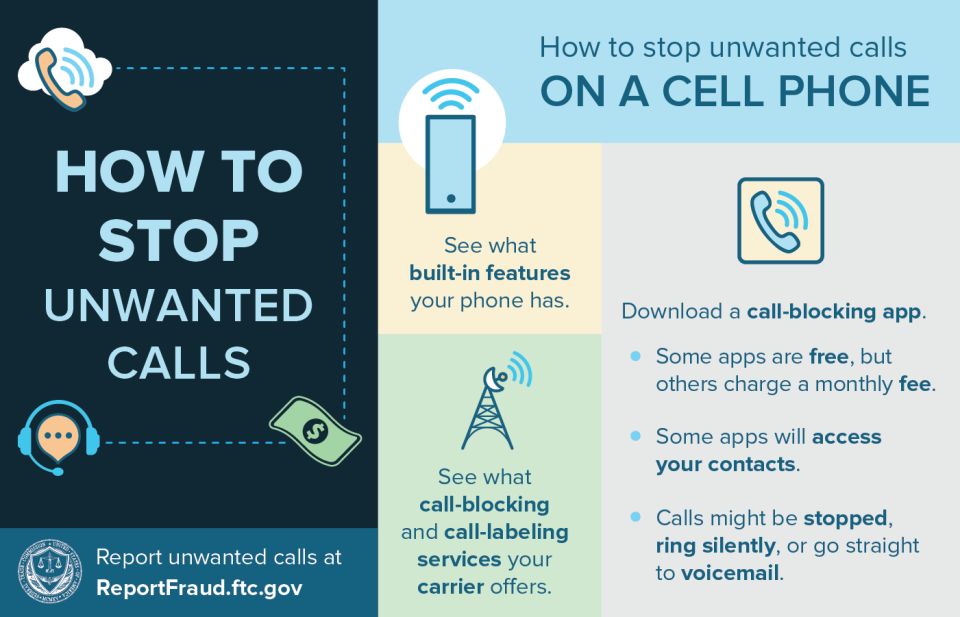
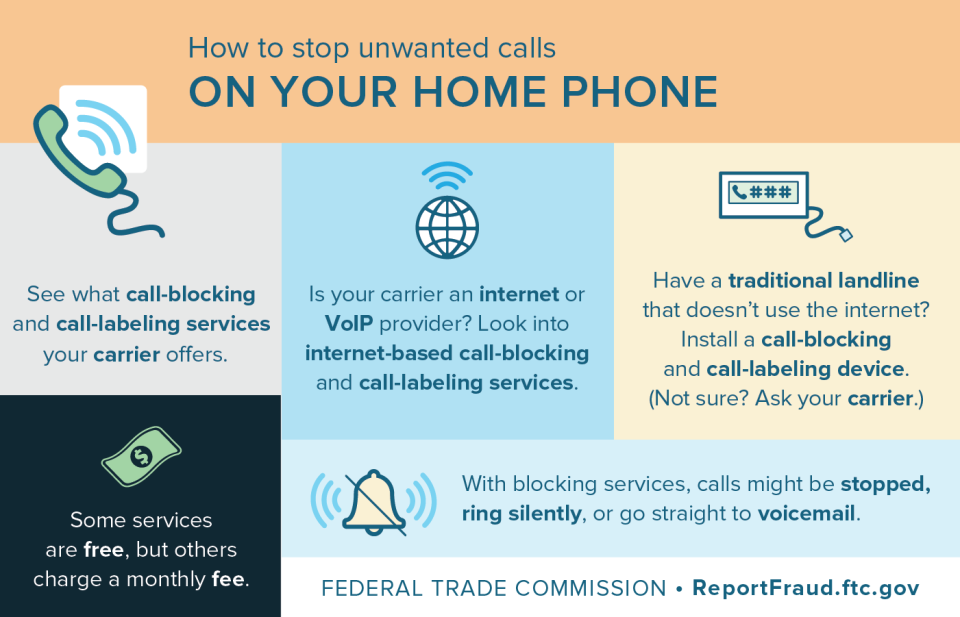
- Talk to your phone company about call-blocking tools they may have and check into apps that you can download to your mobile device to block unwanted calls.
- If you use robocall-blocking technology already, it often helps to let that company know which numbers are producing unwanted calls so they can help block those calls for you and others.
- To block telemarketing calls, register your number on the Do Not Call List. Legitimate telemarketers consult the list to avoid calling both landline and wireless phone numbers on the list.
Robocall Frequently Asked Questions
FAQS ABOUT ROBOCALLS
Robocalls are calls made with an autodialer or that contain a message made with a prerecorded or artificial voice.
Advances in technology have unfortunately allowed illegal and spoofed robocalls to be made from anywhere in the world and more cheaply and easily than ever before. That’s why it’s become more of a problem for consumers and a more difficult problem to solve.
Keep in mind that many robocalls are legal. While we have taken several actions, and continue to work on reducing illegal robocalls, it is a difficult problem that requires complex solutions. The most complex part is identifying the illegal calls in real-time to be able to block them without blocking lawful calls.
WHAT ARE THE RULES FOR ROBOCALLS?
FCC rules require a caller to obtain your written consent – on paper or through electronic means, including website forms, a telephone keypress – before it may make a prerecorded telemarketing call to your home or wireless phone number. FCC rules also require a caller to obtain your consent, oral or written, before it may make an autodialed or prerecorded call or text to your wireless number. There are exceptions to these rules, such as for emergencies involving danger to life or safety.
WHAT ARE THE RULES FOR TELEMARKETERS CALLING A WIRELINE HOME PHONE?
Callers must have your prior express written consent before making telemarketing calls using a prerecorded or artificial voice. Telephone solicitation calls to your home are prohibited before 8 am or after 9 pm.
Telemarketers are no longer able to make telemarketing robocalls to your wireline home telephone based solely on an “established business relationship” that you may have established when purchasing something from a business or contacting the business to ask questions.
ARE ROBOCALLS TO WIRELESS PHONES PROHIBITED?
A consumer’s written or oral consent is required for autodialed, prerecorded, or artificial voice calls or texts made to your wireless number, with a few exceptions such as emergency calls regarding danger to life or safety. Consent must be in writing for telemarketing robocalls. Telemarketers have never been permitted to make robocalls to your wireless phone based solely on an “established business relationship” with you.
WHAT TYPES OF AUTODIALED CALLS ARE PERMITTED UNDER THE FCC RULES?
Not all robocalls are illegal. There are several factors to consider: the technology used to make the call, whether the call is to a landline or a mobile number, whether the content of the call is telemarketing, and whether the called number is on the National Do Not Call Registry.
Market research or polling calls to home wireline numbers are not restricted by FCC rules, nor are calls on behalf of tax-exempt non-profit groups. Informational messages such as school closings or flight information to your home phone are permissible without prior consent. The rules do require all prerecorded calls, including market research or polling calls, to identify the caller at the beginning of the message and include a contact phone number. Autodialed or prerecorded calls to wireless phones are prohibited without prior express consent, regardless of the call’s content, with a few exceptions such as emergency calls regarding danger to life or safety.
WHAT ARE THE RULES ABOUT ROBOCALLS RELEASING TELEPHONE LINES?
Autodialers that deliver a prerecorded message must release the called party’s telephone line within five seconds of the time that the calling system receives notification that the called party’s line has hung up. In some areas, you could experience a delay before you can get a dial tone again. Your local telephone company can tell you if there is a delay in your area.
Are any organizations or individuals exempt from the Do Not Call rules?
Yes. The Do Not Call rules only apply to telemarketing calls. So, the following types of calls are ones that don’t have to comply with do-not-call requests: tax-exempt, non-profit organizations; political organizations; pollsters and survey takers, not making sales calls; religious organizations; and telemarketers to whom you have given prior written consent to call you.
CAN I OPT OUT OF AUTODIALED CALLS?
FCC rules require telemarketers to allow you to opt out of receiving additional telemarketing robocalls immediately during a prerecorded telemarketing call through an automated menu. The opt-out mechanism must be announced at the outset of the message and must be available throughout the duration of the call.
WHERE SHOULD I FILE MY UNWANTED CALL COMPLAINT?
Consumers can file complaints with the FCC by going to fcc.gov/complaints. You should choose the phone form and the unwanted calls issue for all complaints involving unwanted calls, including if your number is being spoofed, blocked, or labeled.
If you have a complaint about telephone fraud or telemarketers who have disregarded the Do Not Call list, we also encourage you to file a complaint with the FTC – visit reporting.AgainstScams.org.
If the unwanted call is an IRS scam, we also encourage you to file your complaint with the Treasury Inspector General for Tax Administration (TIGTA) at www.tigta.gov or call 1-800-366-4484.
What does the FCC do with consumer complaints?
We do not resolve individual unwanted call complaints but such complaints provide valuable information that the FCC uses to inform policy decisions and as the basis of potential enforcement actions against callers violating our rules under the Telephone Consumer Protection Act (for most robocalls) or Truth in Caller ID Act. We may share your complaint with other agencies, such as the FTC, if we have shared jurisdiction over the alleged violation.
Spoofing & Robocalls
SPOOFING AND CALLER ID
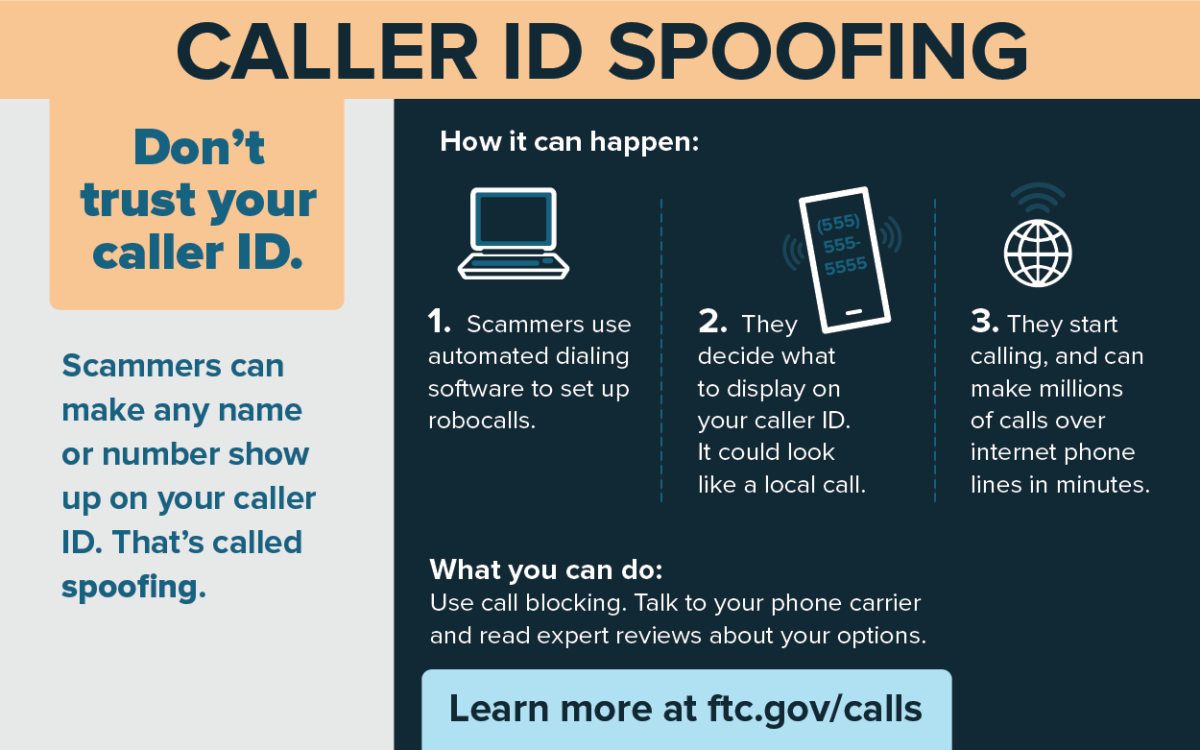
Caller ID spoofing is when a caller deliberately falsifies the information transmitted to your caller ID display to disguise their identity. Spoofing is often used as part of an attempt to trick someone into giving away valuable personal information so it can be used in fraudulent activity or sold illegally, but also can be used legitimately, for example, to display the toll-free number for a business.
WHAT IS NEIGHBOR SPOOFING?
Robocallers use neighbor spoofing, which displays a phone number similar to your own on your caller ID, to increase the likelihood that you will answer the call. To help combat neighbor spoofing, the FCC is requiring the phone industry to adopt a robust caller ID authentication system.
WHEN IS SPOOFING ILLEGAL?
Under the Truth in Caller ID Act, FCC rules prohibit anyone from transmitting misleading or inaccurate caller ID information with the intent to defraud, cause harm or wrongly obtain anything of value. Anyone who is illegally spoofing can face penalties of up to $10,000 for each violation. However, spoofing is not always illegal. There are legitimate, legal uses for spoofing, like when a doctor calls a patient from her personal mobile phone and displays the office number rather than the personal phone number or a business displays its toll-free call-back number.
WHAT CAN YOU DO IF YOUR NUMBER IS BEING SPOOFED?
If you get calls from people saying your number is showing up on their caller ID, it’s likely that your number has been spoofed. We suggest first that you do not answer any calls from unknown numbers, but if you do, explain that your telephone number is being spoofed and that you did not actually make any calls. You can also place a message on your voicemail letting callers know that your number is being spoofed. Usually, scammers switch numbers frequently. It is likely that within hours they will no longer be using your number.
WHAT IS BLOCKING OR LABELING?
If a telephone number is blocked or labeled as a “potential scam” on your caller ID, it is possible the number has been spoofed. Several phone companies and app developers offer call-blocking and labeling services that detect whether a call is likely to be fraudulent based on call patterns, consumer complaints or other means.
FCC rules do not prohibit call blocking or labeling technologies, however, the FCC is very concerned about ensuring that lawful calls are completed and has encouraged providers who block calls to establish a means for a caller whose number is blocked to contact the provider and remedy the problem.
You can legally block the transmission of your phone number when you make calls, so your number will appear as “unknown.” Doing so is not spoofing.
WHAT ARE THE CALLER ID RULES FOR TELEMARKETERS?
FCC rules specifically require that a telemarketer:
- Transmit or display its telephone number or the telephone number on whose behalf the call is being made, and, if possible, its name or the name of the company for which it is selling products or services.
- Display a telephone number you can call during regular business hours to ask to no longer be called. This rule applies even to companies that already have an established business relationship with you.
Combating Spoofed Robocalls with Caller ID Authentication
HOW WILL CALLER ID AUTHENTICATION HELP CONSUMERS?
Caller ID authentication technology enables subscribers to trust that callers are who they say they are, reducing the effectiveness of fraudulently spoofed calls. This technology is critical to protecting Americans from scams using spoofed robocalls because it erodes the ability of callers to illegally spoof a caller ID, which scammers use to trick Americans into answering their phones when they shouldn’t. Caller ID authentication technology also allows consumers and law enforcement alike to more readily identify the source of illegal robocalls and reduce their frequency and impact.
The STIR/SHAKEN framework, an industry-standard caller ID authentication technology, is a set of technical standards and protocols that allow for the authentication and verification of caller ID information for calls carried over Internet Protocol (IP) networks. As implementation continues to progress, it will give Americans more confidence that the caller ID information they receive is accurate and will allow voice service providers to provide helpful information to their consumers about which calls to answer.
WHAT DOES STIR/SHAKEN MEAN?
STIR/SHAKEN is a framework of interconnected standards. STIR/SHAKEN are acronyms for the Secure Telephone Identity Revisited (STIR) and Signature-based Handling of Asserted Information Using toKENs (SHAKEN) standards. This means that calls traveling through interconnected phone networks can have their caller ID “signed” as legitimate by originating carriers and validated by other carriers before reaching consumers. STIR/SHAKEN digitally validates the handoff of phone calls passing through the complex web of networks, allowing the phone company of the consumer receiving the call to verify that a call is in fact from the number displayed on Caller ID.
Unwanted RoboTexts
FCC rules also ban text messages sent to a mobile phone using an autodialer unless you previously gave consent to receive the message or the message is sent for emergency purposes.
- For commercial texts, your consent must be in writing.
- For non-commercial, informational texts (such as those sent by or on behalf of tax-exempt non-profit organizations, those for political purposes, and other noncommercial purposes, such as school closings), your consent may be oral.
The ban applies even if you have not placed your mobile phone number on the national Do-Not-Call list.
TIPS FOR AVOIDING UNWANTED TEXTS
- Do not respond to unwanted texts from questionable sources. Several mobile service providers allow you to block the sender by forwarding unwanted texts to 7726 (or “SPAM”). Check with your provider about options.
- Be careful about giving out your mobile phone number or any other personal information.
- Read through commercial web forms and check for a privacy policy when submitting your mobile phone number to any customer website. You should be able to opt out of receiving texts – but you may have to check or uncheck a preselected box to do so.
- Find out if any company you do business with has a policy that allows it to sell or share your information.
TAKE ACTION AGAINST ROBOTEXTS
File a complaint with the FCC if you receive:
- An unwanted commercial text message is sent to your mobile phone.
- An autodialed text message is sent to your mobile phone if you didn’t consent to the message previously (or it doesn’t involve an emergency).
- Any autodialed text message from a telecommunications company or advertising a telecommunications company’s products or services, if sent without your prior consent.
Remember:
Your first resource to help combat these unwanted calls and texts is YOUR phone company!
Call their customer service number to get help and services that can help! They have tools and services that can help you identify and block these calls. Don’t wait, do it today!
Resources:
- National Do Not Call Registry
- Call Blocking Tools and Resources | Federal Communications Commission (fcc.gov)
- Filing an FCC at consumercomplaints.fcc.gov
- Filing a complaint with the FTC – see reporting.AgainstScams.org
- Report IRS Phone Scams Home | U.S. Treasury Inspector General for Tax Administration OIG (tigta.gov)
More:
-/ 30 /-
What do you think about this?
Please share your thoughts in a comment below!
Table of Contents
- Avoid Automated Robocall Phone Scams & Fraud
- Silencing the Machines: Putting an End to Robocall Scams & Fraud
- Fake Or Fraudulent Robocall Products And Services
- Robocall Dangers
- Unwanted Robocalls
- Robocall Tips
- Robocall Frequently Asked Questions
- Are any organizations or individuals exempt from the Do Not Call rules?
- Spoofing & Robocalls
- Combating Spoofed Robocalls with Caller ID Authentication
- Unwanted RoboTexts
- Remember:
- Resources:
- More:

Rapid Report Scammers

In the U.S. & Canada
U.S. & Canada Suicide Lifeline 988
LEAVE A COMMENT?
Recent Comments
On Other Articles
- Debby Montgomery Johnson on The Danger of Using AI in Law Enforcement – The Grandmother Wrongly Arrested as a Fraudster – 2026: “Excellent article – I can’t imagine the terror Angela most certainly experienced. Compound this with the lack of accountability by…” Mar 24, 09:20
- on The Crazy Gregor MacGregor and the Country of Poyais Scam – History of Scams – 2026: “interesting” Mar 23, 19:24
- on BEC Fraud Reaches $43 Billion Per Year: “oh my gosh so much of an increase in the fraud I pray the officials can continue tracking and make…” Mar 23, 15:09
- on Establishing The United States Task Force To Eliminate Fraud – 2026: “Make Online Safe Again!” Mar 17, 19:11
- on Establishing The United States Task Force To Eliminate Fraud – 2026: “Finally an administration takes the initiative to help solve the gigantic situation. Make America Safe Again, thank you!” Mar 17, 15:41
- on What Is The Difference Between A Scam Victim And A Scam Survivor? [Updated]: “Due to my scams I don’t fully trust anyone online and I shouldn’t even those people I knew in high…” Mar 7, 12:46
- on SCARS 3 Steps For New Scam Victims 2024: “I was very fearful “he” would come to my home because I was knew my address, I spoke to someone…” Mar 7, 09:50
- on Sadness & Scam Recovery: “Before my scam, my mom passed away and I got a divorce, so I was dealing with the loss of…” Mar 7, 09:37
- on The Story Of Kira Lee Orsag (aka Dani Daniels) [Updated]: “There is NO evidence and she is not, she is a victim too. Sebastian, stop letting your anger think for…” Mar 6, 23:18
- on The Story Of Kira Lee Orsag (aka Dani Daniels) [Updated]: “There is real evidence that behind these two people there is something that not many people know. This woman is…” Mar 4, 03:58
ARTICLE META
Important Information for New Scam Victims
- Please visit www.ScamVictimsSupport.org – a SCARS Website for New Scam Victims & Sextortion Victims
- Enroll in FREE SCARS Scam Survivor’s School now at www.SCARSeducation.org
- Please visit www.ScamPsychology.org – to more fully understand the psychological concepts involved in scams and scam victim recovery
If you are looking for local trauma counselors please visit counseling.AgainstScams.org or join SCARS for our counseling/therapy benefit: membership.AgainstScams.org
If you need to speak with someone now, you can dial 988 or find phone numbers for crisis hotlines all around the world here: www.opencounseling.com/suicide-hotlines
A Note About Labeling!
We often use the term ‘scam victim’ in our articles, but this is a convenience to help those searching for information in search engines like Google. It is just a convenience and has no deeper meaning. If you have come through such an experience, YOU are a Survivor! It was not your fault. You are not alone! Axios!
A Question of Trust
At the SCARS Institute, we invite you to do your own research on the topics we speak about and publish, Our team investigates the subject being discussed, especially when it comes to understanding the scam victims-survivors experience. You can do Google searches but in many cases, you will have to wade through scientific papers and studies. However, remember that biases and perspectives matter and influence the outcome. Regardless, we encourage you to explore these topics as thoroughly as you can for your own awareness.
Statement About Victim Blaming
SCARS Institute articles examine different aspects of the scam victim experience, as well as those who may have been secondary victims. This work focuses on understanding victimization through the science of victimology, including common psychological and behavioral responses. The purpose is to help victims and survivors understand why these crimes occurred, reduce shame and self-blame, strengthen recovery programs and victim opportunities, and lower the risk of future victimization.
At times, these discussions may sound uncomfortable, overwhelming, or may be mistaken for blame. They are not. Scam victims are never blamed. Our goal is to explain the mechanisms of deception and the human responses that scammers exploit, and the processes that occur after the scam ends, so victims can better understand what happened to them and why it felt convincing at the time, and what the path looks like going forward.
Articles that address the psychology, neurology, physiology, and other characteristics of scams and the victim experience recognize that all people share cognitive and emotional traits that can be manipulated under the right conditions. These characteristics are not flaws. They are normal human functions that criminals deliberately exploit. Victims typically have little awareness of these mechanisms while a scam is unfolding and a very limited ability to control them. Awareness often comes only after the harm has occurred.
By explaining these processes, these articles help victims make sense of their experiences, understand common post-scam reactions, and identify ways to protect themselves moving forward. This knowledge supports recovery by replacing confusion and self-blame with clarity, context, and self-compassion.
Additional educational material on these topics is available at ScamPsychology.org – ScamsNOW.com and other SCARS Institute websites.
Psychology Disclaimer:
All articles about psychology and the human brain on this website are for information & education only
The information provided in this article is intended for educational and self-help purposes only and should not be construed as a substitute for professional therapy or counseling.
While any self-help techniques outlined herein may be beneficial for scam victims seeking to recover from their experience and move towards recovery, it is important to consult with a qualified mental health professional before initiating any course of action. Each individual’s experience and needs are unique, and what works for one person may not be suitable for another.
Additionally, any approach may not be appropriate for individuals with certain pre-existing mental health conditions or trauma histories. It is advisable to seek guidance from a licensed therapist or counselor who can provide personalized support, guidance, and treatment tailored to your specific needs.
If you are experiencing significant distress or emotional difficulties related to a scam or other traumatic event, please consult your doctor or mental health provider for appropriate care and support.
Also read our SCARS Institute Statement about Professional Care for Scam Victims – click here to go to our ScamsNOW.com website.


Thank you for your comment. You may receive an email to follow up. We never share your data with marketers.