



SCARS Institute’s Encyclopedia of Scams™ Published Continuously for 25 Years
Author:
• Tim McGuinness, Ph.D., DFin, MCPO, MAnth – Anthropologist, Scientist, Director of the Society of Citizens Against Relationship Scams Inc.
Article Abstract
The urban legend that intelligence shields individuals from scams and fraud is debunked as a dangerous misconception. Despite the belief that intelligence provides immunity, smart individuals are often more susceptible due to overconfidence and lack of awareness.
Cognitive biases like the overconfidence bias and the rational actor fallacy contribute to this vulnerability, along with the Dunning-Kruger effect, where limited knowledge leads to overestimation of abilities.
Social media platforms further exacerbate the problem by providing fertile ground for sophisticated scams. Combatting this myth requires promoting awareness, education, and critical thinking skills through financial literacy programs, cybersecurity workshops, and scam awareness campaigns. Empowering individuals to develop skepticism, verify information, and seek advice from trusted sources can mitigate the risk of falling victim to scams, fostering a safer digital landscape for all.

The Urban Legend Myth of The Intelligence Trap: Why Smart People Fall for Scams
Where information is readily available at our fingertips, many people believe that intelligence provides immunity against scams and fraud.
However, the reality is far more complex. While intelligence can certainly be an asset in various aspects of life, it does not inherently shield individuals from falling victim to deceptive schemes. In fact, the perception of being too smart to be scammed often leaves individuals more susceptible to exploitation because they are relying on cognitive biases instead of sound risk-avoidance behaviors.
Cognitive Biases
One of the primary reasons behind this phenomenon is the overconfidence bias and the optimism bias. Highly intelligent individuals may possess a heightened sense of self-assurance in their ability to detect and navigate through deceptive tactics. This overestimation of one’s cognitive abilities can lead to complacency, making individuals less vigilant and more susceptible to manipulation.
Moreover, smart individuals may exhibit a tendency to overlook emotional cues and rely solely on rationality when assessing risk. This cognitive bias, known as the rational actor fallacy, assumes that people always act in their best interests based on logical reasoning. However, scammers are adept at exploiting emotional vulnerabilities, such as fear, greed, or urgency, to override rational decision-making processes.
Furthermore, intelligence does not necessarily correlate with financial literacy or awareness of common scam tactics. Even highly educated individuals may lack knowledge about emerging cybersecurity threats or financial scams, making them easy targets for exploitation.
Another factor contributing to the vulnerability of smart individuals is the Dunning-Kruger effect, where people with limited knowledge or expertise overestimate their abilities. In the context of scams, individuals may believe they possess sufficient knowledge to identify and avoid fraudulent schemes, when in reality, they lack the necessary expertise to discern genuine offers from deceptive ones.
Social Media
Moreover, the fast-paced nature of digital communication and the prevalence of social media platforms have created fertile ground for sophisticated scams to proliferate. Smart individuals may fall prey to phishing emails, fake investment opportunities, or online romance scams due to a combination of trust in technology, lack of skepticism, and the allure of quick gains.
Avoidance
To combat the urban legend myth of immunity to scams among smart individuals, it is essential to promote awareness, education, and critical thinking skills. Financial literacy programs, cybersecurity workshops, and scam awareness campaigns can help equip people with the knowledge and tools necessary to identify and avoid fraudulent schemes.
Developing skepticism and encouraging yourself and other individuals to verify information, conduct due diligence, and seek advice from trusted sources can mitigate the risk of falling victim to scams.
Plus, sharing this information and promoting open dialogue about personal experiences with scams can destigmatize victimization and empower others to recognize and report suspicious activities.
Summary
The belief that intelligence provides immunity against scams and fraud is a dangerous misconception.
Smart individuals are not immune to manipulation and deception; in fact, their overconfidence and lack of awareness can make them even more vulnerable. By promoting awareness, education, and critical thinking skills, we can empower individuals of all intelligence levels to protect themselves from falling victim to scams and fraud in an increasingly complex digital landscape.
More About Urban Legends & Myths:
- SCARS PEARL BOOK – The SCARS Online Safety Password Log Book – SCARS Company Store (againstscams.org)
- Cognitive Biases Catalog 2024 (romancescamsnow.com)
- Optimism Bias – Everything Will Be Fine (romancescamsnow.com)
- Never Again And Other Urban Legends (romancescamsnow.com)
- Urban Legends: JuJu/Voodoo – Hypnosis – Brainwashing (romancescamsnow.com)
- Scam Urban Legends: Anti-Scam Groups Are All Good? No! (romancescamsnow.com)
- Urban Legends – Topic Page (romancescamsnow.com)
- Urban Legends: The Lone Scammer [UPDATED] (romancescamsnow.com)
- URBAN LEGENDS: Why Scammers Ask For Photos? (romancescamsnow.com)
- Online Safety: Identifying Hoaxes and Urban Legends (romancescamsnow.com)
- Urban Legends: Do Something Useful With Their Lives! (romancescamsnow.com)
- Urban Legends – Chapter 2 – Scammers Are Stupid? (romancescamsnow.com)
- Urban Legends – Chapter 4 – Obsessive Scammer Exposing – Updated (romancescamsnow.com)
-/ 30 /-
What do you think about this?
Please share your thoughts in a comment below!
Table of Contents
To Understand All Scams
Read This
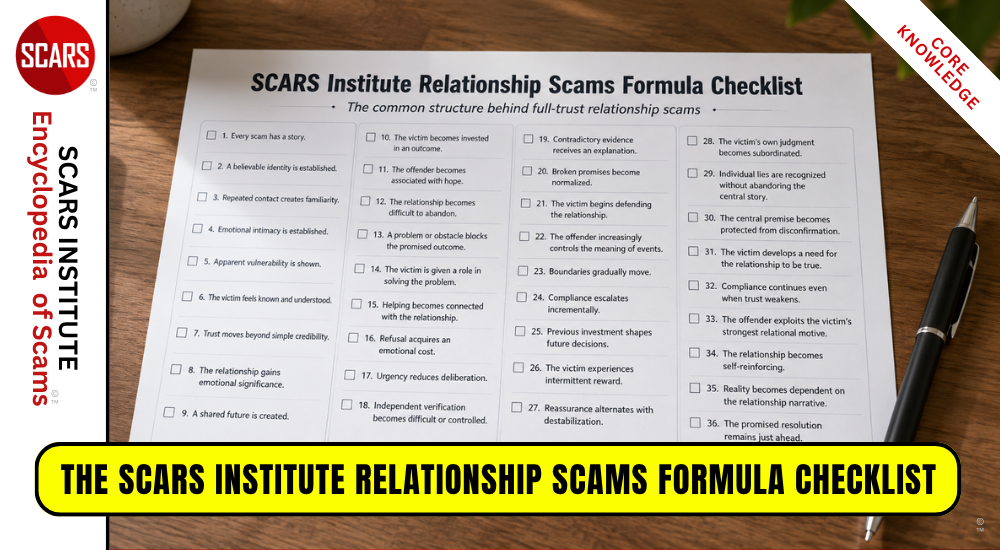
The SCARS Institute Relationship Scams Formula Checklist
This is the Formula that all Relationship Scams Follow




In the U.S. & Canada
U.S. & Canada Suicide Lifeline 988

Recent Comments
On Other Articles
- on SCARS Institute – Romance Scam Simulator: “Fantastic! I have to go to bed, but I’ll do some more tomorrow. I picked an easy scenario tonight, but…” Oct 9, 18:01
- on United States – Federal Bureau of Investigations [FBI]: “It is only that way because of the shame you feel. The reality is that it was not your fault.…” Sep 30, 15:36
- on United States – Federal Bureau of Investigations [FBI]: “yhisis humiliating experience e and isembarassassing to to own up to peolealreadyassume u are not to bright because Arnold and…” Sep 30, 12:28
- on United States – Federal Bureau of Investigations [FBI]: “should be better known by public live in assisiwdlivi g apartment many manyinstancresof Romance scams here ano.us ederly l” Sep 30, 12:24
- on Is It A Scam? Phone Scam Diagnostic – v1: “I tried the this test Is it a phone scam? Mine was. I think this is a helpful tool to…” Sep 30, 10:34
- on Is It A Scam? Romance Scam Diagnostic – v2: “Carole, as you move forward with your recovery, you will learn how this all works. It was not your fault.…” Sep 29, 17:37
- on Is It A Scam? Romance Scam Diagnostic – v2: “I was blinded by such clever manipulation” Sep 29, 15:15
- on The SCARS Institute Relationship Scams Formula Checklist – 2026: “As I read this I could see myself in every step with my scam. I gained a lot more knowledge…” Aug 28, 19:51
- on The Persistence of Danielle Delaunay as a Fake Identity – 2026: “Unfortunately, you are being scammed. She is using a fake name regardless. At this point, your best option is to…” Aug 26, 20:16
- on The Persistence of Danielle Delaunay as a Fake Identity – 2026: “Dear Sirs, I have met this woman with the name Abigail Boateng in Ghana. I have an intensive mail contact…” Aug 26, 12:28

Overconfidence definitely played a part in my manipulation. In my case I learned everything I could about the crypto trading platform used. However none of it mattered since I had been directed to a fake version of the site being used. My money was gone for good shortly after sending it and everything after that was just fake crypto trading until my account eventually was frozen after attempting a withdrawal.
Wielu ludzi jest podatnych na bycie oszukanym od po inteligentnego do prostego człowieka zagrożenie istnieje wszędzie
Correct, everyone can be scammed, and everyone will be scammed.