


SCARS Institute’s Encyclopedia of Scams™ Published Continuously for 25 Years
Author:
• Tim McGuinness, Ph.D., DFin, MCPO, MAnth – Anthropologist, Scientist, Director of the Society of Citizens Against Relationship Scams Inc.
Article Abstract
The urban legend that individuals are too small to be hacked or scammed persists due to various misconceptions and cognitive biases.
People often underestimate the prevalence and sophistication of cyber threats, assuming they are immune to such attacks. This false sense of security stems from optimism bias, lack of awareness, and trust in online platforms’ security measures.
Additionally, individuals may minimize the risk of being targeted, believing they have nothing of significant value or are not engaged in high-risk online behavior.
However, cybercriminals exploit vulnerabilities indiscriminately, utilizing automated tools to target as many individuals as possible. As a result, everyone is susceptible to cyber threats, regardless of their perceived size or importance. Recognizing the realities of cybersecurity and adopting proactive measures is crucial for protecting oneself from falling victim to online scams and hacks.

The Urban Legend Myth of Being Unworthy of Cybercrime: Why You’re a Target Regardless of Size
In the world of cybercrime, there’s a prevailing urban legend or myth that individuals or small entities are immune to being targeted.
The urban legend continuously circulates that unless you’re a high-profile organization or possess significant wealth, hackers, scammers, or cybercriminals won’t bother with you, but this is really just denial. This urban legend or assumption couldn’t be further from the truth. In today’s interconnected world, everyone holds something valuable to cybercriminals: their personal information.
Just consider this: your Social Security number, credit card details, and other private data are like gold nuggets in the digital realm. Even if you perceive yourself as “small potatoes,” your data remains a lucrative target. Cybercriminals aren’t discriminating based on size; they’re after any information they can exploit for financial gain.
Data breaches are rampant, affecting organizations of all sizes. Your information may be stored or used on various platforms, from government websites to online shopping portals. Despite feeling secure, these platforms are not immune to breaches. Once your data is compromised, it becomes a commodity in the underground market, where it’s bought, sold, and traded among cybercriminals.
Moreover, automation has revolutionized cybercrime. Automated tools scour the internet, hunting for vulnerabilities and valuable data across countless targets simultaneously. This means that even if you perceive yourself as insignificant, automated processes can still expose your sensitive information to malicious actors.
Why Do People Believe This?
The urban legend belief that one is too small to be hacked or scammed stems from several misconceptions and cognitive biases that individuals commonly hold:
- Optimism Bias: Many people possess an inherent optimism bias, which leads them to believe that negative events are less likely to happen to them personally. This bias can lead individuals to underestimate the risks associated with cyber threats, assuming that they are immune to such attacks.
- Lack of Awareness: Some individuals may simply be unaware of the prevalence and sophistication of cyber threats in today’s digital landscape. Without a clear understanding of the risks, they may naively assume that cybercriminals only target high-profile organizations or wealthy individuals.
- False Sense of Security: Individuals often place their trust in the security measures implemented by online platforms and service providers. They may believe that as long as they use reputable websites or have antivirus software installed, they are safe from cyber threats. This false sense of security can lead to complacency and a disregard for basic cybersecurity practices.
- Minimization of Risk: When faced with complex and abstract threats like cybercrime, individuals may downplay the likelihood of being targeted. They may rationalize that because they have nothing of significant value or are not engaged in high-risk behavior online, they are unlikely to be targeted by cybercriminals.
- Attribution Bias: In cases where individuals do fall victim to cybercrime, there may be a tendency to attribute blame to external factors rather than acknowledging personal vulnerabilities. This can perpetuate the belief that cyber threats only happen to others and not to oneself.
The belief that one is too small to be hacked or scammed is a combination of cognitive biases, lack of awareness, and misplaced trust in technology. However, as cyber threats continue to evolve and proliferate, individuals need to recognize the importance of cybersecurity and take proactive measures to protect themselves online.
Protect Yourself
What can you do to protect yourself in this digital age?
Firstly, prioritize password security. Using unique passwords for each online account is crucial. While it may seem daunting to remember multiple passwords, employing a password manager can simplify this task and enhance your overall security. You can also get a password logbook here.
Additionally, consider investing in identity theft protection and breach-monitoring services. These services offer proactive measures to safeguard your personal information and notify you of any breaches or compromises promptly.
Ultimately, the urban legend or myth of being unworthy of cybercrime, scammers or hackers, is just that—a myth. In today’s digital landscape, everyone is a potential target, regardless of size or stature. By recognizing the value of your personal information and taking proactive steps to protect it, you can mitigate the risk of falling victim to cybercrime in an ever-evolving threat landscape.
More About Urban Legends & Myths:
- SCARS PEARL BOOK – The SCARS Online Safety Password Log Book – SCARS Company Store (againstscams.org)
- Cognitive Biases Catalog 2024 (romancescamsnow.com)
- Optimism Bias – Everything Will Be Fine (romancescamsnow.com)
- Never Again And Other Urban Legends (romancescamsnow.com)
- Urban Legends: JuJu/Voodoo – Hypnosis – Brainwashing (romancescamsnow.com)
- Scam Urban Legends: Anti-Scam Groups Are All Good? No! (romancescamsnow.com)
- Urban Legends – Topic Page (romancescamsnow.com)
- Urban Legends: The Lone Scammer [UPDATED] (romancescamsnow.com)
- URBAN LEGENDS: Why Scammers Ask For Photos? (romancescamsnow.com)
- Online Safety: Identifying Hoaxes and Urban Legends (romancescamsnow.com)
- Urban Legends: Do Something Useful With Their Lives! (romancescamsnow.com)
- Urban Legends – Chapter 2 – Scammers Are Stupid? (romancescamsnow.com)
- Urban Legends – Chapter 4 – Obsessive Scammer Exposing – Updated (romancescamsnow.com)
-/ 30 /-
What do you think about this?
Please share your thoughts in a comment below!
Table of Contents
To Understand All Scams
Read This
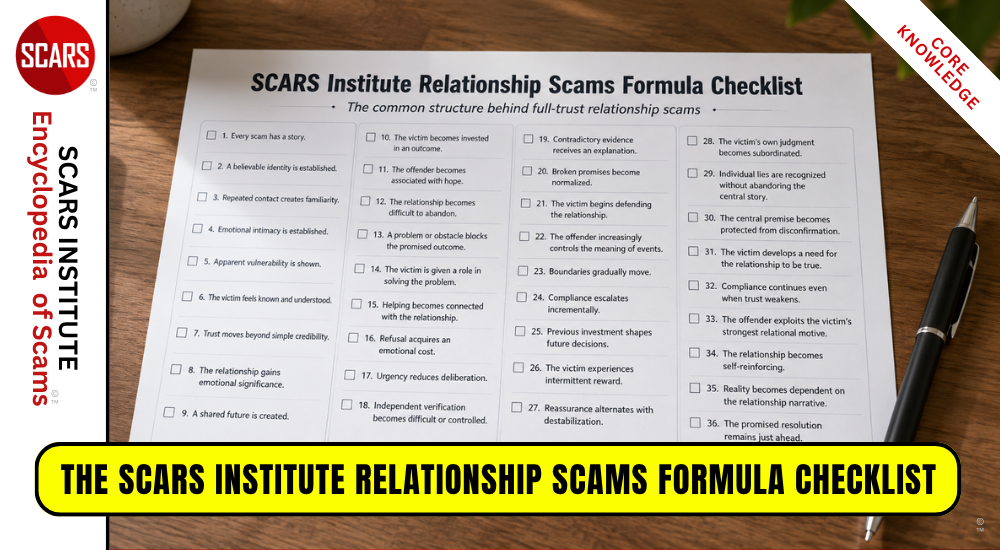
The SCARS Institute Relationship Scams Formula Checklist
This is the Formula that all Relationship Scams Follow


In the U.S. & Canada
U.S. & Canada Suicide Lifeline 988

Recent Comments
On Other Articles
- on SCARS Institute – Romance Scam Simulator: “Fantastic! I have to go to bed, but I’ll do some more tomorrow. I picked an easy scenario tonight, but…” Oct 9, 18:01
- on United States – Federal Bureau of Investigations [FBI]: “It is only that way because of the shame you feel. The reality is that it was not your fault.…” Sep 30, 15:36
- on United States – Federal Bureau of Investigations [FBI]: “yhisis humiliating experience e and isembarassassing to to own up to peolealreadyassume u are not to bright because Arnold and…” Sep 30, 12:28
- on United States – Federal Bureau of Investigations [FBI]: “should be better known by public live in assisiwdlivi g apartment many manyinstancresof Romance scams here ano.us ederly l” Sep 30, 12:24
- on Is It A Scam? Phone Scam Diagnostic – v1: “I tried the this test Is it a phone scam? Mine was. I think this is a helpful tool to…” Sep 30, 10:34
- on Is It A Scam? Romance Scam Diagnostic – v2: “Carole, as you move forward with your recovery, you will learn how this all works. It was not your fault.…” Sep 29, 17:37
- on Is It A Scam? Romance Scam Diagnostic – v2: “I was blinded by such clever manipulation” Sep 29, 15:15
- on The SCARS Institute Relationship Scams Formula Checklist – 2026: “As I read this I could see myself in every step with my scam. I gained a lot more knowledge…” Aug 28, 19:51
- on The Persistence of Danielle Delaunay as a Fake Identity – 2026: “Unfortunately, you are being scammed. She is using a fake name regardless. At this point, your best option is to…” Aug 26, 20:16
- on The Persistence of Danielle Delaunay as a Fake Identity – 2026: “Dear Sirs, I have met this woman with the name Abigail Boateng in Ghana. I have an intensive mail contact…” Aug 26, 12:28

Looking back, I am now aware of how much information I actually shared. My scammers had plenty to work with.