



SCARS Institute’s Encyclopedia of Scams™ Published Continuously for 25 Years

Scams & Magic – The Misdirection: A Key Element
Part 4
Understanding the Methods Used by Both Scammers and Magicians to Deceive
Psychology of Scams – A SCARS Insight
Author:
• Tim McGuinness, Ph.D., DFin, MCPO, MAnth – Anthropologist, Scientist, Director of the Society of Citizens Against Relationship Scams Inc.
Article Abstract
Misdirection is a key technique in both magic and scams, designed to divert attention away from critical elements of the trick or deception. In magic, it allows the magician to perform secret actions unnoticed, creating the illusion of magic. Similarly, in scams, misdirection keeps victims focused on specific details, emotions, or future promises, preventing them from noticing red flags or inconsistencies.
Techniques such as future promises, personal emergencies, and emotional manipulation are used to create cognitive overload, distract from reality, and establish a false sense of security. Understanding these tactics can help potential victims recognize manipulation and protect themselves from scams, much like how knowing about misdirection can demystify magic tricks.

The Misdirection: A Key Element in Magic and Scams
Misdirection is a fundamental technique in both magic and scams, designed to divert attention away from the critical elements of the trick or deception. In magic, misdirection allows the magician to perform sleight of hand or set up the illusion without the audience noticing. In scams, it distracts victims from the scammer’s true intentions, often leading them to overlook red flags or inconsistencies. Let’s explore how misdirection functions in both contexts and its psychological impact on the victims.
Misdirection in Magic
In the world of magic, misdirection is a carefully crafted technique that involves diverting the audience’s attention away from the secret actions that make the illusion possible. Magicians use various methods to achieve misdirection, such as dramatic gestures, engaging patter, or focusing the audience’s gaze on a particular object or area. For example, a magician might make a grand sweeping gesture with one hand while performing a secret move with the other, hidden from the audience’s view.
Misdirection relies on the human brain’s limited capacity for attention and the tendency to focus on what seems most important or interesting. By controlling what the audience pays attention to, magicians can execute complex maneuvers without detection. This manipulation of attention is not only about what the audience sees but also what they remember, as misdirection can create false memories or emphasize certain aspects of the performance while downplaying others.
Misdirection in Scams
In scams, misdirection plays a similar role, albeit with more malicious intent. Scammers use misdirection to keep victims focused on specific details that seem important, while the real deception happens unnoticed. This can involve creating elaborate stories, presenting false evidence, or emphasizing certain emotions to distract from the scam’s true nature.
Future Plans and Promises: One common form of misdirection in relationship scams is the focus on future plans. Scammers often talk about plans to meet in person, get married, or start a life together. These promises keep the victim’s attention on the future, making them less likely to question the present inconsistencies or demands for money. The anticipation and excitement generated by these future promises can overshadow the immediate concerns or red flags, such as requests for financial assistance or evasive answers.
Personal Emergencies: Another classic misdirection tactic is the creation of a personal emergency, such as a sudden illness, accident, or financial crisis. This emergency diverts the victim’s attention to the scammer’s supposed plight, eliciting sympathy and urgency. The victim becomes focused on helping the scammer, often overlooking inconsistencies or implausibilities in the story. The emotional appeal and urgency of the situation can override rational thinking, making the victim more likely to comply with requests for money or personal information.
Emotional Manipulation: Scammers often use emotional manipulation as a form of misdirection. By expressing strong emotions such as love, sadness, or desperation, they can cloud the victim’s judgment and make them more susceptible to manipulation. This emotional misdirection creates a sense of closeness and trust, making the victim less likely to question the scammer’s motives or actions.
Psychological Effects on the Victim
Focus and Distraction: Misdirection in scams works by focusing the victim’s attention on specific aspects of the interaction, such as the future or the scammer’s personal situation. This focus acts as a distraction, preventing the victim from critically analyzing the scammer’s behavior or the overall situation. The human brain’s limited capacity for attention means that when focused on one thing, it is more likely to overlook other details, allowing the scam to proceed unnoticed.
Emotional Manipulation: Misdirection often involves manipulating the victim’s emotions, such as eliciting sympathy, excitement, or urgency. These strong emotions can cloud judgment and reduce the victim’s ability to think critically. Emotional manipulation also creates a sense of immediacy, making the victim more likely to act quickly without thoroughly considering the consequences.
Cognitive Overload: By overwhelming the victim with information, emotional appeals, or urgent situations, scammers can create cognitive overload. This state occurs when the brain is overwhelmed with too much information or too many emotions to process effectively. In this state, the victim is more likely to rely on heuristics or mental shortcuts, such as trusting the scammer’s story because it feels emotionally compelling, rather than critically evaluating the situation.
False Sense of Security: Misdirection can create a false sense of security for the victim. By focusing on specific details or emotions, the scammer can make the victim feel that the situation is genuine and that their relationship or interaction is progressing naturally. This false sense of security makes the victim more likely to comply with requests for money or personal information, believing they are helping a genuine person in need or preparing for a future together.
Conclusion: The Power of Misdirection in Scams
Misdirection is a powerful tool in the arsenal of both magicians and scammers. In the context of scams, it serves to divert the victim’s attention away from the scammer’s true intentions, making it easier to manipulate and deceive. By focusing the victim’s attention on specific details, emotions, or future promises, scammers can exploit the brain’s limited capacity for attention and critical thinking. Understanding how misdirection works can help potential victims recognize the signs of manipulation and protect themselves from falling prey to scams. Just as in magic, where knowing about misdirection can help demystify tricks, awareness of these tactics in scams can empower individuals to avoid becoming victims.
Continue the SCARS Institute Series on Scams & Magic
- Scams & Magic Part 1 – Understanding Financial Fraud Through The Lense Of Stage Magic Manipulation
- Scams & Magic Part 2 – How Relationship Scammers Use Techniques Similar To Magic Acts
- Scams & Magic Part 3 – The Prestige: The Ultimate Revelation
- Scams & Magic Part 4 – The Misdirection: A Key Element
- Scams & Magic Part 5 – The Backstory Setup: Crafting Believable Narratives
- Scams & Magic Part 6 – The Flourish: Adding Flair And Distraction
- Scams & Magic Part 7 – The Time Pressure: Urgency As A Tool
- Scams & Magic Part 8 – Other Stage Magic Techniques Used In Scams
- Scams & Magic Part 9 – The Setup And Anticipation
- Scams & Magic Part 10 – Patter And Rapport
- Scams & Magic Part 11 – Sleight Of Hand
- Scams & Magic Part 12 – The Misdirection Through Details
- Scams & Magic Part 13 – The Switch: Deception
- Scams & Magic Part 14 – The Controlled Reveal: Crafting Suspense
- Scams & Magic Part 15 – The Clean-Up: Final Acts
- Scams & Magic Part 16 – The Setup Or Pre-Show Work
- Scams & Magic Part 17 – The Build-Up: Crafting Suspense And Anticipation
- Scams & Magic Part 18 – The Turn: A Critical Moment
- Scams & Magic Part 19 – Forcing: Manipulating Choices
- Scams & Magic Part 20 – The Load: Strategic Placement
- Scams & Magic Part 21 – The Vanish: Disappearance Acts
- Scams & Magic Part 22 – Transformation: Shaping Realities
- Scams & Magic Part 23 – Restoration: Rebuilding
- Scams & Magic Part 24 – Stage Magic Glossary
More About Magic and Scams
- Equivocation – The Magician’s Choice – The Arts Of Manipulation
- Psychic Scams – Exploiting Scam Victims’ Cognitive Biases And Magical Thinking
- The Art Of Deception: The Fundamental Principals Of Successful Deceptions
- Paradoxical Persuasion – A Scammer Psychological Manipulation Technique
- Suggestibility – A Victim Vulnerability
More About The Psychology of Magic
- The Psychology Of Illusion: How Magicians Manipulate Your Mind And Perception | Alan Hudson
- Advanced Card Magic Techniques: The Ultimate Guide – Card Tricks
- 100 BEST Magic Tricks Revealed! (Video Tutorials) – Improve Magic
- The Magical Art of Manipulation
- Editorial: The Psychology of Magic and the Magic of Psychology – PMC (nih.gov)
- Psychology, stage magic, and demand characteristics — A.P. Grayson (apgrayson.com)
-/ 30 /-
What do you think about this?
Please share your thoughts in a comment below!
Table of Contents
To Understand All Scams
Read This
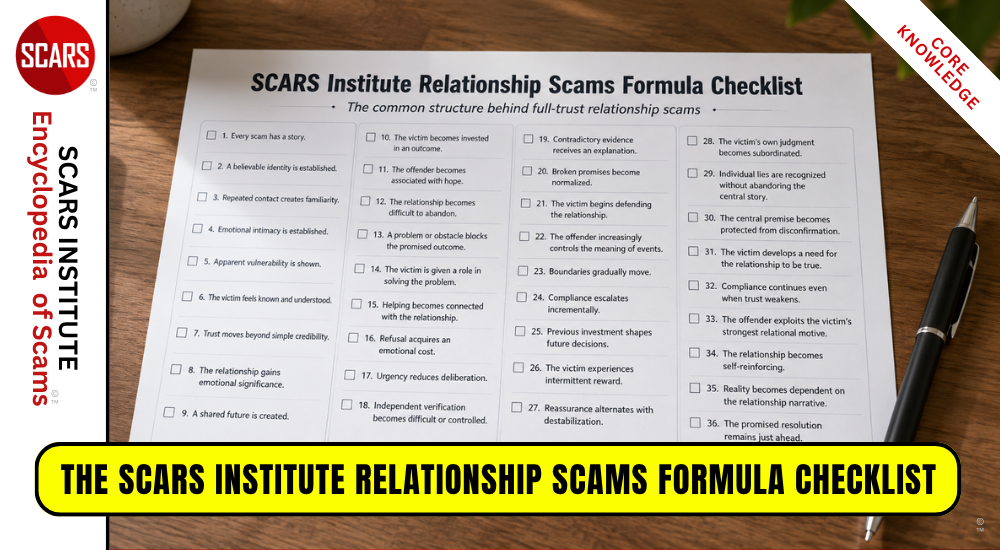
The SCARS Institute Relationship Scams Formula Checklist
This is the Formula that all Relationship Scams Follow




In the U.S. & Canada

U.S. & Canada Suicide Lifeline 988

Recent Comments
On Other Articles
- Barbara on SCARS Institute – Romance Scam Simulator: “Fantastic! I have to go to bed, but I’ll do some more tomorrow. I picked an easy scenario tonight, but…” Oct 9, 18:01
- on United States – Federal Bureau of Investigations [FBI]: “It is only that way because of the shame you feel. The reality is that it was not your fault.…” Sep 30, 15:36
- on United States – Federal Bureau of Investigations [FBI]: “yhisis humiliating experience e and isembarassassing to to own up to peolealreadyassume u are not to bright because Arnold and…” Sep 30, 12:28
- on United States – Federal Bureau of Investigations [FBI]: “should be better known by public live in assisiwdlivi g apartment many manyinstancresof Romance scams here ano.us ederly l” Sep 30, 12:24
- on Is It A Scam? Phone Scam Diagnostic – v1: “I tried the this test Is it a phone scam? Mine was. I think this is a helpful tool to…” Sep 30, 10:34
- on Is It A Scam? Romance Scam Diagnostic – v2: “Carole, as you move forward with your recovery, you will learn how this all works. It was not your fault.…” Sep 29, 17:37
- on Is It A Scam? Romance Scam Diagnostic – v2: “I was blinded by such clever manipulation” Sep 29, 15:15
- on The SCARS Institute Relationship Scams Formula Checklist – 2026: “As I read this I could see myself in every step with my scam. I gained a lot more knowledge…” Aug 28, 19:51
- on The Persistence of Danielle Delaunay as a Fake Identity – 2026: “Unfortunately, you are being scammed. She is using a fake name regardless. At this point, your best option is to…” Aug 26, 20:16
- on The Persistence of Danielle Delaunay as a Fake Identity – 2026: “Dear Sirs, I have met this woman with the name Abigail Boateng in Ghana. I have an intensive mail contact…” Aug 26, 12:28

Thank you for your comment. You may receive an email to follow up. We never share your data with marketers.