



SCARS Institute’s Encyclopedia of Scams™ Published Continuously for 25 Years
Author:
• Tim McGuinness, Ph.D., DFin, MCPO, MAnth – Anthropologist, Scientist, Director of the Society of Citizens Against Relationship Scams Inc.
Article Abstract

Safeguarding Justice: The Crucial Role of Evidence Preservation in Reporting Cybercrimes
In an era dominated by digital interactions, the rise of cybercrimes, scams, and fraud has become an unfortunate reality.
As victims navigate the aftermath of these incidents, they often find themselves in the role of digital detectives, tasked with preserving critical evidence that could bring perpetrators or scammers to justice. Beyond aiding law enforcement, the importance of preserving evidence extends to various facets of combating cyber threats.
Why the Evidence Matters
<ore and more, law enforcement is arresting scammers, and when they do, they often investigate who the scammers have victimized. This leads them to the identities of victims who did not even report, and if those victims have preserved their evidence they are in a better position to see their case added to the charges against the arrested scammers, fraudsters, or cybercriminals. This also improves the chance of eventual money recovery from restitution.
Preserving evidence of a scam is a must for scam victims for several reasons:
- Legal Proceedings: Preserved evidence can serve as a foundation for legal action against scammers. Whether pursuing civil remedies or criminal prosecution, documented evidence strengthens the case and increases the likelihood of a successful outcome.
- Law Enforcement Investigations: Law enforcement agencies rely on evidence to investigate and prosecute scammers. Preserved evidence provides investigators with valuable insights into the nature of the scam, its perpetrators, and their methods, facilitating more effective enforcement actions.
- Pattern Recognition: Preserved evidence when reported helps authorities identify patterns and trends in scam activities. By analyzing multiple cases, law enforcement can uncover broader schemes, track the movements of criminal networks, and implement targeted interventions to disrupt their operations.
- Preventing Further Victimization: Sharing evidence with law enforcement and relevant agencies helps prevent further victimization. By alerting authorities to the tactics and strategies used by scammers, victims contribute to the development of preventive measures and public awareness campaigns, reducing the risk for others.
- Recovery and Restitution: Preserved evidence may aid in the recovery of stolen assets or financial losses. In cases where scammers are apprehended and prosecuted, victims may be eligible for restitution or compensation. Detailed evidence strengthens their claims and supports the restitution process.
- Victim’s Impact Statements and Sentencing: The evidence will help scam victims create better victim impact statements that can have a dramatic effect on the sentences that these criminals receive when convicted.
- Educational Purposes: Preserved evidence can be used for educational purposes to raise awareness about scams and educate the public on how to recognize and avoid them. By sharing their experiences and evidence, victims help empower others to protect themselves from falling prey to similar schemes.
Preserving evidence of a scam empowers victims to seek justice, aids law enforcement in combating cybercrime, and contributes to the prevention of future victimization. It serves as a tangible reminder of the scammer’s actions and ensures that their illicit activities do not go unchecked.
Preserving the Digital Trail
When confronted with a scam or cybercrime, it’s easy to underestimate the significance of seemingly mundane digital artifacts. However, that suspicious email, phishing attempt, or ransomware message represents more than just pixels on a screen – it is tangible evidence with the potential to halt criminal operations and initiate legal proceedings.
Of course, if you were not actually victimized, just report it and then it is no longer needed. But if a victim was harmed in a scam, then the evidence if always needed and scam victims should resist the urge to just delete thinking that it will help them to recover.
Law enforcement agencies, equipped with the right evidence, can trace the digital trail left by cybercriminals. This includes investigating the origin of phishing emails, tracking financial transactions, and identifying patterns in the modus operandi of hackers. For these investigations to be effective, victims must play a proactive role in safeguarding and providing evidence.
Remember that it does not matter if you hear back from an agency after reporting the crime. Many times they simply do not have the resources to follow up unless they need more information or are actively investigating. Sharing the evidence is a critical component in helping law enforcement to make informed decisions and aid their investigations.
Comprehensive Evidence
The array of evidence that can substantiate a cybercrime report can be extensive. Victims should diligently compile and secure documents that might be linked to the incident. This could include canceled checks, certified mail receipts, chatroom or newsgroup transcripts, credit card receipts, and even physical items like envelopes or web links.
Digital evidence is equally crucial, encompassing log files with date and time stamps, social media messages, wire receipts, and copies of emails and web pages. Preserving these electronic documents in their original format, including full email headers, ensures their integrity and authenticity, bolstering the strength of the evidence.
Evidence Items That Should Be Preserved:
Always keep the evidence items in a safe location in the event you are asked to provide them for investigative or prosecution purposes.
All of the following documentation might be considered evidence, but you should keep anything you think could be related to the incident:
- Canceled checks (copies of either sent or received checks)
- Certified or other mail receipts
- Chat or message text
- Credit card receipts
- Envelopes (if you received items via FedEx, UPS or U.S. Mail or other courier)
- Scanned documents (sent or received, including PDF files)
- Log files, if available, with date, time and time zone (most victims will not have these)
- Social media profiles, posts, and messages
- Money transfer order receipts
- Pamphlets or brochures
- Phone bills and call summaries
- Copies of emails, preferably electronic copies. If you print the email, include full email header information
- Copies of web pages, preferably electronic
- Wire transfer receipts and recorder
- Cryptocurrency purchases, wallet information, and transfers
A Toolkit for Justice
Preserving evidence serves as a toolkit for justice, enabling not only the identification and prosecution of cybercriminals but also acting as a deterrent against future crimes. By keeping a detailed record of the incident, victims contribute to the collective effort to curb cyber threats and protect others from falling victim to similar schemes.
Learn more about this here: Reporting Scams – A Scam Victim’s Checklist (romancescamsnow.com)
We also recommend our low-cost SCARS RED BOOK Cybercrime Organized: SCARS RED BOOK – Your Personal Scam Evidence & Crime Record – SCARS Company Store (againstscams.org)
The Role of Victims in Cybercrime Prevention
Victims of cybercrimes are unwittingly thrust into the frontline of cybercrime prevention. Their meticulous preservation of evidence acts as a shield against the evolving tactics of cybercriminals. Moreover, it facilitates collaboration between victims and law enforcement agencies, fostering a symbiotic relationship that strengthens the overall cybersecurity landscape.
Summary
In the scam and cybercrime age, where the battle against cyber threats is forever ongoing, the role of evidence preservation cannot be overstated.
It is a fundamental aspect of reporting cybercrime to preserve the evidence, ensuring that law enforcement agencies have the necessary tools to pursue investigations.
Beyond that, preserving evidence empowers victims to actively participate in the collective effort to retain their law enforcement and reporting options, while safeguarding their future potential recovery. We have seen several cases where the government has forced financial companies to reimburse victims over the years, but that is only possible when the scam victims retain the evidence.
By recognizing the importance of preserving evidence, victims become integral contributors to justice and catalysts for positive change in the fight against cybercrime.
More Reporting Scams & Interacting With The Police:
- Reporting Scams – A Scam Victim’s Checklist (romancescamsnow.com)
- SCARS RED BOOK – Your Personal Scam Evidence & Crime Record – SCARS Company Store (againstscams.org)
- Reporting Scams Worldwide (romancescamsnow.com)
- Victim’s Impact Statements (romancescamsnow.com)
- Law Enforcement & Police – Article Catalog (romancescamsnow.com)
-/ 30 /-
What do you think about this?
Please share your thoughts in a comment below!
Table of Contents
To Understand All Scams
Read This
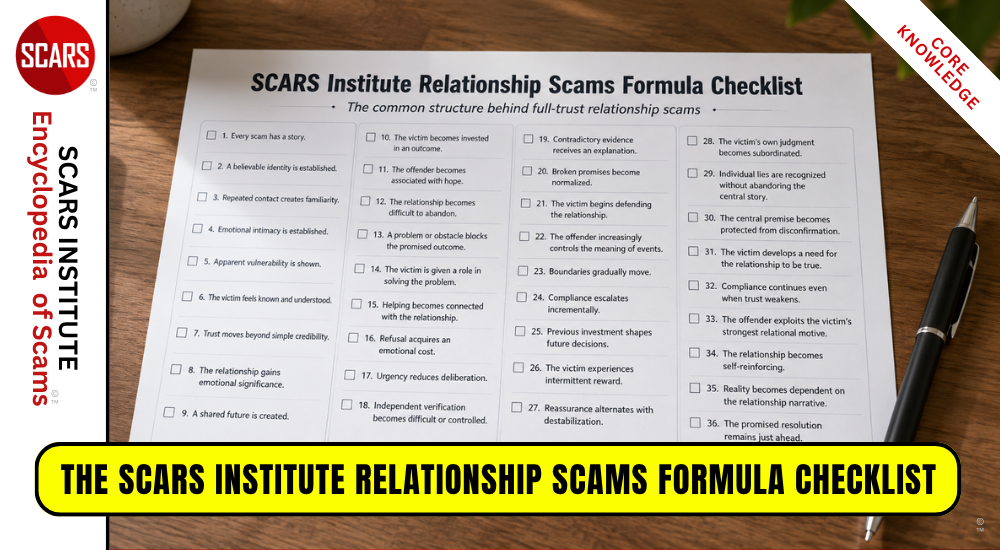
The SCARS Institute Relationship Scams Formula Checklist
This is the Formula that all Relationship Scams Follow




In the U.S. & Canada

U.S. & Canada Suicide Lifeline 988

Recent Comments
On Other Articles
- on SCARS Institute – Romance Scam Simulator: “Fantastic! I have to go to bed, but I’ll do some more tomorrow. I picked an easy scenario tonight, but…” Oct 9, 18:01
- on United States – Federal Bureau of Investigations [FBI]: “It is only that way because of the shame you feel. The reality is that it was not your fault.…” Sep 30, 15:36
- on United States – Federal Bureau of Investigations [FBI]: “yhisis humiliating experience e and isembarassassing to to own up to peolealreadyassume u are not to bright because Arnold and…” Sep 30, 12:28
- on United States – Federal Bureau of Investigations [FBI]: “should be better known by public live in assisiwdlivi g apartment many manyinstancresof Romance scams here ano.us ederly l” Sep 30, 12:24
- on Is It A Scam? Phone Scam Diagnostic – v1: “I tried the this test Is it a phone scam? Mine was. I think this is a helpful tool to…” Sep 30, 10:34
- on Is It A Scam? Romance Scam Diagnostic – v2: “Carole, as you move forward with your recovery, you will learn how this all works. It was not your fault.…” Sep 29, 17:37
- on Is It A Scam? Romance Scam Diagnostic – v2: “I was blinded by such clever manipulation” Sep 29, 15:15
- on The SCARS Institute Relationship Scams Formula Checklist – 2026: “As I read this I could see myself in every step with my scam. I gained a lot more knowledge…” Aug 28, 19:51
- on The Persistence of Danielle Delaunay as a Fake Identity – 2026: “Unfortunately, you are being scammed. She is using a fake name regardless. At this point, your best option is to…” Aug 26, 20:16
- on The Persistence of Danielle Delaunay as a Fake Identity – 2026: “Dear Sirs, I have met this woman with the name Abigail Boateng in Ghana. I have an intensive mail contact…” Aug 26, 12:28

I have followed all these steps. I have kept a digital record of the chat messages, I have all the gift cards and receipts. Even my credit card statements. Plus I printed all copies of any updates I made with Ic3. I updated every time I purchased gift cards. I have it in the event anything moves forward on my case.
I did look up what services are available here in my State. Not much, it is all more geared to PHYSICAL abuse victims rather than cybercrime.
I spent a lot of time documenting my pig butcher fraud experience but it was worth it. It was painful reliving the experience but I was able to gain new insight taking another look at what happened. I can now move forward and don’t have to look back knowing the information is there if ever needed.