

![United States Military Ranks & Insignia - A SCARS Guide [Updated] valentines day warning](https://romancescamsnow.com/wp-content/uploads/2015/02/valentines-day-warning.png "United States Military Ranks & Insignia - A SCARS Guide [Updated] valentines day warning")


SCARS Institute’s Encyclopedia of Scams™ Published Continuously for 25 Years

United States Military Ranks & Insignia
A SCARS Guide to help with recognizing fakes!
Updated to Include United States Space Force Ranks
THE UNITED STATES MILITARY RANK INSIGNIA
Updated with Space Force Ranks
Military rank is more than just who salutes whom. Military rank is a badge of leadership. Responsibility for personnel, equipment, and mission grows with each increase in rank.
Do not confuse rank with pay grades, such as E-1, W-2, and O-5. Pay grades are administrative classifications used primarily to standardize compensation across the military services. The “E” in E-1 stands for “enlisted” while the “1” indicates the pay grade for that position. The other pay categories are “W” for warrant officers and “O” for commissioned officers. Some enlisted pay grades have two ranks.
The Army, for example, has the ranks of corporal and specialist at the pay grade of E-4. A corporal is expected to fill a leadership role and has a higher rank than a specialist even though both receive the same amount of pay. In the Marine Corps, master gunnery sergeants and sergeant majors are E-9s, but the sergeant major has the higher rank.
TABLE OF U.S. MILITARY RANKS
| Pay Grade |
Army and Marine Corps | Navy and Coast Guard | Air Force | Space Force |
|---|---|---|---|---|
| Commissioned Officers |
||||
| 0-1 | Second Lieutenant | Ensign | Second Lieutenant | Second Lieutenant |
| 0-2 | First Lieutenant | Lieutenant Junior Grade | First Lieutenant | First Lieutenant |
| 0-3 | Captain | Lieutenant | Captain | Captain |
| 0-4 | Major | Lieutenant Commander | Major | Major |
| 0-5 | Lieutenant Colonel | Commander | Lieutenant Colonel | Lieutenant Colonel |
| 0-6 | Colonel | Captain | Colonel | Colonel |
| 0-7 | Brigadier General | Rear Admiral | Brigadier General | Brigadier General |
| 0-8 | Major General | Rear Admiral | Major General | Major General |
| 0-9 | Lieutenant General | Vice Admiral | Lieutenant General | Lieutenant General |
| 0-10 | General | Admiral | General | General |
| Special Grades |
||||
| (5 stars) | General of the Army | Fleet Admiral | General of the Air Force | General of the Space Force |
| Warrant Officers |
||||
| W-1 | Warrant Officer | — | — | — |
| W-2–W-5 | Chief Warrant Officer | Chief Warrant Officer | — | — |
| Enlisted Personnel |
||||
| E-1 | Private | Seaman Recruit | Recruit | Specialist 1 |
| E-2 | Army Private/ Marine Private First Class |
Seaman Apprentice | Airman | Specialist 2 |
| E-3 | Army Private First Class/ Marine Lance Corporal |
Seaman | Airman First Class | Specialist 3 |
| E-4 | Corporal | Petty Officer, Third Class | Senior Airman | Specialist 4 |
| E-5 | Sergeant | Petty Officer, Second Class | Staff Sergeant | Sergeant |
| E-6 | Staff Sergeant | Petty Officer, First Class | Technical Sergeant | Technical Sergeant |
| E-7 | Army Sergeant First Class Marine Gunnery Sergeant |
Chief Petty Officer | Master Sergeant | Master Sergeant |
| E-8 | Master Sergeant | Senior Chief Petty Officer | Senior Master Sergeant | Senior Master Sergeant |
| E-9 | Sergeant Major | Master Chief Petty Officer | Chief Master Sergeant | Chief Master Sergeant |
| Special Grades |
||||
| Sergeant Major | Master Chief Petty Officer | Chief Master Sergeant | Chief Master Sergeant of the Space Force | |
United States Military Enlisted Ranks & Insignia
Enlisted Ranks
Service members in pay grades E-1 through E-3 are usually either in some kind of training status or on their initial assignment. The training includes the basic training phase where recruits are immersed in military culture and values and are taught the core skills required by their service component.
Basic training is followed by a specialized or advanced training phase that provides recruits with a specific area of expertise or concentration. In the Army and Marines, this area is called a military occupational specialty; in the Navy, it is known as a rate; and in the Air Force or Space Force, it is simply called an Air Force specialty.
Army: * For rank and precedence within the Army, specialist ranks immediately below corporal. Among the services, however, rank and precedence are determined by pay grade.
Navy / Coast Guard: * A specialty mark in the center of a rating badge indicates the wearer’s particular rating. ** Gold stripes indicate 12 or more years of good conduct. *** 1. Master chief petty officer of the Navy and fleet and force master chief petty officers. 2. Command master chief petty officers wear silver stars. 3. Master chief petty officers wear silver stars and silver specialty rating marks
The U.S. Coast Guard is a part of the Department of Homeland Security in peacetime and the Navy in times of war. Coast Guard rank insignia is the same as the Navy except for color and the seaman recruit rank, which has one stripe.
NOTE: Appearance of U.S. Space Force insignia is the same as the U.S. Air Force.
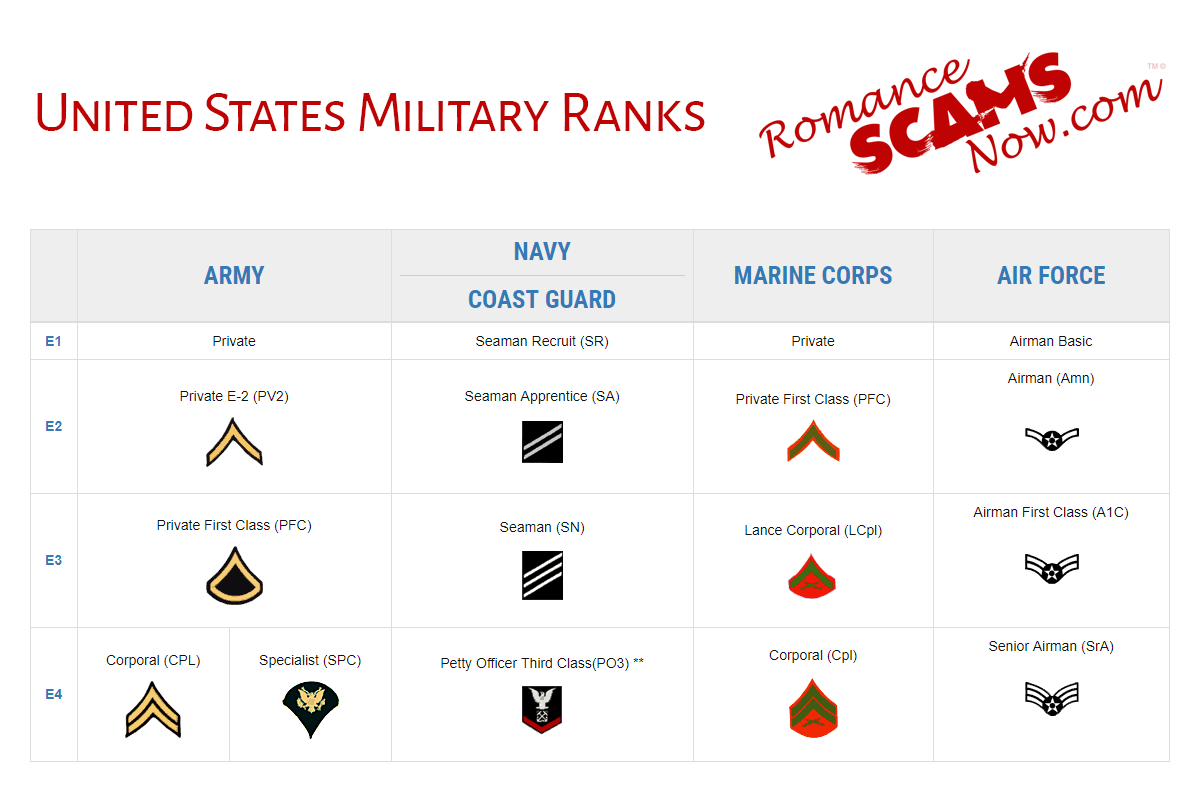
United States Military Rank Insignias – Enlisted Ranks – E1 – E4
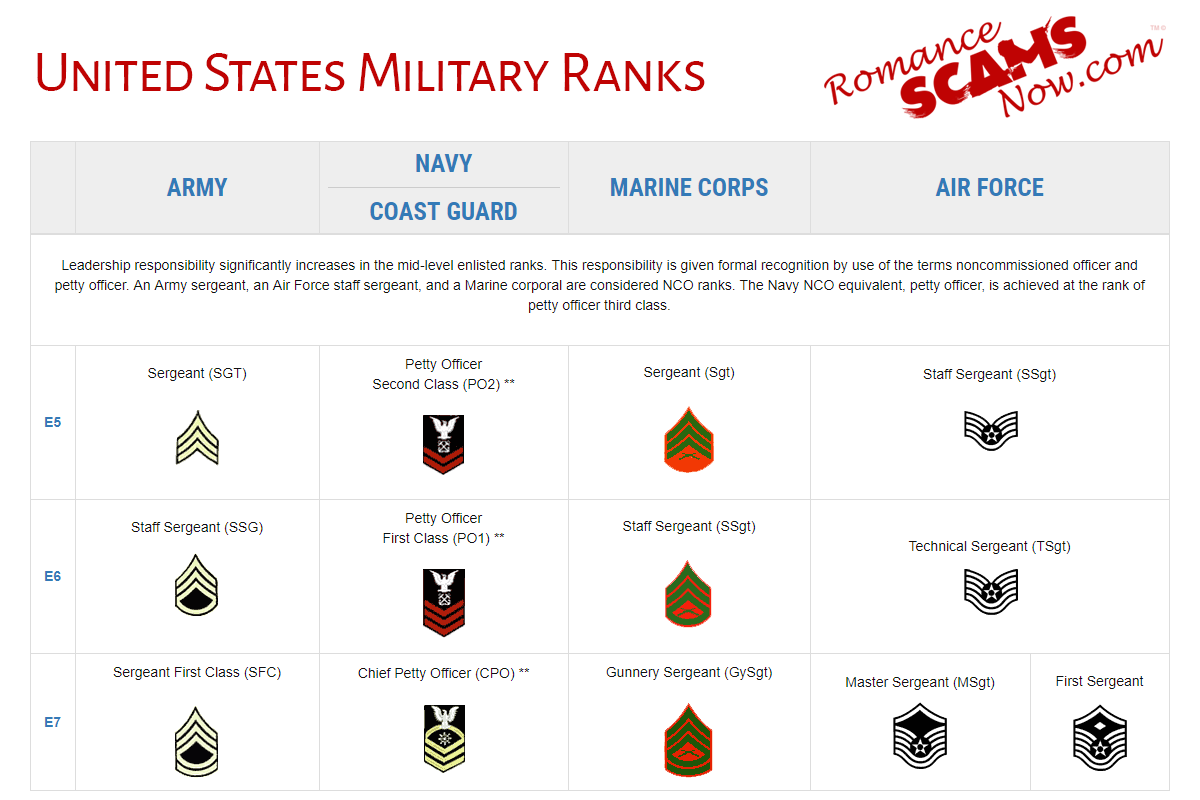
United States Military Rank Insignias – Enlisted Ranks – E5 – E7
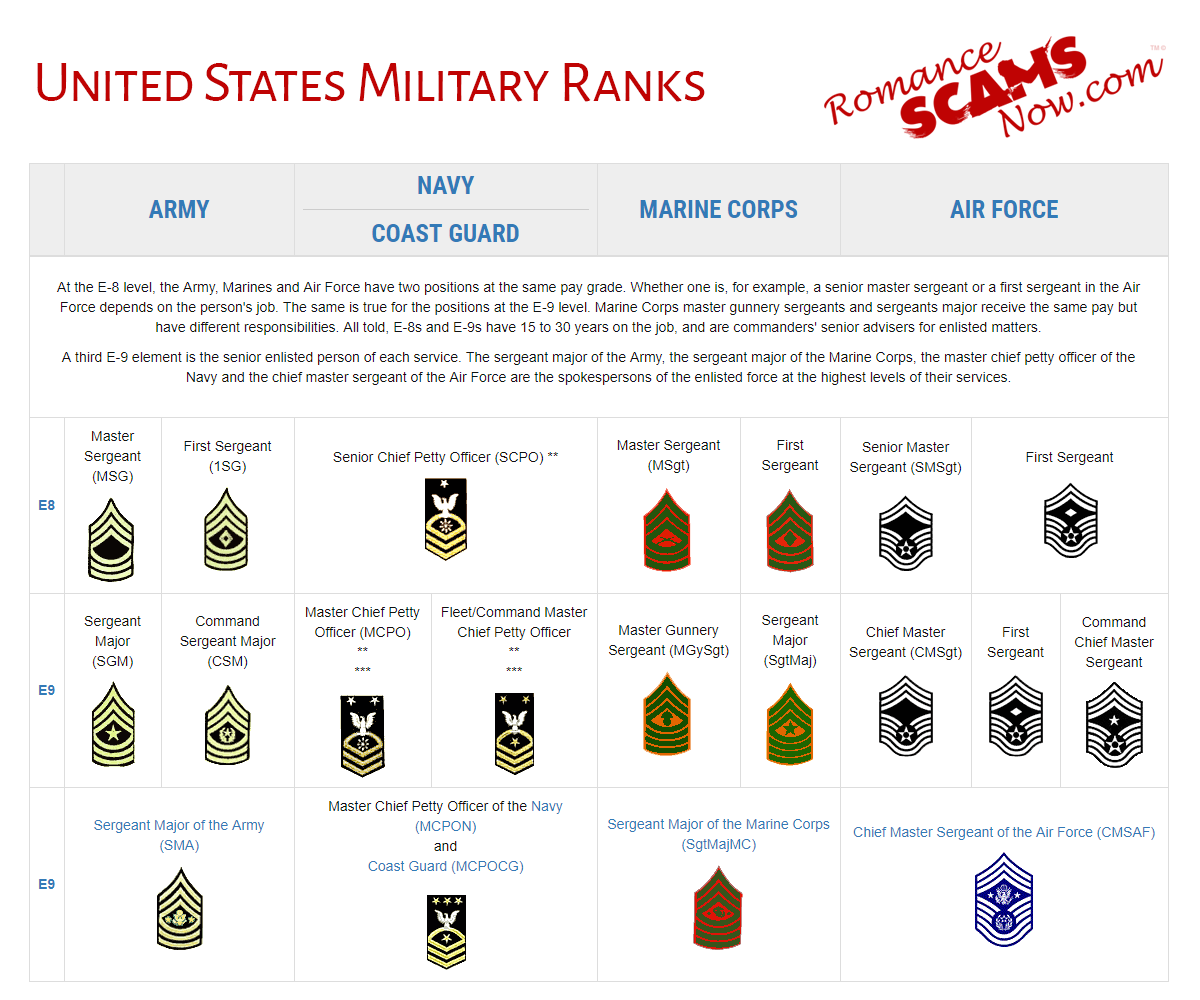
United States Military Rank Insignias – Enlisted Ranks – E8 – E9
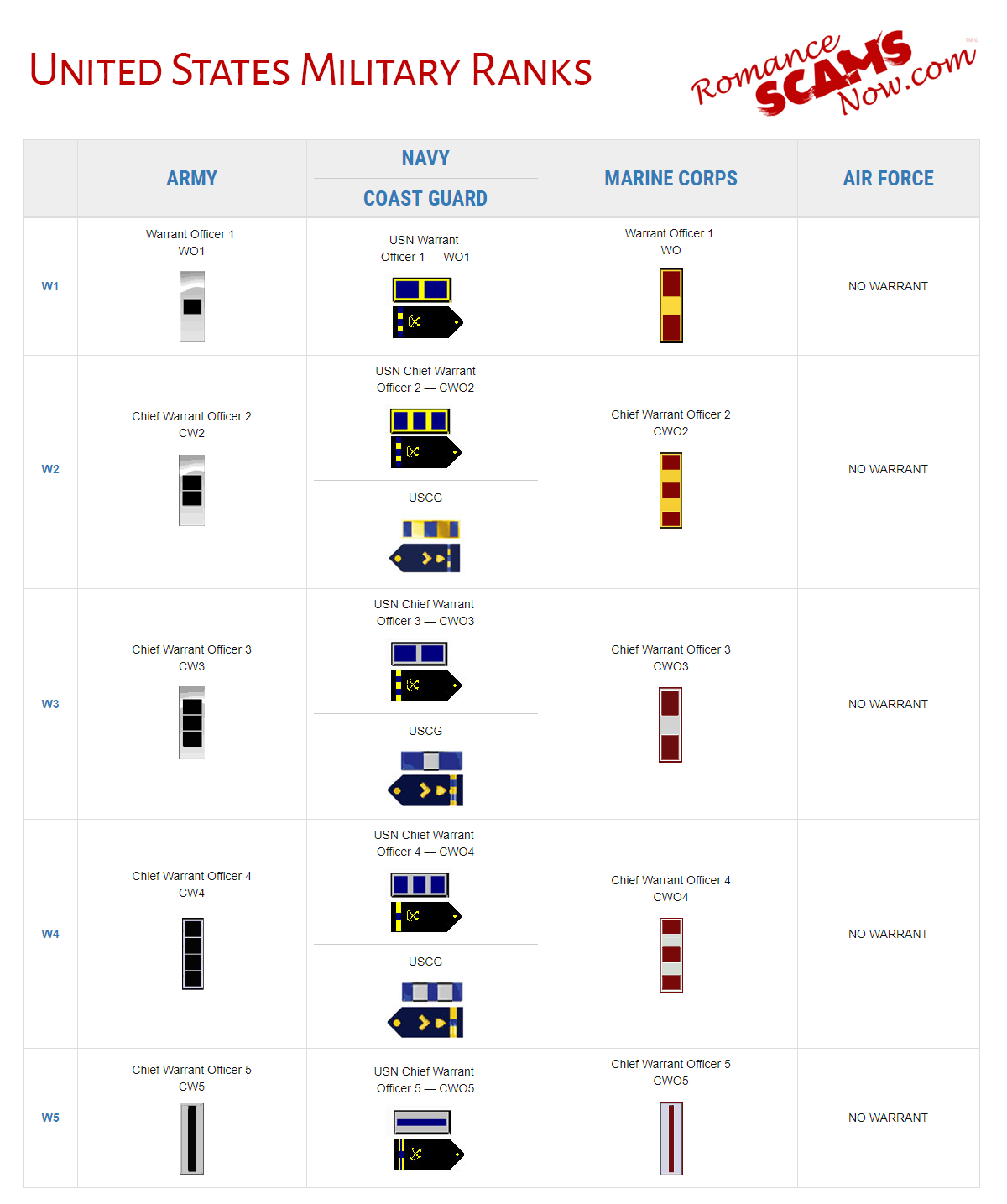
United States Military Rank Insignias – Warrant Offier Ranks – W1 – W5
New U.S. Space Force Ranks
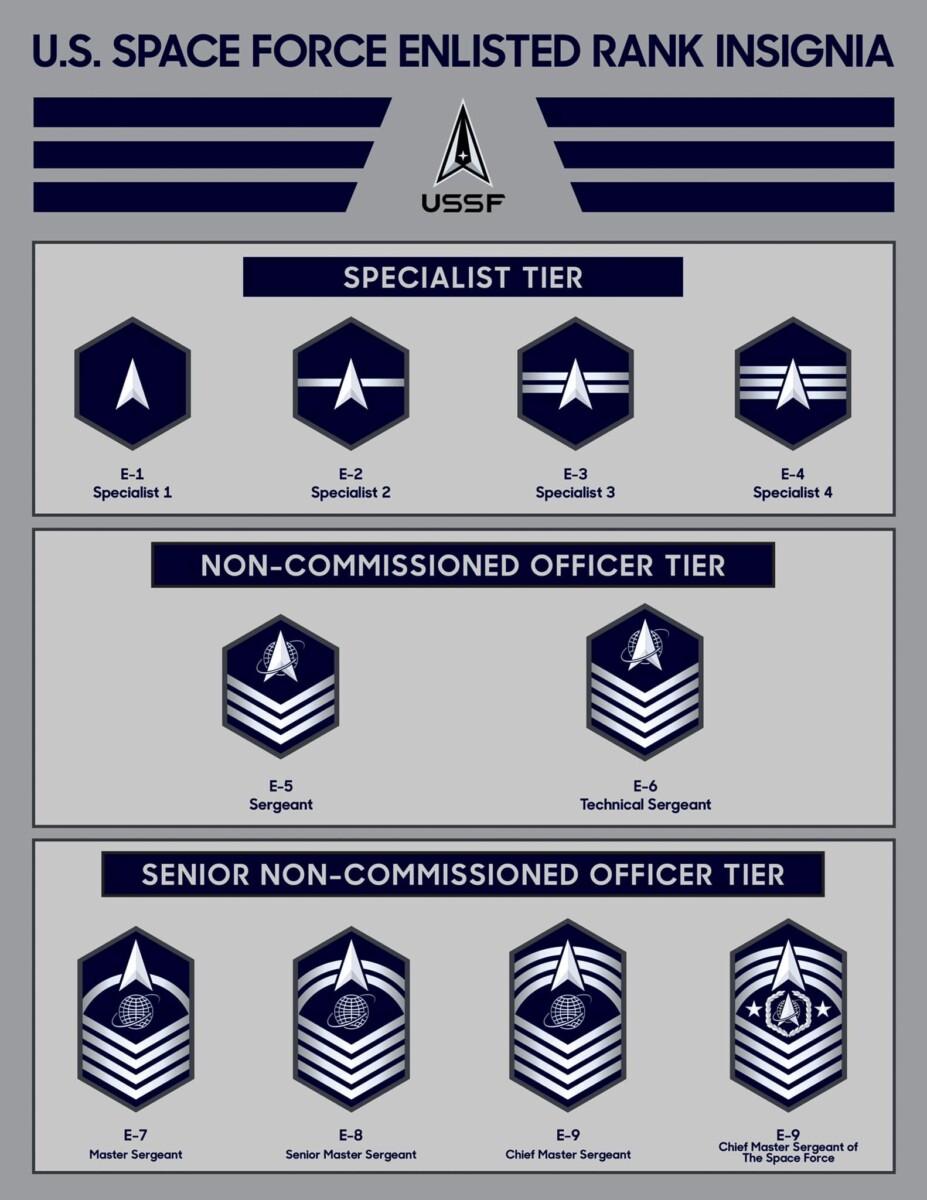
United States Space Force Enlisted Ranks
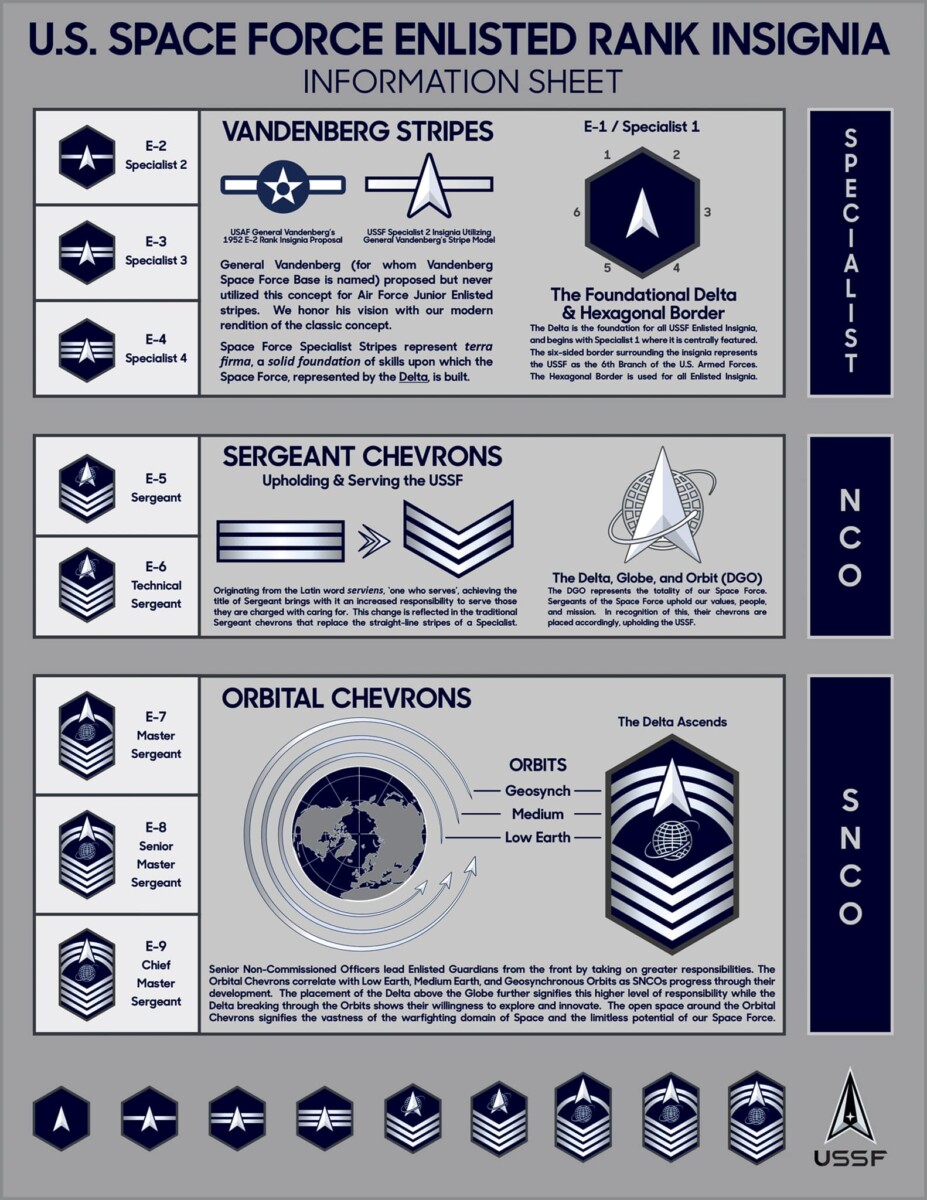
United States Space Force Enlisted Ranks
United States Officer Ranks & Insignia
Officer Ranks
Officer ranks in the United States military consist of commissioned officers and warrant officers. The commissioned ranks are the highest in the military. These officers hold presidential commissions and are confirmed at their ranks by the Senate. Army, Air Force, Space Force, and Marine Corps officers are called company grade officers in the pay grades of O-1 to O-3, field grade officers in pay grades O-4 to O-6, and general officers in pay grades O-7 and higher. The equivalent officer groupings in the Navy are called junior grade, mid-grade, and flag.
Warrant officers hold warrants from their service secretary and are specialists and experts in certain military technologies or capabilities. The lowest ranking warrant officers serve under a warrant, but they receive commissions from the president upon promotion to chief warrant officer 2. These commissioned warrant officers are direct representatives of the president of the United States. They derive their authority from the same source as commissioned officers but remain specialists, in contrast to commissioned officers, who are generalists. There are no warrant officers in the Air Force.
Naval officers wear distinctively different rank devices depending upon the uniform they’re wearing. The three basic uniforms and rank devices used are: khakis, collar insignia pins; whites, stripes on shoulder boards; and blues, stripes sewn on the lower coat sleeves.
NOTE: Appearance of U.S. Space Force insignia is the same as the U.S. Air Force.
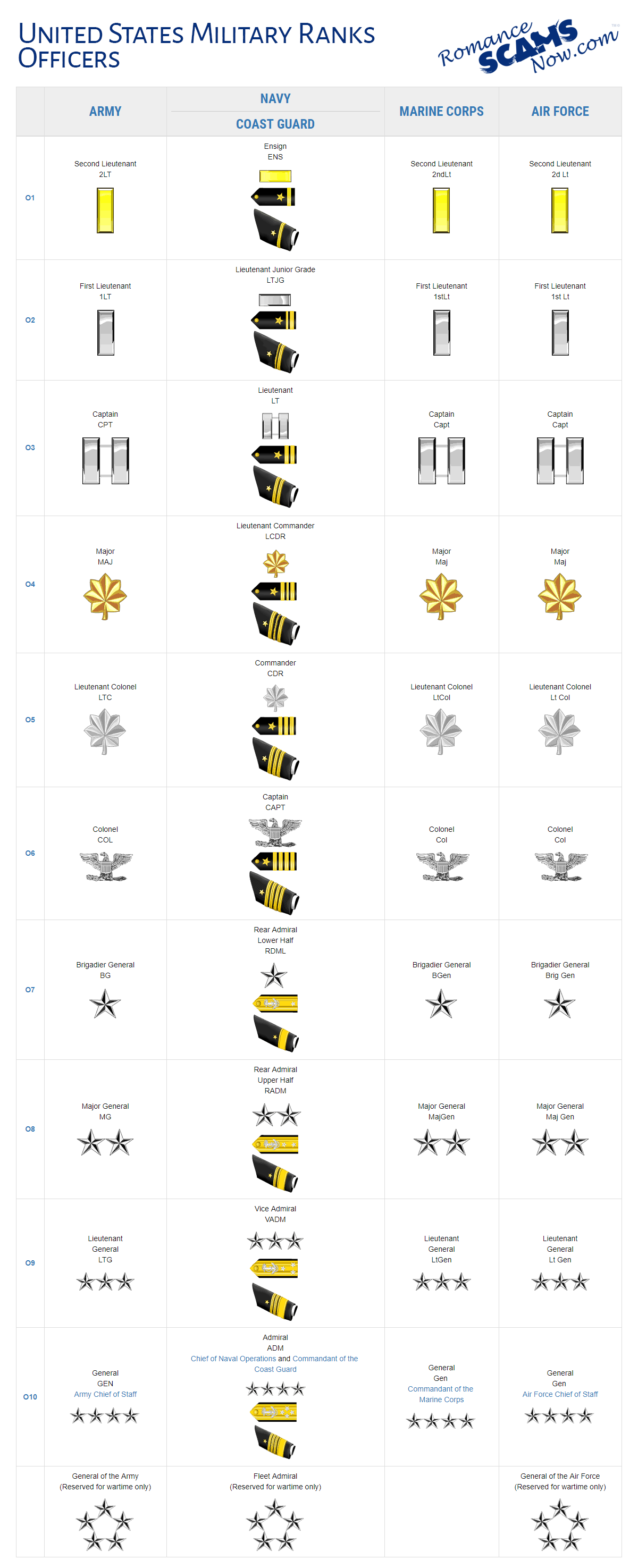
United States Military Rank Insignias – Officer Ranks – O1 – O10
To Learn More About The United States Military Click Here


TAGS: SCARS, Information About Scams, Anti-Scam, Scams, Scammers, Fraudsters, Cybercrime, Crybercriminals, Romance Scams, Scam Victims, Online Fraud, Online Crime Is Real Crime, Scam Avoidance, Military Ranks, Military Insignia, Rank Designs, U.S. Army, U.S. Navy, U.S. Coast Guard, U.S. Marine Corps, U.S. Air Force, U.S. Space Force, Fake Soldiers, Military Impersonators
-/ 30 /-
What do you think about this?
Please share your thoughts in a comment below!
Table of Contents
To Understand All Scams
Read This
The SCARS Institute Relationship Scams Formula Checklist
This is the Formula that all Relationship Scams Follow






In the U.S. & Canada

U.S. & Canada Suicide Lifeline 988

Recent Comments
On Other Articles
- SCARS Institute Editorial Team on United States – Federal Bureau of Investigations [FBI]: “It is only that way because of the shame you feel. The reality is that it was not your fault.…” Sep 30, 15:36
- on United States – Federal Bureau of Investigations [FBI]: “yhisis humiliating experience e and isembarassassing to to own up to peolealreadyassume u are not to bright because Arnold and…” Sep 30, 12:28
- on United States – Federal Bureau of Investigations [FBI]: “should be better known by public live in assisiwdlivi g apartment many manyinstancresof Romance scams here ano.us ederly l” Sep 30, 12:24
- on Is It A Scam? Phone Scam Diagnostic – v1: “I tried the this test Is it a phone scam? Mine was. I think this is a helpful tool to…” Sep 30, 10:34
- on Is It A Scam? Romance Scam Diagnostic – v2: “Carole, as you move forward with your recovery, you will learn how this all works. It was not your fault.…” Sep 29, 17:37
- on Is It A Scam? Romance Scam Diagnostic – v2: “I was blinded by such clever manipulation” Sep 29, 15:15
- on The SCARS Institute Relationship Scams Formula Checklist – 2026: “As I read this I could see myself in every step with my scam. I gained a lot more knowledge…” Aug 28, 19:51
- on The Persistence of Danielle Delaunay as a Fake Identity – 2026: “Unfortunately, you are being scammed. She is using a fake name regardless. At this point, your best option is to…” Aug 26, 20:16
- on The Persistence of Danielle Delaunay as a Fake Identity – 2026: “Dear Sirs, I have met this woman with the name Abigail Boateng in Ghana. I have an intensive mail contact…” Aug 26, 12:28
- on Trauma-Induced Fear May Cause Paranoia: “Very interesting article. I’m wondering if someone would likely recognize that they’re becoming increasingly paranoid, or hypervigilant, or does it…” Aug 24, 12:07

![United States Military Ranks & Insignia - A SCARS Guide [Updated] niprc1.png1 150x1501 11](https://scamsnow.com/wp-content/uploads/2025/04/niprc1.png1_-150x1501-11.webp "United States Military Ranks & Insignia - A SCARS Guide [Updated] niprc1.png1 150x1501 11")
Thank you for your comment. You may receive an email to follow up. We never share your data with marketers.