




SCARS Institute’s Encyclopedia of Scams™ Published Continuously for 25 Years

Scam Basics: Understanding Synthetic Identity Fraud
A Type Of Identity Theft
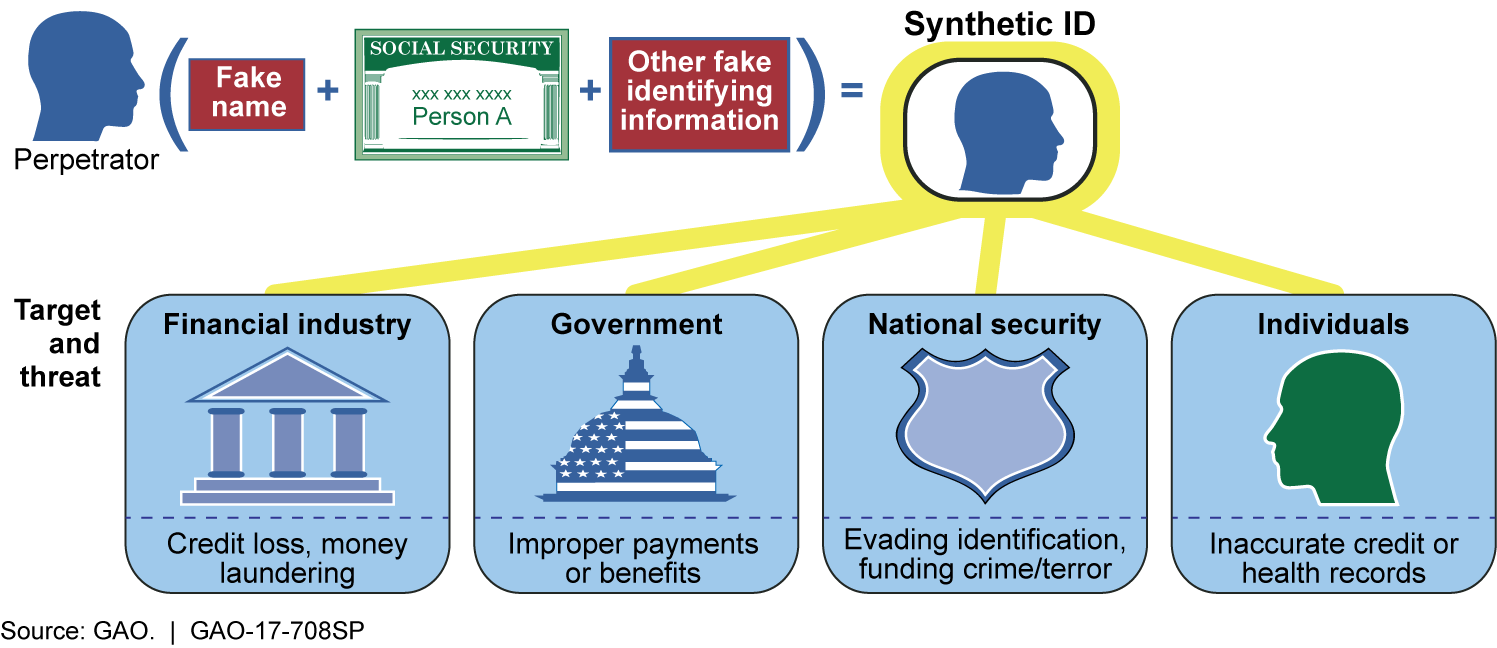
Synthetic Identity Fraud is a type of financial crime in which a criminal (or group of criminals) creates a false identity by combining both real and fabricated information to obtain credit, loans, or other financial products. This crime has been on the rise in recent years, and it poses a significant threat to financial institutions, consumers, and businesses. In this article, we will explore how Synthetic Identity Fraud works, who is behind it, how to detect and investigate it, and how to avoid it.
How Does Synthetic Identity Fraud Work?
Synthetic Identity Fraud is a complex and sophisticated crime that involves the creation of a fictitious identity that can be used to apply for credit or other financial products. The criminals behind this fraud usually combine real and fabricated information to create a new identity that can be used to obtain credit. They may use a real social security number, for example, but combine it with a fake name and address.
Once they have created a synthetic identity, the criminals then use it to open bank accounts or apply for credit cards, loans, or other financial products. They may use these accounts to establish a credit history for the synthetic identity, which they can then use to obtain larger loans or credit lines.
The criminals behind Synthetic Identity Fraud can be individuals or organized crime groups that are well-versed in financial fraud. They often use sophisticated techniques, such as creating multiple synthetic identities, to avoid detection.
Who Are The Typical Criminals Behind Synthetic Identity Fraud?
The criminals behind Synthetic Identity Fraud can be anyone from individuals to organized crime groups. However, they tend to be individuals with a background in financial fraud or organized crime groups that specialize in this type of crime.
Individuals involved in Synthetic Identity Fraud may include those with poor credit scores or a criminal history that makes it difficult for them to obtain credit. They may also include those who are trying to evade creditors or financial institutions. However, most often they are professional cybercriminals in it for the potential financial rewards.
Organized crime groups involved in Synthetic Identity Fraud are often highly sophisticated and organized. They may have access to large amounts of personal information, including social security numbers and other identifying information. They can buy the information that originated from major data breaches on the dark web, or obtain enough information from harvesting data from people’s social media profiles.
They may also have the resources to create multiple synthetic identities and establish credit histories for each one.
How To Detect And Investigate Synthetic Identity Fraud?
Detecting and investigating Synthetic Identity Fraud can be challenging, as the criminals behind this type of fraud are often skilled at covering their tracks. However, there are several methods that can be used to detect and investigate this type of fraud.
One of the most effective methods for detecting Synthetic Identity Fraud is to use data analytics and machine learning algorithms to identify patterns and anomalies in credit applications and transactions. These algorithms can help identify suspicious activity, such as the use of multiple identities or the sudden appearance of a large number of new accounts.
Another method for detecting Synthetic Identity Fraud is to use identity verification tools to verify the identity of individuals applying for credit or other financial products. These tools can help verify that the identity being used is legitimate and reduce the risk of fraud.
Once Synthetic Identity Fraud has been detected, it can be investigated using traditional forensic techniques, such as analyzing financial records and conducting interviews with individuals involved in the fraud. Law enforcement agencies may also work with financial institutions to track down the individuals behind the fraud and bring them to justice.
How To Avoid Synthetic Identity Fraud?
There are several steps that individuals and businesses can take to avoid becoming victims of Synthetic Identity Fraud.
Individuals can protect themselves by monitoring their credit reports regularly and reporting any suspicious activity to credit reporting agencies. They can also protect their personal information by using strong passwords, avoiding sharing personal information online and being cautious about providing personal information over the phone or through email.
Businesses can protect themselves by using identity verification tools and conducting thorough background checks on individuals applying for credit or other financial products. They can also implement robust fraud detection and prevention systems that use data analytics and machine learning algorithms to identify suspicious activity.
Synthetic Identity Fraud is a growing problem that can cause significant financial damage to individuals and businesses. It occurs when criminals use a combination of real and fake information to create a new identity that they can use to apply for credit or other financial products. To avoid becoming a victim of Synthetic Identity Fraud, individuals and businesses need to take proactive steps to protect their personal information and implement robust fraud prevention measures.
Here are some tips on how to avoid Synthetic Identity Fraud:
1. Protect your personal information
One of the most important steps you can take to avoid Synthetic Identity Fraud is to protect your personal information. This includes your social security number, date of birth, and other identifying information. Never share this information online or over the phone unless you are certain that you are dealing with a reputable organization.
2. Monitor your credit report
Regularly monitoring your credit report can help you identify any suspicious activity that could indicate Synthetic Identity Fraud. You can obtain a free copy of your credit report from each of the three major credit bureaus (Equifax, Experian, and TransUnion) once a year. Review your report carefully for any errors or fraudulent activity.
3. Use strong passwords
Using strong passwords can help prevent criminals from gaining access to your online accounts and stealing your personal information. Use a combination of upper and lowercase letters, numbers, and symbols to create a password that is difficult to guess.
4. Be cautious about providing personal information
Be cautious when providing personal information online, over the phone, or through email. Only provide personal information to reputable organizations that you trust. If you receive a phone call or email asking for personal information, verify the legitimacy of the request before providing any information.
5. Implement identity verification tools
Businesses can implement identity verification tools to help prevent Synthetic Identity Fraud. These tools can verify the identity of individuals applying for credit or other financial products, reducing the risk of fraud.
6. Conduct thorough background checks
Businesses should conduct thorough background checks on individuals applying for credit or other financial products. This can help identify any red flags that could indicate Synthetic Identity Fraud, such as a history of financial fraud or a criminal record.
7. Implement fraud detection and prevention systems
Implementing fraud detection and prevention systems can help businesses identify suspicious activity and prevent Synthetic Identity Fraud. These systems can use data analytics and machine learning algorithms to identify patterns and anomalies that could indicate fraud.
Essentially, Synthetic Identity Fraud is a serious problem that can cause significant financial damage to individuals and businesses. However, by taking proactive steps to protect your personal information and implementing robust fraud prevention measures, you can significantly reduce the risk of becoming a victim of this type of fraud. Regularly monitoring your credit report, using strong passwords, being cautious about providing personal information, and implementing identity verification tools and fraud detection and prevention systems are all effective strategies for avoiding Synthetic Identity Fraud.
More About Synthetic Identity Fraud
-/ 30 /-
What do you think about this?
Please share your thoughts in a comment below!
Table of Contents
To Understand All Scams
Read This
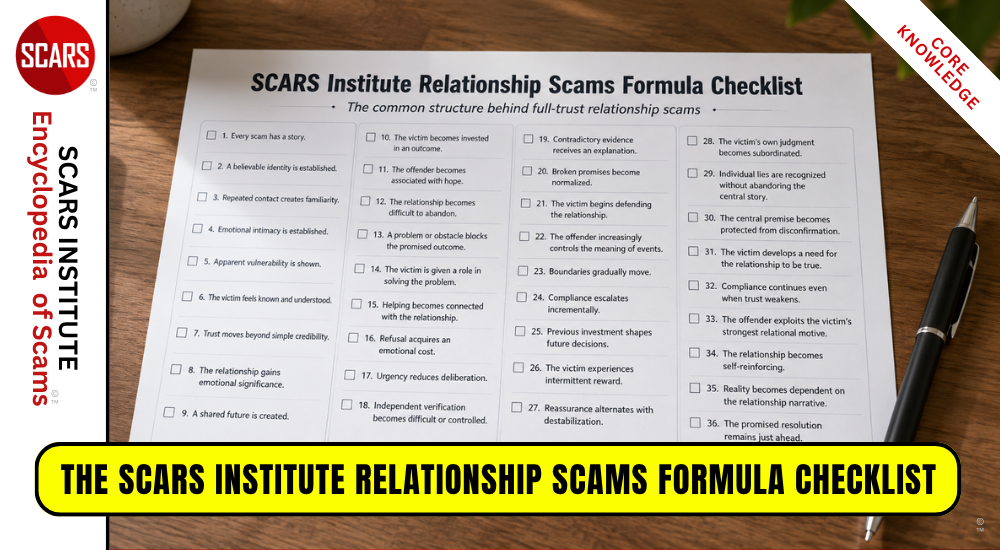
The SCARS Institute Relationship Scams Formula Checklist
This is the Formula that all Relationship Scams Follow




In the U.S. & Canada

U.S. & Canada Suicide Lifeline 988

Recent Comments
On Other Articles
- Barbara on SCARS Institute – Romance Scam Simulator: “Fantastic! I have to go to bed, but I’ll do some more tomorrow. I picked an easy scenario tonight, but…” Oct 9, 18:01
- on United States – Federal Bureau of Investigations [FBI]: “It is only that way because of the shame you feel. The reality is that it was not your fault.…” Sep 30, 15:36
- on United States – Federal Bureau of Investigations [FBI]: “yhisis humiliating experience e and isembarassassing to to own up to peolealreadyassume u are not to bright because Arnold and…” Sep 30, 12:28
- on United States – Federal Bureau of Investigations [FBI]: “should be better known by public live in assisiwdlivi g apartment many manyinstancresof Romance scams here ano.us ederly l” Sep 30, 12:24
- on Is It A Scam? Phone Scam Diagnostic – v1: “I tried the this test Is it a phone scam? Mine was. I think this is a helpful tool to…” Sep 30, 10:34
- on Is It A Scam? Romance Scam Diagnostic – v2: “Carole, as you move forward with your recovery, you will learn how this all works. It was not your fault.…” Sep 29, 17:37
- on Is It A Scam? Romance Scam Diagnostic – v2: “I was blinded by such clever manipulation” Sep 29, 15:15
- on The SCARS Institute Relationship Scams Formula Checklist – 2026: “As I read this I could see myself in every step with my scam. I gained a lot more knowledge…” Aug 28, 19:51
- on The Persistence of Danielle Delaunay as a Fake Identity – 2026: “Unfortunately, you are being scammed. She is using a fake name regardless. At this point, your best option is to…” Aug 26, 20:16
- on The Persistence of Danielle Delaunay as a Fake Identity – 2026: “Dear Sirs, I have met this woman with the name Abigail Boateng in Ghana. I have an intensive mail contact…” Aug 26, 12:28

Thank you for your comment. You may receive an email to follow up. We never share your data with marketers.