




SCARS Institute’s Encyclopedia of Scams™ Published Continuously for 25 Years
Can PTSD Cause Brain Fog?
The Effects Of Trauma Can Linger – Brain Fog Is One Of Them
Thank you to PsychCentral for portions of this information.
About Brain Fog – if you sometimes lack mental clarity and feel fatigued, you may be experiencing PTSD-related brain fog. Post-traumatic stress disorder (PTSD) can arise after you experience a traumatic event.
There are many symptoms, including nightmares, flashbacks, and panic attacks, which can occur spontaneously or when something reminds you of the trauma.
Because of its broad effects on the nervous system, PTSD can cause some less well-known symptoms, too, including dissociation, brain fog, and physical pain.
The Link Between Ptsd And Brain Fog
Experiencing trauma can affect your body and mind in various ways. If you’re living with the aftereffects of trauma, you might notice a slow, sluggish mental state known as brain fog getting in the way of your personal or work life.

What Is Brain Fog?
As the name suggests, brain fog is when you’re unable to think clearly. You might experience:
- spacing out or being unable to focus
- feeling disconnected from your surroundings
- difficulty with memory
- trouble keeping up with conversations
- a short attention span
- losing your train of thought
- feeling disoriented
Brain fog isn’t a condition on its own. Instead, it’s a symptom with a range of possible causes, one of which can be PTSD.
Brain fog can make even simple tasks like grocery shopping very difficult: navigating the car park, remembering a list of items to buy, switching attention between products and prices, and reading ingredients can be confusing, overwhelming and exhausting.
How Can Trauma Cause Brain Fog?
PTSD and brain fog have something in common: inflammation. PTSD can lead to inflammation in the brain (neuroinflammation), which can contribute to brain fog.
Inflammation is a known contributing factor to physical health problems like cancer and heart disease — so it’s no surprise that PTSD-related neuroinflammation can lead to brain changes, as reported in a 2020 reviewTrusted Source.
The National Center for PTSD describes the relationship between inflammation and PTSD as bidirectional causal, which means the two cause or contribute to each other. They also identify a link between PTSD and autoimmune disorders, which research shows are also inflammation-driven.
Brain Fog And Nervous System Changes
Your sympathetic nervous system responds to trauma with a fight, flight, freeze, or fawn response. This response protects you by preparing your body for action against a threat. During this response, your body releases the stress hormone cortisol.
At the right time and in the right amounts, cortisol can be extremely helpful. For example, it can give you the energy to save yourself by accessing fuel (glucose and fatty acids) in your liver.
In excessive amounts though, this stress response can lead to inflammation.
After trauma, your nervous system needs a chance to reset and return to the parasympathetic state known as “rest and digest.” This is because staying in fight-or-flight mode maintains a continuous state of stress that can wear out your body and cause unwanted health effects.
If you live with PTSD, you likely experience repeated stress responses in the form of intrusion symptoms. This means you may live with higher amounts of cortisol.
The elevated inflammation can occur anywhere in your body, including in your brain. This can lead to effects like:
- brain fog
- cognitive difficulties
- memory loss
Complex PTSD
Trauma-related nervous system effects are amplified in complex post-traumatic stress disorder (CPTSD). CPTSD arises from ongoing trauma, like repeated abuse. It can be current or from your childhood.
If you live with CPTSD, you are more likely to experience a continued stress response with even less recovery time.
The repeated or prolonged stress response from PTSD and CPTSD increases your circulating cortisol, which affects your immune system and causes inflammation.
Symptoms of PTSD
According to the American Psychiatric Association (APA), PTSD symptoms fall into four categories:
- Intrusion: unwanted thoughts, such as memories and distressing dreams.
- Avoidance: refusing to talk about the trauma or avoiding people or situations that remind you of it.
- Alterations in cognition and mood: distorted or harmful thoughts, like believing you’re to blame, or that no one is trustworthy.
- Alterations in arousal and reactivity: mood shifts, potentially harmful behavior, hypervigilance, insomnia, and problems concentrating.
Brain fog is a type of alteration symptom that many people with a history of trauma experience.
-/ 30 /-
What do you think about this?
Please share your thoughts in a comment below!
Table of Contents
To Understand All Scams
Read This
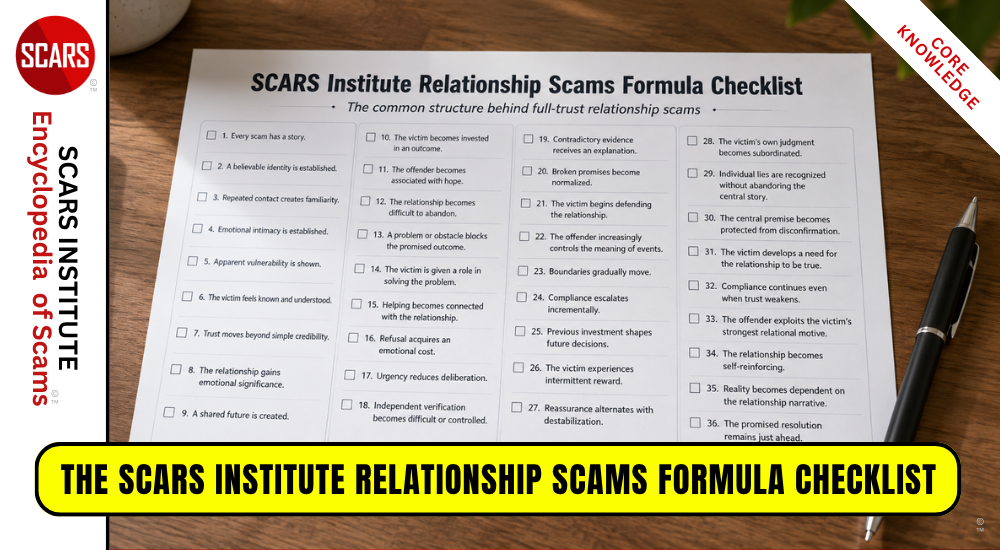
The SCARS Institute Relationship Scams Formula Checklist
This is the Formula that all Relationship Scams Follow




In the U.S. & Canada
U.S. & Canada Suicide Lifeline 988

Recent Comments
On Other Articles
- on SCARS Institute – Romance Scam Simulator: “Fantastic! I have to go to bed, but I’ll do some more tomorrow. I picked an easy scenario tonight, but…” Oct 9, 18:01
- on United States – Federal Bureau of Investigations [FBI]: “It is only that way because of the shame you feel. The reality is that it was not your fault.…” Sep 30, 15:36
- on United States – Federal Bureau of Investigations [FBI]: “yhisis humiliating experience e and isembarassassing to to own up to peolealreadyassume u are not to bright because Arnold and…” Sep 30, 12:28
- on United States – Federal Bureau of Investigations [FBI]: “should be better known by public live in assisiwdlivi g apartment many manyinstancresof Romance scams here ano.us ederly l” Sep 30, 12:24
- on Is It A Scam? Phone Scam Diagnostic – v1: “I tried the this test Is it a phone scam? Mine was. I think this is a helpful tool to…” Sep 30, 10:34
- on Is It A Scam? Romance Scam Diagnostic – v2: “Carole, as you move forward with your recovery, you will learn how this all works. It was not your fault.…” Sep 29, 17:37
- on Is It A Scam? Romance Scam Diagnostic – v2: “I was blinded by such clever manipulation” Sep 29, 15:15
- on The SCARS Institute Relationship Scams Formula Checklist – 2026: “As I read this I could see myself in every step with my scam. I gained a lot more knowledge…” Aug 28, 19:51
- on The Persistence of Danielle Delaunay as a Fake Identity – 2026: “Unfortunately, you are being scammed. She is using a fake name regardless. At this point, your best option is to…” Aug 26, 20:16
- on The Persistence of Danielle Delaunay as a Fake Identity – 2026: “Dear Sirs, I have met this woman with the name Abigail Boateng in Ghana. I have an intensive mail contact…” Aug 26, 12:28

I experienced all of the examples of brain fog in the weeks after the scam ended. I was in a state of shock, denial, avoidance and the pain from the betrayal was so immense. As the weeks went by and I was able to heal somewhat, the fog began to lift and I was able to function better. I still have trouble staying focused for long periods of time, but in the beginning, my attention span was terrible. I’m finally seeing progress in my how I process information, which is so encouraging.
Of the 7 brain fog states I identify with 6 of them. There are times when brain fog is so insulating it is hard to even understand what is happening. But most of the time the different states are quick and move off. Mostly I struggle with feeling disoriented and a short attention span. I was attributing this to my age and the aging process. But….maybe it’s not all aging.