


SCARS Institute’s Encyclopedia of Scams™ Published Continuously for 25 Years

Scams & Magic – Transformation: Shaping Realities
Part 22
Understanding the Methods Used by Both Scammers and Magicians to Deceive
Psychology of Scams – A SCARS Insight
Author:
• Tim McGuinness, Ph.D., DFin, MCPO, MAnth – Anthropologist, Scientist, Director of the Society of Citizens Against Relationship Scams Inc.
Article Abstract
“Transformation: Shaping Realities in Magic and Scams” examines how magicians and scammers use the concept of transformation to alter perceptions and manipulate reality.
In magic, transformation tricks involve changing an object or person from one state to another, using techniques like sleight of hand, mechanical devices, and visual illusions. The magician carefully prepares and uses misdirection to create a seamless and unexpected change, resulting in wonder and amazement for the audience.
Conversely, in scams, transformation refers to the scammers’ ability to shift identities, change narratives, and adapt their tactics to deceive and exploit victims. These transformations are designed to create confusion, manipulate perceptions, and heighten emotional distress, making it difficult for victims to recognize the scam.
Understanding these dynamics helps individuals appreciate the artistry of magic while staying vigilant against manipulative transformations in scams. Recognizing sudden changes in narrative or identity can be crucial for detecting and avoiding fraud.

Transformation: Shaping Realities in Magic and Scams
Transformation: Shaping Realities In Magic
In the art of magic, “Transformation” refers to any trick where the magician changes something from one state to another, creating a startling effect. This could be as simple as turning a red scarf into a blue one, or as complex as transforming an assistant into a tiger. The success of a transformation in magic hinges on the magician’s ability to execute the change seamlessly and unexpectedly.
Techniques of Transformation:
Physical Manipulation: For smaller items, magicians often use sleight of hand or mechanical devices to swap or alter objects without detection. Techniques might involve quick switches, hidden compartments, or deceptive props.
Visual Illusions: Larger transformations might use mirrors, screens, or lighting effects to create illusions that deceive the audience’s visual perceptions, making the transformation appear to occur in real-time.
Execution of the Transformation:
Preparation and Misdirection: Magicians prepare meticulously, often setting up the transformed item beforehand. During the performance, they use misdirection to ensure the audience is looking away at the crucial moment of change.
Dramatic Presentation: The transformation is typically presented with dramatic flair, emphasizing the magical change and enhancing the spectacle and surprise for the audience.
Psychological Effects in Magic:
Wonder and Amazement: The sudden and inexplicable change challenges the audience’s understanding of reality, leading to feelings of wonder and amazement.
Engagement and Curiosity: Seeing an object or person transform in unexpected ways engages the audience’s curiosity and can make them more attentive and invested in the performance.
Suspension of Disbelief: Effective transformations encourage the audience to suspend disbelief, embracing the magical reality presented by the magician and temporarily setting aside skepticism.
Transformation: Shaping Realities In Scams
In the context of scams, particularly those involving identity or financial schemes, “Transformation” refers to the way scammers change their tactics, appearance, or the nature of their schemes to avoid detection or to escalate their fraud.
Techniques of Transformation in Scams:
Identity Shifts: Scammers may transform their identities, using fake profiles, stolen identities, or altered documents to present themselves as trustworthy individuals or legitimate entities.
Narrative Changes: Throughout a scam, the narrative may transform based on the victim’s reactions and responses. Scammers adapt their stories to better manipulate their targets, altering details to exploit the victim’s vulnerabilities.
Execution of the Transformation in Scams:
Adaptation and Escalation: As victims become wary or the scam evolves, scammers transform their approach or escalate their demands to maintain control and continue the deception.
Cover and Concealment: Scammers often change communication methods, tactics, or even the nature of their requests to avoid detection by law enforcement or to confuse the victim.
Psychological Effects in Scams:
Confusion and Uncertainty: As the scammer transforms their tactics or identity, the victim may become increasingly confused and uncertain, making it difficult to make clear, rational decisions.
Manipulated Perceptions: Victims may find it challenging to discern the true nature of their interactions, as continuous transformations skew their perceptions and understanding of the situation.
Heightened Emotional Distress: The scam’s evolving nature can lead to increased anxiety and stress for the victim, particularly as the stakes of the scam escalate.
Comparison and Conclusion
Both in magic and scams, the concept of transformation is used to alter perceptions and realities. In magic, transformations are crafted to entertain and astonish, providing a spectacle that celebrates the impossible. In scams, however, transformations are manipulative tactics designed to deceive and exploit, causing real harm to the victims involved.
Understanding the dynamics of transformation in these contexts can help individuals appreciate the artistry behind magical performances while remaining vigilant and skeptical when encountering potential scams. Recognizing signs of transformation in scams, such as sudden changes in narrative or identity, can be crucial for detecting and avoiding fraud.
Continue the SCARS Institute Series on Scams & Magic
- Scams & Magic Part 1 – Understanding Financial Fraud Through The Lense Of Stage Magic Manipulation
- Scams & Magic Part 2 – How Relationship Scammers Use Techniques Similar To Magic Acts
- Scams & Magic Part 3 – The Prestige: The Ultimate Revelation
- Scams & Magic Part 4 – The Misdirection: A Key Element
- Scams & Magic Part 5 – The Backstory Setup: Crafting Believable Narratives
- Scams & Magic Part 6 – The Flourish: Adding Flair And Distraction
- Scams & Magic Part 7 – The Time Pressure: Urgency As A Tool
- Scams & Magic Part 8 – Other Stage Magic Techniques Used In Scams
- Scams & Magic Part 9 – The Setup And Anticipation
- Scams & Magic Part 10 – Patter And Rapport
- Scams & Magic Part 11 – Sleight Of Hand
- Scams & Magic Part 12 – The Misdirection Through Details
- Scams & Magic Part 13 – The Switch: Deception
- Scams & Magic Part 14 – The Controlled Reveal: Crafting Suspense
- Scams & Magic Part 15 – The Clean-Up: Final Acts
- Scams & Magic Part 16 – The Setup Or Pre-Show Work
- Scams & Magic Part 17 – The Build-Up: Crafting Suspense And Anticipation
- Scams & Magic Part 18 – The Turn: A Critical Moment
- Scams & Magic Part 19 – Forcing: Manipulating Choices
- Scams & Magic Part 20 – The Load: Strategic Placement
- Scams & Magic Part 21 – The Vanish: Disappearance Acts
- Scams & Magic Part 22 – Transformation: Shaping Realities
- Scams & Magic Part 23 – Restoration: Rebuilding
- Scams & Magic Part 24 – Stage Magic Glossary
More About Magic and Scams
- Equivocation – The Magician’s Choice – The Arts Of Manipulation
- Psychic Scams – Exploiting Scam Victims’ Cognitive Biases And Magical Thinking
- The Art Of Deception: The Fundamental Principals Of Successful Deceptions
- Paradoxical Persuasion – A Scammer Psychological Manipulation Technique
- Suggestibility – A Victim Vulnerability
More About The Psychology of Magic
- The Psychology Of Illusion: How Magicians Manipulate Your Mind And Perception | Alan Hudson
- Advanced Card Magic Techniques: The Ultimate Guide – Card Tricks
- 100 BEST Magic Tricks Revealed! (Video Tutorials) – Improve Magic
- The Magical Art of Manipulation
- Editorial: The Psychology of Magic and the Magic of Psychology – PMC (nih.gov)
- Psychology, stage magic, and demand characteristics — A.P. Grayson (apgrayson.com)
-/ 30 /-
What do you think about this?
Please share your thoughts in a comment below!
Table of Contents
To Understand All Scams
Read This
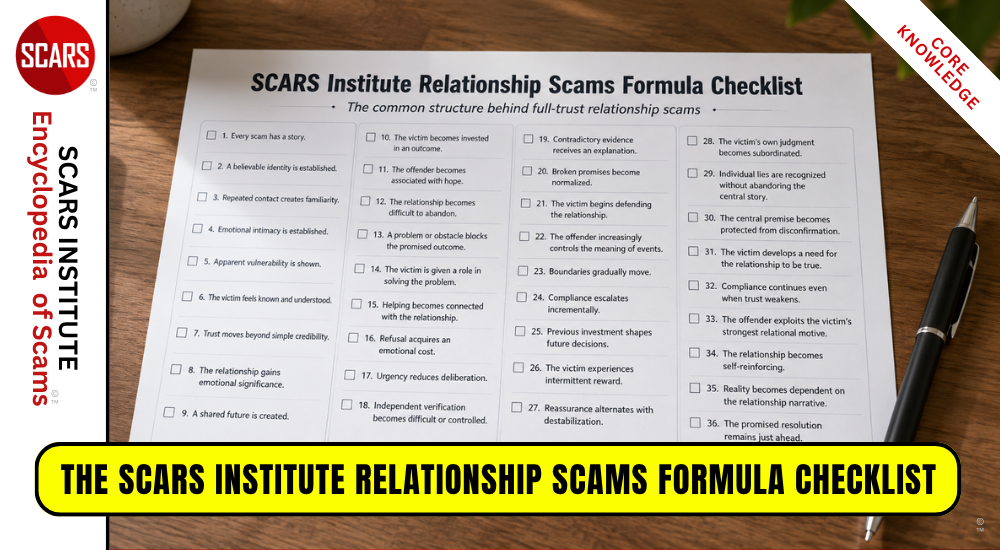
The SCARS Institute Relationship Scams Formula Checklist
This is the Formula that all Relationship Scams Follow



In the U.S. & Canada

U.S. & Canada Suicide Lifeline 988

Recent Comments
On Other Articles
- Barbara on SCARS Institute – Romance Scam Simulator: “Fantastic! I have to go to bed, but I’ll do some more tomorrow. I picked an easy scenario tonight, but…” Oct 9, 18:01
- on United States – Federal Bureau of Investigations [FBI]: “It is only that way because of the shame you feel. The reality is that it was not your fault.…” Sep 30, 15:36
- on United States – Federal Bureau of Investigations [FBI]: “yhisis humiliating experience e and isembarassassing to to own up to peolealreadyassume u are not to bright because Arnold and…” Sep 30, 12:28
- on United States – Federal Bureau of Investigations [FBI]: “should be better known by public live in assisiwdlivi g apartment many manyinstancresof Romance scams here ano.us ederly l” Sep 30, 12:24
- on Is It A Scam? Phone Scam Diagnostic – v1: “I tried the this test Is it a phone scam? Mine was. I think this is a helpful tool to…” Sep 30, 10:34
- on Is It A Scam? Romance Scam Diagnostic – v2: “Carole, as you move forward with your recovery, you will learn how this all works. It was not your fault.…” Sep 29, 17:37
- on Is It A Scam? Romance Scam Diagnostic – v2: “I was blinded by such clever manipulation” Sep 29, 15:15
- on The SCARS Institute Relationship Scams Formula Checklist – 2026: “As I read this I could see myself in every step with my scam. I gained a lot more knowledge…” Aug 28, 19:51
- on The Persistence of Danielle Delaunay as a Fake Identity – 2026: “Unfortunately, you are being scammed. She is using a fake name regardless. At this point, your best option is to…” Aug 26, 20:16
- on The Persistence of Danielle Delaunay as a Fake Identity – 2026: “Dear Sirs, I have met this woman with the name Abigail Boateng in Ghana. I have an intensive mail contact…” Aug 26, 12:28

Thank you for your comment. You may receive an email to follow up. We never share your data with marketers.