



SCARS Institute’s Encyclopedia of Scams™ Published Continuously for 25 Years

Scams & Magic – The Clean-Up: Final Acts
Part 15
Understanding the Methods Used by Both Scammers and Magicians to Deceive
Psychology of Scams – A SCARS Insight
Author:
• Tim McGuinness, Ph.D., DFin, MCPO, MAnth – Anthropologist, Scientist, Director of the Society of Citizens Against Relationship Scams Inc.
Article Abstract
In both magic and scams, “The Clean-Up” refers to the final steps taken to remove any evidence of deception and preserve the intended outcome.
In magic, this involves seamlessly disposing of gimmicks and resetting props to maintain the illusion, leaving the audience in awe and wonder. The clean-up ensures that the audience’s perception of the performance remains magical and flawless.
In scams, the clean-up involves erasing digital footprints, disappearing funds, and severing contact with victims to avoid detection and accountability. This phase leaves victims in confusion, disbelief, and often with long-term emotional and trust issues. Understanding the clean-up process highlights the importance of vigilance and critical thinking in both contexts, helping individuals recognize signs of deception and protect themselves from harm.

The Clean-Up: Final Acts in Magic and Scams
The Clean-Up: Final Acts In Magic
In the world of stage magic, “The Clean-Up” refers to the actions a magician takes to remove any evidence of the trickery involved in a performance. This phase is crucial because it ensures that the illusion remains intact even after the audience leaves, preserving the mystery and professionalism of the magician. The clean-up might involve discreetly disposing of gimmicks, resetting props, or subtly repositioning items while the audience’s attention is directed elsewhere.
Removing Trace Evidence:
Seamless Transition: Magicians often use the applause or distraction of a grand finale to covertly reset or remove any objects that could give away the trick’s method.
Maintaining Illusion: The goal is to leave the audience with no tangible proof of how the trick was performed, maintaining the illusion of magic and preventing any post-performance skepticism.
Psychological Closure:
Sustaining Wonder: By ensuring that no evidence remains, magicians leave the audience in a state of wonder, pondering the impossibility of what they’ve just witnessed.
Reinforcing Memory: The clean-up helps solidify the audience’s memory of the performance as flawless and magical, enhancing their overall experience and satisfaction.
The Clean-Up: Final Acts In Scams
In the context of scams, particularly sophisticated financial or relationship scams, “The Clean-Up” involves scammers taking steps to cover their tracks once their objectives have been achieved or if they sense the risk of exposure. This phase is about erasing evidence, severing contacts, and minimizing the chances of being caught, thereby protecting their ability to scam others in the future.
Covering Tracks:
Erasing Digital Footprints: Scammers may delete profiles, change phone numbers, or remove email accounts to erase any connections to their victims.
Disappearing Funds: Money is quickly transferred out of traceable accounts, often laundered through various channels to obscure its origins.
Severing Contact:
Ghosting Victims: Once the scam is complete, scammers often “ghost” their victims, ceasing all communication and leaving the victim unable to contact them.
Creating Plausible Deniability: In some cases, scammers might set up scenarios that explain their sudden disappearance, such as fabricated accidents or legal troubles, to leave victims with a believable reason for the end of communication.
Psychological Effects in Scams:
Confusion and Disbelief: The sudden disappearance of the scammer and the severing of all ties can leave victims in a state of shock and confusion, struggling to comprehend what has happened.
Closure and Resolution: The lack of closure can have a prolonged psychological impact on victims, leaving them with unresolved emotions and questions that may hinder their recovery.
Victim Blame: Victims may blame themselves for not recognizing the signs earlier, leading to feelings of guilt and self-doubt.
Trust Issues: Experiencing such a betrayal can lead to long-term trust issues, affecting victims’ ability to form new relationships or trust others.
Comparison and Conclusion:
In both magic and scams, “The Clean-Up” serves to preserve the creator’s intentions—whether to sustain the mystery of a magic trick or to escape accountability in a scam. However, the motivations and outcomes vastly differ.
In magic, the clean-up enhances the audience’s enjoyment and admiration for the magician, reinforcing the artistry of the performance. In scams, the clean-up is a self-serving act by the scammer designed to avoid detection and accountability, often leaving victims with significant emotional and financial damage.
Understanding the concept of the clean-up in both contexts highlights the importance of vigilance and critical thinking, whether enjoying a magic show or navigating personal and financial relationships. In the case of scams, recognizing when you might be in the clean-up phase could help mitigate damage and guide you toward seeking help and recovering from the deception.
Continue the SCARS Institute Series on Scams & Magic
- Scams & Magic Part 1 – Understanding Financial Fraud Through The Lense Of Stage Magic Manipulation
- Scams & Magic Part 2 – How Relationship Scammers Use Techniques Similar To Magic Acts
- Scams & Magic Part 3 – The Prestige: The Ultimate Revelation
- Scams & Magic Part 4 – The Misdirection: A Key Element
- Scams & Magic Part 5 – The Backstory Setup: Crafting Believable Narratives
- Scams & Magic Part 6 – The Flourish: Adding Flair And Distraction
- Scams & Magic Part 7 – The Time Pressure: Urgency As A Tool
- Scams & Magic Part 8 – Other Stage Magic Techniques Used In Scams
- Scams & Magic Part 9 – The Setup And Anticipation
- Scams & Magic Part 10 – Patter And Rapport
- Scams & Magic Part 11 – Sleight Of Hand
- Scams & Magic Part 12 – The Misdirection Through Details
- Scams & Magic Part 13 – The Switch: Deception
- Scams & Magic Part 14 – The Controlled Reveal: Crafting Suspense
- Scams & Magic Part 15 – The Clean-Up: Final Acts
- Scams & Magic Part 16 – The Setup Or Pre-Show Work
- Scams & Magic Part 17 – The Build-Up: Crafting Suspense And Anticipation
- Scams & Magic Part 18 – The Turn: A Critical Moment
- Scams & Magic Part 19 – Forcing: Manipulating Choices
- Scams & Magic Part 20 – The Load: Strategic Placement
- Scams & Magic Part 21 – The Vanish: Disappearance Acts
- Scams & Magic Part 22 – Transformation: Shaping Realities
- Scams & Magic Part 23 – Restoration: Rebuilding
- Scams & Magic Part 24 – Stage Magic Glossary
More About Magic and Scams
- Equivocation – The Magician’s Choice – The Arts Of Manipulation
- Psychic Scams – Exploiting Scam Victims’ Cognitive Biases And Magical Thinking
- The Art Of Deception: The Fundamental Principals Of Successful Deceptions
- Paradoxical Persuasion – A Scammer Psychological Manipulation Technique
- Suggestibility – A Victim Vulnerability
More About The Psychology of Magic
- The Psychology Of Illusion: How Magicians Manipulate Your Mind And Perception | Alan Hudson
- Advanced Card Magic Techniques: The Ultimate Guide – Card Tricks
- 100 BEST Magic Tricks Revealed! (Video Tutorials) – Improve Magic
- The Magical Art of Manipulation
- Editorial: The Psychology of Magic and the Magic of Psychology – PMC (nih.gov)
- Psychology, stage magic, and demand characteristics — A.P. Grayson (apgrayson.com)
-/ 30 /-
What do you think about this?
Please share your thoughts in a comment below!
Table of Contents
To Understand All Scams
Read This
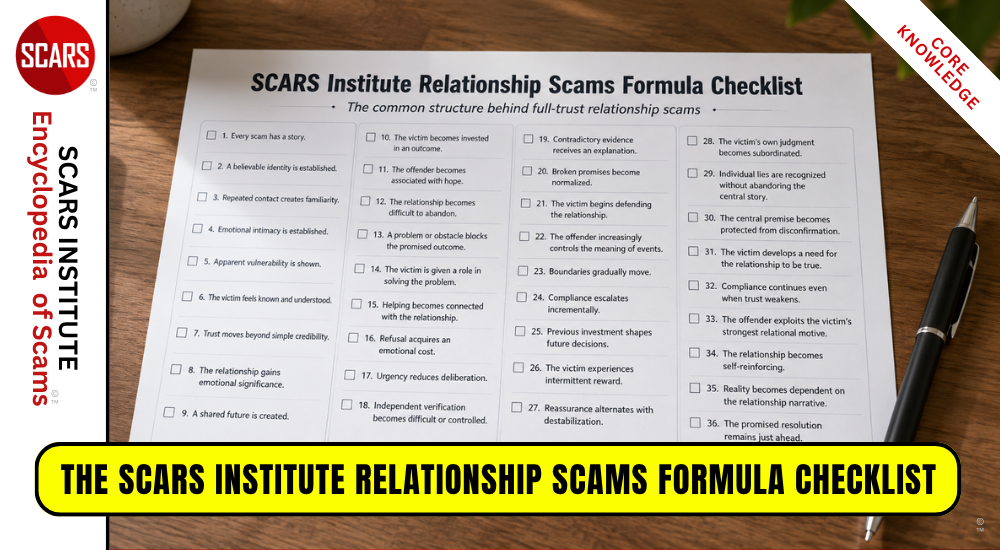
The SCARS Institute Relationship Scams Formula Checklist
This is the Formula that all Relationship Scams Follow




In the U.S. & Canada

U.S. & Canada Suicide Lifeline 988

Recent Comments
On Other Articles
- Barbara on SCARS Institute – Romance Scam Simulator: “Fantastic! I have to go to bed, but I’ll do some more tomorrow. I picked an easy scenario tonight, but…” Oct 9, 18:01
- on United States – Federal Bureau of Investigations [FBI]: “It is only that way because of the shame you feel. The reality is that it was not your fault.…” Sep 30, 15:36
- on United States – Federal Bureau of Investigations [FBI]: “yhisis humiliating experience e and isembarassassing to to own up to peolealreadyassume u are not to bright because Arnold and…” Sep 30, 12:28
- on United States – Federal Bureau of Investigations [FBI]: “should be better known by public live in assisiwdlivi g apartment many manyinstancresof Romance scams here ano.us ederly l” Sep 30, 12:24
- on Is It A Scam? Phone Scam Diagnostic – v1: “I tried the this test Is it a phone scam? Mine was. I think this is a helpful tool to…” Sep 30, 10:34
- on Is It A Scam? Romance Scam Diagnostic – v2: “Carole, as you move forward with your recovery, you will learn how this all works. It was not your fault.…” Sep 29, 17:37
- on Is It A Scam? Romance Scam Diagnostic – v2: “I was blinded by such clever manipulation” Sep 29, 15:15
- on The SCARS Institute Relationship Scams Formula Checklist – 2026: “As I read this I could see myself in every step with my scam. I gained a lot more knowledge…” Aug 28, 19:51
- on The Persistence of Danielle Delaunay as a Fake Identity – 2026: “Unfortunately, you are being scammed. She is using a fake name regardless. At this point, your best option is to…” Aug 26, 20:16
- on The Persistence of Danielle Delaunay as a Fake Identity – 2026: “Dear Sirs, I have met this woman with the name Abigail Boateng in Ghana. I have an intensive mail contact…” Aug 26, 12:28

Thank you for your comment. You may receive an email to follow up. We never share your data with marketers.