



SCARS Institute’s Encyclopedia of Scams™ Published Continuously for 25 Years
Business E-Mail Compromise Scam Warning
Across The World, Businesses Are Losing Over USD$100,000,000,000 A Year In BEC Scams
This is also 100% preventable with basic knowledge and safeguards
FBI Warns American Business Owners of Business E-Mail Compromise Scam
FBI Has Important Information For Area Business Owners Who Find Themselves The Victim Of A Business E-Mail Compromise Scam (BEC also known as CEO Scams).
This sophisticated financial fraud targets businesses of all types, especially those who regularly perform wire transfers. In addition to using spoofed e-mail accounts, the actors often compromise valid business e-mail accounts through social engineering or computer intrusion techniques to initiate wire transfers on the criminal’s behalf.
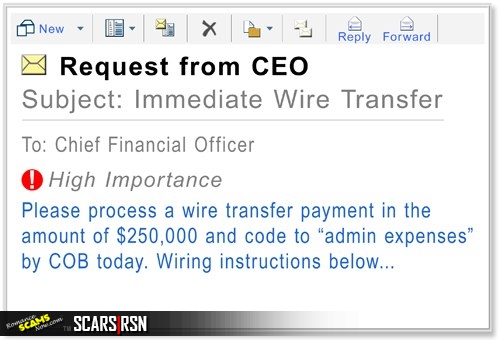
Example of a Business E-Mail Compromise Scam (BEC also known as CEO Scams)
Over the last two years, the FBI’s Internet Crime Complaint Center (IC3.gov) has seen a 2,370% increase in actual and attempted BEC losses, affecting businesses in all 50 states and 131 countries. Since October 2013, those losses total well over $5 billion in the Chicago area alone. Some estimates are that this is over US$100 billion annually (2021).
Tip #1: Know Who to Contact
Business owners who believe they have been caught up in a BEC scam should always contact their bank immediately. The next step is to contact law enforcement. Investigators say that deciding which law enforcement agency to contact in this situation can be confusing.
Each FBI Field office is home to a Business E-mail Compromise Task Force for that area. These local task forces are a joint effort between the FBI, United States Postal Inspection Service, Federal Housing Finance Agency, Local Police Departments, US Treasury Department, US Homeland Security Investigations, Office of Labor Racketeering and Fraud Investigations, and the Board of Governors of the Federal Reserve System Consumer Financial Protection Bureau. They were established in November 2016 to assist regional businesses facing the BEC threat.
Tip #2: Know How to Make Contact
Sending an email to BEC@ic.fbi.gov is the best and easiest way to contact the BEC task force. In your message, include the following:
- Date of the incident
- Summary of the incident
- Victim name
- Victim location (city, state)
- Victim bank name
- Victim bank account number
- Beneficiary name
- Beneficiary account number
- Beneficiary bank location
- Intermediary bank name
- SWIFT/IBAN number
- Date of transaction
- Amount of transaction
- Copies of e-mails, to include header information
Tip #3: Know When to Make Contact
Investigators say it is critical to contact law enforcement as soon as possible. In order to provide the best opportunity for the recovery of your funds, the BEC Task Force must be in a position to take action within 72 hours of the money leaving your account via a wire transfer.
Since its formation, the FBI BEC Task Force has stopped millions of dollars in wire transfers from being completed by cybercriminals.
More
![business-email-compromise-timeline-022717[1]](https://romancescamsnow.com/wp-content/uploads/2021/02/business-email-compromise-timeline-0227171.jpg "Business E-Mail Compromise Scam Warning business email compromise timeline 0227171")
TAGS: SCARS, Information About Scams, Anti-Scam, Scams, Scammers, Fraudsters, Cybercrime, Crybercriminals, Scam Victims, Online Fraud, Online Crime Is Real Crime, Scam Avoidance, BEC Scams, Business Fraud, Business Email Compromise Scams
PLEASE SHARE OUR ARTICLES WITH YOUR FRIENDS & FAMILY
HELP OTHERS STAY SAFE ONLINE – YOUR KNOWLEDGE CAN MAKE THE DIFFERENCE!
THE NEXT VICTIM MIGHT BE YOUR OWN FAMILY MEMBER OR BEST FRIEND!

By the SCARS™ Editorial Team
Society of Citizens Against Relationship Scams Inc.
A Worldwide Crime Victims Assistance & Crime Prevention Nonprofit Organization Headquartered In Miami Florida USA & Monterrey NL Mexico, with Partners In More Than 60 Countries
To Learn More, Volunteer, or Donate Visit: www.AgainstScams.org
Contact Us: Contact@AgainstScams.org
-/ 30 /-
What do you think about this?
Please share your thoughts in a comment below!
Table of Contents
To Understand All Scams
Read This
The SCARS Institute Relationship Scams Formula Checklist
This is the Formula that all Relationship Scams Follow



In the U.S. & Canada
U.S. & Canada Suicide Lifeline 988

Recent Comments
On Other Articles
- Barbara on SCARS Institute – Romance Scam Simulator: “Fantastic! I have to go to bed, but I’ll do some more tomorrow. I picked an easy scenario tonight, but…” Oct 9, 18:01
- on United States – Federal Bureau of Investigations [FBI]: “It is only that way because of the shame you feel. The reality is that it was not your fault.…” Sep 30, 15:36
- on United States – Federal Bureau of Investigations [FBI]: “yhisis humiliating experience e and isembarassassing to to own up to peolealreadyassume u are not to bright because Arnold and…” Sep 30, 12:28
- on United States – Federal Bureau of Investigations [FBI]: “should be better known by public live in assisiwdlivi g apartment many manyinstancresof Romance scams here ano.us ederly l” Sep 30, 12:24
- on Is It A Scam? Phone Scam Diagnostic – v1: “I tried the this test Is it a phone scam? Mine was. I think this is a helpful tool to…” Sep 30, 10:34
- on Is It A Scam? Romance Scam Diagnostic – v2: “Carole, as you move forward with your recovery, you will learn how this all works. It was not your fault.…” Sep 29, 17:37
- on Is It A Scam? Romance Scam Diagnostic – v2: “I was blinded by such clever manipulation” Sep 29, 15:15
- on The SCARS Institute Relationship Scams Formula Checklist – 2026: “As I read this I could see myself in every step with my scam. I gained a lot more knowledge…” Aug 28, 19:51
- on The Persistence of Danielle Delaunay as a Fake Identity – 2026: “Unfortunately, you are being scammed. She is using a fake name regardless. At this point, your best option is to…” Aug 26, 20:16
- on The Persistence of Danielle Delaunay as a Fake Identity – 2026: “Dear Sirs, I have met this woman with the name Abigail Boateng in Ghana. I have an intensive mail contact…” Aug 26, 12:28

Thank you for your comment. You may receive an email to follow up. We never share your data with marketers.