



SCARS Institute’s Encyclopedia of Scams™ Published Continuously for 25 Years
Has Financial Fraud Become a Major Driver of Homelessness with Scam Victims?
♦ A SCARS Commentary by Dr. Tim McGuinness
We all know that addiction, job loss, and mental health issues ranked as the top three responses from experts on homelessness up to 2019. However, something new is being seen across the world, but especially in the United States.
That is Scam Victim Homelessness!
The average losses from cyber-enabled financial fraud are increasing to staggering proportions. It is now estimated that the average loss per victim is nearing $100,000 – in 2019 this was estimated to be $9,000 to $14,000 depending on whom you talked to (the FBI or the FTC.)
Our organization SCARS is now talking with one or more people a day who say they have lost everything, including their homes, and are facing homelessness.
Local police are not doing enough (or in many cases, anything) to help connect these victims with social services that can help them. This is just one of the things that drive Scam Victim Homelessness!
But what makes it worse is the apparent fact that well below 5% of these crimes are never reported to law enforcement (the SCARS Analytics estimate is only 1.2%.) this means they don’t qualify for many services because they are not technically a victim of a crime, since it was never reported.
We talk with people who have nowhere to turn. Unfortunately, our own organization (www.AgainstScams.org) is not able to offer financial assistance – we simply do not have the donors to help victims financially.
Transnational organized cyber-enabled crimes are destroying millions of lives a year. The people making a difference can only help a fraction of those in need, This is a crime wave like nothing the world has EVER SEEN! It affects EVERY resident of every country – directly or indirectly.
Yet as a society, we generally pretend it is not a big deal! It will never happen to me, and if it did I would get my money back. WRONG.
Most victims turn to their local police and walk away with no help. They are either not aware, or are too ashamed to ask their local social services for help. This is a crisis of victims’ legal rights and their human rights!
SCARS would like to form a working group to help explore how we can all do a better job in helping victims on the local level. If you are interested in joining with us on this, please let us know by email at contact@AgainstScams.org. Our goal is to identify resources worldwide that can help avoid Scam Victim Homelessness.
Victims Deserve Better!
Are You Homeless Or At Risk Of Scam Victim Homelessness?
There are many resources that can help when you are facing homelessness, but they can also help any scam victim in need of financial help.
These resources are all for the United States, but similar services are available in many countries. Please check to see what is available in your country!
Article
-/ 30 /-
What do you think about this?
Please share your thoughts in a comment below!
Table of Contents
To Understand All Scams
Read This
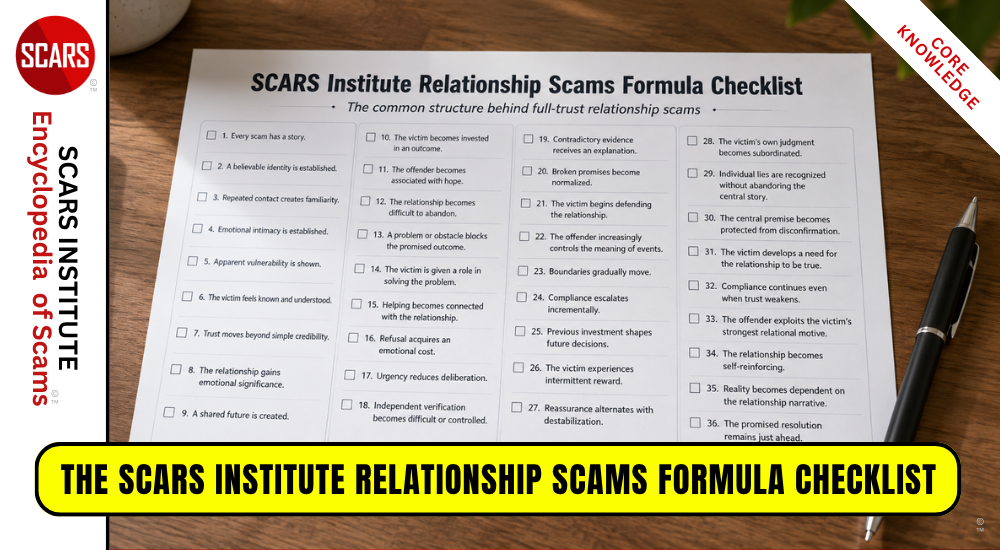
The SCARS Institute Relationship Scams Formula Checklist
This is the Formula that all Relationship Scams Follow



In the U.S. & Canada
U.S. & Canada Suicide Lifeline 988

Recent Comments
On Other Articles
- on SCARS Institute – Romance Scam Simulator: “Fantastic! I have to go to bed, but I’ll do some more tomorrow. I picked an easy scenario tonight, but…” Oct 9, 18:01
- on United States – Federal Bureau of Investigations [FBI]: “It is only that way because of the shame you feel. The reality is that it was not your fault.…” Sep 30, 15:36
- on United States – Federal Bureau of Investigations [FBI]: “yhisis humiliating experience e and isembarassassing to to own up to peolealreadyassume u are not to bright because Arnold and…” Sep 30, 12:28
- on United States – Federal Bureau of Investigations [FBI]: “should be better known by public live in assisiwdlivi g apartment many manyinstancresof Romance scams here ano.us ederly l” Sep 30, 12:24
- on Is It A Scam? Phone Scam Diagnostic – v1: “I tried the this test Is it a phone scam? Mine was. I think this is a helpful tool to…” Sep 30, 10:34
- on Is It A Scam? Romance Scam Diagnostic – v2: “Carole, as you move forward with your recovery, you will learn how this all works. It was not your fault.…” Sep 29, 17:37
- on Is It A Scam? Romance Scam Diagnostic – v2: “I was blinded by such clever manipulation” Sep 29, 15:15
- on The SCARS Institute Relationship Scams Formula Checklist – 2026: “As I read this I could see myself in every step with my scam. I gained a lot more knowledge…” Aug 28, 19:51
- on The Persistence of Danielle Delaunay as a Fake Identity – 2026: “Unfortunately, you are being scammed. She is using a fake name regardless. At this point, your best option is to…” Aug 26, 20:16
- on The Persistence of Danielle Delaunay as a Fake Identity – 2026: “Dear Sirs, I have met this woman with the name Abigail Boateng in Ghana. I have an intensive mail contact…” Aug 26, 12:28

Now in 2024 and 2025 the United States is experiencing a shortage of housing which makes this issue even more critical. But when you’ve lost your home, things like a computer or a cell phone have already been disposed of in many cases, especially the phone. Eliminating phone/internet service provides some available cash. That said most local libraries do provide a place where a person can access a computer and printer along with free internet. In this day when most people are experiencing living paycheck to paycheck or most seniors with only Social Security to depend on it is apparent that adequate income is a serious problem. Increased costs of healthcare add to this problem. Many are just one hospital stay from disaster.
Homelessness has reached epidemic levels overwhelming the system’s capability to properly respond to the needs. The huge assumption is a homeless person must have a phone, computer/tablet, a printer, internet connection and transportation (everything is now online). If a homeless person has access to all of this, they wouldn’t find themselves homeless in the first place. It’s a catch-22.