


SCARS Institute’s Encyclopedia of Scams™ Published Continuously for 25 Years
Originally published 2016
Beware of Savior Victims
One of the things that happen to some victims is they develop a kind of messiah complex – a necessity or mania to help other victims – meaning they think that only they can save others. They become a kind of collectors going around and gathering other souls so they can save them.
They join anti-scam groups to “help” them but actually have no training in victims’ support or related fields, nor any experience in criminology. They are just manic victims that seek to control what happened to them by controlling the experiences of other victims. A savior complex.
From a psychological perspective, this zeal to be an expert and help others is often an avoidance mechanism. They are avoiding their own pain from grief or trauma – at least initially – by trying to control their situation by controlling others. However, after a while, this can become a permanently entrenched behavior.
Saviors are Dangerous to Other Victims
Sadly, they can be very dangerous for some victims since most of you are looking for help, and you may not yet know the difference between real assistance and further manipulation.
This is not the same thing as simply offering advice or support to another victim in need. A Savior almost demands that right to speak for their victims and have them listen to them. They can be very domineering and hostile to differing viewpoints.
They tend to have very narrow and highly vigilante-style approaches to helping others. There is their way, and everyone else is wrong.
Savior Complex
What Is The Savior Complex?
The savior complex is a psychological construct that makes a person feel the need to save other people. This person has a strong tendency to seek people who desperately need help and to assist them, often sacrificing their own needs for these people.
There are many sides to a savior complex and it has many roots. One of its fundamental roots appears to consist of a limiting belief the savior person has that goes something like this:
“If I always help people in need, I will get their love and approval, and have a happy life.”
This Is, of course, a Nice Sounding Fairytale
In our experience, a savior will have such an assertive way of helping others that instead of allowing others to make their own choice, they get used to it and they expect other victims to accept their help, and when rejected can become overtly hostile. They feel entitled to give help whether it is wanted or not, simply because they need to give it. So while they may feel happy because they are helping others, at some level, they feel bitter and frustrated at the same time.
They are not masochistic; they have another belief that even if being a savior will not get them the recognition they want and will not make them happy, it is the noble thing to do. They believe they are somehow better than others because they help people without getting anything back. It is common for them to disagree and try to convince victims that professional experience is somehow invalid, and that the savior knows best.
If you think you have a savior complex or at least something close to it, the best thing you can do is to face up to the practical consequences it has in your life. Being a savior is neither noble nor practical. Learn to give and to ask for what you want, to help and to be helped. This is a healthy way to use your people skills and to interact with others.
Real Victims’ Assistance
Our job, as a real crime victims’ assistance and support organization, is to do our best to keep this a safe environment for you. To offer real knowledge and information based upon our own years of experience as well as based upon professional standards & certificates. We understand where the thin gray line is between support and professional care, and recommend those in need to seek it.
Unfortunately, Saviors Do Not!
It is for this reason that we ban individuals that try to manipulate and “collect” other victims. Unfortunately, they are many and are out there trolling other anti-scam groups. In fact, some groups are founded by such people.
Real victims’ assistance and support is a professional practice that requires training and experience in a multitude of subjects. Many amateurs can actually be dangerous to traumatized victims. Sadly they don’t know that they don’t know and are so driven they will not listen to reason.
Please be careful about connecting with other victims, especially in your early stages. Share information only in secure groups and not by private messages.
Please trust that not every victim is stable yet, and a drowning person can pull you down just as easily. So, for now, please keep a distance and keep yourself safe.
If someone tries to contact you and ask you to communicate privately avoid them, decline and please let us know at once.
Thank you! Stay safe!
-/ 30 /-
What do you think about this?
Please share your thoughts in a comment below!
Table of Contents
To Understand All Scams
Read This
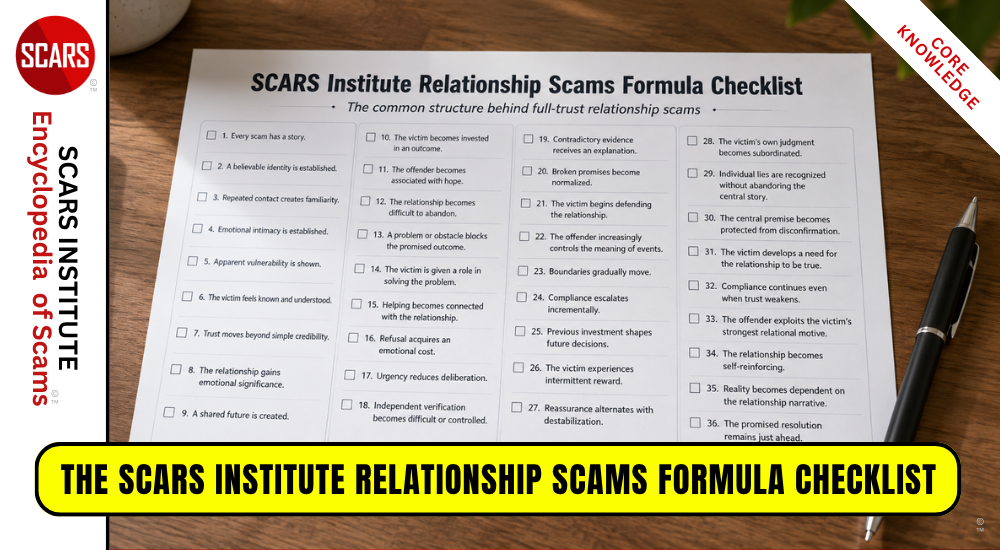
The SCARS Institute Relationship Scams Formula Checklist
This is the Formula that all Relationship Scams Follow

In the U.S. & Canada
U.S. & Canada Suicide Lifeline 988

Recent Comments
On Other Articles
- Barbara on SCARS Institute – Romance Scam Simulator: “Fantastic! I have to go to bed, but I’ll do some more tomorrow. I picked an easy scenario tonight, but…” Oct 9, 18:01
- on United States – Federal Bureau of Investigations [FBI]: “It is only that way because of the shame you feel. The reality is that it was not your fault.…” Sep 30, 15:36
- on United States – Federal Bureau of Investigations [FBI]: “yhisis humiliating experience e and isembarassassing to to own up to peolealreadyassume u are not to bright because Arnold and…” Sep 30, 12:28
- on United States – Federal Bureau of Investigations [FBI]: “should be better known by public live in assisiwdlivi g apartment many manyinstancresof Romance scams here ano.us ederly l” Sep 30, 12:24
- on Is It A Scam? Phone Scam Diagnostic – v1: “I tried the this test Is it a phone scam? Mine was. I think this is a helpful tool to…” Sep 30, 10:34
- on Is It A Scam? Romance Scam Diagnostic – v2: “Carole, as you move forward with your recovery, you will learn how this all works. It was not your fault.…” Sep 29, 17:37
- on Is It A Scam? Romance Scam Diagnostic – v2: “I was blinded by such clever manipulation” Sep 29, 15:15
- on The SCARS Institute Relationship Scams Formula Checklist – 2026: “As I read this I could see myself in every step with my scam. I gained a lot more knowledge…” Aug 28, 19:51
- on The Persistence of Danielle Delaunay as a Fake Identity – 2026: “Unfortunately, you are being scammed. She is using a fake name regardless. At this point, your best option is to…” Aug 26, 20:16
- on The Persistence of Danielle Delaunay as a Fake Identity – 2026: “Dear Sirs, I have met this woman with the name Abigail Boateng in Ghana. I have an intensive mail contact…” Aug 26, 12:28

Thank you for your comment. You may receive an email to follow up. We never share your data with marketers.