




SCARS Institute’s Encyclopedia of Scams™ Published Continuously for 25 Years
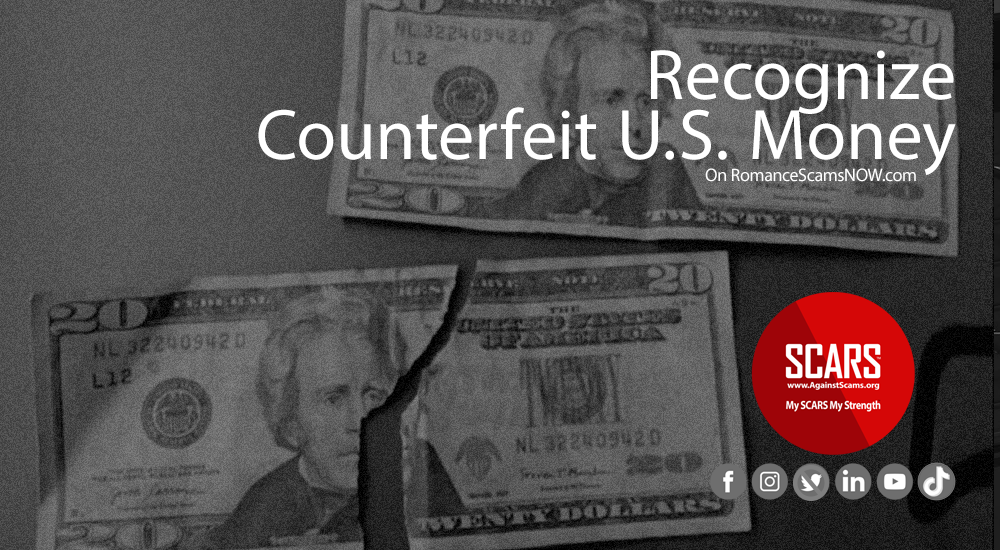
Recognize Counterfeit U.S. Money
A United States Secret Service Guide
Provided by SCARS
Do You Know Your Money?
Learn How To Spot Counterfeit Currency With This Guide!
Counterfeiting currency has been going on since people began using money. It has been dubbed “the world’s second-oldest profession” in some quarters, and we’re not talking about wooden nickels. According to the United States Department of Treasury, an estimated $70 million in counterfeit bills are in circulation, or approximately one counterfeit note for every 10,000 in genuine currency. You probably have some in your wallet right now!
Counterfeiting Is A Financial Crime! It Is A Scam!
Going as far back as 5th Century Rome, Alexander the Barber was one of the first famous counterfeiters. He became so well known that instead of being punished by the ruling Emperor Justinian, he was employed by the state finance department.
One of the first instances of counterfeiting took place in the American colonies when Native Americans would trade shells known as wampum as a form of currency. Blue-black shells, which were rarer, had more value than their white counterparts. As a result, some traders would dye the white shells a blue-black color and pass them off at higher value.
Shells were eventually replaced with coins made out of gold and silver. Each coin was weighted to be precisely the same, the value of the coin based on the weight. However, counterfeiters began to shave the sides of coins to collect the valuable metal, and this is why there are ridges on the outside of coins – to make it easy to spot the shaving.
Among the coin shavers were the English couple Anne and Thomas Rogers, who after being found guilty of treason, and were hanged, drawn and quartered, and burned.
Here is the United States Secret Service Guide to help you recognized the fakes!
[pdf-embedder url=”https://romancescamsnow.com/wp-content/uploads/2021/06/KnowYourMoney.pdf”]
Real or Fake?
The United States Secret Service recommends if you receive a counterfeit:
- Do not return it to the passer (the person that gave it to you)
- Delay the passer if possible (if in-person – and call the local police)
- Observe the passer’s description, as well as that of any companions, and the license plate numbers of any vehicles used
- Contact your local police department or United States Secret Service field office or your national police if outside the U.S.
- Write your initials and the date in the white border areas of the suspect bank note (money)
- Limit the handling of the note. Carefully place it in a protective covering, such as an envelope – this helps preserve fingerprints & DNA
- Surrender the note or coin only to a properly identified police officer or a U.S. Secret Service special agent
If you’ve received a fraudulent note please submit a Counterfeit Note Report through the local Secret Service office, you local, or other national police agency.
TAGS: SCARS, Information About Scams, Anti-Scam, Scams, Scammers, Fraudsters, Cybercrime, Crybercriminals, Romance Scams, Scam Victims, Online Fraud, Online Crime Is Real Crime, Scam Avoidance, Married Scam Victims, Internet Infidelity, Scam Victim Divorce
-/ 30 /-
What do you think about this?
Please share your thoughts in a comment below!
Table of Contents
To Understand All Scams
Read This
The SCARS Institute Relationship Scams Formula Checklist
This is the Formula that all Relationship Scams Follow


In the U.S. & Canada
U.S. & Canada Suicide Lifeline 988

Recent Comments
On Other Articles
- Barbara on SCARS Institute – Romance Scam Simulator: “Fantastic! I have to go to bed, but I’ll do some more tomorrow. I picked an easy scenario tonight, but…” Oct 9, 18:01
- on United States – Federal Bureau of Investigations [FBI]: “It is only that way because of the shame you feel. The reality is that it was not your fault.…” Sep 30, 15:36
- on United States – Federal Bureau of Investigations [FBI]: “yhisis humiliating experience e and isembarassassing to to own up to peolealreadyassume u are not to bright because Arnold and…” Sep 30, 12:28
- on United States – Federal Bureau of Investigations [FBI]: “should be better known by public live in assisiwdlivi g apartment many manyinstancresof Romance scams here ano.us ederly l” Sep 30, 12:24
- on Is It A Scam? Phone Scam Diagnostic – v1: “I tried the this test Is it a phone scam? Mine was. I think this is a helpful tool to…” Sep 30, 10:34
- on Is It A Scam? Romance Scam Diagnostic – v2: “Carole, as you move forward with your recovery, you will learn how this all works. It was not your fault.…” Sep 29, 17:37
- on Is It A Scam? Romance Scam Diagnostic – v2: “I was blinded by such clever manipulation” Sep 29, 15:15
- on The SCARS Institute Relationship Scams Formula Checklist – 2026: “As I read this I could see myself in every step with my scam. I gained a lot more knowledge…” Aug 28, 19:51
- on The Persistence of Danielle Delaunay as a Fake Identity – 2026: “Unfortunately, you are being scammed. She is using a fake name regardless. At this point, your best option is to…” Aug 26, 20:16
- on The Persistence of Danielle Delaunay as a Fake Identity – 2026: “Dear Sirs, I have met this woman with the name Abigail Boateng in Ghana. I have an intensive mail contact…” Aug 26, 12:28

Thank you for your comment. You may receive an email to follow up. We never share your data with marketers.