

SCARS Institute’s Encyclopedia of Scams™ Published Continuously for 25 Years

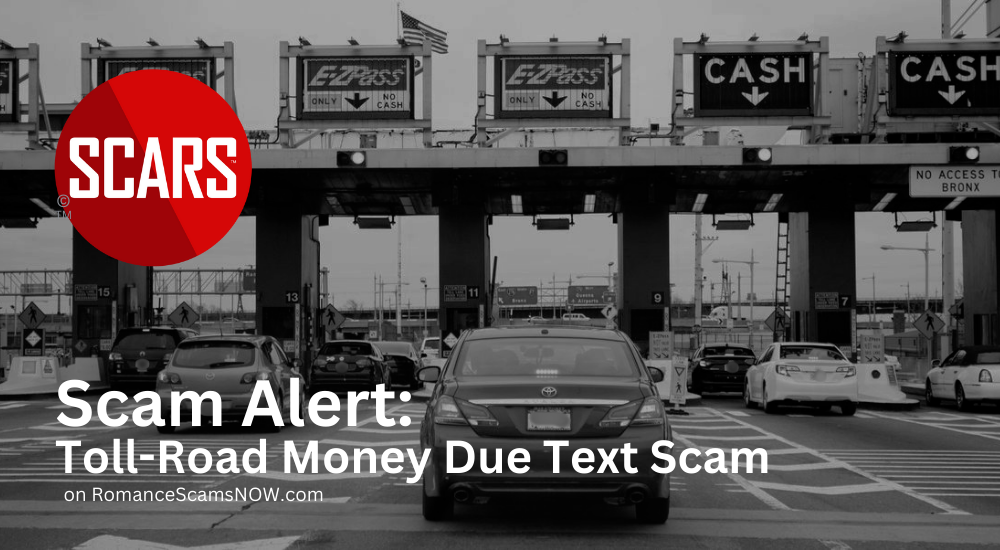
Scam Alert: Toll-Road Money Due Scam – U.S./Canada
Beware of Messages, Texts, and Phone Calls Claiming You Owe Toll-Road Fines!
How Scams Work – A SCARS Insight
Author:
• SCARS Editorial Team – Society of Citizens Against Relationship Scams Inc.
Article Abstract
Scammers are targeting travelers in the United States and Canada. They are employing a new toll-road money-due scam, reaching victims via phone calls, messages, and texts, all in an effort to extract money for fake fines and tolls. These scams typically involve false notifications claiming recipients owe money for unpaid tolls, often accompanied by urgent language and threats of legal repercussions.
Victims are then directed to make payments through specific methods, such as wire transfers or prepaid gift or debit cards, to resolve the supposed debt. The scam may also include fake documentation and an absence of the ability to verify, making it challenging for victims to discern the legitimacy of the communication.
According to the FBI, there has been a surge in complaints related to fraudulent texts representing toll collection services, with over 2,000 reports since early March 2024.
To avoid falling victim to these scams, individuals are advised to verify the source of any communications, question unsolicited messages demanding immediate payment, refrain from providing personal information, and report any suspicious activity to relevant authorities. By remaining vigilant and exercising caution, individuals can protect themselves from financial losses and other adverse consequences associated with toll-road money due scams.
SCARS Recommended Books
People Across the United States and Canada are being Scammed with Toll-Road Money Due Scam – by Phone, Message, and Text Scammers are Trying to Collect Money for Fake Fines and Tolls
A toll-road money-due scam involves fraudsters attempting to deceive individuals into paying fake fines or fees related to alleged violations on toll roads.
The texts or messages, or even phone calls claim the recipient owes money for unpaid tolls and contain almost identical language. The “outstanding toll amount” is similar to the complaints reported to the FBI. However, the link provided within the text is created to impersonate the state’s toll service name, and phone numbers appear to change between states.
Example Toll-Road Money Due Scam Message
(State Toll Service Name): We’ve noticed an outstanding toll amount of $12.51 on your record. To avoid a late fee of $50.00, visit https://myturnpiketollservices.com to settle your balance.
Here’s how the scam typically unfolds:
- False Notification: Victims receive communication, often via email, text message, or phone call, claiming to be from a toll road authority or a collection agency representing them. The message informs the recipient that they owe money due to a violation, such as failing to pay a toll or exceeding the speed limit on a toll road.
- Urgency and Threats: The communication usually emphasizes urgency and may include threats of legal action, license suspension, or increased fines if the alleged debt is not paid promptly. Scammers rely on intimidation tactics to pressure victims into immediate action without questioning the validity of the claims.
- Payment Request: Victims are instructed to make payments through specific methods, such as wire transfers, prepaid gift or debit cards, or cryptocurrency, to resolve the supposed debt. Scammers often provide instructions for making payments that are difficult to trace or reverse, making it easier for them to evade detection.
- Fake Documentation: In some cases, scammers may provide fake documentation, such as official-looking notices or invoices, to lend credibility to their claims. However, these documents are typically forged or misleading and do not represent legitimate fines or fees owed to toll road authorities.
- Absence of Verification: Victims may find it challenging to verify the legitimacy of the communication, especially if they are unfamiliar with the toll road in question or if the scammer provides convincing-sounding details. Often, toll fees and fines can only be seen on a specific authority website. However, legitimate toll road authorities typically have established procedures for handling violations and do not resort to aggressive or deceptive tactics to collect payment.
According to the FBI
The FBI has issued a warning about fraudulent text messages attempting to scam toll road and bridge users.
Since early-March 2024, the FBI Internet Crime Complaint Center (IC3) has received over 2,000 complaints reporting fake texts/smishing texts representing road toll collection service from at least three states. IC3 complaint information indicates the scam may be moving from state-to-state.
If you’re road tripping as the weather gets nice there’s a chance you’ll pass a toll if you’re heading somewhere far. And in this case, you could become a target for this latest scam.
Here’s what the Toll-Road Money Due Scam/fraud looks like:
You get a text that says you owe money for unpaid tolls. They may ask you for sensitive data, and credit card information.
“It goes on and says if you don’t pay now, there will be additional penalties. They want you to respond back or click on the link and not really think about it too much and make that payment. Then there’s a payment link at the bottom and that payment link is a website that closely resembles the toll authority but it’s obviously not the real toll authority,” said Toby Braun, managing partner of American Special Investigative Group.
If you Receive One of these Texts, Messages, or Calls
The following is suggested:
- File a complaint with the IC3, www.ic3.gov, be sure to include:
- The phone number from where the text or message or phone call originated.
- The website link listed within the text
- Check your own account using the toll service’s legitimate website, or contact the toll service’s customer service phone number.
- Delete any fake/smishing texts received.
- If you clicked any link or provided your information, make efforts to secure your personal information and financial accounts – change logins and passwords immediately. Dispute any unfamiliar charges.
Avoiding these Scams
To avoid falling victim to toll-road money due scams, individuals should:
- Next answer unknown phone numbers!
- Verify the Source: Contact the toll road authority directly using official contact information obtained from their website or official correspondence to confirm the validity of any notices or claims received, or search Google for the official website.
- Question Unsolicited Communications: Be cautious of unsolicited communications demanding immediate payment and threatening consequences for non-compliance. Legitimate authorities usually provide multiple opportunities for individuals to address violations before escalating enforcement actions.
- Do Not Provide Personal Information: Avoid sharing sensitive personal or financial information, such as Social Security numbers or credit card details, in response to unsolicited requests, especially if they come from unfamiliar or suspicious sources.
- Report Suspicious Activity: Report any suspected scams or fraudulent communications to relevant authorities, such as the FBI, Federal Trade Commission (FTC), local law enforcement agencies, or consumer protection agencies, to help prevent others from falling victim to similar schemes. See reporting.AgainstScams.org for more information on reporting.
By staying vigilant and exercising caution when dealing with requests for payment related to toll roads, individuals can protect themselves from falling prey to toll-road money due scams and avoid financial losses and other adverse consequences.
More Text & Message Scams:
- Robocalls and Text Scams – How To Stop Them – A SCARS Guide (romancescamsnow.com)
- “Hello” Text Message Scams (romancescamsnow.com)
- Venmo Text Scam (romancescamsnow.com)
- Identify and Stop Scam/Spam Text Messages (romancescamsnow.com)
- Text Message Scam Warning (romancescamsnow.com)
- FluBot: Package Delivery Text Message Shipping Scam (romancescamsnow.com)
- Don’t Click Links In Unknown Text Messages! Ever! (romancescamsnow.com)
-/ 30 /-
What do you think about this?
Please share your thoughts in a comment below!
Table of Contents
To Understand All Scams
Read This
The SCARS Institute Relationship Scams Formula Checklist
This is the Formula that all Relationship Scams Follow




In the U.S. & Canada
U.S. & Canada Suicide Lifeline 988

Recent Comments
On Other Articles
- Barbara on SCARS Institute – Romance Scam Simulator: “Fantastic! I have to go to bed, but I’ll do some more tomorrow. I picked an easy scenario tonight, but…” Oct 9, 18:01
- on United States – Federal Bureau of Investigations [FBI]: “It is only that way because of the shame you feel. The reality is that it was not your fault.…” Sep 30, 15:36
- on United States – Federal Bureau of Investigations [FBI]: “yhisis humiliating experience e and isembarassassing to to own up to peolealreadyassume u are not to bright because Arnold and…” Sep 30, 12:28
- on United States – Federal Bureau of Investigations [FBI]: “should be better known by public live in assisiwdlivi g apartment many manyinstancresof Romance scams here ano.us ederly l” Sep 30, 12:24
- on Is It A Scam? Phone Scam Diagnostic – v1: “I tried the this test Is it a phone scam? Mine was. I think this is a helpful tool to…” Sep 30, 10:34
- on Is It A Scam? Romance Scam Diagnostic – v2: “Carole, as you move forward with your recovery, you will learn how this all works. It was not your fault.…” Sep 29, 17:37
- on Is It A Scam? Romance Scam Diagnostic – v2: “I was blinded by such clever manipulation” Sep 29, 15:15
- on The SCARS Institute Relationship Scams Formula Checklist – 2026: “As I read this I could see myself in every step with my scam. I gained a lot more knowledge…” Aug 28, 19:51
- on The Persistence of Danielle Delaunay as a Fake Identity – 2026: “Unfortunately, you are being scammed. She is using a fake name regardless. At this point, your best option is to…” Aug 26, 20:16
- on The Persistence of Danielle Delaunay as a Fake Identity – 2026: “Dear Sirs, I have met this woman with the name Abigail Boateng in Ghana. I have an intensive mail contact…” Aug 26, 12:28

Thank you for your comment. You may receive an email to follow up. We never share your data with marketers.