

SCARS Institute’s Encyclopedia of Scams™ Published Continuously for 25 Years
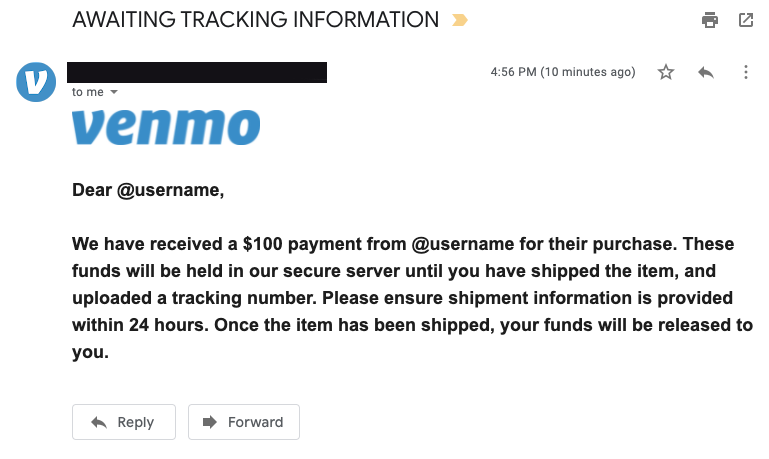
Venmo Text Scam
This Venmo Text Scam involves a scam type known as smishing, aka phishing over SMS. In essence, this is an account takeover fraud.
Beware of the latest scheme known as the Venmo Text Scam, where scammers employ deceptive tactics to trick unsuspecting users into believing their Venmo accounts are on the verge of being charged. These fraudsters send text messages, posing as representatives from Venmo, claiming that immediate action is required to reverse the impending charge. The urgency conveyed in these messages often lures many individuals into taking the bait.
Upon receiving such a Venmo Text Scam text, individuals are prompted to click on a provided link and log in to their Venmo accounts in order to safeguard their funds. However, as you may have already anticipated, this seemingly harmless link is merely a facade created by the criminals to gain access to your sensitive information. Once they obtain your login credentials, they exploit them to drain your funds and exploit your account for their own malicious purposes.
In order to protect yourself from falling victim to this Venmo Text Scam, it is crucial to exercise vigilance and carefully scrutinize any text messages claiming to be from Venmo. Refrain from clicking on the link if any of the following red flags are present:
- Suspicious Domain: If the domain of the provided link appears dubious or unfamiliar, exercise caution and refrain from clicking on it.
- Shortened URLs: If the URL appears to be shortened and you cannot discern its actual destination, exercise caution as it could be a camouflage for a fraudulent website.
- Typos in the URL: Pay close attention to the URL itself. If it contains any typographical errors or inconsistencies, it is likely a phishing attempt.
- Unsolicited Messages: Be wary if you receive the message via unsolicited direct messages (DMs), emails, or random texts. Legitimate notifications regarding your Venmo account are typically sent through official channels.
To ensure the legitimacy of any potential unauthorized charges on your Venmo account, it is advisable to rely solely on the official Venmo application or website. By doing so, you can verify the status of your account and address any concerns securely, without falling into the clutches of scammers.
Remember, staying informed about Venmo Text Scams and practicing caution is paramount in safeguarding your personal information and finances from unscrupulous individuals seeking to exploit unsuspecting Venmo users through text scams.
To Understand All Scams, Read This:
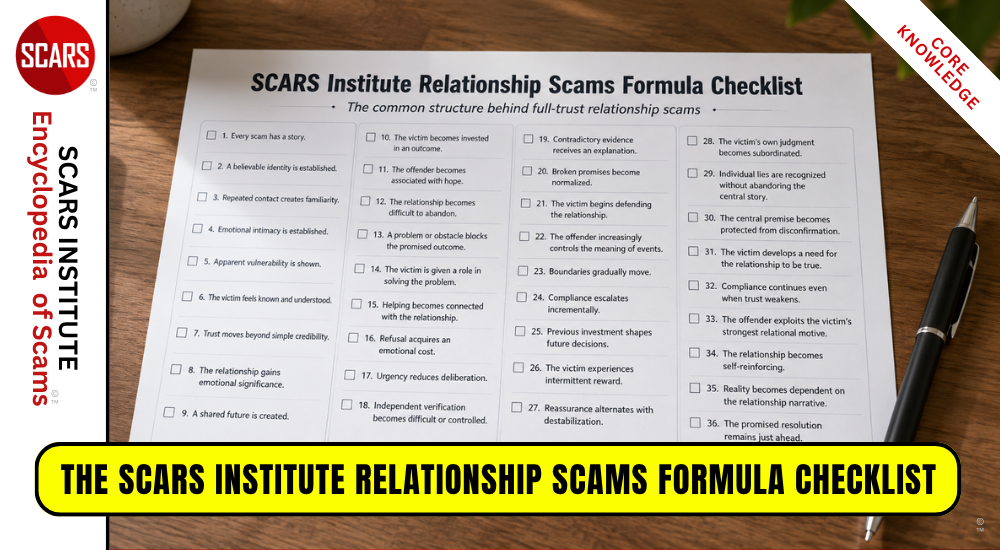
The SCARS Institute Relationship Scams Formula Checklist
This is the Formula that all Relationship Scams Follow
-/ 30 /-
What do you think about this?
Please share your thoughts in a comment below!
Table of Contents
Please Tell Us What You Took From This?
Please Leave A Comment!
Commenting Is An Essential Part Of Healing
Read • Think • Write
Recent Comments
On Other Articles
- Cynthia Frank on The SCARS Institute Relationship Scams Formula Checklist – 2026: “As I read this I could see myself in every step with my scam. I gained a lot more knowledge…” Aug 28, 19:51
- on The Persistence of Danielle Delaunay as a Fake Identity – 2026: “Unfortunately, you are being scammed. She is using a fake name regardless. At this point, your best option is to…” Aug 26, 20:16
- on The Persistence of Danielle Delaunay as a Fake Identity – 2026: “Dear Sirs, I have met this woman with the name Abigail Boateng in Ghana. I have an intensive mail contact…” Aug 26, 12:28
- on Trauma-Induced Fear May Cause Paranoia: “Very interesting article. I’m wondering if someone would likely recognize that they’re becoming increasingly paranoid, or hypervigilant, or does it…” Aug 24, 12:07
- on Spotting AI Scams – Using AI to Catch Artificial Intelligence Scams – 2026: “Wow, very useful and thorough advice! I don’t plan on talking to any strangers online ever again, at least not…” Aug 22, 22:11
- on The Persistence of Danielle Delaunay as a Fake Identity – 2026: “Knowing they are criminals, why would you want to talk to them? Avoid all strangers online.” Aug 19, 12:54
- on The Persistence of Danielle Delaunay as a Fake Identity – 2026: “THERE ARE THREE DANIELLE DELAUNAYS ON FACEBOOK RIGHT NOW USEING HER NAME AND PHOTOS. I’M BEING TOLD THEY ARE ALL…” Aug 19, 11:15
- on Natalie Sparks: Have You Seen Her? Another Stolen Face / Stolen Identity: “John, we are sorry, but you are still being scammed.” Aug 19, 09:52
- on #1 Worldwide – SCARS Anyscam.com: “You have been scammed. The unfortunate part about the images is difficult to address. You can learn more about Sextortion…” Aug 19, 09:48
- on SCARS™ Scam News Now: Six Ghanaian Scammers Arrested in the U.K. For Online Fraud: “Ann, recognizing that it was a scam is the first step in healing. We can help in your after-scam healing…” Aug 19, 09:47
ARTICLE META
Important Information for New Scam Victims
- Please visit www.ScamVictimsSupport.org – a SCARS Website for New Scam Victims & Sextortion Victims
- Enroll in FREE SCARS Scam Survivor’s School now at www.SCARSeducation.org
- Please visit www.ScamPsychology.org – to more fully understand the psychological concepts involved in scams and scam victim recovery
If you are looking for local trauma counselors please visit counseling.AgainstScams.org or join SCARS for our counseling/therapy benefit: membership.AgainstScams.org
If you need to speak with someone now, you can dial 988 or find phone numbers for crisis hotlines all around the world here: www.opencounseling.com/suicide-hotlines
A Note About Labeling!
We often use the term ‘scam victim’ in our articles, but this is a convenience to help those searching for information in search engines like Google. It is just a convenience and has no deeper meaning. If you have come through such an experience, YOU are a Survivor! It was not your fault. You are not alone! Axios!
A Question of Trust
At the SCARS Institute, we invite you to do your own research on the topics we speak about and publish, Our team investigates the subject being discussed, especially when it comes to understanding the scam victims-survivors experience. You can do Google searches but in many cases, you will have to wade through scientific papers and studies. However, remember that biases and perspectives matter and influence the outcome. Regardless, we encourage you to explore these topics as thoroughly as you can for your own awareness.
Statement About Victim Blaming
SCARS Institute articles examine different aspects of the scam victim experience, as well as those who may have been secondary victims. This work focuses on understanding victimization through the science of victimology, including common psychological and behavioral responses. The purpose is to help victims and survivors understand why these crimes occurred, reduce shame and self-blame, strengthen recovery programs and victim opportunities, and lower the risk of future victimization.
At times, these discussions may sound uncomfortable, overwhelming, or may be mistaken for blame. They are not. Scam victims are never blamed. Our goal is to explain the mechanisms of deception and the human responses that scammers exploit, and the processes that occur after the scam ends, so victims can better understand what happened to them and why it felt convincing at the time, and what the path looks like going forward.
Articles that address the psychology, neurology, physiology, and other characteristics of scams and the victim experience recognize that all people share cognitive and emotional traits that can be manipulated under the right conditions. These characteristics are not flaws. They are normal human functions that criminals deliberately exploit. Victims typically have little awareness of these mechanisms while a scam is unfolding and a very limited ability to control them. Awareness often comes only after the harm has occurred.
By explaining these processes, these articles help victims make sense of their experiences, understand common post-scam reactions, and identify ways to protect themselves moving forward. This knowledge supports recovery by replacing confusion and self-blame with clarity, context, and self-compassion.
Additional educational material on these topics is available at ScamPsychology.org – ScamsNOW.com and other SCARS Institute websites.
Psychology Disclaimer:
All articles about psychology and the human brain on this website are for information & education only
The information provided in this article is intended for educational and self-help purposes only and should not be construed as a substitute for professional therapy or counseling.
While any self-help techniques outlined herein may be beneficial for scam victims seeking to recover from their experience and move towards recovery, it is important to consult with a qualified mental health professional before initiating any course of action. Each individual’s experience and needs are unique, and what works for one person may not be suitable for another.
Additionally, any approach may not be appropriate for individuals with certain pre-existing mental health conditions or trauma histories. It is advisable to seek guidance from a licensed therapist or counselor who can provide personalized support, guidance, and treatment tailored to your specific needs.
If you are experiencing significant distress or emotional difficulties related to a scam or other traumatic event, please consult your doctor or mental health provider for appropriate care and support.
Also read our SCARS Institute Statement about Professional Care for Scam Victims – click here to go to our ScamsNOW.com website.


Thank you for your comment. You may receive an email to follow up. We never share your data with marketers.