





SCARS Institute’s Encyclopedia of Scams™ Published Continuously for 25 Years
Fighting Authorized Push Payment Fraud: A New Reimbursement Requirement
This represents a major breakthrough for U.K. Scam Victims
Fraud is the largest contributor to crime in the UK, and authorized push payment (APP) scams continue to have a devastating impact on people who fall victim, with only 46% of reported cases being reimbursed.
The Payment Systems Regulator (PSR) has today published its policy statement on the new “world first” reimbursement requirement (https://www.psr.org.uk/publications/policy-statements/ps23-3-fighting-authorised-push-payment-fraud-a-new-reimbursement-requirement).
Key Points:
- Require payment firms to reimburse all in-scope customers who fall victim to APP fraud in most cases
- Share the cost of reimbursing victims 50:50 between sending and receiving payment firms
- Provide additional protections for vulnerable customers
- Process to begin by end of 2023
The introduction of mandatory reimbursement for APP fraud (money transfer fraud) within the Faster Payments system aims to:
- Incentivize the payment industry to invest in fraud prevention by making every payment firm meet the cost of reimbursing; and
- Increase customer protection so that most victims of APP fraud are swiftly reimbursed
The new reimbursement requirement will apply to all Payment Service Providers (PSPs), with the cost of reimbursement to be shared 50:50 between sending and receiving payment firms.
Sending PSPs must reimburse customers within 5 business days. There will be a maximum level of reimbursement for APP fraud claims under the new reimbursement requirement; the PSR will consult on the appropriate maximum value and this will be published in PSR guidance in Q4 2023.
There is no minimum threshold. Customers will have 13 months from final payment to the fraudster in which to make a claim.
There are two exceptions to reimbursement under the new requirement:
- Where the customer has acted fraudulently (“first-party fraud”)
- Where the customer has acted with gross negligence
The PSR states that: “gross negligence is a high bar and, where suspected, the burden of proof is on the PSP”. The PSR interprets “gross negligence” to be a higher standard than the standard of negligence under common law i.e. the customer needs to have shown a very significant degree of carelessness.
The decision to retain the “gross negligence” exception (as per the CRM Code) was made to guard against the risk that if customers are more confident of being reimbursed, they will take less care in ensuring that their payee is not a fraudster.
Sending PSPs will have the option to apply a claim excess (the appropriate level for such excess will be consulted on in due course). However, the “gross negligence” exception and claim excess must not be applied to vulnerable customers. As part of assessing an APP fraud case, the sending PSP should assess the customer’s situation and any potential vulnerability in line with the FCA’s guidance (FCA, FG21/1 Guidance for firms on the fair treatment of vulnerable customers (February 2021).
The new reimbursement requirement will come into force in 2024. However, the PSR expects PSPs to start work now to implement the new reimbursement requirement. Tenet welcomes the new reimbursement requirement as we continue to see the devastating impact of APP fraud on both individuals and businesses alike.
Portions courtesy of TENET


-/ 30 /-
What do you think about this?
Please share your thoughts in a comment below!
Table of Contents
To Understand All Scams
Read This
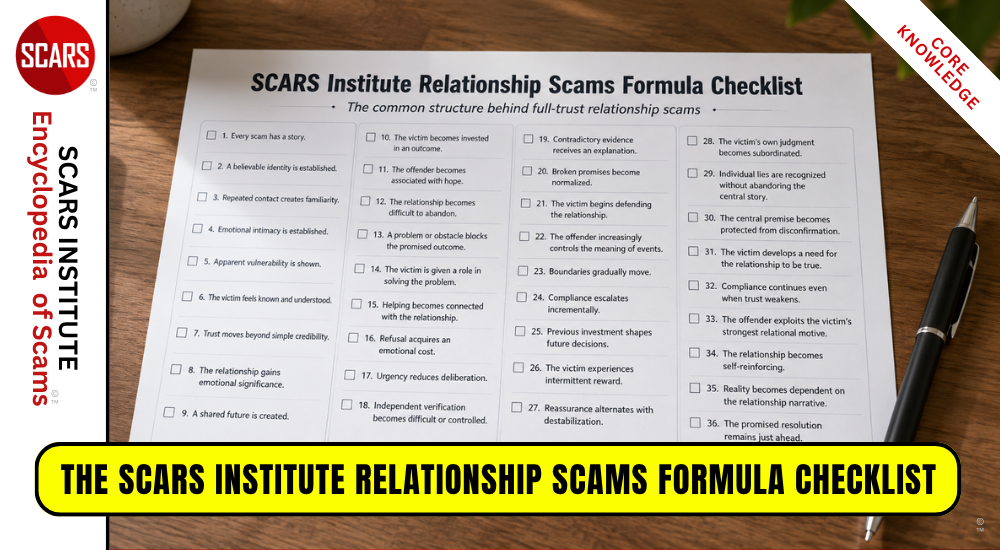
The SCARS Institute Relationship Scams Formula Checklist
This is the Formula that all Relationship Scams Follow



In the U.S. & Canada
U.S. & Canada Suicide Lifeline 988

Recent Comments
On Other Articles
- Barbara on SCARS Institute – Romance Scam Simulator: “Fantastic! I have to go to bed, but I’ll do some more tomorrow. I picked an easy scenario tonight, but…” Oct 9, 18:01
- on United States – Federal Bureau of Investigations [FBI]: “It is only that way because of the shame you feel. The reality is that it was not your fault.…” Sep 30, 15:36
- on United States – Federal Bureau of Investigations [FBI]: “yhisis humiliating experience e and isembarassassing to to own up to peolealreadyassume u are not to bright because Arnold and…” Sep 30, 12:28
- on United States – Federal Bureau of Investigations [FBI]: “should be better known by public live in assisiwdlivi g apartment many manyinstancresof Romance scams here ano.us ederly l” Sep 30, 12:24
- on Is It A Scam? Phone Scam Diagnostic – v1: “I tried the this test Is it a phone scam? Mine was. I think this is a helpful tool to…” Sep 30, 10:34
- on Is It A Scam? Romance Scam Diagnostic – v2: “Carole, as you move forward with your recovery, you will learn how this all works. It was not your fault.…” Sep 29, 17:37
- on Is It A Scam? Romance Scam Diagnostic – v2: “I was blinded by such clever manipulation” Sep 29, 15:15
- on The SCARS Institute Relationship Scams Formula Checklist – 2026: “As I read this I could see myself in every step with my scam. I gained a lot more knowledge…” Aug 28, 19:51
- on The Persistence of Danielle Delaunay as a Fake Identity – 2026: “Unfortunately, you are being scammed. She is using a fake name regardless. At this point, your best option is to…” Aug 26, 20:16
- on The Persistence of Danielle Delaunay as a Fake Identity – 2026: “Dear Sirs, I have met this woman with the name Abigail Boateng in Ghana. I have an intensive mail contact…” Aug 26, 12:28

Thank you for your comment. You may receive an email to follow up. We never share your data with marketers.