


Murphy’s Law for Scams, Scammers, and Scam Victims – Part 1
A SCARS Institute Scam Victim Recovery Insight
Murphy’s Law for scams is not about blaming you. It is about naming the predictable ways the brain, the nervous system, and emotion can be pulled off course under coercion, pressure, and manufactured intimacy. Scammers exploit normal human mechanisms like empathy, attachment, pattern-finding, and the need for certainty. When the situation feels confusing or urgent, the mind often tries to reduce distress by making it feel normal, explaining it away, or turning uncertainty into a story that feels safe enough to follow. These principles are written to help scam survivors recognize what happened without shame, and to translate painful hindsight into practical protection and recovery.
Here are but a few. Trust us, there are many more.
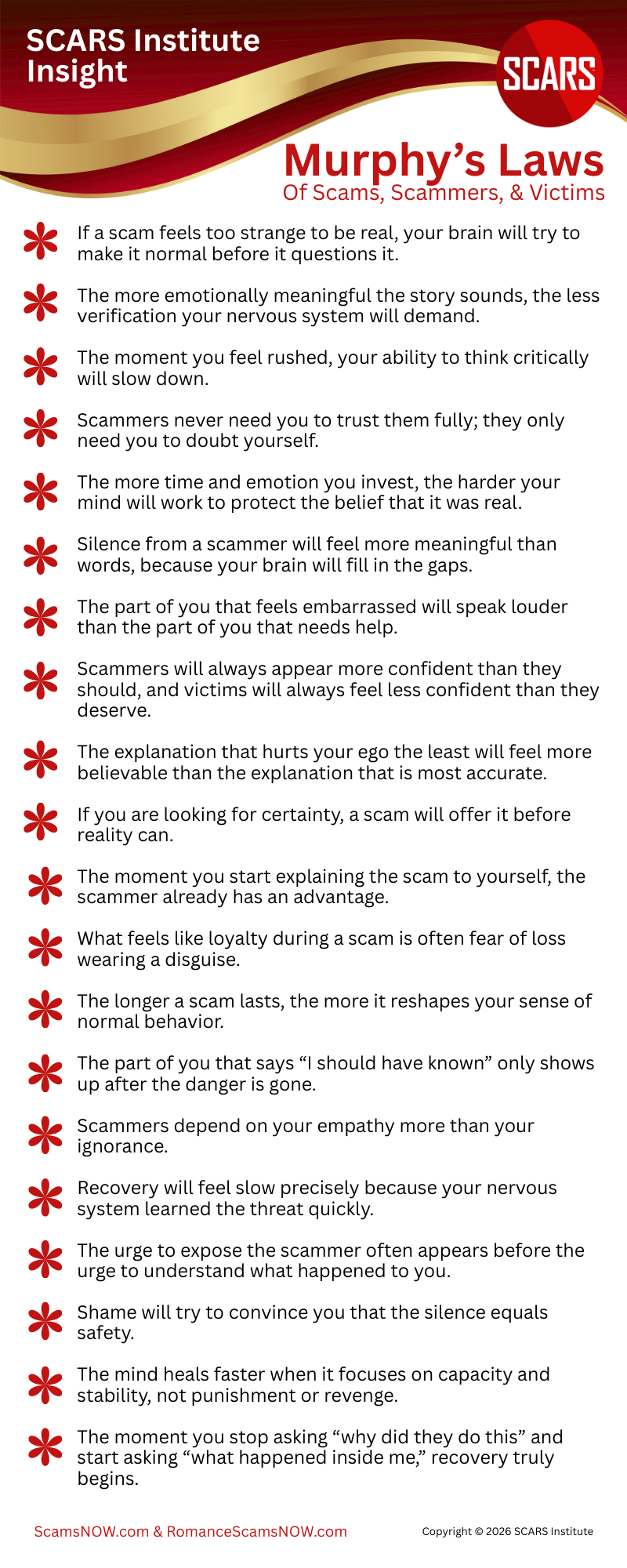
- If a scam feels too strange to be real, your brain will try to make it normal before it questions it.
- The more emotionally meaningful the story sounds, the less verification your nervous system will demand.
- The moment you feel rushed, your ability to think critically will slow down.
- Scammers never need you to trust them fully; they only need you to doubt yourself.
- The more time and emotion you invest, the harder your mind will work to protect the belief that it was real.
- Silence from a scammer will feel more meaningful than words, because your brain will fill in the gaps.
- The part of you that feels embarrassed will speak louder than the part of you that needs help.
- Scammers will always appear more confident than they should, and victims will always feel less confident than they deserve.
- The explanation that hurts your ego the least will feel more believable than the explanation that is most accurate.
- If you are looking for certainty, a scam will offer it before reality can.
- The moment you start explaining the scam to yourself, the scammer already has an advantage.
- What feels like loyalty during a scam is often fear of loss wearing a disguise.
- The longer a scam lasts, the more it reshapes your sense of normal behavior.
- The part of you that says “I should have known” only shows up after the danger is gone.
- Scammers depend on your empathy more than your ignorance.
- Recovery will feel slow precisely because your nervous system learned the threat quickly.
- The urge to expose the scammer often appears before the urge to understand what happened to you.
- Shame will try to convince you that the silence equals safety.
- The mind heals faster when it focuses on capacity and stability, not punishment or revenge.
- The moment you stop asking “why did they do this” and start asking “what happened inside me,” your recovery begins.
These “laws” describe patterns, not flaws. They show how quickly the nervous system learns threat and how slowly it may relearn safety, especially after a relationship scam or prolonged manipulation. The goal is not to replay the past or punish yourself for being human. The goal is to rebuild trust in your perception, strengthen your capacity to pause and verify, and reduce the shame that keeps victims silent. When you treat your reactions as understandable survival responses, you create space for stable recovery. The turning point often arrives when attention shifts away from the scammer’s motives and toward the internal experience that made the scam believable, tolerable, and hard to release. That is where clarity grows, and where lasting safety begins.
Prof. Tim McGuinness, Ph.D.
February 2026
-/ 30 /-
What do you think about this?
Please share your thoughts in a comment below!

LEAVE A COMMENT?
Recent Comments
On Other Articles
- SCARS Institute Editorial Team on United States – Federal Bureau of Investigations [FBI]: “It is only that way because of the shame you feel. The reality is that it was not your fault.…” Sep 30, 15:36
- on United States – Federal Bureau of Investigations [FBI]: “yhisis humiliating experience e and isembarassassing to to own up to peolealreadyassume u are not to bright because Arnold and…” Sep 30, 12:28
- on United States – Federal Bureau of Investigations [FBI]: “should be better known by public live in assisiwdlivi g apartment many manyinstancresof Romance scams here ano.us ederly l” Sep 30, 12:24
- on Is It A Scam? Phone Scam Diagnostic – v1: “I tried the this test Is it a phone scam? Mine was. I think this is a helpful tool to…” Sep 30, 10:34
- on Is It A Scam? Romance Scam Diagnostic – v2: “Carole, as you move forward with your recovery, you will learn how this all works. It was not your fault.…” Sep 29, 17:37
- on Is It A Scam? Romance Scam Diagnostic – v2: “I was blinded by such clever manipulation” Sep 29, 15:15
- on The SCARS Institute Relationship Scams Formula Checklist – 2026: “As I read this I could see myself in every step with my scam. I gained a lot more knowledge…” Aug 28, 19:51
- on The Persistence of Danielle Delaunay as a Fake Identity – 2026: “Unfortunately, you are being scammed. She is using a fake name regardless. At this point, your best option is to…” Aug 26, 20:16
- on The Persistence of Danielle Delaunay as a Fake Identity – 2026: “Dear Sirs, I have met this woman with the name Abigail Boateng in Ghana. I have an intensive mail contact…” Aug 26, 12:28
- on Trauma-Induced Fear May Cause Paranoia: “Very interesting article. I’m wondering if someone would likely recognize that they’re becoming increasingly paranoid, or hypervigilant, or does it…” Aug 24, 12:07
ARTICLE META
A Note About Labeling!
We often use the term ‘scam victim’ in our articles, but this is a convenience to help those searching for information in search engines like Google. It is just a convenience and has no deeper meaning. If you have come through such an experience, YOU are a Survivor! It was not your fault. You are not alone! Axios!
Psychology Disclaimer:
All articles about psychology and the human brain on this website are for information & education only
The information provided in this article is intended for educational and self-help purposes only and should not be construed as a substitute for professional therapy or counseling.
While any self-help techniques outlined herein may be beneficial for scam victims seeking to recover from their experience and move towards recovery, it is important to consult with a qualified mental health professional before initiating any course of action. Each individual’s experience and needs are unique, and what works for one person may not be suitable for another.
Additionally, any approach may not be appropriate for individuals with certain pre-existing mental health conditions or trauma histories. It is advisable to seek guidance from a licensed therapist or counselor who can provide personalized support, guidance, and treatment tailored to your specific needs.
If you are experiencing significant distress or emotional difficulties related to a scam or other traumatic event, please consult your doctor or mental health provider for appropriate care and support.
Also read our SCARS Institute Statement about Professional Care for Scam Victims – click here to go to our ScamsNOW.com website.


Thank you for your comment. You may receive an email to follow up. We never share your data with marketers.