

SCARS Institute’s Encyclopedia of Scams™ Published Continuously for 25 Years
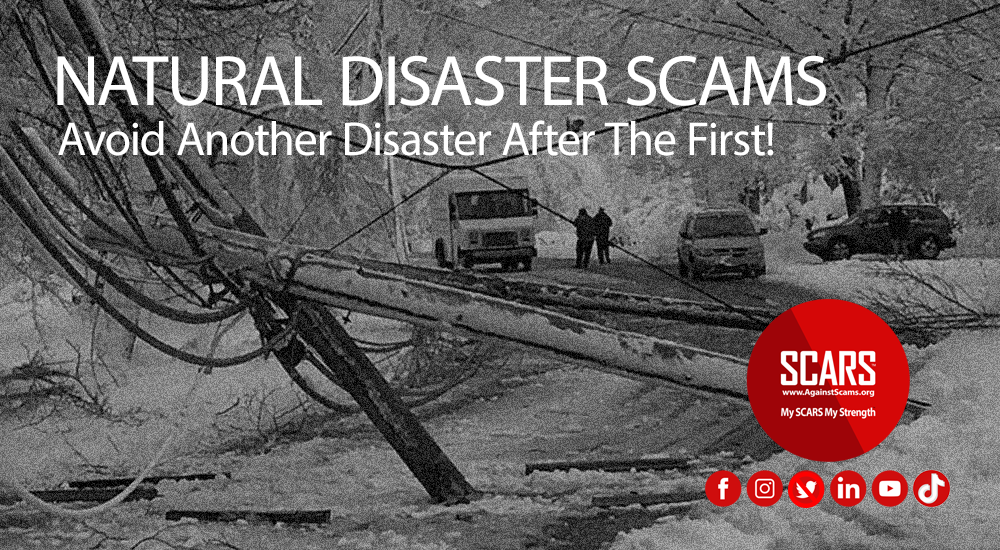
After Storms, Watch Out for Scams
Scammers Watch The Weather Channel Too!
After every natural disaster or major weather event, the scammers will be on the phones, email, and online to get your money!
Scammers Have No Conscience When It Comes To Natural Disaster Scams
If You Are In An Affected Region, Or Even Not, You Will Start Getting The Money Requests!
Natural disasters and severe weather can create opportunities for fraud in their wake, occurring at a time when people may be especially vulnerable, or targeting charitable intentions.
Scammers use phone, text, mail, email, and even go door to door to target residents of affected areas following hurricanes and damaging storms.
Watch Out for Red Flags
First, know that officials with government disaster assistance agencies do not call or text asking for financial account information and that there is no fee required to apply for or get disaster assistance from FEMA or the Small Business Administration.
Anyone claiming to be a federal official who asks for money is an imposter. This is true regardless of what country you live in.
Remember that phone scams often use spoofing techniques to deliberately falsify the information transmitted to your caller ID display to disguise their identity or make the call appear to be official.
IF SOMEONE CALLS CLAIMING TO BE A GOVERNMENT OFFICIAL, HANG UP AND CALL THE PHONE NUMBER LISTED ON THAT GOVERNMENT AGENCY’S OFFICIAL WEBSITE
Never reveal any personal information unless you’ve confirmed you’re dealing with a legitimate official. Workers and agents who knock on doors of residences are required to carry official identification and show it upon request, and they may not ask for or accept money.
Steps for Avoiding Post-Disaster Insurance Scams
If you get a phone call about an insurance claim or policy, don’t give out any personal information or agree to any payment until you can independently verify that the call is legitimate.
If the caller says they’re from your insurance company, hang up and contact your agent or the company directly using the number on your account statement. Policyholders with the National Flood Insurance Program (NFIP Direct) at www.floodsmart.gov or you can call 1-800-638-6620.
Contractors and home improvement companies may also call claiming to be partners with your insurance provider. Never give policy numbers, coverage details, or other personal information out to companies with whom you have not entered into a contract. If your state requires licensing, verify that any contractor you are considering is licensed and carries adequate insurance. Many states have online databases you can check.
Disaster Relief Charity Scams
Consumers should also be aware of scammers posing as representatives of charities seeking donations for disaster relief. There are several steps you can take to protect yourself from this type of fraud:
- Verify all phone numbers for charities. If you need to contact a charity by phone, check the charity’s official website to see if the number you have is legitimate. If you’re using text-to-donate, check with the charity to ensure the number is legitimate before donating.
- Do not open suspicious emails. If you receive a suspicious email requesting donations or other assistance, do not click on any links or open any attachments. Scammers regularly use email for phishing attacks and to spread malware.
- Verify the information in social media posts. Double-check any solicitation for charitable donations before you give. Crowd-funding websites often host individual requests for help but they are not always vetted by the site or other sources.
To report suspected fraud in the United States, call the FEMA Disaster Fraud Hotline toll free at 1-866-720-5721. If you need to report other fraudulent activities during or following a natural disaster, please notify FEMA at 1-866-720-5721 or disaster@leo.gov. In other countries look for your local disaster relief agency or contact your local police.
Tips To Help You Avoid Post-Disaster Scams
Whether you’re getting ready to deal with the aftermath of Gulf Coast storms, Laura and Marco, dealing with the ravages of wildfires out West, reeling from the derecho that struck the Midwest, or facing another natural disaster, handling the aftermath is never easy. But when scammers target people just trying to recover, it can be even worse.
Here Are Some Additional Tips To Help You Avoid Common Post-Disaster Scams
Be skeptical of anyone promising immediate clean-up and debris removal. Some may quote outrageous prices, demand payment up-front, or lack the skills needed.
- Check them out. Before you pay, ask for IDs, licenses, and proof of insurance. Don’t believe any promises that aren’t in writing.
- Never pay by wire transfer, gift card, or in cash. And never make the final payment until the work is done and you’re satisfied.
- Guard your personal information. Only scammers will say they’re an official and then demand money or your credit card, bank account, or Social Security number.
- Know that FEMA doesn’t charge application fees. If someone wants money to help you qualify for FEMA funds, that’s probably a scam.
- Be wise to rental listing scams. Steer clear of people who tell you to wire money or ask for security deposits or rent before you’ve met or signed a lease.
- Spot disaster-related charity scams. Scammers will often try to make a quick profit from the misfortune of others. Check out the FTC’s advice on donating wisely and avoiding charity scams.
Bookmark Dealing with Weather Emergencies
If a weather event or disaster may affect you, make sure you bookmark in your browser the official government websites in advance. This will let you find them quickly when needed, or when you are faced with a scam communication.
Suspect A Scam?
You can also report disaster scams to the FTC at ftc.gov/complaint. Be sure you also report scam phone numbers and email addresses on the SCARS site www.Anyscam.com
How to Avoid Identity Theft and Scams After Natural Disasters
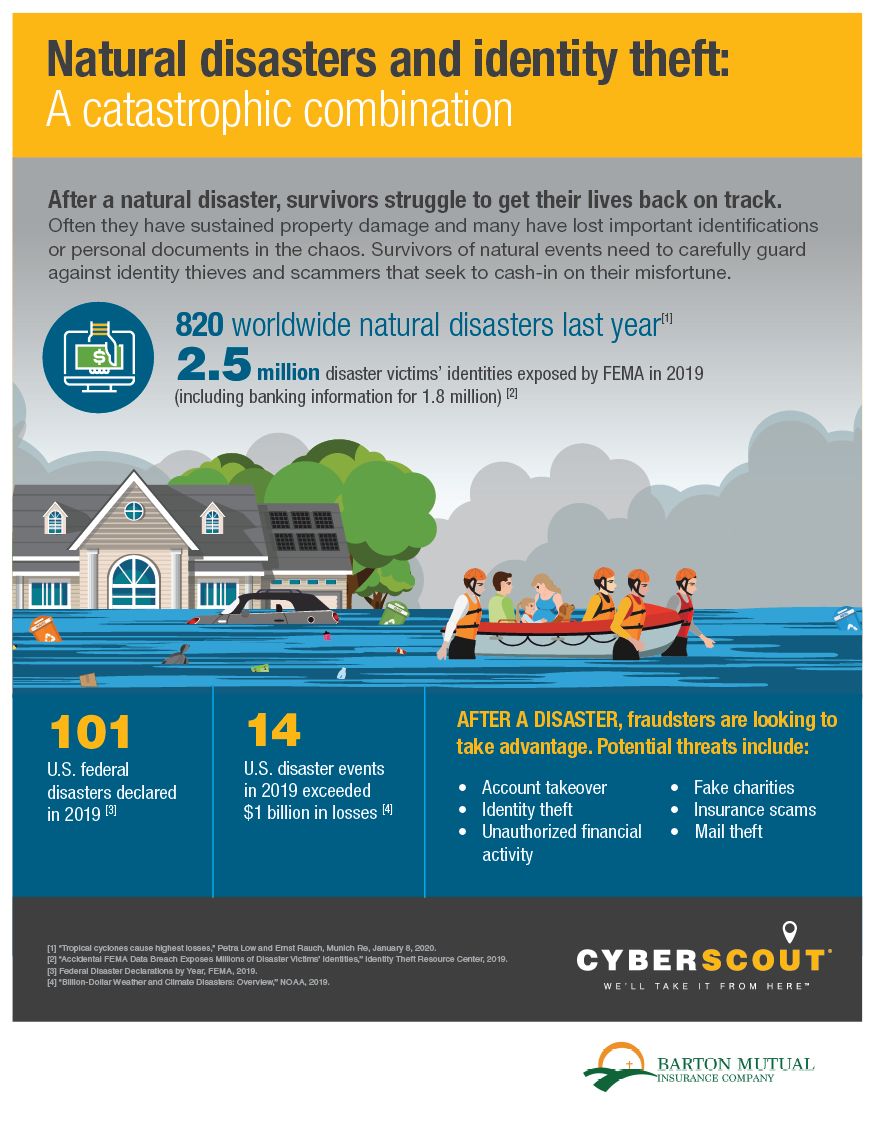
In 2019, the world suffered through 820 natural disasters, including floods, storms, fires, and earthquakes
In the U.S. 14 different disasters, each caused more than one billion dollars in losses—it was the fifth consecutive year with more than 10 billion-dollar disasters.
In the aftermath of disasters, a different kind of danger lurks—identity theft and disaster scams. In the chaos and confusion, identity thieves swipe unsecured personal information and scammers target disaster victims.
Review this infographic courtesy of Bostom Mutual Insurance Company to learn about the impact of natural disasters. Your best defense is a solid disaster plan that also considers identity protection. Start making your plan today.
TAGS: SCARS, Information About Scams, Anti-Scam, Scams, Scammers, Fraudsters, Cybercrime, Crybercriminals, Disaster Scams, Scam Victims, Online Fraud, Online Crime Is Real Crime, Scam Avoidance, Natural Disasters, Weather Events, Emergency Scams, Emergency Fraud, Natural Disaster Fraud, Phone Scams, Insurance Scams, Emergency Support Scams, FEMA Scams,
PLEASE SHARE OUR ARTICLES WITH YOUR FRIENDS & FAMILY
HELP OTHERS STAY SAFE ONLINE – YOUR KNOWLEDGE CAN MAKE THE DIFFERENCE!
THE NEXT VICTIM MIGHT BE YOUR OWN FAMILY MEMBER OR BEST FRIEND!
By the SCARS™ Editorial Team
Society of Citizens Against Relationship Scams Inc.
A Worldwide Crime Victims Assistance & Crime Prevention Nonprofit Organization Headquartered In Miami Florida USA & Monterrey NL Mexico, with Partners In More Than 60 Countries
To Learn More, Volunteer, or Donate Visit: www.AgainstScams.org
Contact Us: Contact@AgainstScams.org
-/ 30 /-
What do you think about this?
Please share your thoughts in a comment below!
Table of Contents
To Understand All Scams
Read This
The SCARS Institute Relationship Scams Formula Checklist
This is the Formula that all Relationship Scams Follow
In the U.S. & Canada
U.S. & Canada Suicide Lifeline 988

Recent Comments
On Other Articles
- Barbara on SCARS Institute – Romance Scam Simulator: “Fantastic! I have to go to bed, but I’ll do some more tomorrow. I picked an easy scenario tonight, but…” Oct 9, 18:01
- on United States – Federal Bureau of Investigations [FBI]: “It is only that way because of the shame you feel. The reality is that it was not your fault.…” Sep 30, 15:36
- on United States – Federal Bureau of Investigations [FBI]: “yhisis humiliating experience e and isembarassassing to to own up to peolealreadyassume u are not to bright because Arnold and…” Sep 30, 12:28
- on United States – Federal Bureau of Investigations [FBI]: “should be better known by public live in assisiwdlivi g apartment many manyinstancresof Romance scams here ano.us ederly l” Sep 30, 12:24
- on Is It A Scam? Phone Scam Diagnostic – v1: “I tried the this test Is it a phone scam? Mine was. I think this is a helpful tool to…” Sep 30, 10:34
- on Is It A Scam? Romance Scam Diagnostic – v2: “Carole, as you move forward with your recovery, you will learn how this all works. It was not your fault.…” Sep 29, 17:37
- on Is It A Scam? Romance Scam Diagnostic – v2: “I was blinded by such clever manipulation” Sep 29, 15:15
- on The SCARS Institute Relationship Scams Formula Checklist – 2026: “As I read this I could see myself in every step with my scam. I gained a lot more knowledge…” Aug 28, 19:51
- on The Persistence of Danielle Delaunay as a Fake Identity – 2026: “Unfortunately, you are being scammed. She is using a fake name regardless. At this point, your best option is to…” Aug 26, 20:16
- on The Persistence of Danielle Delaunay as a Fake Identity – 2026: “Dear Sirs, I have met this woman with the name Abigail Boateng in Ghana. I have an intensive mail contact…” Aug 26, 12:28

Thank you for your comment. You may receive an email to follow up. We never share your data with marketers.