


SCARS Institute’s Encyclopedia of Scams™ Published Continuously for 25 Years

Pig Butchering Scam/Crypto Investment Scam
A Relationship Scam
Crime Typology Overview / Victim Impact Analysis
CRIMINOLOGY & VICTIMOLOGY – A SCARS Institute Article Catalog
Pig Butchering Scam/Crypto Investment Scam is a form of investment fraud where criminals exploit emotional vulnerability & desires to gain financial, personal, or psychological advantage over their victims.
A Pig Butchering Scam/Crypto Investment Scam is a part of a broader category of Trust-Based Relationship Scams
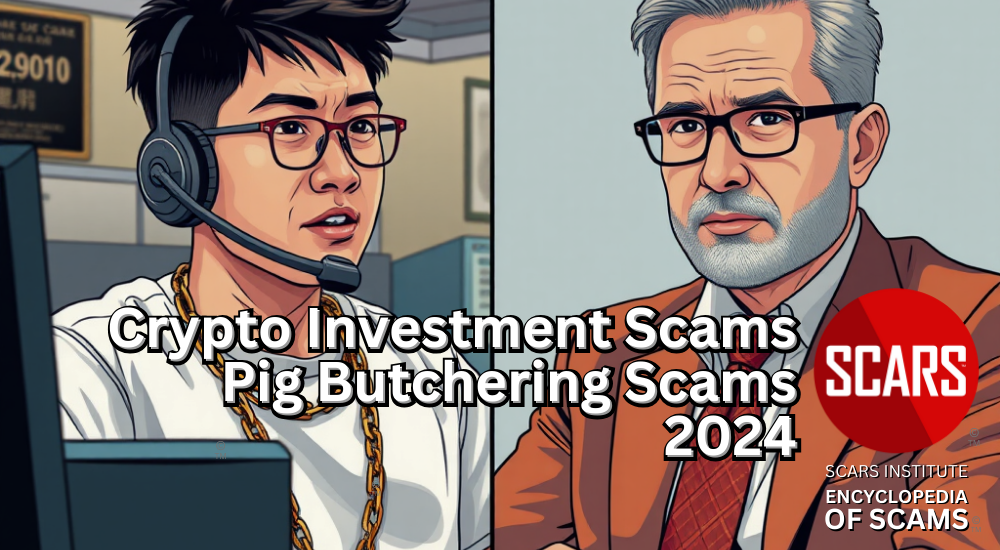
A pig butchering scam, also known as a crypto investment scam, is a sophisticated form of financial fraud that combines romance or friendship, deception, and false investment opportunities to exploit victims for large sums of money. The term originated in China and refers to the process of “fattening up” the victim over time with false promises and emotional manipulation, followed by an abrupt financial slaughter (rug pull) when the scammer drains the victim’s funds or simply disappears. This type of fraud is now considered one of the fastest-growing and most financially devastating scams operating globally.
Pig butchering scams target individuals through social media platforms, dating apps, encrypted messaging services, and even random text messages. The initial contact is often casual and appears coincidental, such as a message that seems mistakenly sent to the wrong person. The scammer quickly shifts the conversation to friendly small talk, often complimenting the victim or expressing interest in building a connection. Unlike traditional romance scams that focus purely on emotional manipulation, pig butchering scams combine relationship-building with false financial expertise.
Scammers typically present themselves as successful investors, business professionals, or financially independent individuals. They use stolen photographs, fake social media profiles, and fabricated personal histories to create a believable identity. The story often includes living abroad, working in finance, or having inside knowledge of cryptocurrency or stock markets. Their role as a supposed financial expert establishes credibility early in the relationship.
Once trust is established, the scammer introduces the victim to the idea of investing in cryptocurrency or foreign exchange markets. They often claim to have access to exclusive investment platforms, insider information, or trading strategies that yield guaranteed profits. The conversation is carefully structured to create excitement about quick financial growth, while also positioning the scammer as a mentor or guide. Victims may be shown fake trading dashboards, counterfeit websites, or fabricated account statements to demonstrate false profits and build credibility.
The scammer encourages the victim to start with small investments, often allowing them to see modest, fabricated returns to build confidence. The victim may be able to withdraw a small amount of money initially, reinforcing the belief that the investment is legitimate. Over time, the scammer pressures the victim to increase their investment, claiming that higher profits require larger deposits. This manipulation can stretch over weeks or months, with daily communication designed to deepen both emotional trust and financial dependency.
As the victim becomes more financially entangled, the scammer may invent scenarios that require urgent action, such as exclusive investment windows, market volatility, or sudden opportunities that require immediate deposits. These tactics create pressure and urgency, leading victims to drain savings, take out loans, or liquidate assets to meet the scammer’s demands. In some cases, victims are manipulated into believing they are partners in a lucrative investment, only to discover that the entire platform is fake.
Once the scammer determines that the victim has no more funds to extract, they cut off contact, disappear from the communication channels, or lock the victim out of the fake investment platform. Victims are left with significant financial losses, no means of recovery, and emotional devastation. The financial slaughter at the end of the scam is where the term pig butchering derives its meaning.
Typical victims of pig butchering scams come from diverse backgrounds, but common patterns have emerged. Many victims are financially stable, middle-aged adults seeking companionship, friendship, or networking opportunities online, though younger investors can also easily become victims. Individuals who are new to cryptocurrency, curious about investing, or unfamiliar with the technology behind digital assets are particularly vulnerable. These scams often target people with retirement savings, home equity, or other liquid assets that can be quickly transferred.
Victims experiencing loneliness, social isolation, or significant life transitions, such as divorce, bereavement, or career changes, are frequent targets. Scammers exploit emotional vulnerability alongside financial ambition, making the fraud difficult to detect until significant damage has occurred. Unlike traditional romance scams that rely purely on emotional deception, pig butchering scams use a calculated mix of affection, trust-building, and financial manipulation.
The modus operandi of pig butchering scams follows a predictable yet highly effective sequence. First, the scammer establishes contact under a casual or friendly pretext. Second, they build an emotional connection by engaging in daily conversations, sharing fabricated personal stories, and expressing interest in the victim’s life. Third, they introduce the idea of cryptocurrency or investment opportunities, often presenting themselves as successful traders or investors with insider knowledge. Fourth, they demonstrate fake profits through counterfeit platforms, fraudulent account dashboards, or doctored screenshots.
Once the victim is convinced, the scammer encourages initial investments, often starting with small amounts to build trust. As the victim sees false returns, they are persuaded to invest larger sums, sometimes exceeding tens of thousands or even hundreds of thousands of dollars. The scammer maintains control over the narrative by responding quickly to questions, providing false reassurance, and manufacturing proof of success. When the victim attempts to withdraw significant funds, they may encounter fabricated fees, frozen accounts, or unresponsive customer service, all controlled by the scammer. Eventually, the scammer vanishes, leaving the victim with severe financial losses and no realistic options for recovery.
The impact on victims extends beyond financial devastation. Many victims experience intense emotional trauma, including betrayal, humiliation, and self-blame. The combination of relationship manipulation and financial exploitation creates a complex form of psychological harm that often leads to depression, anxiety, and social withdrawal. Victims report feelings of isolation, as shame prevents them from disclosing the scam to friends, family, or law enforcement.
The financial consequences can be catastrophic. Some victims lose life savings, retirement funds, or funds earmarked for education, home ownership, or medical expenses. Others fall into debt, max out credit lines, or face legal complications after transferring large sums. Even when the financial loss is smaller, the psychological toll often persists, leaving victims distrustful of online interactions, investments, or future relationships.
In severe cases, victims experience lasting damage to their mental health, with some reporting symptoms consistent with post-traumatic stress, including intrusive thoughts, emotional numbness, and heightened distrust. The dual betrayal of emotional manipulation and financial exploitation leaves victims feeling powerless and ashamed, complicating recovery.
Many pig butchering scams originate from organized criminal networks operating large scam centers, often located in Southeast Asia. These centers function as illegal compounds where hundreds of individuals carry out online fraud under strict control. Disturbingly, a significant number of the so-called scammers working in these operations are not willing participants but victims themselves. Many are lured into these scam centers through fake job advertisements promising high-paying positions in customer service, marketing, or the tech industry. Once they arrive, their passports are confiscated, and they are held captive, forced to engage in online fraud under threats of violence, torture, or financial penalties.
Reports from international law enforcement and human rights groups confirm that human trafficking is deeply embedded in the operation of these scam compounds. Workers endure harsh conditions, extreme surveillance, and physical abuse if they refuse to comply. While they appear to be perpetrators from the outside, many of these individuals are victims of labor trafficking, caught in a cycle of exploitation while being forced to target unsuspecting individuals worldwide. Understanding this hidden layer of the crime highlights the complexity of pig butchering scams and the need for coordinated efforts to address both financial fraud and human trafficking within these operations.
Pig butchering scams represent a dangerous evolution of online fraud. They combine elements of romance scams, investment fraud, and social engineering to exploit victims for maximum financial gain. The crime is often orchestrated by organized criminal networks operating across borders, making prosecution and recovery extremely difficult. Public awareness, prevention efforts, and victim support are essential to reducing the impact of these scams and helping those affected rebuild their lives.
Tim McGuinness, Ph.D., DFin, MCPO, MAnth – Anthropologist, Scientist, Polymath, Director of the Society of Citizens Against Relationship Scams Inc.
Related Articles

















Find More Pig Butchering Scam/Crypto Investment Scam Articles
- On RomanceScamsNOW.com
- Search for Pig Butchering Scams
- Search for Crypto Investment Scams On RomanceScamsNOW.com
- History of Scams
- On ScamsNOW.com
- On ScamPsychology.org
- Scam Victim Stories
- Romance Scammer Photos on ScammerPhotos.com
-/ 30 /-
What do you think about this?
Please share your thoughts in a comment below!
Table of Contents
To Understand All Scams
Read This
The SCARS Institute Relationship Scams Formula Checklist
This is the Formula that all Relationship Scams Follow




In the U.S. & Canada

U.S. & Canada Suicide Lifeline 988

Recent Comments
On Other Articles
- Barbara on SCARS Institute – Romance Scam Simulator: “Fantastic! I have to go to bed, but I’ll do some more tomorrow. I picked an easy scenario tonight, but…” Oct 9, 18:01
- on United States – Federal Bureau of Investigations [FBI]: “It is only that way because of the shame you feel. The reality is that it was not your fault.…” Sep 30, 15:36
- on United States – Federal Bureau of Investigations [FBI]: “yhisis humiliating experience e and isembarassassing to to own up to peolealreadyassume u are not to bright because Arnold and…” Sep 30, 12:28
- on United States – Federal Bureau of Investigations [FBI]: “should be better known by public live in assisiwdlivi g apartment many manyinstancresof Romance scams here ano.us ederly l” Sep 30, 12:24
- on Is It A Scam? Phone Scam Diagnostic – v1: “I tried the this test Is it a phone scam? Mine was. I think this is a helpful tool to…” Sep 30, 10:34
- on Is It A Scam? Romance Scam Diagnostic – v2: “Carole, as you move forward with your recovery, you will learn how this all works. It was not your fault.…” Sep 29, 17:37
- on Is It A Scam? Romance Scam Diagnostic – v2: “I was blinded by such clever manipulation” Sep 29, 15:15
- on The SCARS Institute Relationship Scams Formula Checklist – 2026: “As I read this I could see myself in every step with my scam. I gained a lot more knowledge…” Aug 28, 19:51
- on The Persistence of Danielle Delaunay as a Fake Identity – 2026: “Unfortunately, you are being scammed. She is using a fake name regardless. At this point, your best option is to…” Aug 26, 20:16
- on The Persistence of Danielle Delaunay as a Fake Identity – 2026: “Dear Sirs, I have met this woman with the name Abigail Boateng in Ghana. I have an intensive mail contact…” Aug 26, 12:28

Thank you for your comment. You may receive an email to follow up. We never share your data with marketers.