

SCARS Institute’s Encyclopedia of Scams™ Published Continuously for 25 Years
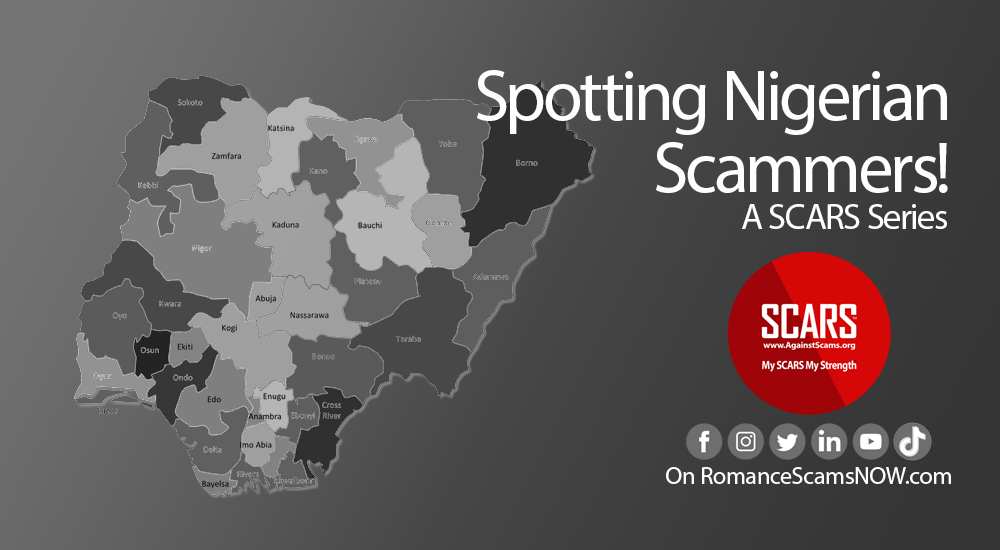
Spotting Scammers: Often Nigerian Scammers Will Use Other Identities As A Part Of Their Scams, Such As Attorneys Or People To Receive The Money Who Have Nigerian Names!
Knowing the typical Nigerian women’s first names can be helpful in spotting scammers, especially romance and impersonation scams and scammers.
Here are a few ways this helps in spotting scammers:
- It can help you to identify potential scams. If you are contacted by someone who ultimately wants money from you for whatever reason and has a common Nigerian woman’s first name, it is more likely that they are a scammer. However, remember that scammers often use American or European common names because they are more likely to be trusted. But at some point during the scam, they may introduce new characters to reinforce the scam or receive the money that will have Nigerian names.
- It can help you to be more cautious. If you are aware that many romance and impersonation scams originate from Nigeria, you may be more cautious when communicating with people from that country. You may be less likely to give out personal information or send money to someone you do not know well.
- Abigail
- Ada
- Adaobi
- Adaeze
- Adanna
- Adeola
- Aderonke
- Adesuwa
- Adetokunbo
- Adetola
- Afoma
- Aina
- Aisha
- Amaka
- Amara
- Anwuli
- Asabe
- Ayo
- Bimbo
- Blessing
- Bunmi
- Chiamaka
- Chidera
- Chioma
- Chinelo
- Chinyere
- Chisom
- Chizoba
- Comfort
- Damilola
- Deborah
- Ebun
- Ebunoluwa
- Efe
- Efemena
- Elizabeth
- Esther
- Fausat
- Felicia
- Folasade
- Funke
- Funmilayo
- Gift
- Grace
- Habiba
- Hadiza
- Halima
- Ifeoma
- Ijeoma
- Ifeoluwa
- Ihuoma
- Ijeoma
- Ikenna
- Imoleayo
- Ireti
- Jennifer
- Jumoke
- Kafilat
- Kemi
- Khadijah
- Kikelomo
- Latifat
- Loveth
- Maryam
- Modupe
- Morenike
- Munachimso
- Ngozi
- Nkechi
- Nkemdilim
- Nneka
- Nneoma
- Nnenna
- Nonye
- Nwakaego
- Obiageli
- Ogechi
- Oluwabunmi
- Oluwakemi
- Oluwaseun
- Omolara
- Onyinyechi
- Osinachi
- Patience
- Peace
- Precious
- Rashidat
- Ronke
- Rukayat
- Safiya
- Shade
- Simisola
- Sola
- Temitope
- Teniola
- Titilayo
- Titi
- Tope
- Uche
- Zainab
- Abidemi
- Abisola
- Adaugo
- Adebimpe
- Adebola
- Adepeju
- Adewunmi
- Aduragbemi
- Afolake
- Agatha
- Agnes
- Aina
- Ajoke
- Aminat
- Anthonia
- Arit
- Ayisat
- Ayobami
- Ayomide
- Barakat
- Basirat
- Bidemi
- Bilqis
- Bisi
- Bola
- Bose
- Bukola
- Bimpe
- Chidinma
- Chigozie
- Chika
- Chiwendu
- Christy
- Cynthia
- Damisi
- Doyin
- Ebunoluwa
- Edidiong
- Ejiro
- Ekpemupolo
- Eno
- Enobong
- Eniola
- Enitan
- Eucharia
- Eunice
- Favour
- Fatimah
- Felicity
- Florence
- Folashade
- Foluke
- Frances
- Funmilola
- Ganiyat
- Gladys
- Halimah
- Hamdalah
- Hanifat
- Hassana
- Ifunanya
- Ijeoma
- Iretioluwa
- Janet
- Jesutofunmi
- Joke
- Juliana
- Justina
- Kafilah
- Kafilat
- Kafilat
- Kanyinsola
- Khairat
- Kudirat
- Latifah
- Latifat
- Mariam
- Mariam
- Mary
- Modinat
- Morenike
- Morufat
- Mosunmola
- Nafisat
- Naimah
- Ngozi
- Nkem
- Nkemdirim
- Nneoma
- Nneka
- Nnenna
- Nneoma
- Nonyem
- Omobolanle
- Omolola
- Omolola
- Onome
- Oyinlola
- Oyinkansola
- Rashida
- Rafiat
- Ramota
- Rashidat
- Rukayat
- Ruth
- Saheedat
- Salmat
- Sekinat
- Shade
- Shakirat
- Shukurat
- Sidi
- Sikirat
- Simisola
- Stella
- Taiwo
- Temilade
- Temilola
- Temitope
- Teni
- Titi
- Tope
- Tunde
- Uche
- Uju
- Yetunde
Additional Tips for Spotting Scammers from Nigeria
Here are some additional tips for spotting romance and impersonation scams:
- Be wary of unsolicited contact. Scammers often reach out to potential victims via online dating sites, social media, or email. If you receive a message from someone you do not know, be careful about clicking on any links or opening any attachments.
- Beware of high-pressure tactics. Scammers often try to pressure their victims into making a decision quickly, without giving them time to think it through. If someone is trying to rush you into sending them money or giving them personal information, run away!
- Beware of promises that seem too good to be true. Scammers often make promises of love, wealth, or success. If someone is promising you something that seems too good to be true, it probably is.
- Do your research. Before you agree to anything, take the time to research the person you are communicating with.You can also try to reverse image search their profile photos to see if they are being used elsewhere online.
- Trust your instincts, not your emotions. If something feels wrong, it probably is. If you have any doubts about a situation, don’t be afraid to walk away.
If you think you may have been a victim of a romance or impersonation scam, it is important to report it to the authorities – go to reporting.AgsinstScams.org to learn how.
-/ 30 /-
What do you think about this?
Please share your thoughts in a comment below!
Table of Contents
To Understand All Scams
Read This
The SCARS Institute Relationship Scams Formula Checklist
This is the Formula that all Relationship Scams Follow




In the U.S. & Canada
U.S. & Canada Suicide Lifeline 988

Recent Comments
On Other Articles
- Barbara on SCARS Institute – Romance Scam Simulator: “Fantastic! I have to go to bed, but I’ll do some more tomorrow. I picked an easy scenario tonight, but…” Oct 9, 18:01
- on United States – Federal Bureau of Investigations [FBI]: “It is only that way because of the shame you feel. The reality is that it was not your fault.…” Sep 30, 15:36
- on United States – Federal Bureau of Investigations [FBI]: “yhisis humiliating experience e and isembarassassing to to own up to peolealreadyassume u are not to bright because Arnold and…” Sep 30, 12:28
- on United States – Federal Bureau of Investigations [FBI]: “should be better known by public live in assisiwdlivi g apartment many manyinstancresof Romance scams here ano.us ederly l” Sep 30, 12:24
- on Is It A Scam? Phone Scam Diagnostic – v1: “I tried the this test Is it a phone scam? Mine was. I think this is a helpful tool to…” Sep 30, 10:34
- on Is It A Scam? Romance Scam Diagnostic – v2: “Carole, as you move forward with your recovery, you will learn how this all works. It was not your fault.…” Sep 29, 17:37
- on Is It A Scam? Romance Scam Diagnostic – v2: “I was blinded by such clever manipulation” Sep 29, 15:15
- on The SCARS Institute Relationship Scams Formula Checklist – 2026: “As I read this I could see myself in every step with my scam. I gained a lot more knowledge…” Aug 28, 19:51
- on The Persistence of Danielle Delaunay as a Fake Identity – 2026: “Unfortunately, you are being scammed. She is using a fake name regardless. At this point, your best option is to…” Aug 26, 20:16
- on The Persistence of Danielle Delaunay as a Fake Identity – 2026: “Dear Sirs, I have met this woman with the name Abigail Boateng in Ghana. I have an intensive mail contact…” Aug 26, 12:28

Thank you for your comment. You may receive an email to follow up. We never share your data with marketers.