



SCARS Institute’s Encyclopedia of Scams™ Published Continuously for 25 Years

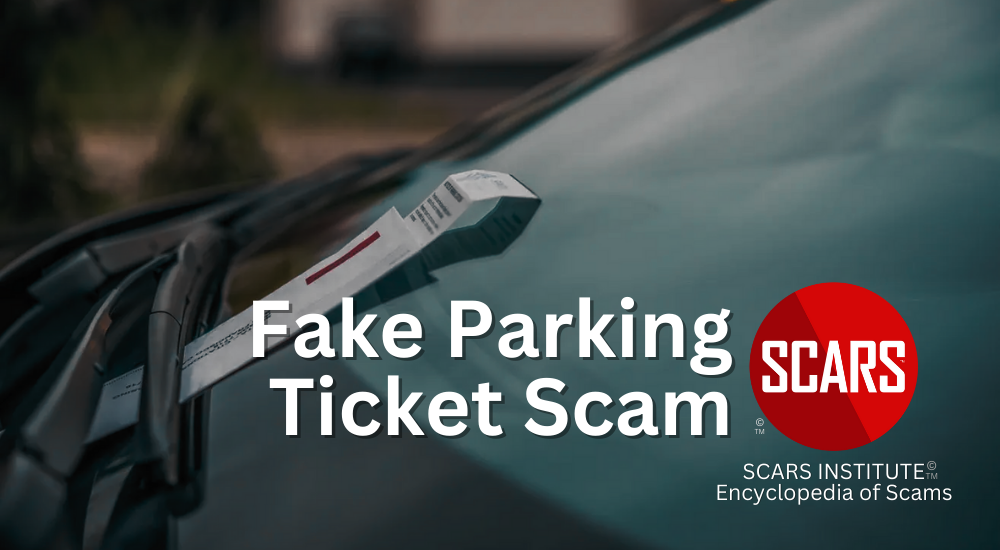
Fake Parking Ticket Scam
A Local Version of a Phishing Scam!
How Scams Work – A SCARS Institute Insight
Author:
• SCARS Institute Encyclopedia of Scams Editorial Team – Society of Citizens Against Relationship Scams Inc.
Article Abstract
Parking ticket scams are increasingly being used by criminals across the United States and Canada to steal money and personal information from unsuspecting drivers. These scams involve placing fake parking tickets on vehicles, and directing victims to fraudulent websites that closely resemble official parking authority sites.
When drivers enter their payment card information, scammers gain access to their bank accounts, leading to potential financial loss and identity theft. The risks of falling for such scams are significant, as they can result in unauthorized transactions, drained bank accounts, and further complications from stolen personal information.
To protect yourself, it’s crucial to verify the legitimacy of any parking ticket, look out for red flags like unusual payment methods or misspelled words, and avoid clicking on links in text messages. If you identify a fake ticket, preserve it as evidence and report the incident to local authorities. Regularly monitor your accounts for unauthorized activity and take immediate action if you suspect fraud. Staying vigilant and informed can help prevent becoming a victim of these deceptive schemes.
Beware of Parking Ticket Scams: How to Protect Yourself from Identity Theft and Payment Card Fraud
Parking ticket scams are becoming a growing concern across the United States and Canada, with scammers using fake tickets to steal money and personal information from unsuspecting drivers.
This fraudulent activity has been reported in various cities, from New York to Southern California, and most recently in Calgary, Canada.
How the Fake Parking Ticket Scam Works
The scam works by placing fake parking tickets on vehicles, leading drivers to fake websites that closely resemble official parking authority sites. Once there, drivers are prompted to enter their payment card information, which scammers then use to empty their bank accounts or commit identity theft.
Scammers have become increasingly sophisticated in creating fake parking tickets that look almost identical to legitimate ones. The primary goal is to trick drivers into believing they have received a real ticket, prompting them to pay the supposed fine through a fake website. These fraudulent sites often have URLs that are very similar to the official parking authority websites, making it difficult for victims to spot the difference.
In Calgary, for example, scammers have been issuing fake tickets that direct victims to a website called “calgaryparkplus.com,” which mimics the official Calgary Parking Authority’s website, “calgaryparking.com.” In some U.S. cities, scammers have taken a different approach by sending text messages claiming the recipient owes a parking fine, along with a link to a fake payment site. In Southern California, scammers have even started using QR codes on fake tickets to redirect victims to their fraudulent websites.
Once a driver enters their payment card information on these fake sites, scammers can quickly access their bank accounts, potentially draining them of funds. In addition to stealing money, scammers can also use the stolen information for identity theft, leading to further financial and legal complications for the victims.
The Risks Involved
The primary risks of falling for a parking ticket scam are twofold: financial loss and identity theft. When a scammer gains access to your payment card information, they can make unauthorized transactions, empty your bank account, or use your credit card for fraudulent purchases. Moreover, with the personal information collected through these scams, criminals can open new credit accounts in your name, apply for loans, or even commit other forms of fraud, leaving you to deal with the fallout.
How to Protect Yourself from the Parking Ticket Scam
To protect yourself from parking ticket scams, it’s essential to stay vigilant and take the following precautions:
- Verify the Ticket: Always verify the legitimacy of a parking ticket before making any payments. Check the website URL on the ticket and compare it to the official website of your local parking authority. If you’re unsure, contact the parking authority directly through a phone number or website you know is legitimate or call your local police to confirm.
- Look for Red Flags: Pay attention to details on the ticket. Misspelled words, unusual payment methods (like QR codes), or requests for information that seem excessive should raise red flags. Legitimate parking tickets will have clear, accurate information and direct you to an official government or municipal website.
- Avoid Clicking on Links in Text Messages: If you receive a text message claiming you owe a parking fine, be cautious. Do not click on any links provided in the message. Instead, visit the official parking authority website directly through your browser or contact them to verify any outstanding fines.
- Do Not Destroy Fake Tickets: If you identify a ticket as fake, do not destroy it – preserve it as evidence. Do not follow any instructions on it, and report the incident to your local parking authority or law enforcement.
- Monitor Your Accounts: Regularly monitor your bank and credit card statements for any unauthorized transactions. If you suspect that your payment information has been compromised, contact your bank or credit card company immediately to report the fraud and protect your accounts.
Summary
Parking ticket scams are a deceptive and increasingly common method for criminals to commit payment card fraud and identity theft. By staying informed and taking proactive steps to verify the legitimacy of any parking tickets you receive, you can protect yourself from falling victim to these scams. Always be cautious with your personal information and seek verification from trusted sources before making any payments online.
-/ 30 /-
What do you think about this?
Please share your thoughts in a comment below!
Table of Contents
To Understand All Scams
Read This
The SCARS Institute Relationship Scams Formula Checklist
This is the Formula that all Relationship Scams Follow





In the U.S. & Canada

U.S. & Canada Suicide Lifeline 988

Recent Comments
On Other Articles
- Barbara on SCARS Institute – Romance Scam Simulator: “Fantastic! I have to go to bed, but I’ll do some more tomorrow. I picked an easy scenario tonight, but…” Oct 9, 18:01
- on United States – Federal Bureau of Investigations [FBI]: “It is only that way because of the shame you feel. The reality is that it was not your fault.…” Sep 30, 15:36
- on United States – Federal Bureau of Investigations [FBI]: “yhisis humiliating experience e and isembarassassing to to own up to peolealreadyassume u are not to bright because Arnold and…” Sep 30, 12:28
- on United States – Federal Bureau of Investigations [FBI]: “should be better known by public live in assisiwdlivi g apartment many manyinstancresof Romance scams here ano.us ederly l” Sep 30, 12:24
- on Is It A Scam? Phone Scam Diagnostic – v1: “I tried the this test Is it a phone scam? Mine was. I think this is a helpful tool to…” Sep 30, 10:34
- on Is It A Scam? Romance Scam Diagnostic – v2: “Carole, as you move forward with your recovery, you will learn how this all works. It was not your fault.…” Sep 29, 17:37
- on Is It A Scam? Romance Scam Diagnostic – v2: “I was blinded by such clever manipulation” Sep 29, 15:15
- on The SCARS Institute Relationship Scams Formula Checklist – 2026: “As I read this I could see myself in every step with my scam. I gained a lot more knowledge…” Aug 28, 19:51
- on The Persistence of Danielle Delaunay as a Fake Identity – 2026: “Unfortunately, you are being scammed. She is using a fake name regardless. At this point, your best option is to…” Aug 26, 20:16
- on The Persistence of Danielle Delaunay as a Fake Identity – 2026: “Dear Sirs, I have met this woman with the name Abigail Boateng in Ghana. I have an intensive mail contact…” Aug 26, 12:28

Thank you for your comment. You may receive an email to follow up. We never share your data with marketers.