


SCARS Institute’s Encyclopedia of Scams™ Published Continuously for 25 Years
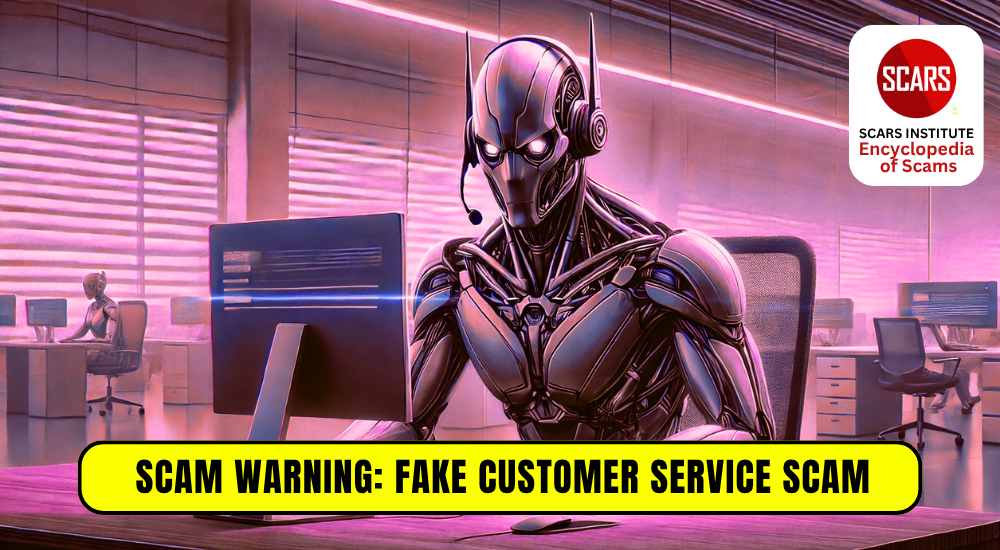
Fake Customer Service Scams
How They Target You and How to Protect Yourself
How Scams Work – A SCARS Institute Insight
Article Abstract
Fake customer service scams exploit your instinct to seek help when problems arise, using fake listings, cloned websites, and social media traps to deceive you. These scams create an illusion of legitimacy, convincing you to share sensitive information or grant access to your devices. Emotional vulnerability, especially frustration or anxiety, makes it easier for scammers to bypass your defenses. The damage they cause can be immediate and severe, leading to financial loss or identity theft. Protecting yourself requires deliberate caution: always verify contact information, avoid sharing personal data, and stay alert to common red flags. Trustworthy customer service never demands urgency, secrecy, or blind compliance. Awareness and steady verification remain your best defenses against these evolving threats.

Fake Customer Service Scams: How They Target You and How to Protect Yourself
Understanding the Rise of Fake Customer Service Scams
Scammers are constantly adapting, finding new ways to exploit trust and create confusion. One of the fastest-growing fraud tactics today is the use of fake customer service scams. These schemes manipulate your instinct to reach out for help when a problem arises, offering what appears to be official support but is actually a carefully constructed trap.
Fake customer service scams often begin when you search online for a phone number, email, or chat support for a well-known company—banks, airlines, retailers, or tech firms. Instead of reaching the company’s real support team, you find a fake listing created by scammers. These listings are designed to look legitimate, often using professional-sounding names and accurate-looking branding. Once you make contact, the scammer poses as a company representative, ready to “help” you resolve your issue.
The interaction feels authentic at first. They may have access to publicly available information about the company’s procedures, making their script sound believable. The goal, however, is not to solve your problem. It is to gain access to your personal information, steal money, or install malware on your device. In some cases, they may request remote access to your computer under the guise of troubleshooting, or they may ask for sensitive information such as your Social Security number, credit card details, or bank account credentials.
How Scammers Create the Illusion of Legitimacy
The success of fake customer service scams depends heavily on creating a convincing illusion. Scammers often purchase ads to place fake phone numbers and websites at the top of search engine results. These listings appear more trustworthy simply because they are prominently displayed.
Another tactic is cloning real websites. A fake customer service page may look almost identical to the legitimate company’s website, using similar logos, language, and even URL structures. Scammers rely on the fact that when you are stressed or frustrated, you are less likely to scrutinize minor details. A single misplaced letter in a web address or an unfamiliar extension like .co instead of .com is often the only visible clue.
Social media also plays a role. Scammers create fake customer support accounts on platforms like Facebook, X, or Instagram. They respond quickly to public complaints or inquiries, pulling unsuspecting victims into private conversations where they can exploit them more easily.
Common Red Flags You Should Recognize
Fake customer service scams, while sophisticated, often display subtle warning signs. Recognizing these can help you avoid falling victim.
-
Unsolicited contact: If you receive an unexpected call, message, or email claiming to be from customer service, treat it with caution. Legitimate companies typically require you to initiate contact.
-
Requests for sensitive information: No legitimate customer service representative will ask for your password, Social Security number, or full credit card details over the phone or via email.
-
Pressure tactics: Scammers often create a sense of urgency, claiming that immediate action is needed to prevent loss or further problems.
-
Requests for payment: If you are asked to pay fees upfront to resolve an issue, especially via wire transfer, gift cards, or cryptocurrency, you are almost certainly dealing with a scammer.
-
Remote access demands: Be extremely cautious if someone asks you to install software or grant remote access to your device. Reputable companies will not require this unless you are already engaged in a verified support session.
How These Scams Exploit Emotional Vulnerability
Scammers understand that people seeking customer support are often already frustrated, anxious, or upset. They use these emotions to their advantage. By offering immediate, confident help, they lower your defenses. Emotional states like frustration make it harder to spot inconsistencies or question requests that would otherwise seem suspicious.
You may feel relieved to finally be speaking with someone who seems to be solving your problem. That sense of relief is exactly what scammers target, using it to bypass your critical thinking and gain the information or access they are after. Their calm tone, technical jargon, and friendly manner are all part of the deception.
What Happens Once Scammers Have Your Information
If a scammer succeeds in deceiving you, the consequences can be immediate and severe. Access to your personal information allows them to steal money directly from your accounts, commit identity theft, or open new credit lines in your name. If they install malware or gain remote access, they can spy on your device activity, steal more data over time, or even lock you out of your own systems.
Once they have what they need, scammers typically vanish without a trace, leaving you to discover the breach later when the damage has already been done. Often, by the time victims realize they have been scammed, personal or financial harm is already underway.
Practical Steps to Protect Yourself
Protecting yourself from fake customer service scams begins with caution and deliberate action.
-
Always verify contact information directly through the official company website. Avoid using search engines or social media links to find customer support numbers.
-
Bookmark official websites you use frequently to avoid mistyping addresses in a hurry.
-
If you are contacted unexpectedly by someone claiming to be from customer service, end the call or communication and reach out directly through official channels.
-
Never share sensitive information like passwords, Social Security numbers, or full financial details over the phone or via email.
-
Refuse to grant remote access to your device unless you are completely sure you are dealing with a verified company representative, and even then, remain cautious.
-
Monitor your bank accounts and credit reports regularly for signs of unauthorized activity.
If you believe you have encountered a fake customer service scam or have already engaged with one, take immediate action. Contact your bank, change your passwords, and report the scam to the Federal Trade Commission at www.reportfraud.ftc.gov. Early intervention can help minimize the damage.
Why Awareness Is Your Strongest Defense
Scammers thrive on confusion and urgency. They count on you being too distracted to notice the inconsistencies in their story. Awareness, therefore, becomes your strongest defense. Knowing that fake customer service scams exist makes you less likely to trust without verifying.
Trust your instincts. If something feels wrong or if you are being pushed to act quickly without time to think, step back. Take the time to verify, question, and protect yourself. Real customer service does not demand your immediate obedience. It offers you clear, respectful, and safe ways to resolve your issues.
As scammers become more sophisticated, staying informed is no longer optional. It is a critical part of safeguarding your financial and personal well-being. By remaining cautious and deliberate, you can protect yourself from the hidden dangers of fake customer service scams and ensure that when you seek help, it comes from a source you can trust.
-/ 30 /-
What do you think about this?
Please share your thoughts in a comment below!
Table of Contents
To Understand All Scams
Read This
The SCARS Institute Relationship Scams Formula Checklist
This is the Formula that all Relationship Scams Follow




In the U.S. & Canada
U.S. & Canada Suicide Lifeline 988

Recent Comments
On Other Articles
- on SCARS Institute – Romance Scam Simulator: “Fantastic! I have to go to bed, but I’ll do some more tomorrow. I picked an easy scenario tonight, but…” Oct 9, 18:01
- on United States – Federal Bureau of Investigations [FBI]: “It is only that way because of the shame you feel. The reality is that it was not your fault.…” Sep 30, 15:36
- on United States – Federal Bureau of Investigations [FBI]: “yhisis humiliating experience e and isembarassassing to to own up to peolealreadyassume u are not to bright because Arnold and…” Sep 30, 12:28
- on United States – Federal Bureau of Investigations [FBI]: “should be better known by public live in assisiwdlivi g apartment many manyinstancresof Romance scams here ano.us ederly l” Sep 30, 12:24
- on Is It A Scam? Phone Scam Diagnostic – v1: “I tried the this test Is it a phone scam? Mine was. I think this is a helpful tool to…” Sep 30, 10:34
- on Is It A Scam? Romance Scam Diagnostic – v2: “Carole, as you move forward with your recovery, you will learn how this all works. It was not your fault.…” Sep 29, 17:37
- on Is It A Scam? Romance Scam Diagnostic – v2: “I was blinded by such clever manipulation” Sep 29, 15:15
- on The SCARS Institute Relationship Scams Formula Checklist – 2026: “As I read this I could see myself in every step with my scam. I gained a lot more knowledge…” Aug 28, 19:51
- on The Persistence of Danielle Delaunay as a Fake Identity – 2026: “Unfortunately, you are being scammed. She is using a fake name regardless. At this point, your best option is to…” Aug 26, 20:16
- on The Persistence of Danielle Delaunay as a Fake Identity – 2026: “Dear Sirs, I have met this woman with the name Abigail Boateng in Ghana. I have an intensive mail contact…” Aug 26, 12:28

Thank you for this. I greatly appreciate any and all updates, informing me of the latest trends. I realize it’s ever-evolving and so difficult to keep up with.