




SCARS Institute’s Encyclopedia of Scams™ Published Continuously for 25 Years
Don’t Stalk The Face In The Photo! It’s A Crime
We Are All Sympathetic That Victims Are Scammed!
But Don’t Make It Worse By Breaking The Law Too!
SCARS Basics Series
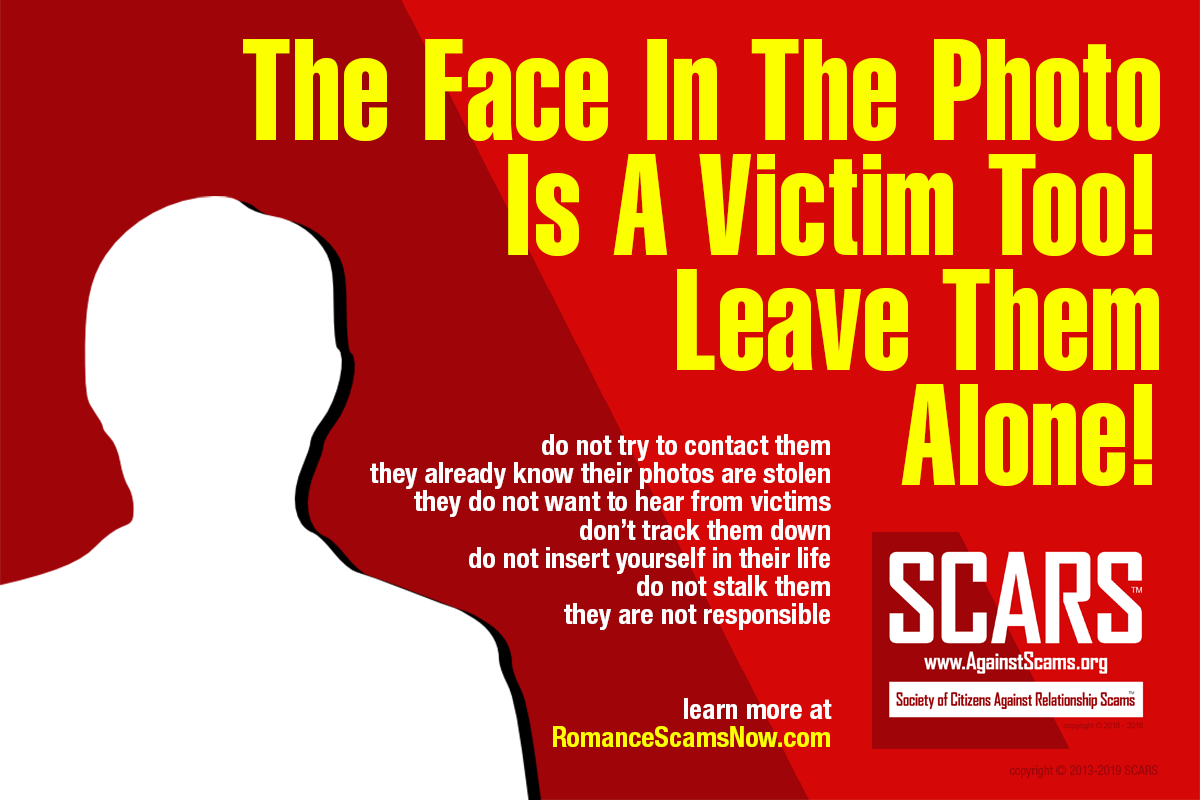
People Who Have Had Their Photos Stolen Are Victims Too!
They Are Impersonation Victims!
However, it is even more of a problem when the scam victim that fell for those photos hunts down the impersonation victims.
That hunting down is can be a crime too! Called Stalking or Cyberstalking!
In the United States, individuals are classified as victims of stalking or harassment if they experienced at least one of the behaviors listed below on at least two separate occasions.
In addition, the individuals must have feared for their safety or that of a family member as a result of the course of conduct or have experienced additional threatening behaviors that would cause a reasonable person to feel fear.
Often scam victims will contact, threaten, and intrude into the lives of the impersonation victim. Some engage in serious threats, including calling the police on the impersonation victims, harassing their spouses and children, and even showing up at their homes and places of work.
Stalking behaviors by a scam victim include:
- making unwanted phone calls;
- sending unsolicited or unwanted letters or emails;
- following or spying on the victim;
- showing up at places without a legitimate reason;
- waiting at places for the impersonation victim;
- leaving unwanted items, presents, flowers, love letters or emails; or
- posting information or spreading rumors about the victim on the Internet/social media, in a public place, or by word of mouth
We Advise
We advise every scam victim to leave the person alone who appears in the photos. Scam victims do not have a relationship with them since their photos were stolen.
The U.S. Army has asked the United States Department of Justice to investigate stalking, cyberstalking, or harassment behavior of scam victims against active-duty military personnel and veterans whose photos were used in scams.
Never is it acceptable for a scam victim to make someone else’s life miserable, to harass them or stalk them online or in person. Scam victims need to understand that their desire to alert the impersonation victim is driven by something more than concern, and it is not their job to do it. Their job is to notify and report to the police and let them take any action warranted.
Scam victims that cannot accept this situation are putting themselves at risk of going from victim to criminal!
We implore all scam victims to leave the person in the photo alone!
-/ 30 /-
What do you think about this?
Please share your thoughts in a comment below!
Table of Contents
To Understand All Scams
Read This
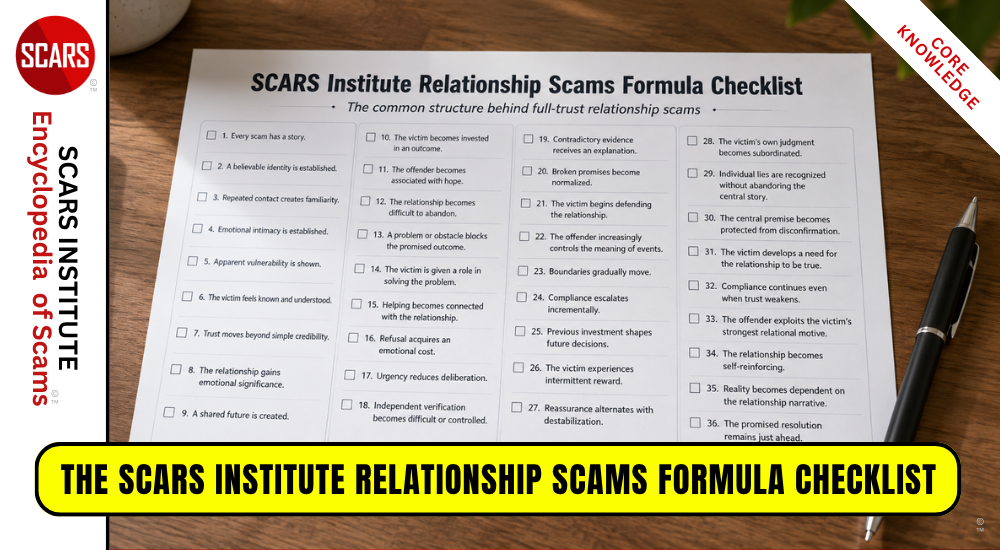
The SCARS Institute Relationship Scams Formula Checklist
This is the Formula that all Relationship Scams Follow

In the U.S. & Canada
U.S. & Canada Suicide Lifeline 988

Recent Comments
On Other Articles
- on SCARS Institute – Romance Scam Simulator: “Fantastic! I have to go to bed, but I’ll do some more tomorrow. I picked an easy scenario tonight, but…” Oct 9, 18:01
- on United States – Federal Bureau of Investigations [FBI]: “It is only that way because of the shame you feel. The reality is that it was not your fault.…” Sep 30, 15:36
- on United States – Federal Bureau of Investigations [FBI]: “yhisis humiliating experience e and isembarassassing to to own up to peolealreadyassume u are not to bright because Arnold and…” Sep 30, 12:28
- on United States – Federal Bureau of Investigations [FBI]: “should be better known by public live in assisiwdlivi g apartment many manyinstancresof Romance scams here ano.us ederly l” Sep 30, 12:24
- on Is It A Scam? Phone Scam Diagnostic – v1: “I tried the this test Is it a phone scam? Mine was. I think this is a helpful tool to…” Sep 30, 10:34
- on Is It A Scam? Romance Scam Diagnostic – v2: “Carole, as you move forward with your recovery, you will learn how this all works. It was not your fault.…” Sep 29, 17:37
- on Is It A Scam? Romance Scam Diagnostic – v2: “I was blinded by such clever manipulation” Sep 29, 15:15
- on The SCARS Institute Relationship Scams Formula Checklist – 2026: “As I read this I could see myself in every step with my scam. I gained a lot more knowledge…” Aug 28, 19:51
- on The Persistence of Danielle Delaunay as a Fake Identity – 2026: “Unfortunately, you are being scammed. She is using a fake name regardless. At this point, your best option is to…” Aug 26, 20:16
- on The Persistence of Danielle Delaunay as a Fake Identity – 2026: “Dear Sirs, I have met this woman with the name Abigail Boateng in Ghana. I have an intensive mail contact…” Aug 26, 12:28

The only thing I did was a reverse-lookup on a couple of the photos shared with me, once I started to suspect I was being scammed. There were no hits and when I looked at the facebook profile more closely, I noticed that ALL photos associated with the fake profile had been uploaded on the same day, even though the captions spanned years. Confirmation to me that the profile was stolen and the captions used to showcase fake photos.
It was a very tough reality for me to accept, but there was the proof.
I appreciate this article as some of the information was not known by me. I did reach out to the celebrity regarding the scam basically because of ignorance. I’ve never been through this before and I mistakenly thought the FBI was going to take more immediate action. I was afraid of the FBI arriving to question the celebrity and the celebrity would be shocked about this. Apparently, issues such as scam impersonators must be something celebrities protect themselves from legally. Not sure. Anyway, I did send a letter to alert the celebrity about the impersonation and to let them know they may need to take legal action. I thought it was the responsible and right thing to do as I felt I brought this trouble to them with my interaction with the imposter.
The pig butchers photos I received from them on Telegram are some of the same photos on their Facebook page. They even confirmed that it was their Facebook page (which also must be fake). I wish law enforcement would track down who is updating that Facebook page.
The Facebook pages rarely lead to a real person. However, once a criminal has been identified, then the profiles provide valuable evidence, as long as a vigilante does not have it deleted first.