



SCARS Institute’s Encyclopedia of Scams™ Published Continuously for 25 Years

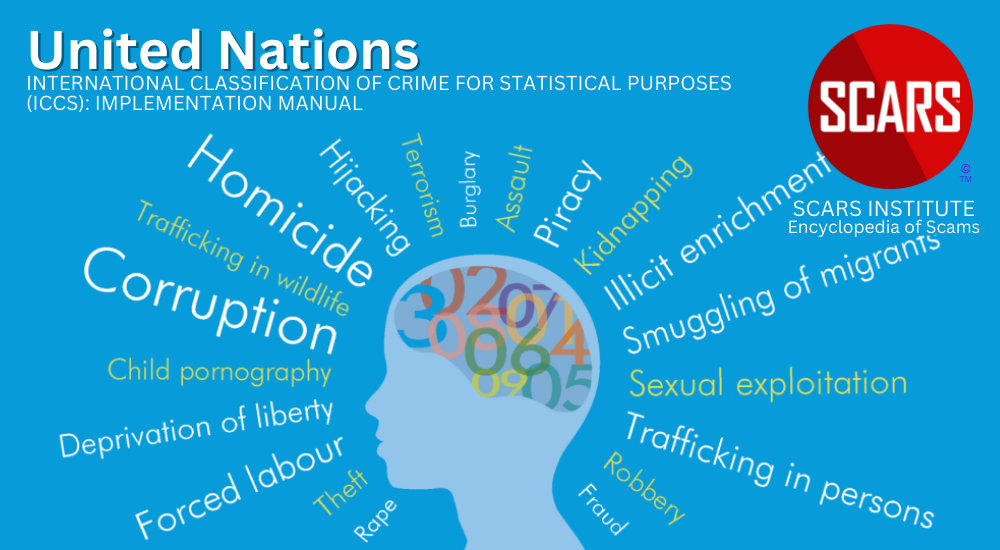
United Nations New Crime Classification System for Crime Including Scams Fraud and Cybercrimes
The United Nations Office on Drugs and Crime Releases Their New: International Classification of Crime for Statistical Purposes (ICCS): Implementation Manual
Presented by the SCARS Institute
Authors:
• SCARS Institute Encyclopedia of Scams Editorial Team – Society of Citizens Against Relationship Scams Inc.
• United Nations Office on Drugs and Crime (UNODC)
Article Abstract
The ICCS Implementation Manual 2025, released by the United Nations Office on Drugs and Crime, provides a comprehensive classification system for scams, fraud, and cybercrime, enabling law enforcement, financial institutions, and policymakers to better detect, prevent, and prosecute these crimes. The manual categorizes fraud into sections covering general financial fraud, online scams, identity theft, bribery, and money laundering, while also distinguishing cyber-enabled crimes (such as phishing and social engineering) from cyber-dependent crimes (such as hacking and ransomware attacks).
Recognizing the global nature of fraud and cybercrime, the ICCS system helps standardize data collection, improve international cooperation, and enhance real-time information sharing between jurisdictions. It highlights challenges in tracking scams, such as differences in national laws, evolving fraud tactics, and underreporting by victims, and proposes AI-driven fraud detection, stronger financial regulations, and delayed transaction approvals for high-risk payments as countermeasures.
The manual (below) also emphasizes the importance of public awareness campaigns and harsher penalties for convicted fraudsters. Ultimately, the ICCS framework seeks to modernize global crime classification, improve enforcement strategies, and strengthen financial and digital security in an era of increasingly sophisticated cyber threats.
The United Nations Office on Drugs and Crime Releases Their New: International Classification of Crime for Statistical Purposes (ICCS): Implementation Manual
The ICCS Implementation Manual 2025 provides a detailed framework for classifying and analyzing crimes, including scams, fraud, and cybercrime. Below is a comprehensive summary of the sections relevant to these topics:
The Benefit of the ICCS Categorization System
The real benefit of the ICCS classification system for scams, fraud, and cybercrime lies in its ability to create a universal, standardized framework for identifying, reporting, and combating these crimes across different jurisdictions. Fraud and cybercrime are inherently global issues, often involving perpetrators, victims, and financial systems in multiple countries. Without a consistent classification system, law enforcement agencies, financial institutions, and regulatory bodies struggle to share intelligence, track criminal trends, and enforce legal actions effectively. By categorizing scams, fraud, and cybercrime into clear, well-defined segments, the ICCS system enables better data collection, trend analysis, and international cooperation, allowing authorities to identify emerging threats, coordinate investigations, and allocate resources efficiently. Additionally, this structured approach improves public awareness and victim support by clearly defining different types of scams and fraud, helping consumers recognize and avoid deception. Ultimately, the ICCS classification system strengthens global crime prevention efforts, enhances legal enforcement, and ensures more effective policymaking in the fight against financial and digital crime.
Overview of Fraud, Scams, and Cybercrime in the ICCS Framework
The manual classifies fraud, scams, and cybercrime under Acts Involving Fraud, Deception, or Corruption (ICCS Section 07). It recognizes these as crimes that involve deception with the intent to secure financial or personal gain.
Classification of Fraud and Scams
The manual categorizes various fraudulent activities, including:
-
-
- General Fraud – The use of deceit to obtain money or property.
- Internet Fraud – Scams conducted online, including phishing, fake investment opportunities, and romance scams.
- Embezzlement – Misappropriation of funds by someone in a position of trust, both in the public and private sectors.
- Money Laundering – Concealing the origins of illegally obtained money.
- Bribery and Corruption – Including both active and passive bribery, particularly in financial and political environments.
-
The manual underscores that scams have evolved significantly due to technological advancements, with criminals leveraging digital platforms to commit fraud at an unprecedented scale.
Cybercrime and Technology-Enabled Fraud
Cybercrime is categorized separately as Acts Against Computer Systems (ICCS 0903). The manual makes a distinction between:
-
-
- Cyber-Enabled Crimes – Traditional crimes facilitated by digital technology, such as online fraud, identity theft, and cyberstalking.
- Cyber-Dependent Crimes – Offenses that specifically target computer systems, such as hacking, ransomware, and denial-of-service (DoS) attacks.
-
Key elements of cybercrime classification include:
-
-
- Hacking and Unlawful Access – Unauthorized entry into digital systems.
- Malware and Ransomware Attacks – Programs designed to damage or control systems.
- Phishing and Social Engineering – Fraudulent tactics to extract personal or financial information.
- Attacks on National Infrastructure – Including sabotage of governmental or corporate digital assets.
-
The manual also emphasizes the importance of real-time detection and preventative measures, urging governments and private institutions to collaborate on cybersecurity initiatives.
Data Collection and Statistical Challenges
The manual discusses the challenges of recording and categorizing fraud and cybercrime, given their cross-border nature. Key issues include:
-
-
- Variability in National Laws – Different legal definitions of fraud and scams across countries.
- Evolving Scam Tactics – Constantly changing fraud methods that evade detection.
- Difficulties in Victim Identification – Many victims do not report scams due to embarrassment or lack of legal awareness.
-
To address these issues, the manual recommends:
-
-
- Developing uniform reporting standards for financial institutions and tech companies.
- Enhancing real-time information sharing among law enforcement agencies.
- Applying AI-driven fraud detection systems.
-
Legal and Law Enforcement Responses
The manual highlights international efforts to combat scams and cybercrime, including:
-
-
- Fast-tracking prosecution of scammers – Establishing dedicated cybercrime courts.
- Public registries of convicted fraudsters – Similar to sex offender lists, to deter repeat offenders.
- Cross-border collaboration – Enhancing law enforcement cooperation to track and arrest international scam networks.
-
Recommended Countermeasures
The ICCS manual outlines several strategies for reducing fraud and scams, including:
-
-
- Stronger Financial Regulations – Implementing mandatory fraud verification for large transactions.
- Improved Public Awareness – Running global scam-awareness campaigns.
- AI-Based Scam Detection – Monitoring digital communications for scam indicators.
- Delayed Transaction Approvals for High-Risk Payments – Adding verification steps before processing suspicious transactions.
- Harsher Financial Penalties for Fraudsters – Seizing assets and imposing heavy fines on convicted scammers.
-
The Future of Fraud and Cybercrime Prevention
The manual concludes by stressing the need for continuous adaptation in fraud prevention, as criminals constantly develop new tactics. It advocates for a global, technology-driven approach that integrates AI, financial oversight, and legal enforcement to stay ahead of emerging threats.
Classification System as Applies to Scams Fraud and Cybercrime
Categorization of Scams, Fraud, and Cybercrimes (ICCS Implementation Manual 2025)
The ICCS Implementation Manual 2025 classifies scams, fraud, and cybercrimes under various sections, emphasizing their evolving nature and the necessity for standardized categorization for law enforcement and statistical tracking. Below is the categorization:
1. Fraud and Scams (ICCS Section 07: Acts Involving Fraud, Deception, or Corruption)
This category includes offenses involving deception, misrepresentation, and financial exploitation.
A. General Fraud
-
-
- Financial Fraud – Deceptive practices used to gain financial advantage.
- Insurance Fraud – Falsifying claims to receive undue insurance payouts.
- Credit Card Fraud – Unauthorized use of financial accounts for personal gain.
- Loan and Banking Fraud – Fraudulent activities involving loans, mortgages, or banking services.
-
B. Investment and Business Scams
-
-
- Ponzi and Pyramid Schemes – Fraudulent investment schemes promising high returns.
- Securities and Stock Market Fraud – Manipulating stock prices, insider trading, and false investment offerings.
- Fake Business and Franchise Scams – Fraudulent business proposals or non-existent franchises.
-
C. Online and Social Scams
-
-
- Romance Scams – Exploiting emotional relationships for financial gain.
- Lottery and Sweepstakes Scams – Fake prize notifications requiring upfront payments.
- Charity and Disaster Relief Scams – Fraudulent solicitations for fake charitable causes.
-
D. Identity and Employment Fraud
-
-
- Identity Theft – Unauthorized use of personal information for financial gain.
- Fake Job Scams – False employment offers requiring upfront payments or identity documents.
- Resume and Credential Fraud – Misrepresentation of qualifications for personal gain.
-
E. Bribery and Corruption
-
-
- Public Sector Corruption – Bribery, embezzlement, or abuse of power by government officials.
- Private Sector Corruption – Fraudulent practices in business settings, such as kickbacks or insider deals.
- Money Laundering – Concealing the origins of illegally obtained money.
-
2. Cybercrime and Technology-Enabled Fraud (ICCS Section 09: Acts Against Computer Systems)
Cybercrime includes offenses that target or use digital systems to facilitate fraud or deception.
A. Cyber-Enabled Financial Crimes
-
-
- Online Banking Fraud – Hacking or phishing to gain access to financial accounts.
- Cryptocurrency Fraud – Fake investment schemes, Ponzi schemes, or scams involving digital currencies.
- E-commerce Fraud – Selling fake products or non-delivery of purchased goods online.
-
B. Phishing, Social Engineering, and Digital Fraud
-
-
- Phishing Attacks – Fraudulent emails, texts, or phone calls to steal personal data.
- Business Email Compromise (BEC) – Impersonation of executives to manipulate financial transactions.
- Deepfake and AI-Based Scams – Manipulated audio or video content used for fraud.
-
C. Hacking and Unauthorized Access
-
-
- Unauthorized Data Access (Hacking) – Illegally accessing personal, corporate, or governmental digital systems.
- Ransomware Attacks – Encrypting digital assets and demanding payment for decryption keys.
- Denial-of-Service (DoS) Attacks – Disrupting websites, networks, or services through excessive traffic.
-
D. Cyberstalking and Digital Harassment
-
-
- Online Harassment and Cyberbullying – Using digital platforms to intimidate or threaten individuals.
- Doxxing – Publishing private information online with malicious intent.
- Revenge Porn and Sextortion – Exploiting personal media for financial or emotional manipulation.
-
E. Crimes Against Critical Infrastructure
-
-
- Cyber Attacks on National Security Systems – Targeting government networks, defense systems, or power grids.
- Corporate Espionage and Data Breaches – Theft of trade secrets or unauthorized leaks of sensitive data.
-
3. Legal and Regulatory Crimes Related to Fraud and Cybercrime
These offenses involve legal violations that facilitate fraud or cybercrime.
A. Facilitating Fraud and Financial Crimes
-
-
- Running or Managing a Fraudulent Organization – Operating large-scale scam networks.
- Producing or Distributing Counterfeit Goods – Selling fake luxury goods, pharmaceuticals, or electronics.
- Use of Shell Companies for Fraud – Hiding illicit activities behind false business entities.
-
B. Impersonation and False Representation
-
-
- Impersonating Law Enforcement or Officials – Using fake credentials to commit fraud.
- Fake Tech Support Scams – Pretending to offer technical assistance to gain financial access.
- False Representation of a Licensed Professional – Fraudulently posing as doctors, lawyers, or other professionals.
-
C. Digital Money Laundering and Underground Markets
-
-
- Dark Web Marketplaces – Online platforms for selling illegal goods and services.
- Crypto Money Laundering – Using digital currencies to launder illicit funds.
- Fake Payment Processing Services – Setting up fraudulent payment gateways to facilitate scams.
-
4. Cross-Border and Organized Crime Elements
Some scams and fraud schemes involve international operations and organized crime networks.
A. Transnational Fraud and Scam Networks
-
-
- International Money Mule Operations – Using unsuspecting individuals to launder money.
- Call Center-Based Scam Operations – Fraud rings operating fake customer support centers.
- Cross-Border Romance and Inheritance Scams – Scams that exploit international victims.
-
B. Links to Organized Crime
-
-
- Ties Between Fraud Rings and Criminal Organizations – Links between fraud groups and larger crime syndicates.
- Human Trafficking and Scam Labor – Coercing individuals to work in scam call centers.
- Terrorist Financing Through Fraud – Using fraud to fund extremist activities.
-
Conclusion
The ICCS Implementation Manual 2025 provides a detailed classification of scams, fraud, and cybercrimes, distinguishing between traditional financial fraud, cyber-enabled fraud, technology-based crimes, and cross-border criminal activities.
These categorizations help law enforcement, policymakers, and financial institutions develop targeted strategies to detect, prevent, and prosecute fraudulent activities. The manual emphasizes the need for global cooperation, enhanced technology, and stronger regulations to combat the ever-evolving landscape of scams and cybercrime.
By standardizing fraud classification and implementing technology-driven countermeasures, it aims to enhance global crime prevention and victim protection.
International Classification of Crime for Statistical Purposes (ICCS): Implementation Manual
-/ 30 /-
What do you think about this?
Please share your thoughts in a comment below!
Table of Contents
To Understand All Scams
Read This
The SCARS Institute Relationship Scams Formula Checklist
This is the Formula that all Relationship Scams Follow



In the U.S. & Canada

U.S. & Canada Suicide Lifeline 988

Recent Comments
On Other Articles
- Barbara on SCARS Institute – Romance Scam Simulator: “Fantastic! I have to go to bed, but I’ll do some more tomorrow. I picked an easy scenario tonight, but…” Oct 9, 18:01
- on United States – Federal Bureau of Investigations [FBI]: “It is only that way because of the shame you feel. The reality is that it was not your fault.…” Sep 30, 15:36
- on United States – Federal Bureau of Investigations [FBI]: “yhisis humiliating experience e and isembarassassing to to own up to peolealreadyassume u are not to bright because Arnold and…” Sep 30, 12:28
- on United States – Federal Bureau of Investigations [FBI]: “should be better known by public live in assisiwdlivi g apartment many manyinstancresof Romance scams here ano.us ederly l” Sep 30, 12:24
- on Is It A Scam? Phone Scam Diagnostic – v1: “I tried the this test Is it a phone scam? Mine was. I think this is a helpful tool to…” Sep 30, 10:34
- on Is It A Scam? Romance Scam Diagnostic – v2: “Carole, as you move forward with your recovery, you will learn how this all works. It was not your fault.…” Sep 29, 17:37
- on Is It A Scam? Romance Scam Diagnostic – v2: “I was blinded by such clever manipulation” Sep 29, 15:15
- on The SCARS Institute Relationship Scams Formula Checklist – 2026: “As I read this I could see myself in every step with my scam. I gained a lot more knowledge…” Aug 28, 19:51
- on The Persistence of Danielle Delaunay as a Fake Identity – 2026: “Unfortunately, you are being scammed. She is using a fake name regardless. At this point, your best option is to…” Aug 26, 20:16
- on The Persistence of Danielle Delaunay as a Fake Identity – 2026: “Dear Sirs, I have met this woman with the name Abigail Boateng in Ghana. I have an intensive mail contact…” Aug 26, 12:28
